Urgency Of West Samoa’s
p. 23 · Read in the full issue
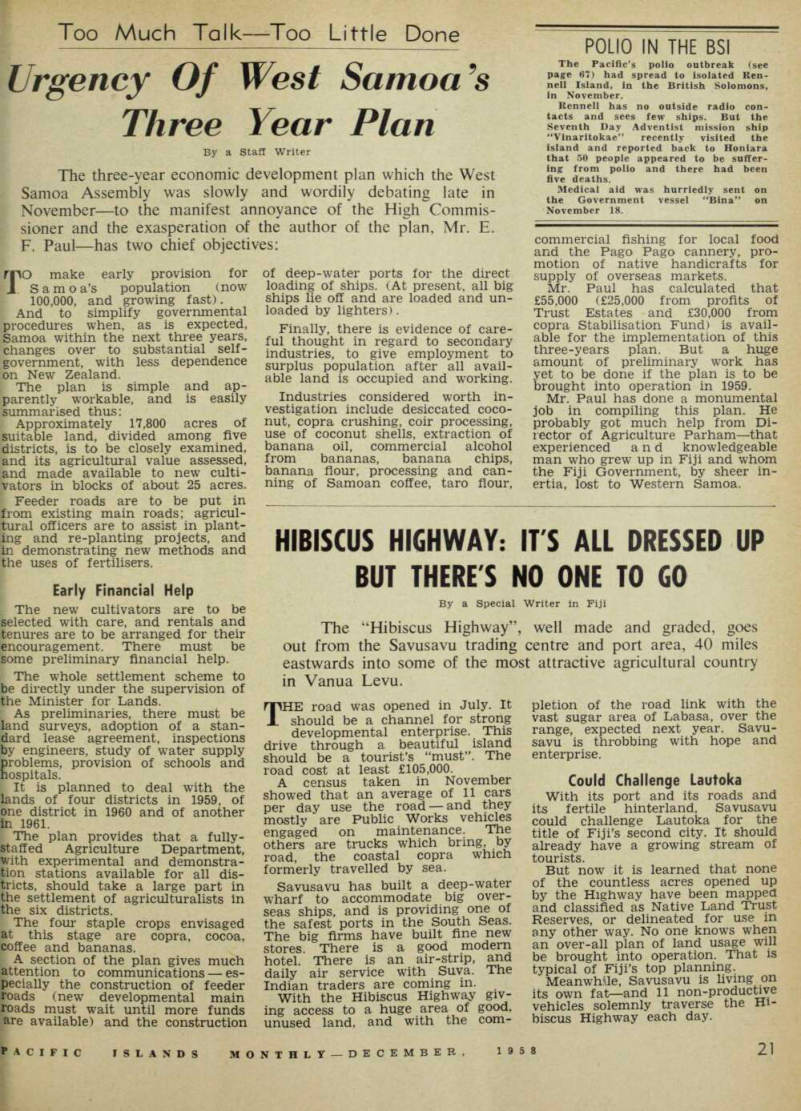
Too Much Talk —Too Little Done Urgency Of West Samoa’s Three Year Plan
By a Staff Writer
The three-year economic development plan which the West Samoa Assembly was slowly and wordily debating late in November—to the manifest annoyance of the High Commis sioner and the exasperation of the author of the plan, Mr. E.
F. Paul—has two chief objectives:
mo make early provision for J. Sa m o a’s population (now 100,000, and growing fast).
And to simplify governmental procedures when, as is expected, Samoa within the next three years, changes over to substantial self government, with less dependence on New Zealand.
The plan is simple and ap parently workable, and is easily summarised thus: Approximately 17,800 acres of suitable land, divided among five districts, is to be closely examined, and its agricultural value assessed, and made available to new culti vators in blocks of about 25 acres.
Feeder roads are to be put in from existing main roads; agricul tural officers are to assist in plant ing and re-planting projects, and in demonstrating new methods and the uses of fertilisers.
Early Financial Help
The new cultivators are to be selected with care, and rentals and tenures are to be arranged for their encouragement. There must be some preliminary financial help.
The whole settlement scheme to be directly under the supervision of the Minister for Lands.
As preliminaries, there must be land surveys, adoption of a stan dard lease agreement, inspections by engineers, study of water supply problems, provision of schools and hospitals.
It is planned to deal with the lands of four districts in 1959, of one district in 1960 and of another in 1961.
The plan provides that a fully staffed Agriculture Department, with experimental and demonstra tion stations available for all dis tricts, should take a large part in the settlement of agriculturalists in the six districts.
The four staple crops envisaged at this stage are copra, cocoa, coffee and bananas.
A section of the plan gives much attention to communications es pecially the construction of feeder roads (new developmental main roads must wait until more funds are available) and the construction
„ of deep-water ports for the direct loading of ships. (At present, all big ships lie off and are loaded and unloaded by lighters).
Finally, there is evidence of careful thought in regard to secondary industries, to give employment to surplus population after all available land is occupied and working.
Industries considered worth investigation include desiccated coconut, copra crushing, coir processing, use of coconut shells, extraction of banana oil, commercial alcohol from bananas, banana chips, banana flour, processing and canning of Samoan coffee, taro flour,
commercial fishing for local food and the Pago Pago cannery, pro motion of native handicrafts for supply of overseas markets.
Mr. Paul has calculated that £55,000 (£25,000 from profits of Trust Estates and £30,000 from copra Stabilisation Fund) is avail able for the implementation of this three-years plan. But a huge amount of preliminary work has yet to be done if the plan is to be brought into operation in 1959.
Mr. Paul has done a monumental job in compiling this plan. He probably got much help from Di rector of Agriculture Parham —that experienced and knowledgeable man who grew up in Fiji and whom the Fiji Government, by sheer in ertia, lost to Western Samoa.