Pacific Report
pp. 121-155 · Read in the full issue

The month’s round-up of news and pictures of people and events, from PIM correspondents in the South Pacific.
No Escape to the Islands
For NZ Taxpayers
Did you, riled by ever-increasing taxation, perhaps think of settling up your debts, obtaining a final taxation clearance —without which you cannot purchase an air or sea ticket —and slipping off to earn a living in some of the less governed Pacific islands?
Did you have the idea that what you would earn there would be your business and only yours, so long as the local tax-gatherers, if any, did not lay hands on you? , If you did, and you are a New rZealander, get ready to pay up—or to stay away from home for a long, long time —for they’re waiting for you.
This was proved in an Auckland Court recently when a man was
fined £lOO on each of nine charges, and ordered to pay over £lO,OOO in back tax relating to concealed in come.
One of the charges related to earnings in the New Hebrides from scrap metal recovery, supervising the construction of an oil company in stallation—which went broke—and clearing land for a cocoa plantation.
With the bottom of the New Zea land purse at present being scraped, any person who has been away from the country for some time and who then returns is fair game for in vestigation.
The prodigal son will need to prove that he paid taxation in the country where he was situated, or be ready to pay up at New Zealand, Australian, or other relevant rates.
You may feel that your home is where you hang your hat up, but NZ taxation authorities have other criteria. As far as they are con cerned you have a permanent home somewhere in the Dominion even though you may depart from it for a period of years, and although you may have enjoyed none of its social securities during that period, you are still liable for taxation.
Australian businessmen, making short visits to New Zealand re cently, have complained that before they can get a tax clearance to re turn home previously a mere formality—t axat i o n department officials have demanded to be paid tax on the income the visitor was earning at home in Australia.
Mr. Nash and his boys are fast making New Zealand a good place to get out of; and a better place to stay away from. In comparison with the New Zealand variety, Australian tax gatherers are just softies.
The Trials of the
Mail Order Firms
Boys’ wear advertised in cata logues of Australian firms have been causing some strife among Papua- New Guinea natives.
Fully-grown natives in the Terri tory are known as house boys and
in general talk are referred to as “boys”.
Natives who read catalogues and see children’s clothes advertised as boys’ wear assume it is meant for them and write down ordering shorts and shirts.
When the goods arrive they learn too late that “boy” has another meaning.
The P-NG Superintendent of Posts and Telegraphs (Mr. W. MacPher son), said in Port Moresby in Oc tober that cash on delivery orders from the natives was causing con cern among Australian firms.
Mr. MacPherson said the natives enthusiastically wrote down order ing goods which were posted to them —collect from the local Post Office.
However, in the meantime the natives had either spent their money, moved elsewhere, or simply “gone walkabout”.
After Post Office officials had un successfully tried to locate the natives the parcels had to be re turned to the firms at their expense.
Mr. MacPherson said about one third of cash on delivery parcels were returned unclaimed.
In many instances insufficient addresses were sent to firms, and in inland areas the Post Office had little hope of finding one native out of thousands.
Rush For Housing Loans
The Fiji Housing Authority has been rushed with applications for its new cash loans scheme for low in come workers. The Authority will give loans up to £5OO, if the applic ant’s average weekly earnings do not exceed £l2.
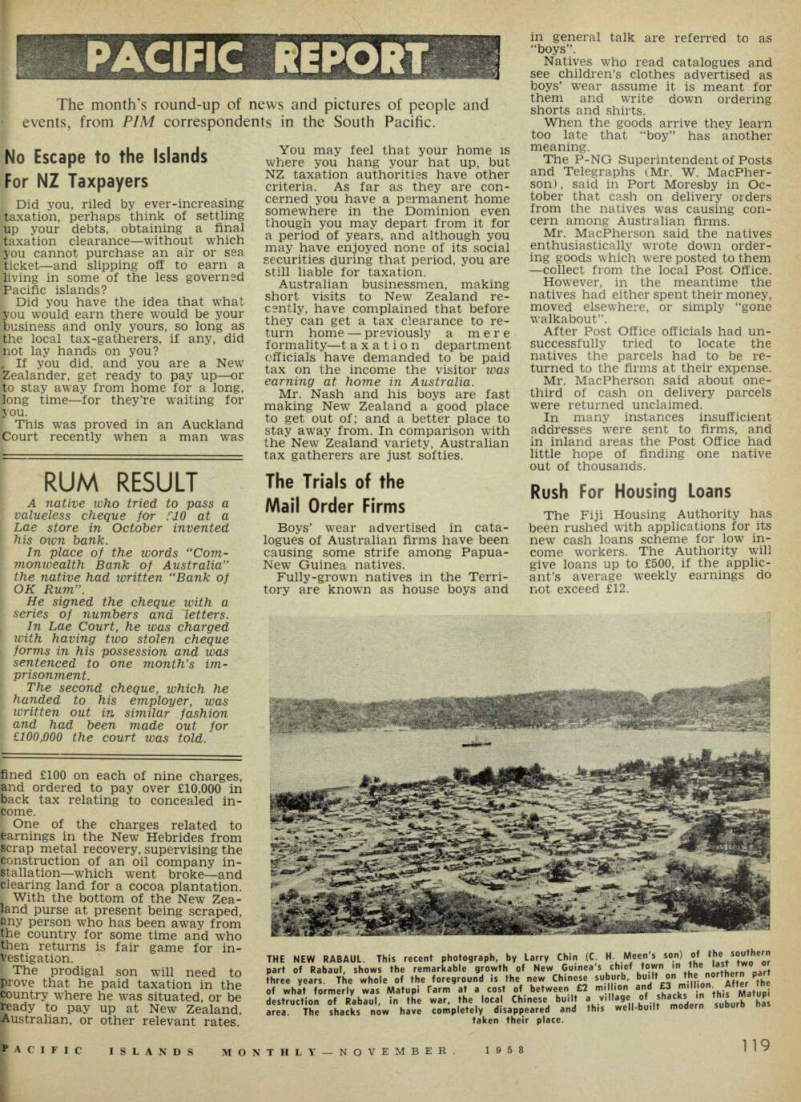
THE NEW RABAUL. This recent photograph, by Larry Chin (C. H. Meen 's son) of the southen part of Rabaul, shows the remarkable growth of New Guinea's chief town in the last two or three years. The whole of the foreground is the new Chinese suburb, built on the northern part of what formerly was Matupi Farm at a cost of between £2 million and £2 million. After the destruction of Rabaul, in the war, the local Chinese built a village of shacks in this Matupi area. The shacks now have completely disappeared and this well-bult modern suburb has taken their place.
Christmas Is.—New
Boss, New Stamps
Australia assumed administrative control of Christmas Island (Indian Ocean) on October I—although the official transfer to Australia from the United Kingdom took place in December, 1957.
Also on October 1, the newly appointed Australian Official Representative took up his post there. The Department of Terri tories announced his name only the day before —and it wasn’t, as some people seemed to think it might be, someone from one of the higher
echelons in the P-NG public service.
It was a Mr. D. E. Nickels, who has been living at Mittagong, NSW, and of whom nothing is known except that he lived for years in Malaya and speaks Malay. Christmas has no indigenous population, but some hundreds of Malay speaking phosphate workers. Its economic value lies entirely in its phosphate deposits.
Two weeks after taking over administration control, Australia issued the island’s first postage stamps. They went on sale on October 15 and are in 10 denomina tions, from 2 cents to one Straits dollar. Each of the stamps is in a distinctive colour, but each has the same design—that of the current Australian showing Her Majesty Queen Elizabeth, but overprinted with the words Christmas Island”.
New Mission Prefecture
in Papua
One of the last administrative acts of the late Pope Pius XII was the proclamation of a new Prefecture Apostolic in New Guinea, to be known as the Prefecture Apostolic of Kikori.
The area concerned was formerly
part of the Vicariate Apostolic of Port Moresby.
In November, 1955, a small group of Capuchin Franciscan Fathers arrived in this area from Pitts burgh, USA, to set up five mission stations in newly controlled areas.
They were the first members of this Catholic Order to be represented in New Guinea —or, we believe, any where in the South Pacific Islands area.
A Prefecture is lowest of the three grades of administrative district, the others being Vicariate and Diocese. A Prefecture need not be under the direct control of a Bishop.
The effect of the order in this case is to simplify the administra tion of the area, placing it under more local control.
Rewa Cane-Farmers
are Reluctant
Very few Indian cane-farmers in the Rewa Valley, Fiji, have made an attempt to change over from cane to some other crop, although the last crush at the Colonial Sugar Refining Co. mill at Nausori will be in 1959.
This is causing some concern to Government and CSR officials —but little to the farmers themselves, who are evidently determined to hang on to the last; or hope that the company will change its mind about closing the mill. (See PIM August, p. 19).
A spokesman for the company said in Fiji in late October that the decision to close was irrevocable.
The last crush will be in 1959 and no cane planted after August, 1958, will be purchased; ratoons from cane planted this year will not be taken.
The decision to close Nausori mill was made and announced over a year ago and sine 3 then company officials and officers of tne Depart ment of Agriculture have been trying to interest local farmers in alternative crops. A few have changed over to growing rice, vege tables, maize and peanuts; and a little long-term planting of cocoa and coconuts has been done.
In July it was announced that a group of Indians would launch a £1 million company to work the Rewa —maybe as another cane growing proposition, or for dairying.
But nothing more has been heard of this company.
The cane-farmers have so long been dependent on the CSR Co. that few of them can bring themselves to face the fact that after next year they are on their own.
Seen Any
Whales Lately?
There has been a great revival of interest in whaling as a possible South Pacific alternative industry these past few years, particularly since the new Norfolk Island station was established three years ago and has successfully taken its full quota of 120 whales each season since then.
At present, both Fiji and Tonga are actively investigating possibil ities by carrying out preliminary
whale-sighting surveys.
There has also been a lot of whale-tagging proceeding under the direction of Professor W. H. Dawbin, of Sydney University, throughout
the area, as part of a scientific study of whale movements and migrations going on all over the world.
In March last year PIM carried an item (p. 20) concerning Irvine’s Whaling Company, of Rarotonga, established there in August, 1865, and thought to have been the first commercial shore-b ased whaling station —and perhaps the only one —ever to operate in the Cook Islands.
This item, based on an extract from an old newspaper, caught Professor Dawbin’s eye.
He would be most interested to receive further information about the operations of this or any other whaling company based in the Cook Islands in past years, and if any one has any evidence —old letters, photos, or news clippings concern ing any such activities he —or PIM —would like to receive details. There is some evidence that there may also have been a whaling station ashore at Penrhyn, in the Northern Cooks, for a time.
One of the first tests of whether a commercial whaling station is likely to be a success in any par ticular area is based on the sight ing of ten times the number of whales required to make the venture financially successful, as it has been proved in practice, that only about one in ten of the whales sighted will be caught.
A station may do well one year and poorly the next. But if a mini mum of 1,000 whales pass your par ticular neck of the woods each year, you can begin to show some interest.
Even if, without keeping any par ticular lookout, you spot a hundred from your coastal location there may be hope. If you think so, con tact Professor Dawbin.
A whale these days, properly
One of the neatest of the new buildings in the New Guinea port of Madang is the harbour master's office. The harbour-master (Capt. J. H. Evans) has added to its attractiveness by constructing a tropical garden in front, and placing a ship's wheel on the base of his specially-erected flagpole.
processed, yields about 8 h tons of i oil, and about a third of that weight in other products, and is worth ; around £BOO. A modern station icapable of handling, say, three whales per day during the season icosts upwards of £150,000 to establish.
late Precautions Follow
Fiji's Polio Outbreak
Although few if any precautions seem to have been taken in the islands eastward of Fiji immediately after the outbreak of polio in Fiji in August, by the end of October a lot of people were really beginning to worry.
Cases have been reported in Tonga and West Samoa and precau tions—if a little late —were being taken in other Territories.
In mid-October, New Zealand rushed supplies of Australian-made Salk vaccine to the Cook Islands and Niue and began a vaccination campaign.
In American Samoa, the govern ment health service brought in an iron lung for emergencies and began m anti-polio vaccination campaign imongst all children up to those of iiigh school age.
Owners of the liner Southern *ross refused to allow her to berth it Suva on October 28 or to embark :he six passengers who were booked )ut on her. A spokesman for the )wners said that they had a lot of roung people on board and the risk )f picking up polio could not be ;aken.
Because the new Fiji Governor md his party were on board, southern Cross anchored in the itream and the party was taken ishore in a tender. The vessel then iailed off for Tahiti, leaving six yould-be travellers lamenting.
There seems, as yet, no restrictions «n Union Steamships Co. vessels, ofua and Matua, which regularly un between NZ, Fiji, the Samoans, mnga and Niue. To restrict these essels now would be shutting the
stable after the horse has departed; the time for this would have been in August, when the outbreak first occurred in Suva.
The epidemic in Fiji seems now to be on the wane. Fresh cases are still being reported from country districts but there have been no new cases in Suva since October 3.
Up to October 25, the total number of cases was 222 for the whole Colony, of which over 100 were still in hospital. There had been a num ber of deaths, and a considerable amount of after care is going to be required.
The worst of the epidemic in Tonga also seems to be over, although in late October a total
number of over 100 cases had been reported.
Only four cases had been reported in Western Samoa up until late October: these came from widely scattered areas and the suggestion is that the Samoans have a large degree of immunity and that a big epidemic is not expected.
Science Increases
Populations AND Food
People who see menace in science’s contribution to the over-population of the world through the raising of health standards may take heart from the fact that science is also enormously increasing the world’s food resources.
One way in which it is doing the latter may prove a shot in the arm to the Hawaiian-based tuna fishing fleet.
In November-December, 1955, the US Fish and Wildlife Service’s Pacific Ocean Fishery Investigation vessel Hugh M. Smith netted a sample of sardines in a bay in the Marquesas Islands. A small fish with a big name —Harengula vittata —it is apparently peculiar to these waters.
It was considered worth while to try transplanting some of these sardines to Hawaiian waters, where the live-bait tuna fishing industry is languishing for want of live bait.
The first transfer was not very successful. Of 130 buckets of sardines taken aboard only about 20 buckets survived the rough weather passage back to the leeward
TAKING NO CHANCES. Eastern Samoa won't be caught off guard in the polio epidemic, which started in Fiji recently and has been causing some anxiety (see below). Children up to high school standard age have already been vaccinated and the entire population may eventually be done. In addition, resourceful Dr. John Kennedy, administrator of the hospital at Pago, recently had this iron lung flown in from the US at short notice, in case of emergency.
With it, on a Coast Guard aircraft, came $20,000-worth of polio vaccine. —Pan American Prints.
::oast of Oahu, where they were re leased with more curiosity than hope.
Subsequently, as PIM reported at the time, further small shipments were brought back by F & WS vessels in the course of routine jruises south, the latest consign ment being released last June.
Meanwihle, some of these sardines were netted in Hawaiian waters by .ocal fishermen seeking bait-fish, which indicated that the Marquesan immigration was at least surviving 1 not multiplying.
Now, according to an October lews release from the Fishery In vestigations office in Honolulu, there js good evidence that the sardines ire successfully spawning.
Numbers have been petted not mly round Oahu but also as far iway as Kauai and Maui. Further more, tests have shown them to
)e in many ways superior to the ocal Nehu — Anchoviella purpuera — Fhich has been the bait fish of the )ast.
They are hardier, more capable of Standing long ocean voyages in bait lanks. and, if established, should permit local tuna fishermen to travel huch further afield. There is also she probability that the sardine will provide a new food source for other deal commercially valuable fish, such as the Ulua.
Fishery Investigation scientists Jonsider that it will not be clear for several years yet as to whether the sardine is going to prove commerci dly valuable, but it does appear hat local bait resources might be ioubled or tripled as the sardine seems to prefer sandy, rocky ieaches rather than the brakish oays favoured by the Nehu, and the
former type of habitat is more plentiful in the Hawaiian Islands.
If this experiment does prove the success that is hoped, it should have equal possibilities in other South Pacific areas. Furthermore it opens up the possibility that other kinds of fish, either for bait purposes or directly edible, might well be transplanted from less inhabited areas of plenty, to areas of large population where fish are not plentiful and could offer a valuable alternative human dietary source.
Many kinds of fish, like most human beings, are inclined to remain in a limited locality throughout their life cycle. There is no
reason to suppose that, if forceably transferred, they might not take equally well to another similar habitat far removed from the first, A lot of publicity has already been given to South Pacific Com mission co-operation in transferring the tilapia fish to ponds all over the South Pacific. (Tilapia is also being experimented with as a bait fish in Hawaii).
SPC has also assisted in the transfer of commercially valuable shell fish, mother-of-pearl oysters within the Cook Group and trochus from Fiji to Aitutaki—and perhaps soon MOP from the Cooks to the Tokelaus.
Jap Snails a Great
Pest in N. Britain
The giant shellback snails, intro duced by the Japanese into New Guinea, from the Palau Islands during World War 11, still are a very destructive pest in some parts of the Territory.
Mr. lan Purvis, who has a plantation behind Kokopo, Gazelle Peninsula, carries on an endless war with the snails. In some of his areas it has been necessary to re plant with young coconut trees a dozen times; and the snails also do great damage to young cocoa trees.
The planters use poisoned snail
baits —they can cost up to 2ld each, and thousands are called for. This method is effective, but very costly.
The Planters’ Association has moved in, and is supplying thousands of snail-baits, at manufacturing cost.
Not as Many as
They Thought
A remarkable recovery from a severe internal disorder has been made by Mr. Alan Roberts, P-NG Director of Native Affairs. He spent months in Melbourne, being surgically treated because of “adhesions” that had formed after an operation which followed an accident of 50 years ago.
As if to prove he’s all right, IVI Roberts recently went on a strenuoi six weeks patrol of the shrinkii “uncontrolled area” in the corner Central New Guinea formed by tl Dutch and Papua-New Guin< borders. He formed the opinic that very few natives remain the who have not been in contact wii Europeans. He examined a larj area in which it had been assurm there was a large native populatio but discovered that much of it entirely unpopulated.
Troubles of the
Copra Producers
According to copra producei there are some strange practic and anomalies in the New Guint coastal copra trade, which is , large a part of the Territory economy.
Why are the native crews allow* to “pinch” so large a proportio
of the loose copra remaining in ship’s hold after unloading?
Badly-sewn bags, the fierce ul of hooks by the wharf workers, an, general carelessness, result in proportion of the bags breakiri open, and always there is s amount of loose copra lying abou< It should be swept up and n bagged, and go either to the Boair or back to the owner.
But, no. The native crews grsi it, bag it and, after dark, carry along to a Chinese store, where is easily sold.
It happens so often that creve now seems to regard it as thei rightful perquisite.
And why do copra inspectors often slash a copra-bag in tW
niddle, thus destroying the bag, instead of cutting it down the seam, so that it can be sewn up again, md remain in use?
Evidently, in the minds of some nspectors, the planter is a really lasty piece of work, who packs his food copra down along the seams )f the bag, and puts the rubbish right in the centre, where Enemy STo. 1 (inspector) will not be likely © look!
Fiji Credit Unions
\re Booming
Records show that after a credit mion had been operating 4i years ;he men, women and children of Jurelevu, a Fiji village, have 143 sav ngs accounts with total assets of :2,810.
This village has only 14 dwellings md its income comes solely from lie sale of fresh fish and garden iroduce.
Burelevu villagers have made 384 oans from their credit union ©tailing £7,326. “Never yet has inybody failed to pay back his oan”, said John Yalimai, 34, lecretary of the branch.
Loans have been used to buy slothing and farm implements, to )ay tuition fees for schooling, to >uy an outboard motor so that ishing grounds may be reached nore quickly, and to build four mproved housing units.
Yalimai emphasised the fact that he credit union is run by Fijians, lot by European supervisors.
In the new year the national ®hventi° n of Fijian credit unions vin be held in Burelevu and will >e conducted entirely by Fijians.
U present there are 235 credit
unions in Fiji, with a total member ship of 24,000.
The Fiji Credit Union League was the first league outside of the United States to request member ship in the Credit Union National Association (CUNA) with head quarters at Madison, Wisconsin, USA. The Fijian credit unions follow the CUNA model credit union plans. Fiji admission to CUNA was granted on August 9, 1958.
This means that a Fijian delegate may now officially represent the Fiji Credit Union League at the annual convention of CUNA in America, and that Fijians can share in the insurance plan of CUNA.
According to this plan, at a member’s death, an outstanding loan will be paid by CUNA, and the member’s beneficiaries will receive, in addition to his shares, an equivalent sum supplied by CUNA.
Organiser of credit unions in Fiji is an American Jesuit, Father Marion Ganey. In 1953 he was invited to Fiji by the then Gover nor, Sir Ronald Garvey, who had seen Credit Unions founded by Father Ganey in operation in British Honduras, while serving there as Governor.
Today 194 of the 235 credit union branches of Fiji belong to the Fiji Credit Union League.
Father Ganey, who says credit
lion branches are still multiplying, Sieves there will be eventually 100 ;r cent, membership in the Fiji redit Union League. Membership , the league is necessary to enjoy le insurance benefits of CUNA.
Fijian credit unions, in less than re years, have become one of the Itstanding examples of native ivelopment in the South Pacific.
er Cargo was
ja-Water
HMNZS Endeavour, New Zealand’s itarctic expedition ship, back from mainly oceanographic research uise to the tropical Pacific, dis larged a cargo of sea-water at ickland late in October.
The sea-water, in 44-gallon drums, presented samplings taken at irious points and depths during e cruise. Analysis is expected to ed light on the distribution of (clear bomb fall-out as well as the irizontal and vertical speed of Dvement of ocean currents in the uise area.
The samples will be subjected to e now well-known “Carbon-14” fang method.
f HO Opens Office
Tonga
An office and laboratory as head larters for the World Health Or nisation’s enviromental sanitation bject in Tonga, was officially ened by Prince Tu’ipelehake at mialofa in September.
The WHO project has as its Qect the establishment of a pure
and adequate fresh water supply for the Tongan capital, and with it a solution to the sanitation and sewage disposal problem.
A WHO engineer is due to arrive in November to take charge of the unit. AMP Peni Mapa who has already undergone special courses overseas, will work under the engineer.
Following the opening of the Nukualofa headquarters field tests carried out on the local water supply with imported equipment have shown that the present town water supply is of a satisfactory
standard of purity bacteriologically.
Mr. J. Spillius, a WHO Social Anthropologist, is handling the public relations side of the project, and a number of public meetings have been held where the objects of the project have been explained to the people.
They Don't Like
Their Cocoa Control
Although seven of the eight unofficial members of the Papua- New Guinea Legislative Council criticised the Cocoa Industry Bill, it nonetheless was pushed through the Chamber by official majority, at the September meeting.
This bill, which has been on the stocks for some time, was intro duced at the last session and adjourned (allegedly to let everyone interested discuss it) and is designed to “ensure that cocoa leaving the Territory reaches a certain mini mum standard”.
The opinion amongst unofficial members was expressed by Mr. lan Downs, elected member for New Guinea Mainland, when he stated that “the Administration has gone overboard to buyers without much thought to growers”.
Introducing the bill, the Assistant Administrator, Dr. John Gunther, said that within three or four years, the Territory would produce an amount of cocoa equal to Australia’s present requirements.
“To ensure that the New Guinea product establishes a good name and finds its rightful place on the world market, it is considered necessary to protect the interests of the industry from damage that can be done by a few careless producers,” Dr. Gunther continued.
It was not the intention of the
NATIVE MEMBERS OF P-NG COUNCIL. The three Nominated Native Members of the Legis lative Council of Papua and New Guinea. From left to right, they are: Simogen, BEM, of the Sepik District, New Guinea; John Vuia, of New Guinea; and Mahuru Rarua-Rarua, of Papua. Mr. Rarua-Rarua speaks well, and fluently, in English—he is one of the very few native men who can thus express himself effectively and constructively. He is a school teacher. Simogen's contributions to debate are thoughtful and valuable, and he speaks easily —but only in Pidgin. His interpreter at Council meetings usually is Mr. Keith McCarthy.
bill to prohibit export of any coco it meant only that cocoa reachb a certain specified standard wou bear the Government stamp—coc could be exported whether it bo the stamp or not.
The bill provides for inspects by Government inspectors, and i
official stamp only for that coc considered up to standard.
Critics of the bill complained th this move would benefit buyers the expense of growers.
Mr. B. E. Fairfax-Ross said ti fact that the Government stan was placed on Territory cocoa d not mean that it would earn oc penny more on the Australii market.
He said he did not believe growe should submit their produce Government inspection unless thl were guaranteed something in i turn.
Dr. Gunther’s reply was that ti responsibility of the bill lay wr the New Guinea Planters’ Assoc;; tion. It was the result of a cco ference held earlier in the year which administration represent! tives and members of the Plant© Association drafted a proposi ordinance.
Rabaul Beautification
Now-Not 1960
Civic minded people have alreas started discussing ways and me©; for the celebration of the Jubir< of Rabaul in 1960.
One member of the Toe Advisory Council (which has aiiti
its views on beautifying Rabaul, md promoting literary competitions dower festivals, etc.) remarked that aow would be a good time to clear )ut all those unsightly shanties dis figuring the waterfront.
Unless strong measures are taken, ;hese sub-standard shanties will ;ontinue to spring up wherever hers exists the combination of tinerant natives, discarded scrap ron and rubbish—and a long water ront.
Provision for casual accommoda ion for natives is necessary, labaul could well do with a scheme Imilar to that of Port Moresby, inhere the Salvation Army runs an Ldministration-built accommoda ion centre where natives are able o stay for short periods at a very ow cost. (The Administration is supposed o have funds available for this sort f thing—see “PIM” October , p. 141.
I his should interest Father Dwyer ).
ilump Forces Tahitians
hit of N. Cal.
So far as New Caledonia is con erned, this year will be known as tie one of the Great Exodus. The lessageries Martimes vessel, ■adedonien which left Noumea in lie second week in October, took r ith her 100 Tahitians returning ome. The previous vessel took early as many.
With the big Yate dam now earing completion, little work is yailable in New Caledonia for the most of whom are un tilled. They are going home with tie savings they have been able > make there—which is plain sense.
New Caledonia is no place to live on savings alone.
Another sign of the economic times is the fall in deposits at the local savings bank. Number of depositors is up, but deposits are down by about 2 million Pac fcs in recent months.
M: r L A Prncnortc
■ rrospeciS
Shou d fae Br j ghter New Caledonia is hoping that wit h the American recession at least halted, there may be better prospects for the nickel industry in the npvf vpnr Hard on the heels of this renewed optimism came a seven man Japanese delegation to Noumea to thrash out with New Caledonian nickel interests, the programme for 1959—h0w much, what grade, and at what price.
It is felt that next year, exports of nickel, although not approaching tb e peak of a COU P Ie of years ago, will improve on the present position.
However, so far as Japan is con cerned, it is known that there is a stockpile there of 4,000 tons of nickel smelted from New Caledonia ore which was bought during the boom period—and thus at a high Price— and naturally, this will have to be used before they can be much buoyancy in the Japanese market.
Plent V ° f lenders
In N 7 111 Unfortunately, by the time statistics are made available by governments they are invariably out of date, and a summary of the
RABAUL WEDDING. Attractive bride is Eulalie Woo, eldest daughter of Mr. and Mrs. Thomas Woo, who was married to August Narm, eldest son of Mr. and Mrs. E. Achok. Left to right are: Joseph Chow (best man), the bridegroom and bride, Father B. Franke, who officiated, and Mary Woo (bridesmaid).
Photo: Larry Chin.
number of Pacific Islanders resident in New Zealand at the September, 1956, census, only recently published, is possibly well short of the mark by now.
The total of Islanders from New Zealand territories, including those with a percentage of non-islands blood, was 6,908 at that time. Of these, 5,030 were in the Auckland Province and 3,991 of these were in Auckland city.
Other distributions were: Wellington Province, 1,292 —of which 997 were in the Wellington-Hutt city area: Hawke’s Bay, 253; Canter bury, 170; Otago-Southland, 68; Taranaki, 54; Nelson, 29; Marl borough, 7; Westland, 5.
The various Islands Groups were represented as follows: Samoa, 3,740; Cook Islands, 2,320; Niue, 848.
Of the grand total of 6,908, 1,845 have been born in New Zealand, 1,366 were under school age, and a further 1,071 were between five and 14 years of age.
Contract Let For
Coast Watchers 7 Light
The contract for the construction of the Coast Watchers’ Light, at Kalibobo Point, Mada n g, New Guinea, has been let to Boulder Pty. Ltd., NSW. The terms of the contract provide for the com pletion of the work by April 9, 1959.
Particulars of this lighthouse— which is of a special design, appro priate to the commemoration of the Coast Watchers who lost their lives in World War ll—have previously been published in this journal.
The three bronze memorial plaques which will be placed at the foot of the lighthouse are being prepared by K. G. Luke (Aus tralasia) Ltd., Melbourne. On one of these plaques, the inscription will be in Pidgin English, as a tribute to the loyalty of those natives who supported the Coast Watchers in their operations behind the enemy lines.
NG Labour Inspections
Can Be Farcical
Plantation owners philosophically put up with the periodical inspec tions of their plantation labour by Native Labour Inspectors; but that does not lessen the often farcical nature of the proceedings, reports a New Guinea corres pondent.
The procedure seldom varies.
Line up the labourers; count them; check them off against contracts; inspect the workers individually check their issues of blankets, ooxes, bowls, cups, spoons, mosquito -lets; check their houses, cook louses, water supply, latrines. All
this is what the planter expects, and generally he co-operates, to get it over.
It is when he gets his copy of the inspector’s report that the shock comes. It often reads like the dossier of some criminal under investigation.
The most trivial breaches of “regulations” are noted and com mented upon, usually ending with the grim warning: “You are hereby instructed to do this or that, and so avoid action being taken”.
“Never yet, in these reports (says one planter) have I seen comments like these: ‘A clean and healthy labour line and no complaints.’
‘No sores or bandages on the line.’ ‘No deaths since last inspection— no serious cases in hospital.’ ‘All houses, blankets and utensils clean and correct.’
“The alleged breaches of regula tions are filed away in these re ports, but never—so far as I know —any statement to show that the planter is carrying out his obliga tions satisfactorily. So, if ever the file has to produced by high officialdom, it is a one-way file.
“I once complained about this to an inspector. His reply was: ‘We are instructed by Moresby not to report in detail on what the in spection shows—only the breaches’.”
Thursday Island's
Pearling Slump
Perched on the top of Cape York Peninsula, in the midst of Torres lStrait’s tropical beauty, is the tiny, one-time flourishing isle of Thurs day Island.
One-time flourishing because its once prosperous pearling industry is causing concern with a “slack”
period.
Most pearl beds accessible to native divers have been cleaned out.
On top of this, both early and post war divers made the fatal mistake of cleaning beds right out, and leaving nothing for regeneration.
The recent introduction of Jap divers, contrary to popular opinion, did not give the waning industry its much-needed and hoped-for boost.
Most good shell is now below the divers’ workable depth of 40 fathoms.
The main contributing factor to the Jap divers’ failure was in experience with such tricky currents as exist in TI waters and the ex pense of bringing them out (£100,000) has remained unjustified.
Some extent of the present slump in the Island’s pearling trade may be gauged when it is learned that present-day hauls of shell average about 2 h tons per day, as against 35 tons per day just after the war, when the industry was at its peak.
One of the main problems con fronting authorities at present is the repatriation of the Jap divers, about 70 of whom are “stranded” temporarily in barracks built for them.
Worse Off Than In 1914
In the matter of telephone com munication, the people of the Gazelle Peninsula, New Britain, were worse off in 1958 than they were in 1914, said Mr. Dudley Jones, elected Member for New Guinea Islands in the P-NG Legislative Council.
In 1914, the Germans had an efficient telephone system whereby any of their officials could ring
through from Kokopo and speak to the Governor who, said Mr. Jones, lived at Toma, near Rabaul.
And, in 1942, when the Japanese invasion threatened, the ADO at Kokopo was able to ring through to most of the plantations in the dis trict and warn them.
If an invasion came today, no such warning could be given be cause there was no telephone system.
Nondugl Would
Do Better With Pigs
The famous Nondugl sheep breed ing station in the Highlands of New Guinea may end up as a pig husbandry farm, if the experts have their way.
Shortly after the war, Sir Edward Hallstrom, a wealthy Sydney busi nessman, set up the Nondugl station and stocked it with Romney Marsh sheep. The idea was to teach the natives to produce wool so that they might be able to weave warm clothes to keep out the Highland cold.
About 1,200 sheep were first established there and in 1950 the whole thing, with a considerable endowment, was handed over by Sir Edward to the Hallstrom Live stock and Fauna Trust, which then came under direct Administrative supervision.
However, the sheep did no better under the Trust than they had done previously. The climate is far too wet for sheep; they get foot rot and they also get some sort of intestinal parasite. Latest figures indicate that the present flock, in spite of introductions of new blood from Australia from time to time, has dwindled to about 800.
In the last few months the station has lost 160 sheep. Some have died from disease; some have been killed by wild pigs.
Some time ago, the Minister for
Each year boys w ho attend school in NZ from NZ islands territories meet in a special camp at Waikanae, arranged by the Government. This year, in September, 42 boys from Western Samoa, Niue and the Cooks enjoyed three weeks of relaxation before returning to third-term exams. Above, a Niuean quartet, comprised of Salefoto Hukui, Atuua Tatui, Terry Chapman and [?]lkinepule McMillan, enjoys the sun. Top, Tangata Tutaka, from Atiu, and George Ellis, Manihiki, prove that the camp wasn't quite ALL play, however!
Territories, sent Colonel Rose, a cattle expert from the Northern Territory, to Nondugl to look the station over. Colonel Rose sub sequently recommended that it be turned into a pig farm.
Very small flocks of sheep that have been given almost individual atttention by their owners, manage to do adequately. But it is quite obvious that natives who under stand nothing about sheep husbandry will never raise sheep in New Guinea’s wet climate.
They will no doubt do much better with pigs for which they have a tradition of affinity, reaching away back into history.
How to Get Food For
Fiji's Half-Million
Explaining, in a special broadcast in Fiji, the objects of the survey upon which he now is engaged there, Professor O. H. K. Spate, of the Australian National University, made the following interesting points: Fiji must face, fairly soon, the serious problem created by an in creasing number of people in a small land.
In a little over 12 years from how, it seemed certain that, instead of the 350,000 people in Fiji, there will be nearly 600,000.
But the islands will not have grown any larger; instead, there is
danger of losing valuable land by soil erosion and loss of soil fertility.
“Since most of the land which is not already fairly fully used is in Fijian ownership, it is essential to find ways in which the Fijians may use their land for the best advan tage of themselves and of the Colony as a whole.
“These should be ways by which they may grow more and better crops, and be able to afford more of the good things of life—not just money, but the things which money wisely saved and wisely spent can bring, such as better houses, better schools —and better schooling which is not quite the same thing.”
But this raised questions about the links between Fijian social life and Fijian economic advance. Fiji has two very different methods of ordering social and economic life, the traditional and the modern, each of which has its good and its not-so-good points. If the Fijians are to go forward in economic development, it is desirable to retain, where possible, the good points of the old system.
Can Fijians afford to keep all their old customs — kerekere, for in stance? How can we make sure that money from copra or bananas or cocoa is not just eaten up in little things—so that the people are no better off —but is used to bring in more money, or be a solid gain for better living?
How can economic work be best ordered, through communal pro grammes, or co-operatives, or by individual farmers, or by a com bination of all three?
Can we use the communal system, created for social activities, for economic purposes?
What are the parts to be played by the Fijian Chiefs and people, and by Government Departments, such as Agriculture or Forests?
How were they to square the good things of the old days with the pressing needs of new times?
These were difficult questions, and could be solved only by hard think ing and hard work, in the next 10 or 20 years.
Rabaul Church
Will be a Memorial
Chairman of the Methodist Over seas Mission in Rabaul, Rev.
Wesley Lutton, set two plaques and dedicated a foundation stone to mark the building of the new Methodist Church and office block in Rabaul in early October.
The foundation stone, which was set in the office block in memory of a former chairman, Rev. W. Cox, is from a building destroyed dur ing the Japanese occupation of Rabaul.
Mr. Lutton said the new church would be a memorial to the men and women who died in the war, many of them in the Montevideo Maru. Just as those who died came from all walks of life and every religion, so this church would belong to all those who needed it.
He expressed his complete faith in
the Tolai people and paid tribute to their qualities of leadership and ability which, guided aright, could take them far. “A Christian is colour-blind,” said Mr. Button, “We must learn to walk together and in this way will quench any idle desire for an irrational nationalism: rather we will encourage a healthy in dependence.”
Rabaul Methodist Minister, Rev.
Ivan Fardon, told the people that Methodist had been omitted from the official name of the new church in the hope that it might become a United Church in the future.
Irving Johnsons Build a
Ditch-Crawling Yacht
After spending the last 25 years sailing around the world in the brigantine Yankee, with selected parties of students and tourists, Captain and Mrs. Irving M. John son, of Springfield, Massachusetts, ended this phase of their life in 1957. The Yankee, late in 1957 made her last voyage, and was sold.
For many years, the Yankee and her friendly owners were frequent and well known visitors in most of the Islands groups of the Pacific.
In April, 1957, the Yankee visited Suva, on her way to New Hebrides, Solomons, New Guinea, East Africa, and home.
But the Johnsons have not finished with cruising. They are going to carry out a lifetime’s ambition, and sail through most of the rivers and canals of Europe.
Captain Johnson has been in Europe, surveying the scene; and the ketch Yankee now is being built, to his specifications, in a shipyard near Amsterdam.
She is much smaller than the two previous Yankees, but they calcu late she will go anywhere in Europe between the Mediterranean and the Baltic, where there is a system of rivers and canals. She should be ready in July, 1959—and in that summer the Johnsons will take off —inland.
The new Yankee is described as a cross between an ultramodern ditch-crawling yacht and a seagoing galleon of old times, complete with great cabin aft and five windows across the stern. She would not take first prize in a beauty contest, but she will not be a wallflower for lack of good looks.
Her vital statistics are: 50 ft 7 in. overall, 42 ft 6 in. on the waterline, 15 ft 4 in. beam, with a draft of 4 ft with centerboards raised and 7 ft 6 in. with boards down.
Her masthead ketch rig will inelude an unusual sail called a mule, of which great things are expected. Lines of the ship were drawn by Sparkman and Stephens,
who are the world leaders on shallow draft centerboard craft, She is to be a flush deck craft with a huge midships cockpit. This cockpit can be closed in and even heated when awning and trans parent curtains are rigged, There are numerous water tanks and a diesel engine.
The bottom and topsides are of a new type of steel called Corten, stiffer and stronger and more resis tant to corrosion, and the bottom is 50 per cent, thicker than usual.
The propeller is specially protected against damage and the rudder is extra strong. There is automatic electric steering with a remote control device. (Over)
Ketch Yankee
Notable Book From
A Mission Press
Th(T~immediate problem which faced all Christian missions in the Pacific over 100 years ago was to render their message into in telligible Melanesian or Polynesian dialects.
The work of establishing a local grammar and vocabulary for a non literate people occupied the pioneers; and the printing and distribution of religious texts based on these amateur or scholarly exercises followed immediately.
Both Catholic and Protestant missionary societies have piecemeal collections of early catechisms, prayer books, Gospels, tracts and grammars. Few of these are com plete; and fewer have been adequately catelogued.
A booklet by Father Patrick O’Reilly, Imprints of the Fiji ICatholic Mission (published by the Catholic Mission, Fiji, at 30 -) is both a history of the Catholic Press [ in Fiji and a compilation of works edited or printed there, from the time of Father Breheret’s “Book of : the Catholic Religion” to the appearance, in Fijian, of a centennial memorial of the Mission, in 1944. Most of the works were produced at Levuka or Loreto.
Among the 127 items listed are an early grammar compiled in Paris, in 1884, a Fijian-English dictionary printed at Rewa, in 1902. a Rotuma-English manual of 1906, and a Latin-English-Fijian diction ary—“ex typis polyglottis Laure tanis”—of 1933.
For the rest, tracts, circular letters, gazettes and bulletins make up the bulk, enlivened by a book of Fijian folk-lore, and crowned with the monumental Epistles and Gospels, printed at Loreto, in 1891.
Successful Appeal
For NG Family
The appeal for the widow and six small children of the late Mr.
Dudley Young-Whitford, begun in Papua-New Guinea in mid-Septem ber, is expected to exceed £2,000 by the time it closes in mid-November.
Mr. Young-Whitford was an Assistant District Officer in the P-NG service and had served in a number of parts of the Territory where he was highly regarded. He was only 34 at the time of his sudden death in Port Moresby hospital, in September.
The Hams Will Miss Him
Otto Hickman Hornung, who died on lonely Jarvis Island on October
11, will be missed by the world’s radio amateurs, among others.
Since the US Navy walked out of Palmyra, northern-most of the Line atolls after the war, Palmyra has been virtually unknown to anyone but the “Hams” —and to the Hams thanks only to this retired photo grapher from Honolulu.
Whether he was there prior to the war we do not know, but he was down there soon after, acting as caretaker for Leslie Fullard-Leo (better known perhaps by his Holly wood stage name of Leslie Vincent) who owns 49 of the 52 islets.
Some of Hornungs time was spent in maintaining and dismantling war surplus equipment, some was spent in making weather observations, some in fishing, entertaining visit ing fishermen who very occasionally flew down there by chartered plane from Honolulu, some in entertain ing occasional yachtsmen, and a good deal more in pleasing the world’s radio “Hams” who were always eager to make contact with that rare outpost and obtain a QSL-card for a place of pride on the radio shack wall.
Hornung seems to have been transferred to Jarvis, nearest land to the geographic and magnetic equators, at the commencement of the IGY, to carry out magnetic observations there.
His place was taken at Palmyra, we believe, by Jack and Leah Wheeler, of Honolulu, with their yacht Gemini, which has cruised to Tahiti in recent years. Jack Wheeler is another keen “Ham” who operates from his yacht when afloat. (See PIM Cruising Yachts, October). A , Jarvis is one of the least known islands in the Pacific as to its war and post-war history. PIM reported in March, 1936, that Great Britain
NEW CENTRE FOR PAPUA. The Salvation Army Welfare Centre at Koki, Port Moresby, was officially opened on September 27. It has already cost well over £lO,OOO. Here, it is photo graphed from the top of the hill looking towards Koki. The sloping ground on the right is being converted into lawns and gardens. See "PIM" October, page 40.
had renounced all claim to this island on February 28 of that year, and round that time a substantial settlement was established, an air strip surveyed, and a radio station set up by the US Department of Air Commerce.
Since the Pacific War it has been uninhabited, except for Hornung’s IGY residence. The island is now under the jurisdiction of the US Dept, of the Interior. (Hornung apparently suffered a heart attack. When he did not keep his radio skeds, the Royal Navy land ing ship Narvik, attached to the nuclear base at Christmas Island, sailed for Jarvis and found him dead.)
Flew Up—Came
Back by Road
If planes have feelings, then a DC3 belonging to Qantas Airways had big shame (as they say in Pidgin) when it ignominiously re turned to Lae, NG, by road, in early November.
The DC3 set out from Lae on October 18 on a routine flight to Wau but after landing it appeared to run wild, slewed off the strip, sliced through a fence and ended up on the road.
It carried seven passengers and a crew of three. Only one passenger was slightly hurt; he had not done up his seat belt, and was thrown to the floor.
The person who came out of it worst was Mrs. Hohnen, wife of Mr. John Hohnen, MLC, general manager of New Guinea Goldfields Ltd. The Hohnens were down to meet the plane and when Mr.
Hohnen saw it skidding straight for them, he picked up his wife and hurled her out of the way.
The Wau airstrip—the first ever built in the Territory—runs steeply uphill. It is understood that its surface was very slippery at the time of the mishap.
The slow journey back from Wau to Lae along the road was due to begin on November 2 and would probably last three days.
The 62-foot fuselage was to be transported on a low-loader (if it could all be got on, otherwise about 20 ft would be cut off). The low loader was to be preceded by police patrols and be followed by a mobile crane to help swing the whole thing around some of the sharp bends on the 90 miles of mountain road.
Bringing up the end of the process ing would be a truck carrying 20 native labourers to provide man power when necessary.
Mr. Hasluck Hopes
To Open It
It was announced in Rabaul, New
Guinea, late October that Mr. Paul Hasluck, Minister for Territories, will open the new native hospital at Nonga, New Britain north coast, in mid-December.
Which pre-supposes, of course, that (a) the Liberal Party is going to win the forthcoming Federal elections; and (b) that Mr. Hasluck is still going to be Minister for Territories, if it does.
The new hospital is only a few miles from Rabaul, will serve as a base hospital for the whole New Britain District and will be a medical training centre as well.
Buildings and equipment cost some thing like £250,000.
Rabaul General Hospital (non native) at Namanula is still a war time job of tarred paper. But Rabaul residents who have com plained have been told by their District Commissioner that it won’t be that way for long. Rabaul is the last of the three big P-NG centres to get its hospital. Some thing like £1 million has been spent on base hospitals in Lae and Port Moresby. (Over)
The new French Constitution is still a big talk ing point in the French Pacific territories following the successful "Yes" vote in the September referendum. Here, a father in Noumea, New Caledonia, explains it.
Photo: Fred Dunn.
Head-Tax Clash in NG
Inquiry Ended
After hearing evidence during four weeks in Navuneram Village (Gazelle Peninsula area) and Rabaul, and one week in Port Moresby, the inquiry into the shoot ing at Navuneram Village on August 4 was concluded in Moresby on October 10.
The Chief Justice of Papua and New Guinea (Mr. Justice Mann), who as a special Commissioner conducted the inquiry on behalf of the Australian Commonwealth Gov ernment, will report directly to the Minister for Territories, and the latter presumably will present the report to Parliament.
The Navuneram incidents arose out of measures taken by the Dis trict Commissioner and other high officials to compel the inhabitants of Navuneram village to pay the £2 head tax, introduced by the ad ministration last year. The natives of the Gazelle Peninsula, the Tolais, in their relations with the Admin istration, have been regarded for years as difficult to handle.
Navuneram villagers resisted all demands for the tax. Finally, an official party, led by Police Com missioner Chris Normoyle and Dis trict Commissioner J. R. Foldi, and guarded by armed police, approached the village on August 4. The official party was attacked, and the police were ordered to fire over the heads of the villagers. Two natives were killed and one wounded.
After lively exchanges between Port Moresby, Rabaul and Canberra, the Commission of Inquiry was ordered.
Mr. Normoyle, giving evidence be fore the Commission, said that there
had been “an upsurge” of sorcery among the Tolai people; that these particular villagers on August 4 seemed to have been maddened by betel-nut chewing; that the at titude of the natives towards the official party on August 4 was hostile and aggressive; that in dividual fighting broke out between the natives and the police, and officials were attacked; that he saw District Officer Foldi struggling on the ground with four natives; that he saw Inspector Holloway being pursued by natives who were throw ing stones: that stones from silng shots came over the tree-tops and fell among the party; that several police were trying to hold the Navuneram leader, Manoa, who came crashing through a hedge and was “roaring like a bull”; that he saw about 100 natives coming over a rise from Tavilu village. He con sidered the situation as dangerous and critical, and he ordered the police to fire over the heads of the villagers.
A Sentimental
Journey
It was a sentimental pilgrimage for Emile Mercier. It was 33 years since he had last seen New Caledonia —and Noumea then had no big new buildings and “about half a dozen cars”.
When he returned in September he found that easily half of Noumea’s buildings were big and new, and there were 6,000 cars to keep him dodging in the streets. (“Even in Sydney drivers are less dangerous”).
A member of an old and respected New Caledonian family, Mercier has long since made his own name iff
Australia as a top Press cartoonist and humourist, whose crazy draw ings have made tinned gravy famous throughout the land, and Etaoin & Shrdlu Ltd. an honoured business name, although neither exists out side of Mercier’s world.
Mercier spent part of his boyhood on the Isle of Pines, 30 miles off New Caledonia’s southern tip, where Mercier Snr. had a bakery—and back to the isle Emile went during his New Caledonian visit.
“I knew I was home,” he said, “when the wind brought the smell of that sea.”
And just to prove to himself he had been there, Mercier gathered a little bag of fine-as-talcum sand from the beach, and a bunch of pink orchids growing on the aerodrome.
New Ways of
Getting There
Beginning December 7, a Qantas Super Constellation under charter to TEAL will operate a new service across the Tasman and on to Fiji.
The new service will leave Mel bourne each Sunday at 7.30 a.m., fly to Auckland, and then on to Nadi, p.rriving a.t 9 p.m. to connect witn Qantas Super-Constellation service from Australia to the United States.
It will return to Melbourne along the same route the following day.
This will give travellers a new
ANOTHER ADDITION. Yet another building for expanding Port Moresby in the Country Women's Association hostel, which was officially opened by the Administrator, Brigadier Cleland, in October. The building cost about £15,000 and includes a meeting hall and accommodation for expectant mothers visiting from out-stations. It's several years since the CWA first planned and began to work towards establishing the hostel. —Papuan Prints.
Emile Mercier on the Isle of Pines ... an orchid and a bag of sand Photo: Fred Dunn.
oute from Australia to Fiji, with top-over privileges at Auckland; nd allow New Zealand passengers 0 travel right through to London 1 they wish on the same type of ircraft. It will also increase to two er week, then Melbourne-Auckland ervice.
The new arrangement gives effect o an agreement reached some aonths ago between the Australian nd New Zealand Governments.
It is emphasised by the com lanies concerned that this is a ?EAL service, run with aircraft aerely chartered from Qantas and hat it does not, in any way, in ringe the rights New Zealand has 0 a monopoly of trans-Tasman air raffic, (It was said in New Zealand some aonths ago, at the time that it was ecided to re-equip both TEAL and iantas with Lockheed Electras, hat this was the “thin end of the (edge” and paved the way for Jantas to break in on TEAL’S Tas aan monopoly.) Meanwhile, PlM’s Noumea corre pondent reports that air communi ations between Australia and New Jaledonia were in a snarl in mid )ctober following the ban by the Australian Department of Aviation n the use of Tontouta, New Jaledonia’s international airport, lid the subsequent suspension of iantas services.
The French airline, TAI, had to modify its schedules. •ne Pari s-Auckland service no Miger touches Austraila on the way ut, making a hop from Saigon to hak in Dutch New Guinea, and hence direct to Noumea.
On the return flight, the old route from NZ to Noumea, then Brisbane, etc., is followed.
The service, Paris-Papeete istill touches Darwin and Brisbane on the voyage out but flies direct Brisbane- Nadi, Fiji. A DCS makes the connection Noumea-Nadi to pick up the passengers, mail and freight destined for New Caledonia. On it’s return to Paris the plane flies its usual route, Bora Bora-Nadi- Noumea-Brisbane-Darwin and on to Paris.
The DCS which went to Nadi in mid-October was unable to load all the passengers or freight for Noumea, and had to make an extra trip next day. Some passengers from Sydney had taken four days to reach Noumea and were annoyed about it.
But work is going ahead on the Tontouta strip and it is hoped that the situation will become normal in a few weeks, Six thousand barrels of Coltex arrived by a recent ship from France, to be used on surfacing the runways.
The French. Minfstry of Civil Aviation has ordered the strip at Magenta near Noumea closed to traffic until certain important works are carried out.
This strip is used by the internal line, Transpac, which runs between Noumea and the Loyalty Islands, Public Works are working on the strip which will be closed for at least one month.
During that period, Transpac will use Tontouta aerodrome. (Over)
Surveyors are
P-NG's Great Need
The area of 35,000 acres of land in the rich Warangoi Valley, near Rabaul, New Guinea, bought three years ago by the Administration, and which Territorians confidently expected to be thrown open for agricultural leases, has again become a matter of agitation.
Last year there was great dis appointment that only five blocks were made available; this year the position has been aggravated and not assisted by the fact that only four blocks are offered for leasing.
The necessity for rural expansion becomes increasingly apparent in
Rabaul, already top-heavy with trading centers. Growing numbers of Chinese shops are trying to sur vive on the copra and cocoa produc tion which is the main source of income for the district. Increased land development is economically essential to this part of the Terri tory, and there are Europeans, Asians and natives who, given the oportunity, will take up leases.
Recently the RSL expressed its dissatisfaction with the small area of land to be made available, but another problem is that the land must be surveyed first, and there are not enough surveyors.
The District Advisory Council had something to say about it at its last meeting when it recommended that
“every endeavour” be made to secu: as much land as possible and make it available for settlemer Exploratory surveys were talked ' —and there they were back to tl same problem: Where to get tl surveyors.
Surveyors are needed not only fi land settlement (and the new Soldi' Settlement Scheme will complica matters), but also for titles f( plantations and other properties.
During the Jap regime tl majority of land titles were lost ( destroyed; at the present rate < progress 15 years may elapse befo; titles can be issued to all properl owners and Administration lessees Private people and companies fir the task of arranging their own su: veys practically impossible, but mar have offered to assist financially i helping the Administration to gi land surveyed. Surveyors are skille
and while they are able to com mand substantial salaries in Au.i tralia, P-NG is unattractive. Bv. until more surveyors are available any land settlement scheme mui lag behind—even when the pre liminary step of making land avaii able. has been accomplished.
Two New Senior Posts
For NZ Territories
Mr. A. O. Dare, Resident Conn missioner for Niue Island for tit last two years, in October Wi\ appointed Assistant Secretary of tE: New Zealand Island Territories D»( partment.
His position on Niue will be take: by Mr. D. W. R. Heatley, chief clere in the Department’s head office : Wellington.
Mr. Dare is 41. He was with the NZ Navy Department from 1935 to 1951 and held commissioned rank in the RNZ Navy in World War II —part of his service being spent on the Monowai when she was an armed merchant cruiser.
He was for a time an assistant inspector with the Public Service Commission, and went to Rarotonga in 1953 as official secretary to the Cook Islands Administration.
Mr. Dare is a former Auckland
man, and in the late 1930’s he was prominent in Auckland athletics as a distance runner. He is an active and able administrator.
Mr. Heatley, new Resident Com missioner on Niue is 53 and has had 37 years’ service with the Govern ment. He was secretary to the Resident Commissioner of the Cooks at Rarotonga from 1925 to 1931, and assistant secretary Western Samoa from 1945 to 1949.
He has been Island Territories’ chief clerk since 1949, but was tem porarily Resident Commissioner for the Chatham Islands last year. He will be accompanied to Niue by his wife.
Coconut Products
£lOO,OOO Fire
An estimated £lOO,OOO worth of damage was done when a fire broke out in Coconut Products Ltd. copra-meal store on the Rabaul waterfront on November 3.
Coconut Products is a subsidiary of W. R. Carpenter and Co., and the copra meal is a by-product of the company’s copra crushing mill in Rabaul.
About 2,000 tons of bagged meal and several hundred tons of copra went up in the blaze, the store was completely demolished and damage was done to equipment, such as metal conveyor chutes, etc.
The crushing mill, power plant and other installations were not
damaged—thanks to the efforts of hundreds of Europeans and natives who fought the blaze and kept it from spreading.
Loss of the copra in either Rabaul or Suva would be a serious blow to the copra industry in those territories.
MacARTHUR MEMORIAL. The Dutch Ambassador to Australia, Mr. A. H. Lovink, took a look at the General Douglas MacArthur Memorial during his first visit to NNG recently. The memorial was erected by the Royal Netherlands Army on "MacArthur Hill", near Hollandia, where visitors have a magnificent view of Lake Sentani. Low clouds and mists cover the nearby ranges. In this photograph, Mr. Lovink (left) is with the District Commissioner of Hollandia, Mr. F. R. J. Eibrink Jansen, ant Mrs. Jansen.
Mr. A. O. Dare, NZ's Assistant-Secretary of Island Territories.
Mr. D. W. R. Heatley, new Resident Com missioner on Niue.
Happy Days for
Pacific Planters
Pacific copra planters have had reason to be happy over the last month, as Philippines copra on the London market, with a couple of minor set-backs, continued to climb steadily. It reached a peak October c.i.f. price of £StgB2/10/- on the last day of the month—which gave an average for October of £Stg. 78/10/- —up about £Stg.3 on the previous month.
It is on this average, Philippines price that planters in such places as P-NG will ultimately be paid for their copra—most of the territories that are still operating through a Copra Board pay a tentative price, with adjustments to be made on a final price.
It is the final price that makes planters happy.
High prices carried on into No vember—the price in London on November 6 being around £Stg.Bl.
But it was quoted as nominal — which means, of course, “if there are any takers”.
Consumers, unlike the planters, are not happy with the situation at all and are limiting their purchases to the minimum and using altern ative oils where possible, although these, too, have hardened in price.
The high price for copra is directly .attributable to the loss of produc tion in Indonesia (because of the Troubles); and in the Philippines ;(because of drought, typhoons and a disease which is supposed to be killing coconut trees off at about two million per year).