There Were Volcanoes At The
pp. 90-105 · Read in the full issue
The Day the Ambrym Hospital Blew Up There Were Volcanoes At The Bottom Of Their Garden
By Nettie Frater
It was 1913—the last year in which the world was to know real peace. Out in the remoter Pacific Islands, in those days before radio communications and air transportation had shat tered isolation, international situations of the kind that bedevil us today were quite unknown. But life was not without its excitement. For the people who ran the hospital at Ambrym, in the New Hebrides group, there was, for example, the morn ing they awoke to find that there were volcanoes at the bottom of their garden.
FOR beauty of situation, the hos pital at Ambrym had every thing to commend it.
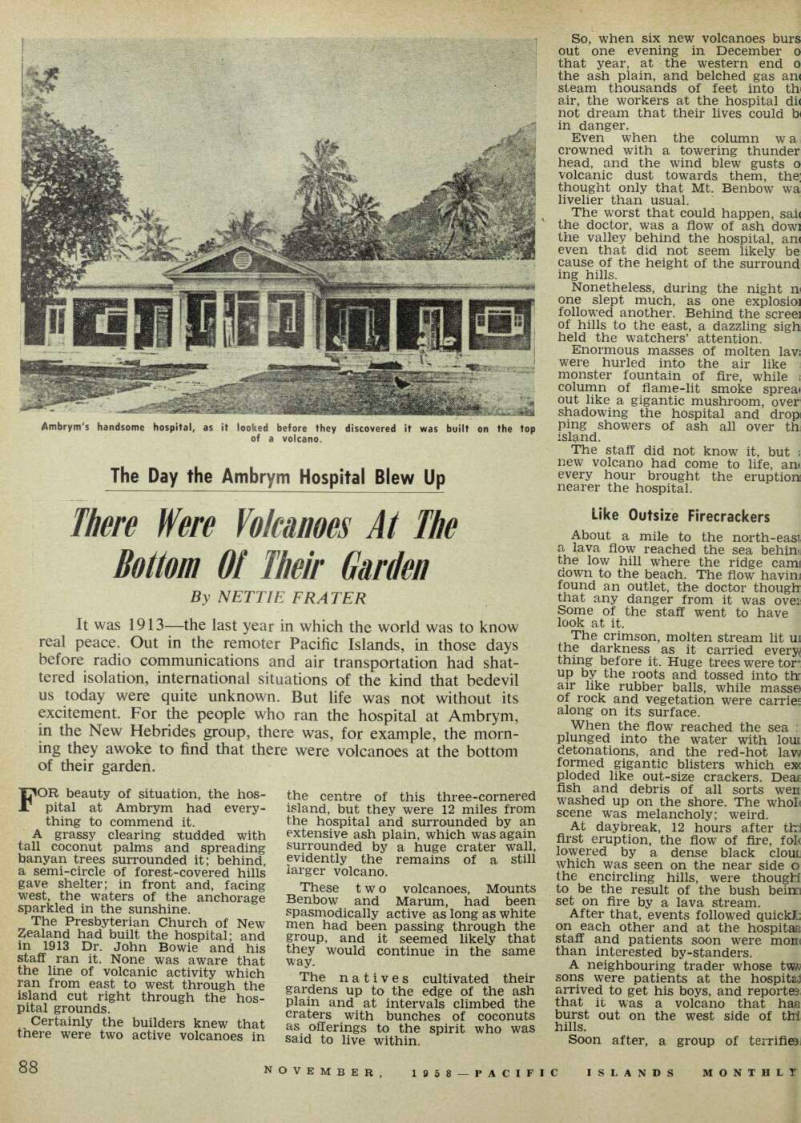
A grassy clearing studded with tall coconut palms and spreading banyan trees surrounded it; behind, a semi-circle of forest-covered hills gave shelter; in front and, facing west, the waters of the anchorage sparkled in the sunshine.
The Presbyterian Church of New Zealand had built the hospital; and in 1913 Dr. John Bowie and his staff ran it. None was aware that the line of volcanic activity which ran from east to west through the island cut right through the hos pital grounds.
Certainly the builders knew that there were two active volcanoes in
the centre of this three-cornered island, but they were 12 miles from the hospital and surrounded by an extensive ash plain, which was again surrounded by a huge crater wall, evidently the remains of a still larger volcano.
These two volcanoes, Mounts Benbow and Marum, had been spasmodically active as long as white men had been passing through the group, and it seemed likely that they would continue in the same way.
The natives cultivated their gardens up to the edge of the ash plain and at intervals climbed the craters with bunches of coconuts as offerings to the spirit who was said to live within.
So, when six new volcanoes burs out one evening in December o that year, at the western end o the ash plain, and belched gas am steam thousands of feet into th air, the workers at the hospital di( not dream that their lives could b in danger.
Even when the column w a crowned with a towering thunder head, and the wind blew gusts o volcanic dust towards them, the; thought only that Mt. Benbow wa livelier than usual.
The worst that could happen, sail the doctor, was a flow of ash dowi the valley behind the hospital, am even that did not seem likely be cause of the height of the surround ing hills.
Nonetheless, during the night m one slept much, as one explosioi followed another. Behind the screei of hills to the east, a dazzling sigh held the watchers’ attention.
Enormous masses of molten lav: were hurled into the air like ; monster fountain of fire, while ; column of flame-lit smoke spreat out like a gigantic mushroom, over shadowing the hospital and drop ping showers of ash all over th. island.
The staff did not know it, but i new volcano had come to life, am every hour brought the eruption nearer the hospital.
Like Outsize Firecrackers
About a mile to the north-east, a lava flow reached the sea behim. the low hill where the ridge cami down to the beach. The flow havim found an outlet, the doctor though that any danger from it was ovei Some of the staff went to have look at it.
The crimson, molten stream lit ui the darkness as it earned thing before it. Huge trees were tor* up by the roots and tossed into thr air like rubber balls, while masse of rock and vegetation were carries along on its surface.
When the flow reached the sea ; plunged into the water with lout detonations, and the red-hot law formed gigantic blisters which ex< ploded like out-size crackers. Deat fish and debris of all sorts wen washed up on the shore. The whoL scene was melancholy; weird.
At daybreak, 12 hours after thi first eruption, the flow of fire, fol< lowered by a dense black cloul which was seen on the near side o the encircling hills, were though! to be the result of the bush beinn set on fire by a lava stream.
After that, events followed quick!: on each other and at the hospitae staff and patients soon were mons than interested by-standers.
A neighbouring trader whose tw* sons were patients at the hospitsd arrived to get his boys, and reporter that it was a volcano that hac burst out on the west side of thl hills.
Soon after, a group of terrifies
Ambrym's handsome hospital, as it looked before they discovered it was built on the top of a volcano.
‘Steam Shot Up Where Hospital Had Stood’
natives from one of the bush villages reported that the earth had opened up in the valley and the lava had formed a lake of fire. They told of villages blown up and others sur rounded by lava, while they them selves had had narrow escapes.
Most of them carried children but the old people and cripples had to be left behind. They made for the nearby village to warn the natives there and escape with them in their canoes.
Born on Top of a Volcano The gravity of the situation was at last realised at the hospital.
Preparations were now made to evacuate the patients.
One woman had given birth to a child a few hours before and she and her new son were the first to be put on board the hospital launch. (That boy had literally been born on top of a volcano.) Another woman had her baby born on the way to safety. While the patients black and white, were being moved to the boats, a small volcano burst out 500 yards away, [stressing the need for haste.
The hospital launch was filled with the more helpless patients and sent off to the island of Malekula, with John Robertson, one of the doctor’s assistants. The doctor and Herbert Bailey, his other assistant, ■raced round to make sure that [everyone had left the hospital and [mission houses.
Mrs. Bowie, the house girls, walk ing patients and staff, piled into the big rowing boat.
By this time, fire was spurting from the ground at the edge of the hospital clearing, and ash was fall ing heavily. As Dr. Bowie and Bailey ran back to the shore, the earth heaved and swayed beneath them. Now a fresh problem arose —the laden boat was too heavy to come right into the beach and the sea was boiling. A crate was found and throwing it down on the edge of the water, they leaped onto it and then into the boat.
Hospital Blown Up
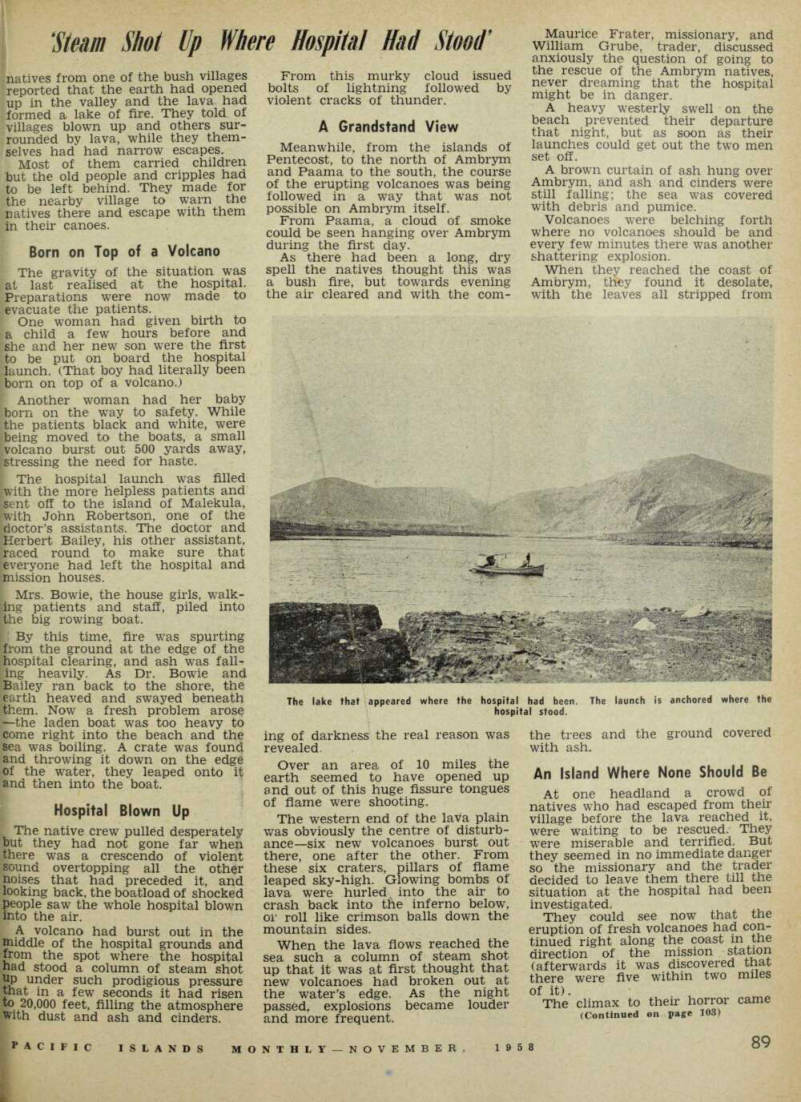
The native crew pulled desperately but they had not gone far when there was a crescendo of violent sound overtopping all the other noises that had preceded it, and looking back, the boatload of shocked people saw the whole hospital blown into the air.
A volcano had burst out in the middle of the hospital grounds and from the spot where the hospital had stood a column of steam shot up under such prodigious pressure that in a few seconds it had risen to 20,000 feet, filling the atmosphere with dust and ash and cinders.
From this murky cloud issued bolts of lightning followed by violent cracks of thunder.
A Grandstand View
Meanwhile, from the islands of Pentecost, to the north of Ambrym and Paama to the south, the course of the erupting volcanoes was being followed in a way that was not possible on Ambrym itself.
From Paama, a cloud of smoke could be seen hanging over Ambrym during the first day.
As there had been a long, dry spell the natives thought this was a bush fire, but towards evening the air cleared and with the com-
Maurice Frater, missionary, and William Grube, trader, discussed anxiously the question of going to the rescue of the Ambrym natives, never dreaming that the hospital might be in danger.
A heavy westerly swell on the beach prevented their departure that night, but as soon as their launches could get out the two men set off.
A brown curtain of ash hung over Ambrym, and ash and cinders were still falling; the sea was covered with debris and pumice.
Volcanoes were belching forth where no volcanoes should be and every few minutes there was another shattering explosion.
When they reached the coast of Ambrym, they found it desolate, with the leaves all stripped from
ing of darkness the real reason was revealed.
Over an area of 10 miles the earth seemed to have opened up and out of this huge fissure tongues of flame were shooting.
The western end of the lava plain was obviously the centre of disturb ance—six new volcanoes burst out there, one after the other. From these six craters, pillars of flame leaped sky-high. Glowing bombs of lava were hurled, into the air to crash back into the inferno below, oi' roll like crimson balls down the mountain sides.
When the lava flows reached the sea such a column of steam shot up that it was at first thought that new volcanoes had broken out at the water’s edge. As the night passed, explosions became louder and more frequent.
the trees and the ground covered with ash.
An Island Where None Should Be
At one headland a crowd of natives who had escaped from their village before the lava reached it, were waiting to be rescued. They were miserable and terrified. But they seemed in no immediate danger so the missionary and the trader decided to leave them there till the situation at the hospital had been investigated.
They could see now that the eruption of fresh volcanoes had con tinued right along the coast in the direction of the mission station (afterwards it was discovered that there were five within two miles of it).
The climax to their horror came (Continued on page 103)
The lake that appeared where the hospital had been. The launch is anchored where the hospital stood.
when, on rounding the last point, they saw a volcano roaring out from the exact spot they had ex pected to see the hospital.
Not only that —there was an island in front of the anchorage where no island should be.
But where were the occupants of the hospital?
Mr. Filmer, a missionary on Pente cost, also watched the progress of the eruption from the time it first broke out. Fortunately, he had a good view of the approach to the hospital of each new volcano and realising the danger, he set off in the night to help.
Morning brought only a dull grey light, with the Ambrym hills dimly seen through the drifting clouds of ash. As the launch chugged along the coast, Filmer and his boys sud denly felt an explosion that made the launch lurch and plunge. They were just in time to see fragments of the hospital being hurled through the air.
Enveloped in falling cinders and
almost choked with ash, Filmer turned the launch a little further out to sea.
As the boat moved through the murk, the men heard the sound of oars and voices. In another minute they came on Dr. Bowie and his party in their rowing boat. Through burning cinders they were quickly transferred to the launch.
Desperate Shuttle Service
All this Frater and Grube learnt from Filmer himself, who had trans ferred his passengers to a schooner which shortly arrived from the island of Malekula.
Filmer then returned, met the launches from Paama and after an exchange of news, all three set to work.
For the next few days, planters, missionaries and traders ran a shuttle service evacuating natives from the beaches of Ambrym and taking them to neighbouring islands, Qnmp wpvp k-iUpH in tv>P hnch villages but man y more escaped to re t urn to their home country when the volcanoes had quietened. The region round the hospital site was so desolated that there was nothing to return to, so others remained work on omer isianas.
Even today, Mt. Benbow still erupts intermittently, showering ash on neighbouring islands. It serves as a grim reminder of the powers lying dormant in that three-cornered island of Ambrym.