Tropicalities
pp. 87-88 · Read in the full issue
Pacific Islands Monthly
Magazine Section
The Lord Shall Provide
FORTY-ODD years ago King George Tubou II of Tonga ordered a smart yacht from the leading Auckland boat-builder of the day. What her total cost was I do not recall—but when Onelua eventually arrived at Nukualofa there was still a sum of £3OO out standing, and her builders were apparently not altogether happy about the financial arrangements.
L At least I gathered as much from a communication which I received prior to the arrival of the yacht, asking me to act on behalf of the builders and to arrange for collec tion of the money before she was rhanded over.
I was a little worried. After all, “putting the hard word” on a King is not an altogether enviable task, 'especially if you are a government employee, as I was at the time.
As it happened, due to the King being in the northern islands, the yacht was already lying in Nukua lofa Harbour before I had an oppor tunity to obtain an audience with him. Under these circumstances, if •the builders’ misgivings were in any [way well founded, the prospects of t my mission proving successful rather poor.
The audience was duly granted and I lodged a strong plea on behalf of the builders for a prompt settle ment of the sum still owing.
King George took it well, but as -expected, declared that he just did not have the cash available im mediately—£3oo was £3OO in those days, and a King has many calls on his exchequer. So that seemed to be that!
I was about to withdraw when I noticed a far-away thoughtful look in King George’s eye and re alised that there was still some hope of success. “Jack”’ he said, >“tell them to send for the Old Man”.
The Old Man was the Rev. Mr.
Watkin, head of the Tongan Church and, it seemed to me, a most un likely source of raising a loan on a yacht. However, I obeyed, and withdrew.
Later in the day I received a visit from Mr. Watkin and was dumb founded when he produced and paid over the outstanding sum.
Some days later I again saw the King. “You received the money, Jack?” he said.
“Yes, Your Majesty,” I said, “but tell me, how did you do it?”
A merry twinkle came into his eye. “Well,” he said, “it’s all very simple, as I see it. The law says that I am head of the Church in Tonga—so, as long as there’s cash in the Church’s safe, there’s really no problem, is there?” — J. D.
Whitcombe.
Any Papuan Like a
Silk Topper?
AFTER Wally Maidment died, in Daru, Papua, in September, old friends were assisting Mrs.
Maidment in rearranging his records and personal effects, ac cumulated there over a period of 40 years.
One of their liveliest discoveries was a perfect example of a tall, silk top-hat, stowed away behind a book-case and carefully protected
against tropical pests. Inside, it had the inscription “Manufactured for the Australian Exhibition”.
“Imagine this thing here, away out in Daru,” writes Mrs. Jan Croft.
“I am told that the late Archie Baldwin once wore it at an official function on this island. What shall we do with it?”
Has any reader any practicable suggestion? Has anyone a home for the ancient topper? PIM has not seen one of this shiny black variety in Australia for a quarter century—the grey ones sometimes get out for an airing at functions like the Melbourne Cup.
The Sogeri Veteran
ALTHOUGH well advanced in years, Mr. P. J. McDonald, of the Sogeri Valley, is still a fine figure of a man on horseback; and, on horseback, he directed some important sections of the Papuan Show at Sogeri on September 15.
Over his riding-boots he wore a pair of glittering spurs. A word of admiration brought an interesting fact—“PJ” carried those spurs through three wars—the Boer War, World War I and World War 11.
“PJ” thoroughly enjoys himself
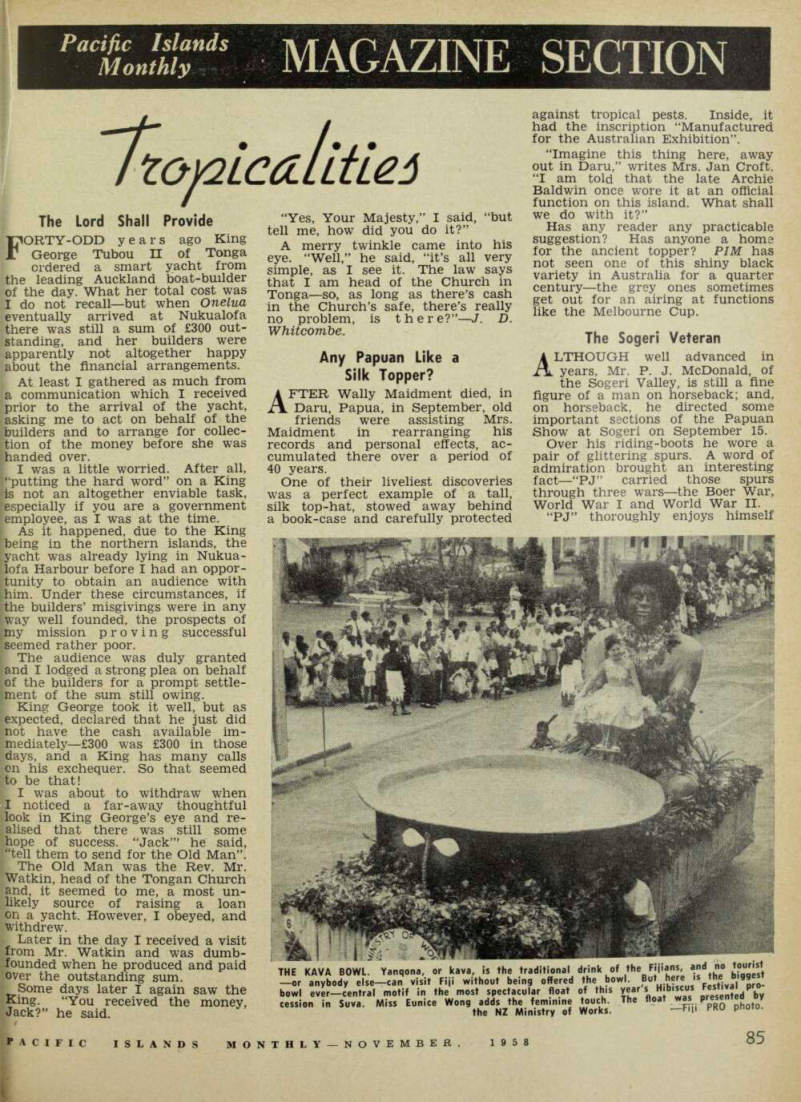
THE KAVA BOWL. Yanqona, or kava, is the traditional drink of the fijians, and no tourist -or anybody else-can visit Fiji without being offered the bowl. But here is the biggest bowl ever —central motif in the most spectacular float of this year's Hibissus Festival pro cession in Suva. Miss Eunice Wong adds the feminine touch. The float was presented by the NZ Ministry of Works.
at a party—and there were many parties in and around the Sogeri Show. He had a long session at one table with a squared-faced visitor, and got on well with him.
Finally, he said, confidentially: “You know, it’s a funny thing—but you look just like Orme Denny”.
And as a matter of fact, it was Captain Orme Denny, over from Lae on Qantas business.
Islands' Paradise at
Paris Prices
A Correspondent In New
Caledonia, complaining about the high cost of living, says the situation is beginning to get too crazy for him.
A block of land in Noumea, he says, now sells at the same price as a similar block on the Champs Elysees. And New Caledonia im ported last year, he says, 30,000 frozen heads of poultry valued at £A21,000. But although they came from France, Denmark, Holland and Australia, they could be bought for one-third less than the local birds.
Who Invented Those
Hula Hoops?
DID the current American hula hoop craze—they call it hoola hcop—start at Pitcairn Island?
Mr. A. Wotherspoon who returned to New Zealand recently after serv ing as teacher on the island, thinks that it did.
Writing to the NZ Herald, Mr.
Wotherspoon said that when he took charge of the Pitcairn school in 1956 he found some cane hoops stowed away in a cupboard. They were issued to the children who very quickly became skilled at rotating them round their bodies by a slight hula motion of the hips.
The craze was at its height on the island when Captain Irving Johnson’s brigantine yacht Yankee arrived on the scene on its last round-the-world cruise from the United States. Movies were shot while at the island, which included shots of the hula-hoop operations.
The movies were later widely shown in the United States and Mr. Wotherspoon feels sure that this was the beginning of what has be
come a major crazq, even wit adults, in the United States, wit special light tubular plastic hoop being manufactured, and hoola-hoo recordings in rock-and-roll temp selling by the million. — JPS . (Time magazine and othe authorities give the credit for ha\ ing invented the hula-hoop to Am tralia, where it was a craze a coup] of years ago. Hooping there is no as dead as the dodo; and so is tb Yo Yo craze that fallowed it.-
Pim Ed.)
No More Drum Beats
Along the Rewa
CIVILISATION has final] reached the Islands. Fiji i November plans to introduce Bill making it an offence to “bes any drum, lali or tom-tom, or bin any horn or shell, or play upa any musical instrument, or sir ... to the reasonable annoyanc or disturbance of the public”.
Offenders can be fined £5 or give a month in gaol.
We can only guess at what Robe;!
Louis Stevenson would have said
Those Kiwis Aren't Scared
Of Anything
THE Royal New Zealand Ai Force sent a party from Suva t Noumea in October for officii talks on air-sea rescue operation The party travelled in Sunderlan flying-boat No. 13. There were : passengers and crew. It was tH captain’s 13th wedding anniversan And the date was the 13th.
Nothing else happened worth r<porting.
There are New Guineans
in the West Indies
IF you wish to annoy a N© Guinea man, ask him how man countries in the world ha T J Birds-of-Paradise. He will, < course, reply. New Guinea only, an you then can tell him he is wrom BOP’s live and flourish on a sms island off the coast of Tobags north of Trinidad, in the Wes Indies. Someone transferred thee there from New Guinea a loir time ago; and they became estah lished and flourished there. Thu are strictly protected.
Mr. Vines, a high officer of British cocoa-buying organisatioo who visits most of the tropics countries of the world passed tHd news around when he was in Rabae in September.