And Just About Everybody
pp. 69-71 · Read in the full issue
October was Eclipse Time in the Cooks
And Just About Everybody Got Into The Act
From Gordon Russell, in Rarotonga Because, at about 9 a.m., October 12, the moon chose to intercept, for four precious minutes, between the sun and the isles of Pukapuka, Nassau, Suwarrow, and five others nearby, both September and October were disturbing months in the Cooks.
OVER that period this cluster of scattered South Sea isles was the playground, not only of Polynesians and romanticists, but of long-haired scientific types on projects, operations, expeditions.
The air was filled not with soft music and laughter, but with nuclear devices, rockets, helicopters,
TNT, and other modern playthings.
On August 25, a great mobile laboratory, the USS Fort Defiance, moved in on remote, primitive Pukapuka to disgorge a small army of specialists replete with eclipse shooting gadgets, helicopters, am phibious “ducks”, bulldozers, TNT, Coca-Cola and chewing gum.
All the best expeditions these days usurp a slice of ocean to themselves, and in early October Fort Defiance had its very own Keep-Off zone just north of Puka puka. It began to probe the atmos phere with instrument laden rockets, designed to rise some 150 miles and, among other things, furnish photo
graphic records should cloud block the view of the scientists below.
For some weeks before this, a detachment of the shore party was busy dynamiting a bigger and better boat passage across the substantial Pukapuka coral reef using that earth-moving “Take it away, Buddy” style peculiar to US service per sonnel on assignment.
From all accounts an impressive job was done. About 50 tons of TNT and other labour-saving de vices produced a deep and cun ningly orientated passage, with a dog-leg course and stilling-pool de signed to dissipate the ocean swell that likes to dump heavy laden Pukapukan outrigger canoes against solid coral.
They Left Something
No matter how much this Ameri can Eclipse Expedition may have temporarily eclipsed the social, spiritual and economic concepts of the people of Pukapuka, it has made handsome recompense in the form of this permanent passage.
On September 22, there arrived non-stop from Tokyo for a one-day visit to Rarotonga the 600-ton Oshoro-Maru, en route to lonesome, uninhabited Suwarrow, venue of the Japanese Eclipse Expedition.
Normally a fisheries research vessel of the Hokkaido University Fisheries faculty, the Oshoro-Maru, was on this occasion laden with scientists and students. For nine hours there were many Japanese,
well armed with cine and still cameras, bowing and smiling in Avarua township.
A local Advancement of Science Committee took charge of the official Japanese party. Among din ing, visiting and sight-seeing arrangements, the Japanese man aged to sandwich in an address on eclipse affairs by Dr. Aio Kato, leader of the expedition, and his deputy, Dr. Suemoto, at a well attended gathering in the local courtroom. By 5 p.m., all the visitors were aboard again, plus one local resident, Jack Best, as liaison officer for the Cook Islands Administra tion. An hour later the little ship was headed north for its date with the sun and moon at 4 minutes past 9, local time, October 12, at Anchorage Islet, Suwarrow.
First Japanese
Many years ago an ordinance was framed to debar Orientals from entry to these islands and this was the first occasion on which a group of Japanese had set foot on Rarotongan soil.
Polynesians are never rude to guests but there was an air of re straint apparent on this occasion.
Many of the Europeans were pre pared to extend the hand of friend ship. at least on a scientific level.
Locals were rather intrigued with the brand name of the standard
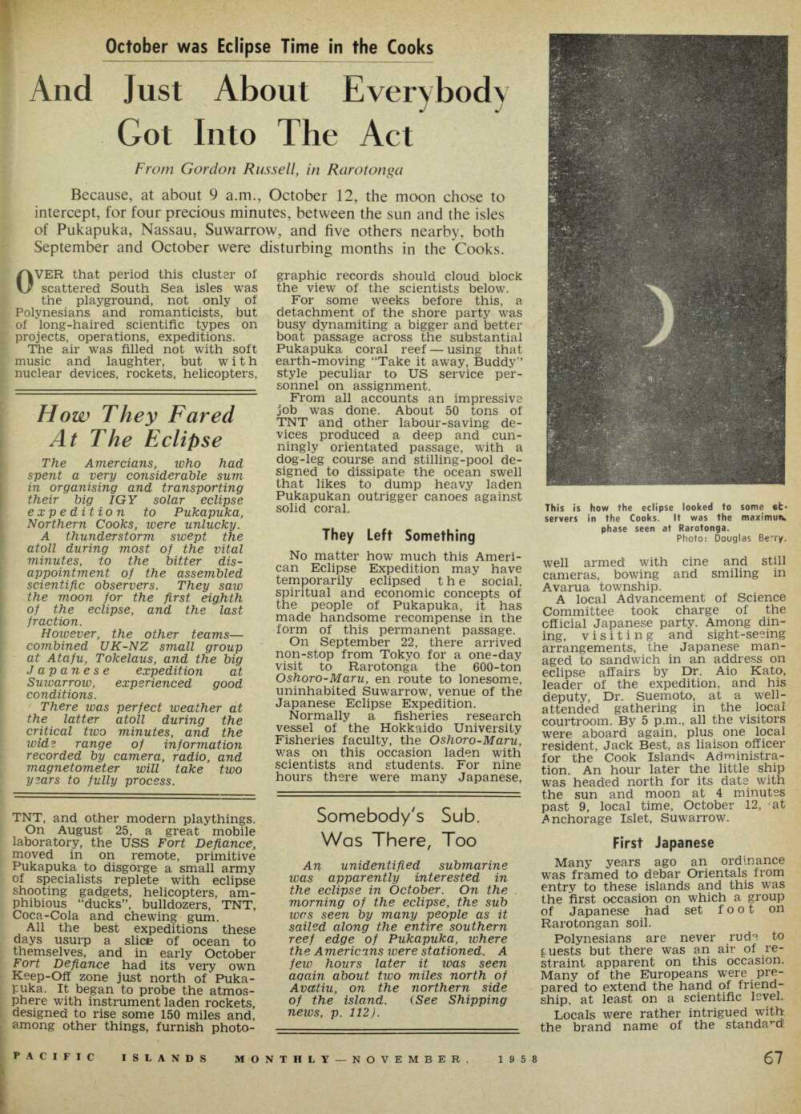
This is how the eclipse looked to some oc -servers in the Cooks. It was the maximur phase seen at Rarotonga.
Photo: Douglas Berry.
issue Japanese cigarette, “Peace”.
And some ardent local golfers, addressing their Saturday afternoon ball, were disconcerted to observe the nose of a cine camera project ing from the rear of a truck as it careered the length of Rarotonga’s airport. (But golfers are so easily put off their game.) Aboard Oshoro-Maru were five teams of scientists, two from the lohoku University (astronomical and geophysical), one from the fokyo Astronomical Observatory, )ne from the Science Faculty at £yoto University, and a party from ;he Japanese Hydrographic office.
Sach had a specific assignment at
piwarrow.
The Track The track of this total solar clipse embraced eight islands; three h the Tokelaus, three in the Cooks, wo in the Societies. Britain and lew Zealand were represented at Ltafu, in the Tokelaus. The Russians Fere scheduled for Mopelia in the iocieties.
An Australian team, earlier ex acted at Aitutaki in the Cooks— list outside the total eclipse track rfailed to materialise.
This 1958 eclipse was rather pecial, the only one to fall within tie IGY, into which so much effort as gone to advance knowledge of tie earth’s atmosphere and beyond.
Best grandstand seat was at little fassau, just south of Pukapuka, ut the hazardous landing condi tons on this reef-bound islet ruled t out. Next best possies were ’ukapuka and Suwarrow.
See also shipping news, including Thanks to Uncle Sam”, page 111.
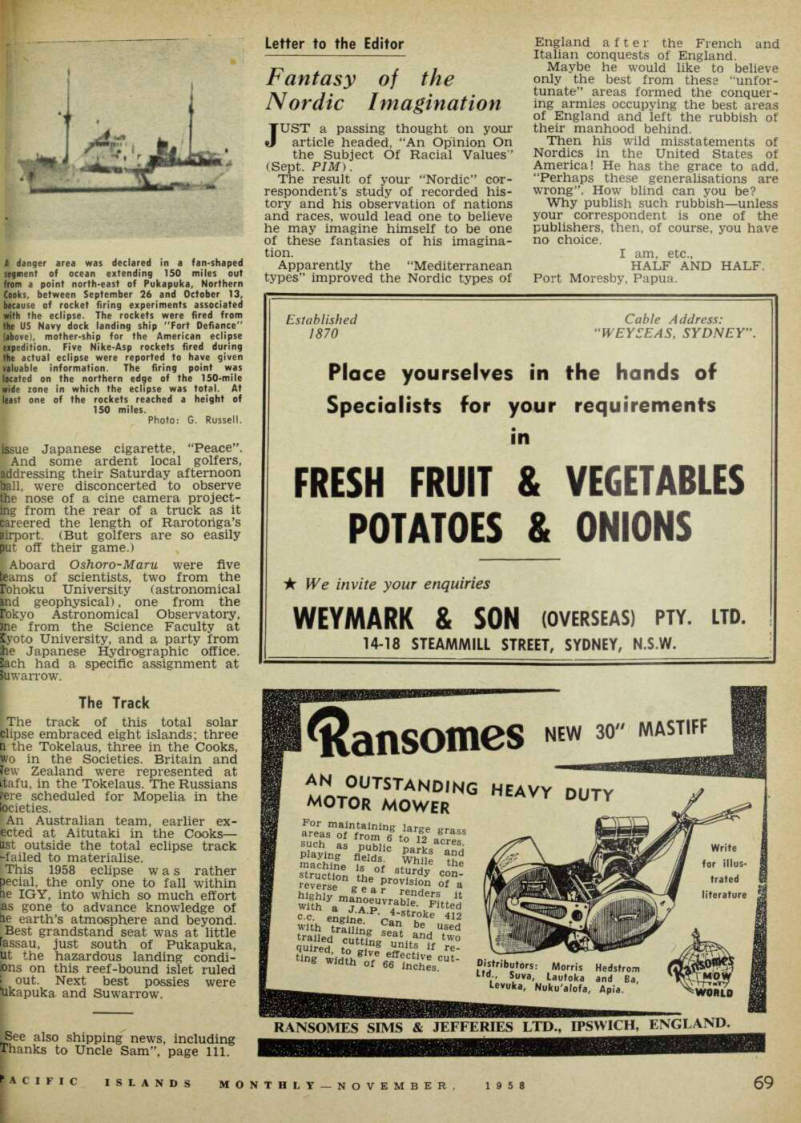
A danger area was declared in a fan-shaped segment of ocean extending 150 miles out from a point north-east of Pukapuka, Northern Cooks, between September 26 and October 13, because of rocket firing experiments associated with the eclipse. The rockets were fired from the US Navy dock landing ship "Fort Defiance" (above), mother-ship for the American eclipse expedition. Five Nike-Asp rockets fired during the actual eclipse were reported to have given valuable information. The firing point was located on the northern edge of the 150-mile wide zone in which the eclipse was total. At least one of the rockets reached a height of 150 miles.
Photo: G. Russell.