More Gubertese Move Out —To
pp. 59-63 · Read in the full issue

A New Pacific Migration
Become New Solomon Islanders
By Captain Brett Hilder
The migration of Pacific Islanders is still, for many, a live and ;present problem—not an academic conundrum to tease the minds of scientists and others. Transfer of islanders, from one Pacific territory to another, is still going on, organised and conducted as it never was in the days of antiquity. The Gilbertese are some of these modern migrants, with a Colony, now 400 strong, in Gizo in the Western Solomons Most of these New Solomon Islanders got there by way of the Phoenix Islands Settlement Plan.
THE Settlement Plan was entered into enthusiastically immedi ately the Phoenix Group eight tiny islands, total area 17 square miles) was included in the Gilbert and Ellice Islands Colony, in 1937. i There were two reasons for this: Et was a temporary solution to over population in the Southern Gilberts; and it was one way of staking Britain’s claim to specks of land that had previously been unimport ant.
When trans-Pacific airservices be came a practical proposition, in the mid-thirties, a gentlemanly war de veloped between Britain and the United States over ownership of a number of these Line Islands. The US annexed Howland and Baker, just north of the Phoenix, in 1935; find put in a claim for Enderbury and Canton, which later came under joint control of US and UK.
Three Islands Used
Britain, in 1937, officially took the Phoenix under her wing. Only three of the islands were used for the Resettlement Plan Sydney, Gardner and Hull. Model villages were built for the 700 migrants, and each family was given land and coconut trees. Unfortunately, the population kept on increasing—even
on Sydney, which was never par ticularly successful as a new home.
Now it has become necessary to move the Sydney people again—this time, to a completely new environ me n t at Gizo, in the British Solomon Islands.
Like Moving the Pitcairners
The change from flat, streamless coral atolls, to a large, volcanic island, with fertile soil, mountains and running streams, might have been expected to completely dis organise the Giibertese, but they appear to have settled down well.
The first of them made the transfer about two years ago; in September the Burns Philp motor vessel Tulagi transferred the rest of the Sydney islanders to Gizo, in one operation.
The whole thing went off very happily, and was blessed by the most favourable weather.
The importance of this latest phase of the Phoenix Islands Settle ment Plan can only be compared with the transfer of the total population of Pitcairn Island to Norfolk Island in 1856. On that occasion the transport Morayshire was under charter for several
months, part of the charter-price being based on a rate of 1/- a day per person.
The Morayshire moved the 193 Pitcairners and their gear in one lift, taking two months to cover the 3,350 miles. The total bill for the job was £4,478/19/6, paid to the agents in Sydney, who were Smith, Campbell & Company.
The 1958 Tulagi Operation con-
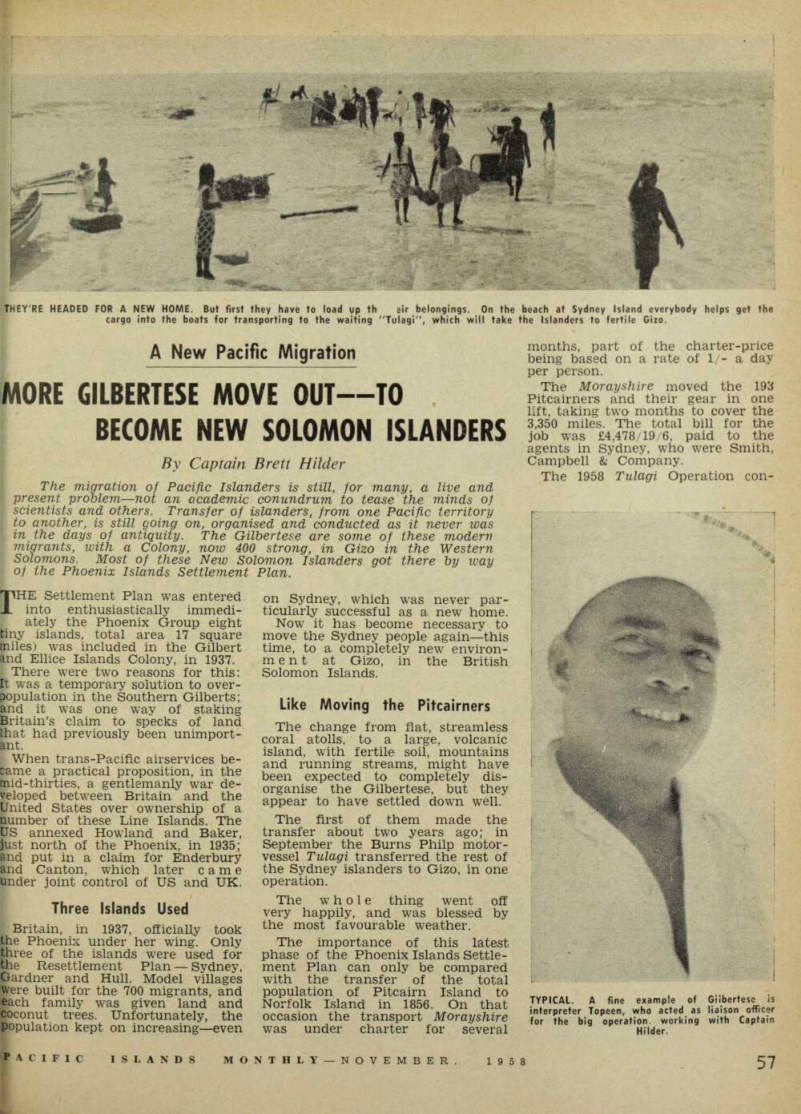
THEY'RE HEADED FOR A NEW HOME. But first they have to load up th eir belongings. On the beach at Sydney Island everybody helps get the cargo into the boats for transporting to the waiting "Tulagi", which will take the Islanders to fertile Gizo.
TYPICAL. A fine example of Giibertese is interpreter Topeen, who acted as liaison officer for the big operation, working with Captain Milder.
iiisted of the transfer of the 215 Sydney Islanders, with about 80 ions of personal gear and 36 sea going canoes, over a distance of just !,000 miles, in the 10 days from the ► Bth to the 27th of September.
The contract price for the whole operation was reported to be under
Is,Ooo.
There was a strong probability lhat the ship would be delayed at Sydney Island by the usual bad surf on the reef at the landing >lace, which has a worse reputation or bad working conditions than the bounty Bay landing-place.
We arrived off Sydney Island at ; a.m. on the 18th, and steamed iround until daylight showed us rhat the Gods had provided in the ray of weather. These small islands ire open to the weather from all luarters, and are affected by storms 1 thousand miles away..
We had been warned that the surf ?as as bad as Washington Island, rhere special boats are used on a leavy moored hawser, so we ex acted to do all the loading by anoes through the surf.
The last ship to work the island lad been the Government vessel 'e Matapula, and she had spent *ver a week cruising around the sland looking for a safe landing dace. She lifted only 17 people in hat time, wihch was not very en ouraging for us, as we had to try 0 embark the whole remaining •opulation..
On the previous afternoon we had ticked up Mr. Paul Laxton, District Jommissioner of the Phoenix Group, -t Canton Island, where we had fficially entered the Phoenix Customs District, and where we also oiTOwed a surf boat which we loped might be more useful than ur own heavy cargo boats.
When Mr. Laxton asked me how aany weeks we expected to be at jydney Island, I replied, “Two or
hree. . . . days!”
All Persuasion, But No Force We prepared a 44-gallon drum nd anchor to drop outside the Breakers, with a boat rope long Tiough to reach the beach and ecure to a coconut tree, but we lid not expect to get the boats F ery close to the shore.
At dawn we steamed in towards he western end of the island, and vith the help of the echo-sounder nanaged to find a precarious mchorage just two cables off the >each near the landing place.
There was no wind to speak of, md a line of breakers along the ‘eef, but they turned out to be only ibout two feet high, instead of the nore usual ten or 20 feet..
The Chief Kaubure came off in lis canoe to meet us, and we already lad the Native Magistrate aboard, living picked him up at Tarawa. 3oth these men were named John,
spelled “TTON” and “TEON” respectively, and pronounced differently, the latter spelling sounding more like “Shawn”.
We also had aboard a Gilbertese interpreter named Te Topeen, who was my Liaison Officer for the whole operation. He was provided by the Government, and he was most helpful.
The District Commissioner pointed out the best landing-place, which, like everything else on the charts, was very misleading There was a passage blasted through the reef to allow boats to get near the beach even at low water, and piles of luggage, bundles of mats and some canoes were
already appearing on the beach ready for the great exodus, The DC had orders to use all persuasion but no force in the evacuation, but all the natives were not only reconciled to leaving the island on which they had seen so many lean and hungry years, but they entered into the work of em barkation with good humour and h a PPY enthusiasm, Some of my photographs of the new settlement in the Solomons were viewed with favourable com ™ents ' particularly the one of the ‘ a / ge v , l . llage , J meeting-house or Maneapa , undei construction at the time it was photographed, The profusion of trees at the new
Their Canoes Went With Them
home, felled timber and the obvious fertility of the soil were also en couraging factors.
Only the Dogs and Rats Remain
After loading all the heavier baggage we began to wonder if the stream of personal effects would ever stop piling up on the beach.
The DC had laid down that no heavy furniture, houses, trees or permanent parts of the island were to be removed, so we only had a few folding beds and rather col lapsible meat-safes to cope with.
There were a few sewing machines, and two bicycles, for Sydney Island had neither trade-stores nor the money to use in them.
The accumulation of copra con sisted of one single ton, which we left behind for collection from Can ton Island at some later date.
It is unlikely that the Govern ment intends to leave the island deserted for long, and some copra cutters will probably be sent there occasionally until some small settle ment is made there to maintain British sovereignity.
Another problem was the live stock, which I had declined to carry to the Solomons because of quaran tine regulations. But we found that all the pigs had been eaten some time before, so that when I per mitted the settlers to take their pel kittens along, it left only a few dogs and rats to forage for themselves on the deserted island.
The women and children were loaded aboard by means of net slings fitted with wooden flooring, and then, just as the daylight was ending, we started to load all the canoes into the holds.
Precarious Anchorage
We finished about 9 p.m., with the ship still hanging on to her pre carious anchorage. We left the island in the calm moonlight to the melodious strains of groups of sing ing settlers on their way to a better home.
We spent the next morning at Canton Island, where we landed the District Commissioner and his party, before setting out for a pleasant week at sea on the long track to the Solomons. ‘ During the trip the settlers were dosed every day with the anti malarial drug provided by the Gov ernment, and this turned out to be, to our surprise, nothing less than Atebrin, which, as an anti-malarial, went out of favour elsewhere, in the late war years.
During the first night a child died, aged about one year, but a few days later a birth made the numbers right again, to the total of 216 souls. [ We had to restrict the supply of
fresh water to the Government ration of one gallon per day per person much more than the Gilbertese generally have on their sandy islets.
First Running Water
When we reached the Solomons we found that we would arrive at Gizo after dark on the 26th, so we called first at Port Purvis for fresh water supplies.
The sight of the hills and mountains, covered with jungle, and rearing up into the very clouds was a most remarkable sight for people who had never seen any land but sand, and that mostly only 10 feet above sea-level.
We had had a few rain squalls, which gave the settlers a good opportunity for shower-baths, but when we had filled the tanks at Port Purvis we gave them the use of the hoses for an excited burst of washing themselves, each other, and all their clothes—probably the first time in their lives they had seen running water in such quantities.
"A Lively Picnic"
We passed through Blackett Strait at dawn on the 27th, and anchored off Titiana Point, near Gizo, at 8 a.m. in very calm con ditions.
We were met by the District Commissioner and a small fleet of boats to assist in the landing, and after the formalities were completed,
the disembarkation turned into a very lively picnic.
A new village had been built for the new settlers by the 200-odd Gilbertese who had settled there during the previous two years. The total number of the community is now over 420, and this number will have to be divided in the near future.
The foreshore at Titiana consists of a reef-sheltered stretch of sand and coconuts, to make the settlers feel at home, and the hills of rich soil rise up behind with more timber than can be used and more space for gardens than the Gilbertese could ever have imagined.
Most of the food crops are strange to them, and they are amazed at the rate of growth of food plants, after the slow and laborious cultivation of Taro in pits of compost in their own islands.
Settling Down
The new settlement consists of houses raised well above the ground, in the fashion of the Southern Gilbert Islands, from whence most of the settlers originally migrated.
About 20 per cent, of the settlers came direct from the Gilberts, the other 80 per cent, being the Sydney Islanders, who had survived 20 years in the Phoenix Group.
I have every faith in the Gilbertese experiment in the Solomons, believing that it is the only solution for the over-popula tion of the Gilberts, and the lack of population in the Solomons.
Already there have been a couple of marriages between the Gilbertese and local Melanesian people.
LOCK, STOCK—AND CANOE. As the Gilbertese line the rails of the "Tulagi", no doubt wondering about their new home, the ship's winches begin to handle the 36 canoes which accompanied their owners to Gizo. The canoes were stowed in the holds.