Re-Discovered Louis Becke
pp. 43-47 · Read in the full issue
"The Best Writer For Those Who Know The Pacific"
It’S Time The Publishers
By Lew Priday
As a result of an article of mine published in the Sydney Bulletin in 1955 to celebrate the centenary of Louis Beck’s birth, I have received a request to supply a Paris literary maga zine with material for a series of stories about this leading figure in our literature of the South Seas. This is a distinction for the work of Becke.
r;E request gives me an excuse
for going further than before into the career of the man Becke, both as trader, and super cargo, and as writer.
In 1955, the most valuable new material I came across was a letter,
unpublished at that time, which
Becke wrote asking Captain Donald McLeod, the pioneer New Hebridean
trader, for a job.
The letter was kindly sent me by
Captain McLeod’s nephew, Mr.
Graham Kerr, of Noumea, himself
a veteran trader, and it was his intention later to give it to the Mitchell Library. The letter, ad dressed to McLeod, at Havannah
Harbour, Efate, read: —
c/o R. Pfoeffer, Esq., P.O. Box 14.
Manly Beach, Sydney.
October 1, 1892.
Dear Sir, I respectfully venture to write to you to inquire if you can give me employment as a trader on any of your stations in the New Hebrides. I have had about 15 years’ experience in various parts of the islands as trader —Samoa, Tonga, Ellice Group, Line and Caroline Islands and also New Britain. I arrived in Sydney from the Line Islands about a year ago. I am 35 years of age, married (with two children) am well up in all branches of the island trade, a good rough carpenter and used to sail small craft, but cannot navigate.
I am also a good bookkeeper and accoun tant and have very satisfactory references as to my ability and sobriety.
I was in Noumea about 10 months ago, on my way to Sydney, and I heard that you were soon expected there. I am sorry now that I did not remain there and await your arrival, but at the time I had the intention of going on to Sydney and then to Samoa. Since then I have been advised by my friends in Samoa not to go there, as business is so very bad, and I have had to remain in Sydney.
I did endeavour (words deleted) I was advised by Captain Henry and Captain Hawkins to write to you. I saw Captain Hawkins two days ago and he told me that if I wrote to you via Noumea a letter would be pretty safe to reach you.
I may mention that Captain Hawkins is one of the references alluded to, he has known me for many years.
I should very much like to return to the islands, either as trader or in some other capacity, and, if I could, obtain a station where my wife could accompany me. If
that would not be possible at first, per haps it could be managed later on.
I would be willing to serve you under an agreement for two or three years. If my wife and children could come with me I would be willing to work on commission, but if they could not I should be satisfied with wages. I have not enclosed you any of my testimonials for fear of their not reaching you safely, but I can refer you to some gentlemen in Sydney to whom I am well known, and from whom you can obtain information as to my character, etc.
Trusting I may have the favour of a reply at your earliest convenience . . .
I am, Sir.
Yours obediently
L. G. Becke.
This letter deserves a place in
literary history. For had McLeod’s
answer been favourable, George Louis Becke would have continued his trading life in an island group where life was, formerly, extremely hazardous: another year or two in a malarial climate would probably have polished him off for good; Becke. the writer we know, would never have come into being.
In Desperation
McLeod, after so many years in a climate which won the group the title of a white man’s grave, was a sick man when he received it; he soon retired to Noumea for medical treatment and a year or so after wards died there of an enlarged
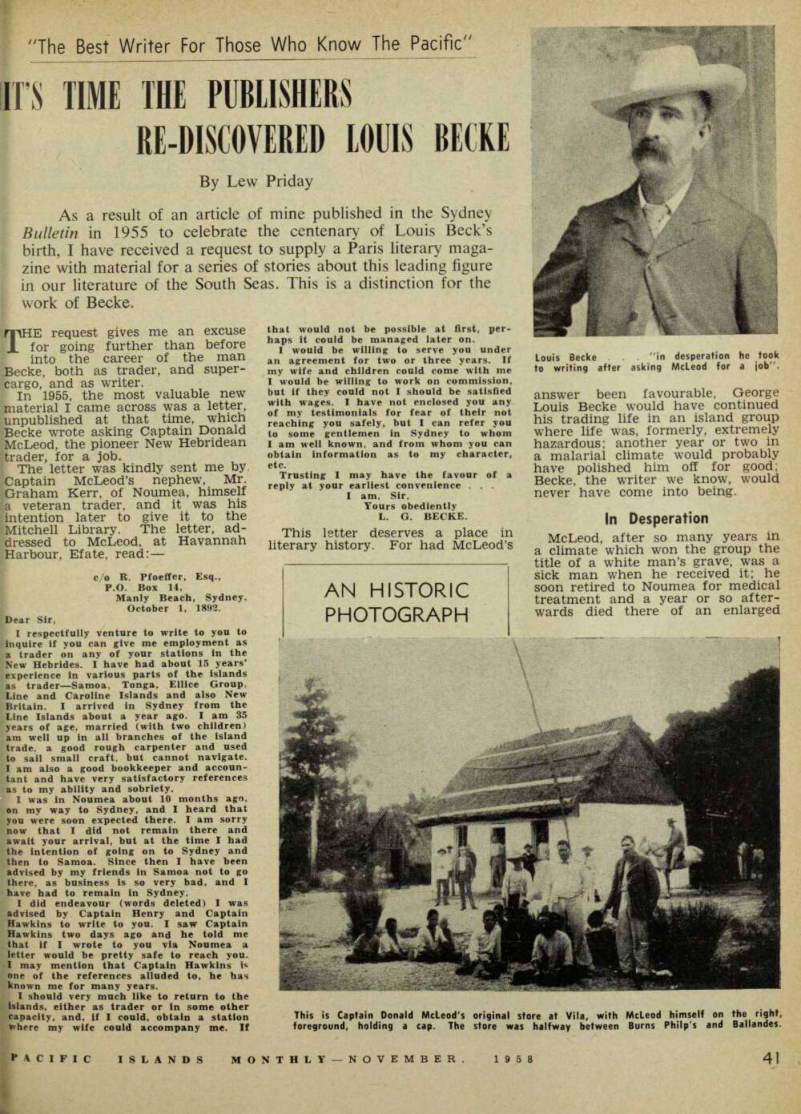
Louis Becke . "in desperation he took to writing after asking McLeod for a job".
spleen. The letter was found among uis papers a long time after his Heath.
Becke in desperation took to writing.
He had left the islands with a sick wife and two daughters and a malaria hangover, had tried run ling a small poultry farm, had ;ried, too, cutting scrub on contract it Manly, a backbreaking and un profitable occupation which he juickly abandoned.
Next, his appeal to McLeod laving come to nothing, he got a job in a Coogee pub, and it is here :hat Archibald, Favenc and the Bulletin group of writers discovered aim one Saturday in the bar, lolding patrons spellbound with stories of islands life.
' The rest is well known: how Becke went overseas, was taken up py the publishers who found a ready public for his yarns; and later his return to the Pacific and death in Sydney in 1913.
Since the letter to McLeod was published, I have come across a bhotograph of McLeod’s old store in Port Vila. There in the right fore ground, with his seaman’s cap in tiis hand, is tough old McLeod himself (identified for me by Mr.
Graham Kerr’s brother Hugh, who lied only last year in Hornsby).
The store itself was situated near Che waterfront something like half way between Vila’s two other lead ing stores —that of Higginson’s French Company (later Ballandes) and that of the Australasian New Hebrides Company (later Burns Philp).
Edition "Marred"
Angus and Robertson celebrated (if such is the word?) the Becke pentenary in 1955 by pubishing an inferior-looking edition of By Reef and Palm, quite the most easily obtainable of all Becke’s books on the second hand market, where most of his other books are now priced between £2 and £3.
Worse still, the edition was marred, by the inclusion of Lord Pembroke’s original preface, full of inaccuracies and mis-statements as it was.
Lovers of the Pacific must feel their favourite author deserves a better memorial. But where is that to come from?
Since Australian publishers have neither the energy nor the enter prise to do the proper thing, one must live in hopes that some top rank English publisher will re discover Becke and familiarise a new reading public with the excit ing Pacific in the trading era of sail.
Someday, surely, a wide selection, “The Best of Becke”, will prove a good selling proposition, with a modern introduction covering the known facts about the author’s character, life, and “discovery”.
It is the fashion among the feeble race of Australian critics to repeat parrot fashion that, thanks to
Archibald, By Reef and Palm contains the cream of Becke’s writing —but how many of these critics are acquainted with his other stories?
Becke certainly wrote many potboilers to keep himself alive, yet here and there are to be found brilliantly evocative pictures of life on the lonely atolls and the waterfronts of the high island ports, that are quite equal to the bulk of By Reef and Palm episodes, and these deserve to be preserved.
Off hand, I would mention that inimitable study of a beachcomber, “The Cook of the‘Spreeto Santoo’w and a word portrait of an old native gossiping with a trader through a moonlight night over a bottle of grog.
The title of the story momentarily slips my memory, but there are a
dozen others that are almost as good. tu p Dp** am ,ne DesT 0T Becke, as the not always accurate Rascals in Paradise book by Grove Day and Michener points out, is the best of all writers for those who know the Pacific. This is because he is the most authentic, Unlike RLS, and Jack London (whose islands stories are so adolescent) Becke didn’t live in the islands to write about them.
Before ever he was asked to put pen to paper his retentive mind as chock-a-block full of the Pacific scene, and he is always at his best when his sole effort is to describe the life he himself actually lived, and the islanders he lived among, Had he lived in cinema times
Becke might have made a fortune; happily for literature he preceded those times, so that one can go to his work for the music of the breakers on the reef, unadulterated by the sugar-sweet wailings of the ukulele.
Islands literature has lost all reality since island life became distorted for scenario purposes.
One (Becke) remains, the many change and pass. . . .