High Freight Rates And
pp. 24-159 · Read in the full issue
The Breeze is Beginning to Blow in the South Pacific
High Freight Rates And The Shipping Slump
After a long period of great activity, if not always high profits, ships manned by high-cost Australian and New Zealand crews are beginning to feel the cool breeze of the current re cession in the shipping world.
SOUTH Pacific territories have been largely unaware of the serious world shipping recession which has laid up about 8,000,000 gross tons of shipping or about 7 per cent, of the world’s merchant fleet.
The slump has mainly affected tankers and bulk-cargo tramps, and the resulting very low freight rates currently offering should be favour ably influencing copra prices in Europe—although they do not seem to be doing so, from the South Pacific.
So far the slump has not greatly affected shipping in regular fixed trades, but there are signs that it may now do so.
One such sign came in an ai nouncement from the Union Stea, Ship Co. in October that their wa: time-built 7,211-ton Wairuna, on tl regular Australia-trans-Pacific rui is to be laid up.
Main reason for the lay-up is th: the freight rate for the usual bad loads of timber from Canada is u longer economic for a ship of th age, on New Zealand registry. (C the day of the announcement ■ the lay-up of Wairuna, the Gree motor-ship Evangelismos arrived : Auckland with a full cargo of Cai adian timber).
At that date the Union Compau did not anticipate that any othi trans-Pacific freighters would I laid off at present.
A Pacific trade that is prosperin is the expanding refrigerated me:; trade to North America, Hawaj and Japan, from New Zealand.
The J. Lauritzen Line of Denmai announced in mid-October that thu are placing a fourth ship in tM trade —lndian Reefer. She is a vess of 2,824 tons gross with a refrijj erated cargo capacity of 188,000 cutt feet, built in 1939 and with a goo turn of speed like the others in tH trade.
In Fiji, at about the same tirm two inter-island ships were laid u for lack of cargoes. (See shippin
section, this issue).
Subsidising Australian Crews
The shipping recession has hsj no apparent effect on Pacific freigjr rates yet, and in New Guinea mid-October, the Planters’ Associa tion Executive had a few blua things to say about copra freights Australia and' Europe. There wv in what they saii j although they probably ovee simplified the problem. The witld drawal of the “subsidy” (the exisa ence of which seemed to annoy a II of people) could hardly bring freight down; to the contrary. „ T he , Co P ra freight rate fr o c Rabaul to Sydney is £7/15/- pq ton, and from P-NG ports to UK : £lO per ton. This compares un favourably with reputed £3/155 iiom Fiji to UK for raw sugar; am £3 per ton on wheat from Wa Australia to UK. The planters wes (Continued on page 155)
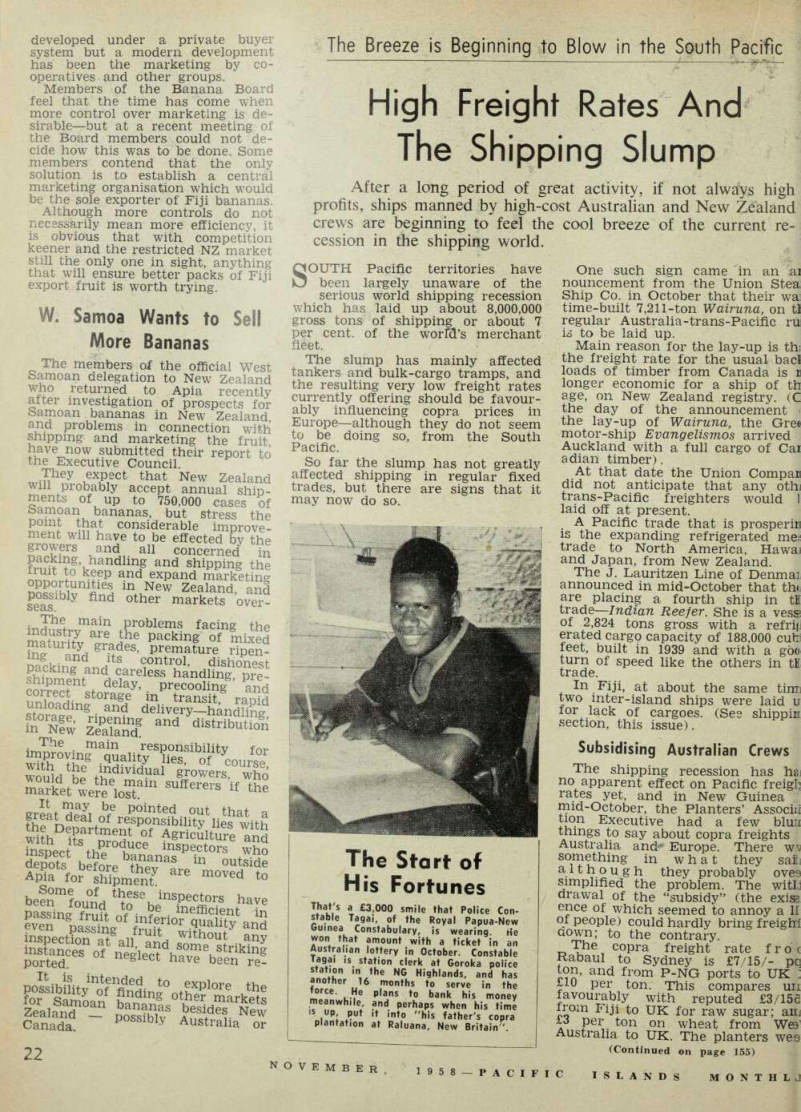
The Start of
His Fortunes
That s a £3,000 smile that Police Con stable Tagai, of the Royal Papua-New Guinea Constabulary, is wearing. He won that amount with a ticket in an Australian lottery in October. Constable Tagai is station clerk at Goroka police station in the NG Highlands, and has another 16 months to serve in the force. He plans to bank his money meanwhile and perhaps when his time is up, put it into “his father's copra plantation at Raluana, New Britain".
of the opinion that £7 per ton for copra from P-NG ports to UK would be a reasonable rate.
So far as the Australia-New Guinea trade is concerned, the Association
would like to see all shipping lines, Australian or foreign, competing for the trade. At present, according to one member of the Association who attended the meeting, the Australian taxpayer and the NG copra planter subsidise the “inefficiency” of Aus tralian crews” to the extent of £lOO,OOO per annum.
He was referring to a statement made in the House of Represent atives recently, when the Minister for Territories, in a reply to a question stated: “To retain Bulolo, Malekula and Malaita on the Australian shipping register with Australian crews and operating under Australian conditions In competition with vessels operating under different conditions, £lOO,OOO a year subsidy is paid and an as surance is given that the ships will get all the copra for shipment be
tween the Territory and Australia.”
At present there are four Burns Philp ships and three of the New Guinea-Australia Line on the Aus tralia-New Guinea ssrvice. Only the Burns Philp vessels up-lift copra, in addition to the above vessels, there are several, such as those owned by the Australia West Pacific Line, which trade down from the Far East to Australia via New Guinea ports
NG Coffee for Euro P e?
Visiting Australia and S-W Pacific ports currently, is Mr. Folke Hillerstrom, owner and managing director of the Australia-W es t Pacific Line. He arrived in Sydney in time to farewell the Line’s Delos, which left for the Far East and Islands ports on October 28,
carrying the Australian Trade Mission to the Far East.
On November 4, in company with Mr. J. O. Johnsen, Sydney managing director of Wilh. Wilhelmsen, he flew to New Guinea. They will spend eight days in the New Guinea High lands surveying the prospects of shipping Highlands coffee in the Line’s ships, via the Far East, to Europe.
If this trade could be developed, it would be a very good thing for NG coffee planters who are at pre sent entirely dependent upon the Australian market. At the present stage of coffee development, in the Territory, however, there may not be sufficient coffee available to make shipments to Europe worthwhile — although the potential is certainly there.
Those Wharf Priorities
Another chore that will be under taken by Mr. Hillerstrom before he returns to Sweden via Noumea, New Hebrides and New Zealand, will be a visit to the Territories Depart ment in Canberra to discuss the present “priority” system that operates in Papua-New Guinea ports, to the detriment, so he says, of his own Line’s vessels.
At present, under this priority system, if the vessels of the two regular shipping services on the Australia-New Guinea run, arrive at a Territory port while a “foreign” ship—that is, one without a priority —is loading or unloading, the vessel without the priority must pull out and let the Australian-based vessel get in to the wharf.
Mr. Hillerstrom cites the case of his company’s Citos, which in August was at Lae within a short time of completing loading when a priority vessel arrived. Citos had to give way. As the delay in Lae would be considerable, Citos then proceeded to Rabaul and Honiara, BSIP, then went all the way back to Lae to complete loading, before sailing for Brisbane.
Masta Ben . . .
. . . and Buka