Disorder, Fire Bombs,
pp. 21-157 · Read in the full issue
Pouvanaa and 22 Others Arrested
Disorder, Fire Bombs, Liven Up Tahiti
A series of extraordinary political incidents in Tahiti cul minated in October in the arrest of French Deputy Pouvanaa a Oopa and some 22 of his RDPT followers, on charges of terrorism.
FRENCH Polynesia hitherto has been regarded as one of the most peaceful Territories of the South Pacific.
The October trouble seems to have grown out of the administrative friction of early 1958, plus some bitter exchanges between political parties in July-October, in connec tion with the De Gaulle referendum.
The Tahitians concerned seem to have been badly led and advised.
The events of October 10-11, in which the followers of Pouvanaa apparently tried to start fires in Papeete with bottles of petrol (“Molotov cocktails”) indicate a policy and procedure so ill-planned and stupid as to be almost in credible.
The terrorist charges seem to be linked with the strong anti-French vote registered in French Polynesia on September 27-28 in the referen dum on the ne.w De Gaullist Con stitution.
A Background of Trouble
The background of this trouble reaches back a long way.
Pouvanaa a Oopa—a big, hand some man of mixed French and Tahitian blood, aged 63—always has been the centre of a little group of
active Leftists. But they counted for little in French Polynesia until in very recent times the French Government of the Fourth Republic (now dead) gave to the French South Pacific Territories a large measure of self-government, based on the common roll, covering all races.
On the basis of the common roll, the majority of the voters in French Polynesia were semi-illiterate or illiterate and were easily brought in as followers of demagogues like Pouvanaa. A general election, at the end of 1957, returned a Terri torial Assembly of 34 —divided almost equally between the Rightist Union Tahitienne Democratique, and the Leftist Rassemblement Democratique Populations Tahiti (or RDPT).
Revolt Against RDPT Early in 1958, a Government was formed by the RDPT, Celan Gerusalemy being President of the Assembly, and Pouvanaa a Oopa be ing Premier.
The new Government brought in a tax on incomes, and made public declarations in favour of breaking away from the French Union, and forming an independent republic.
This was the measure of the
RDPT’s thinking capacity. Anyone would know that a Territory with French Polynesia’s small population and very limited economic resources could not get any advantage through being run as an independent State.
The Rightist sections of the com munity rose in revolt against the Leftist extremists.
After two days of civil disorder, at the end of April, the Governor, M. Bailly, took charge of the Admin istration and the Assembly repealed the new taxation laws.
The Governor and M. Gerusalemy went to Paris in July to report upon the position in Tahiti —which still was strained.
A Provisional Administration—in which the Rightist leaders, Messrs.
Poroi and Bambridge were promin ent and which included Pouvanaa, carried on.
By this time, General de Gaulle had taken over Governmental re responsibility in France; ani it was deemed wise to do nothing further in French Polynesia until the new Constitution was adopted and functioning.
Referendum and Bad Feeling
Then came the hard, brief cam paign in which the Territory’s voters were summoned to say either Oui or Non to the proposition that the De Gaulle Constitution should supplant the Fourth and establish the new Fifth Republic.
New Caledonian Leftist leaders ad vocated “Yes”, and New Caledonia’s vote was overwhelmingly “Yes”. But a section of Pouvanaa’s RDPT
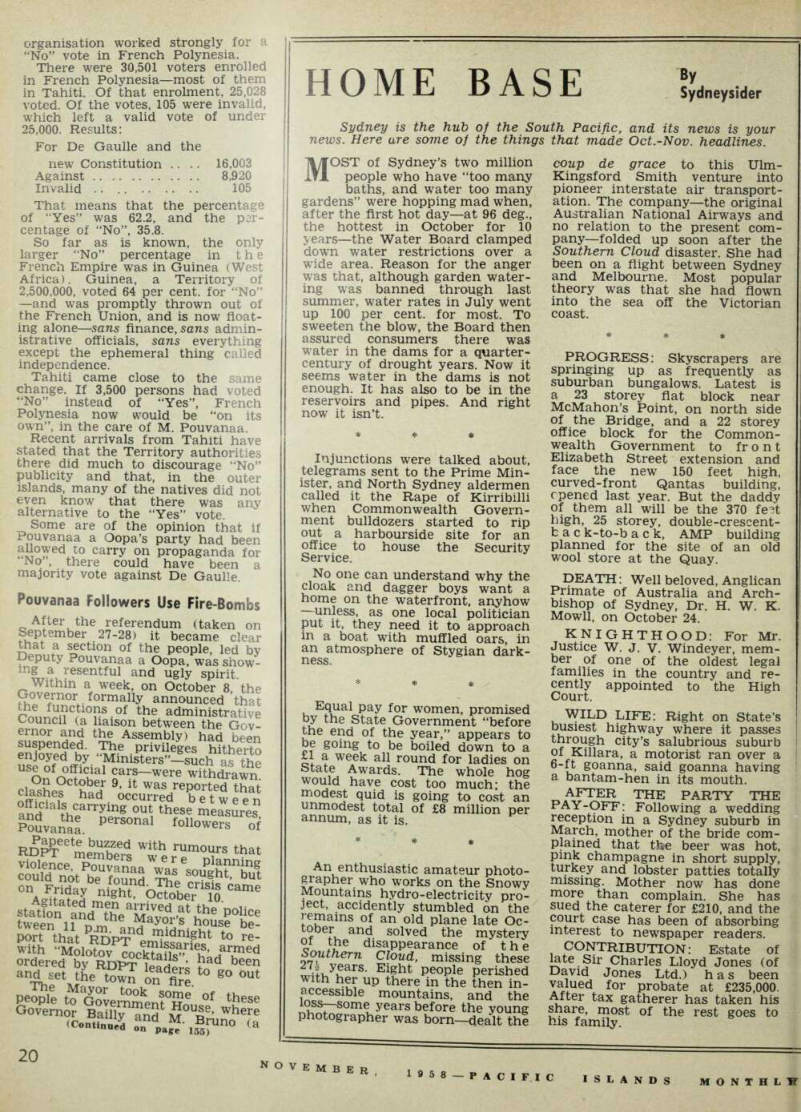
French Deputy Pouvanaa a Oopa is directed into the police van after his arrest in Papeete.
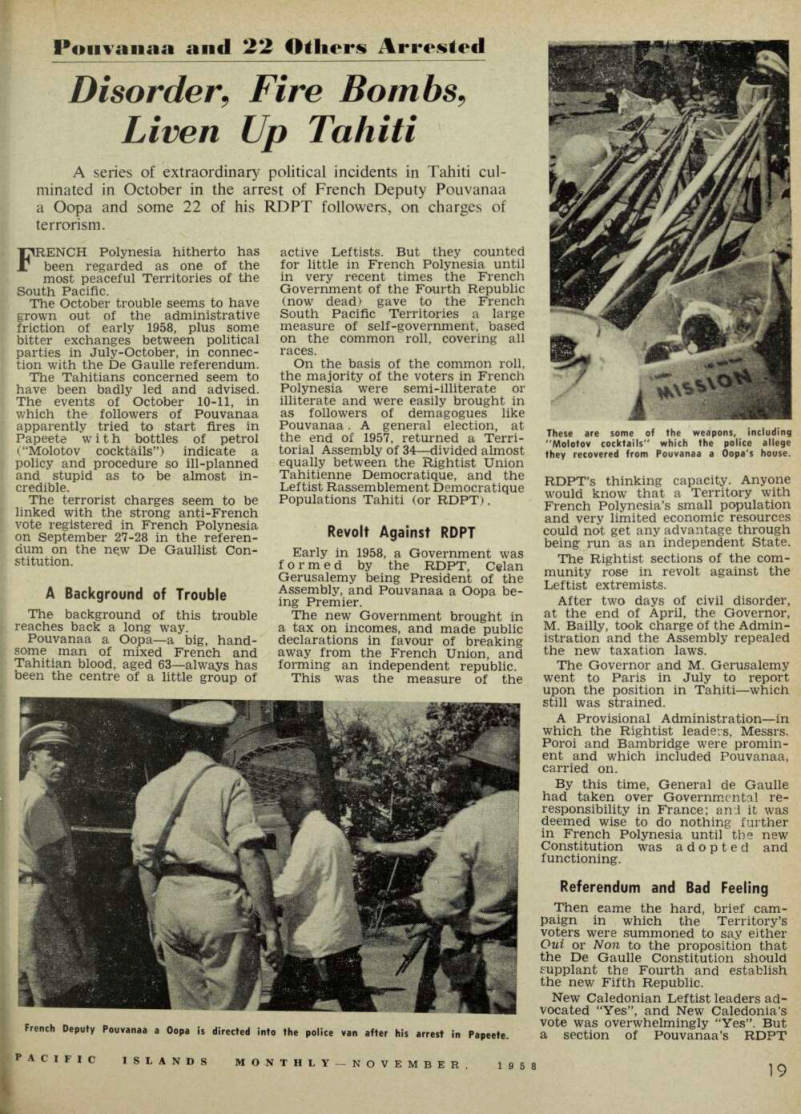
These are some of the weapons, including "Molotov cocktails" which the police allege they recovered from Pouvanaa a Oopa's house.
organisation worked strongly for a “No” vote in French Polynesia.
There were 30,501 voters enrolled in French Polynesia—most of them in Tahiti. Of that enrolment, 25,028 voted. Of the votes, 105 were invalid, which left a valid vote of under 25.000. Results: For De Gaulle and the new Constitution .. .. 16,003 Against 8,920 Invalid 105 That means that the percentage of “Yes” was 62.2, and the per centage of “No”, 35.8.
So far as is known, the only larger “No” percentage in the French Empire was in Guinea (West Africa). Guinea, a Territory of 2.500.000, voted 64 per cent, for “No” —and was promptly thrown out of the French Union, and is now float ing alone —sans finance, sans admin istrative officials, sans everything except the ephemeral thing called independence.
Tahiti came close to the same change. If 3,500 persons had voted “No” instead of “Yes”, French Polynesia now would be “on its own”, in the care of M. Pouvanaa, Recent arrivals from Tahiti have stated that the Territory authorities there did much to discourage “No” publicity and that, in the outer islands, many of the natives did not even know that there was any alternative to the “Yes” vote.
Some are of the opinion that if Pouvanaa a Oopa’s party had been allowed to carry on propaganda for No , there could have been a majority vote against De Gaulle.
Pouvanaa Followers Use Fire-Bombs
After the referendum (taken on September 27-28) it became clear that a section of the people, led by Deputy Pouvanaa a Oopa, was show mw^vJ esentful and ugl y spirit.
Withm a week, on October 8, the Governor formally announced that PmiiSSw 10 ? 8 ■ of the administrative Council (a liaison between the Gov ernor 5 n 3 the Assembly) had been suspended. The privileges hitherto enjoyed by “Ministers”— such as the U on f n of l iC v! al " ars were withdrawn 6 clShe? Ct h«H r 9 ’ was / eported tha t ~- Sl > e , s nad occurred between and lal the arrylng out these measures Pouvanaa. PerSOnal of Rnpr eet m bu ? zed with rumours that nlght ’ October 10 Agitated men arrived at tw a e» n if n n d m the house°be- Port that P RDPT n erSsfarfes* ‘° re ‘ with “Molotov cocktails” ha/T ed ordered bv RDPr i^ s ’ i lad beer »
andse.SL'S g 0 out
people to Government 0 !?' 6 of these
De Gaullist envoy from Paris) in terviewed them. They decided that ‘all was calm”.
But the fire-bugs were out. A Uhinese shopkeeper lit up his premises at 2 a.m.. He was warned jy a small group of men: “If you lon’t want to die, you should leave it once.” He left.
At about 2 a.m., two bottles of laming petrol were thrown into the louse of Robert Herve, a leading litizen; and soon afterwards three jottles were tossed into the premises
if shopkeeper Arupa.
The police had been on the alert. 3y 2.20 a.m. the alarm sirens were sounding—and police, soldiers and •esponsible citizens hurriedly as sembled. Half-a-dozen men, armed pith “Molotov cocktails,” were cap ured. They confessed that they
were carrying out the orders of certain RDPT personnel to set fire to the town.
Arrest of the Deputy
Early in the morning of Saturday, October 11, the Governor issued orders for the arrest of Pouvanaa a Oopa, Deputy of French Polynesia and Vice-President of the Assembly Territoriale. A cordon was thrown around his house at 9 a.m., and he was called on to surrender. He sub mitted quietly.
It was found that his home, a con struction of solid cement, had been transformed into a small fortress, with loopholes cut in the walls.
Here is the official list of what the police found there: 1 large American flag. 3 automatic Winchester carbines. 1 American repeating carbine. 1 automatic pistol. 6 well-sharpened bush knives. 20 clubs of various patterns.
British and American army clothing.
A considerable quantity of big stones, suitable for throwing.
Crowbars, harpoons and underwater spearguns. 1 beer-making plant.
A collection of pornographic photo graphs.
There was a stock of “Molotov cocktails”, and a considerable body guard.
It was reported at first that 50
persons had been arrested and were awaiting trial; but apparently many were questioned and released.
On October 28, it was stated that five more persons had been charged with acts of terrorism, bringing the total to 23. Pouvanaa then was still in gaol, awaiting trial.
It also was announced that the Territorial Assembly had decided that the local Government, suspended on October 8, should be dissolved: and the Assembly set up a Com mittee to discuss the future status of French Polynesia (presumably as a unit enjoying a degree of self government within the French Union).
It was announced from Paris on October 22 that M. Pierre Sicaud, aged 47, a senior official of the French Overseas Territories Min istry, would proceed at once to Tahiti, to assume duty as Governor; and that M. Camille Bailly would then return to Paris, for a new assignment.