The Dutch Suggest A Consultative
pp. 19-20 · Read in the full issue
No Defence Talk at Canberra Conference, But—
Union’ With Papua-New Guinea
From a Special Correspondent in Canberra The over-publicised Canberra conference between Netherlands New Guinea and Papua-New Guinea administrative heads in October introduced a new phrase into officialdom’s vocabulary—“consultative union”.
BUT it achieved little else of note.
The conference was attended by senior officers of both Ad ministrations and their External Affairs representatives.
Thanks largely to work on the sidelines by bland, smiling Dr. A.
Helmi, Indonesian Ambassador to Australia, and the Indonesian Foreign Minister, Dr. Subandrio, the talks opened against a background of suspicion from overseas that the Netherlands and Australia were about to decide on some joint de fence scheme for the two territories.
And any Australian-Dutch mil itary alliance in New Guinea “would endanger peace in South Asia”, declared Dr. Subandrio, on the eve of the talks.
The participating countries denied they would discuss defence. The talks would be purely on adminis trative problems, they said.
No Defence Talk
And as it turned out, the confer ence did not discuss defence.
It discussed possible schemes for sending more Australian technical officers to NNG, of improving educa tional programmes and communi cations—and similar matters that were an extension of the adminis trative liaison that is already operat ing between the two territories.
None of it could have been head line material, even in the sensitive Indonesian Press.
But one note was struck by the Dutch which could have significant implications. They pressed for a “consultative union” between the two territories.
This union they visualised as a joint advisory body to include a representation of indigenous people from both territories.
Not Yet Ready This body could, presumably, pave the way eventually for something in the nature of a joint federation of both territories, which would ulti mately give the native people a large say in the running of their countries.
This end result is not far removed from the policies that both Govern ments have independently sketched
out for their respective territories —that is, that eventually the in digenous inhabitants will be allowed to control their own destinies.
But that time is not yet, and the Australians said so. They said it was too early for such a union to operate—the people were not ad vanced enough on the Australian side of the border, or, in fact, on either side.
But the Dutch pressed the sug gestion.
And as the conference progressed it seemed that the main D,:tch aim was to get Australia to agree to some kind of consultative union, and that the other considerations of liaison were secondary.
Privately in some quarters in Canberra it was suspected that possibly Holland was looking merely for a way out of her NG problems.
It was a fact that many people at home could not see why Holland held on to New Guinea, but all agreed that Indonesia should not have it.
A consultative union, whatever it
might mean in practice, would allow the Dutch eventually to withdraw and save face at home.
Can't Afford Not To Australia, once she had agreed to a proposal, could be depended upon to take a big share of the respon sibility of making such a union work.
She could not afford not to, being already deeply committed on her
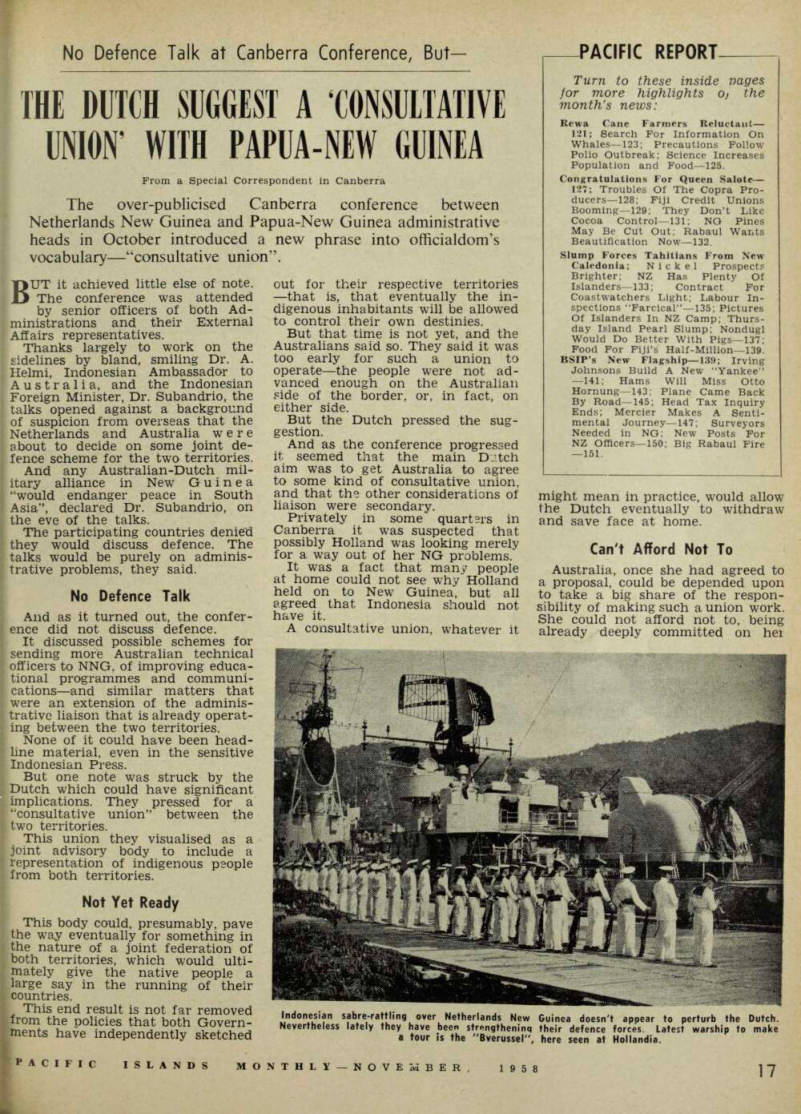
Indonesian sabre-rattling over Netherlands New Guinea doesn't appear to perturb the Dutch.
Nevertheless lately they have been strengthening their defence forces. Latest warship to make a tour is the "Bverussel", here seen at Hollandia.
own side of the border.
Australia, though, had no inten tion of being thus forced into tak ing over West New Guinea, and a message to the conference from Australian External Affairs Minister Casey rejected the proposal.
Although nobody said so, Aus tralia without doubt does not look on her own New Guinea policy as a separate one in itself. It cannot be separated from the effects of other plans she may formulate in the South Pacific.
"Reappraisal"
is mom ent some tning in th.o way of a rcaDDraisal S Canberra aC ‘^ C “ may take Bn tish Solomons, the Sw aUd FlJi ln the Australia, soon enough will hav#> }° decid e just what she stands fo? m the South Pacific.
Decisions affecting New Guinea are going to be vital-especiado f the recent good pronfise of oil becomes a reality.
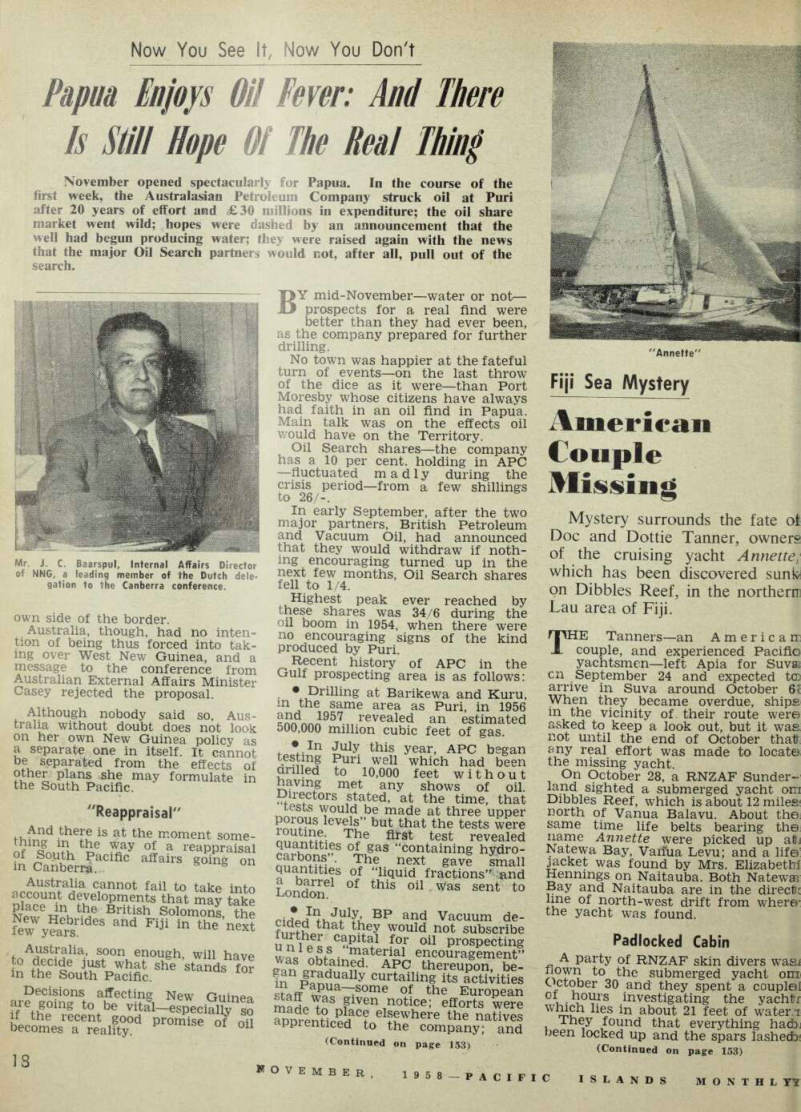
Mr. J. C. Baarspul, Internal Affairs Director of NNG, a leading member of the Dutch dele gation to the Canberra conference.