Pacific Commerce and Produce
pp. 167-168 · Read in the full issue
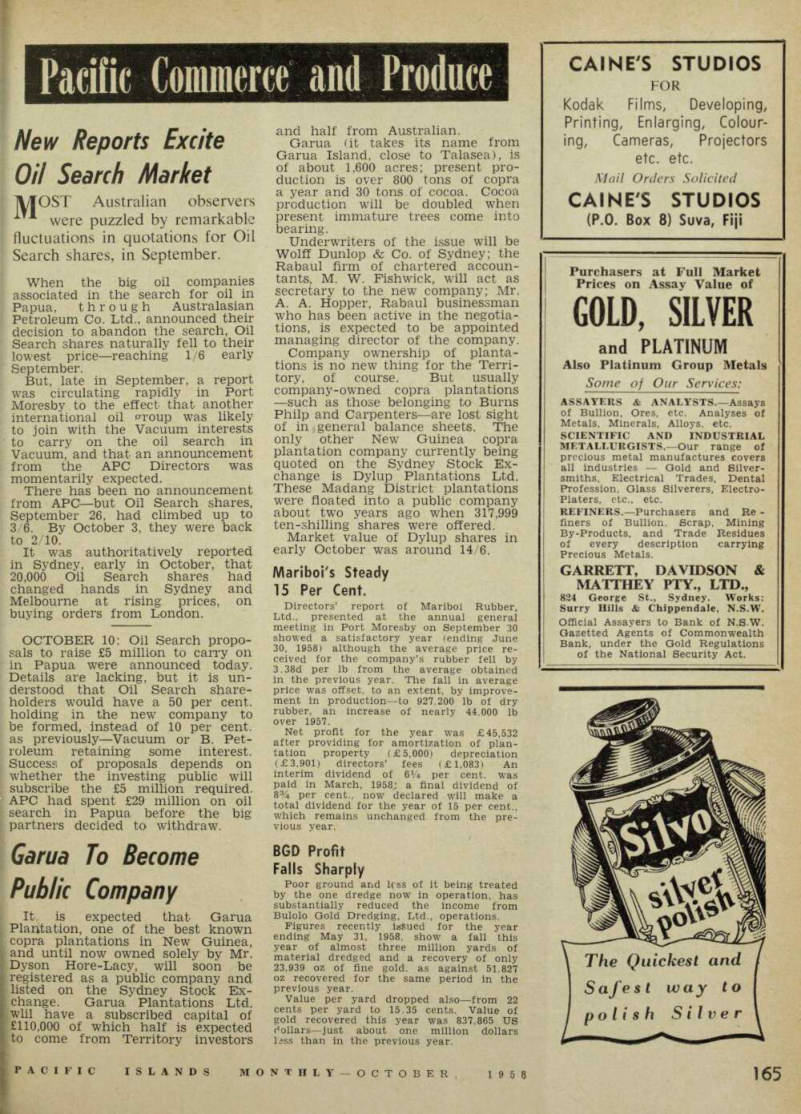
New Reports Excite
Oil Search Market
11/lOST Australian observers
were puzzled by remarkable
fluctuations in quotations for Oil
Search shares, in September.
When the big oil companies associated in the search for oil in Papua, through Australasian Petroleum Co. Ltd., announced their decision to abandon the search, Oil Search shares naturally fell to their lowest price—reaching 1/6 early September.
But, late in September, a report was circulating rapidly in Port Moresby to the effect that another international oil proup was likely to join with the Vacuum interests to carry on the oil search in Vacuum, and that an announcement from the APC Directors was momentarily expected.
There has been no announcement from APC—but Oil Search shares, September 26, had climbed up to 3/6. By October 3, they were back to 2/10.
It was authoritatively reported in Sydney, early in October, that 20,000 Oil Search shares had changed hands in Sydney and Melbourne at rising prices, on buying orders from London.
OCTOBER 10: Oil Search propo sals to raise £5 million to carry on in Papua were announced today.
Details are lacking, but it is un derstood that Oil Search share holders would have a 50 per cent, holding in the new company to be formed, instead of 10 per cent, as previously—Vacuum or B. Pet roleum retaining some interest.
Success of proposals depends on whether the investing public will subscribe the £5 million required.
APC had spent £29 million on oil search in Papua before the big partners decided to withdraw.
Garua To Become
Public Company
It is expected that- Garua Plantation, one of the best known copra plantations in New Guinea, and until now owned solely by Mr.
Dyson Hore-Lacy, will soon be registered as a public company and listed on the Sydney Stock Ex change. Garua Plantations Ltd. wlil have a subscribed capital of £llO,OOO of which half is expected to come from Territory investors
and half from Australian.
Garua (it takes its name from Garua Island, close to Talasea), is of about 1,600 acres; present pro duction is over 800 tons of copra a year and 30 tons of cocoa. Cocoa production will be doubled when present immature trees come into bearing.
Underwriters of the issue will be Wolff Dunlop & Co. of Sydney; the Rabaul firm of chartered accoun tants, M. W. Fishwick, will act as secretary to the new company; Mr.
A. A. Hopper, Rabaul businessman who has been active in the negotia tions, is expected to be appointed managing director of the company.
Company ownership of planta
tions is no new thing for the Terri tory, of course. But usually company-owned copra plantations —such as those belonging to Burns Philp and Carpenters—are lost sight of in general balance sheets. The only other New Guinea copra
plantation company currently being
quoted on the Sydney Stock Ex change is Dylup Plantations Ltd.
These Madang District plantations were floated into a public company about two years ago when 317,999 ten-shilling shares were offered.
Market value of Dylup shares in early October was around 14/6.
Mariboi's Steady
15 Per Cent.
Directors’ report of Mariboi Rubber, Ltd., presented at the annual general meeting in Port Moresby on September 30 showed a satisfactory year (ending June 30, 1958) although the average price re ceived for the company’s rubber fell by 3.38 d per lb from the average obtained in the previous year. The fall in average price was offset, to an extent, by improve ment in production—to 927,200 lb of dry rubber, an increase of nearly 44,000 lb over 1957.
Net profit for the year was £45,532 after providing for amortization of plan tation property (£5,000) depreciation (£3,901) directors’ fees (£1,083) An interim dividend of 6Vi per cent, was paid in March, 1958; a final dividend of 8% per cent., now declared will make a total dividend for the year of 15 per cent., which remains unchanged from the pre vious year.
BGD Profit
Falls Sharply
Poor ground and less of it being treated by the one dredge now in operation, has substantially reduced the income from Bulolo Gold Dredging, Ltd., operations.
Figures recently issued for the year ending May 31, 1958, show a fall this year of almost three million yards of material dredged and a recovery of only 23,939 oz of fine gold, as against 51,827 oz recovered for the same period in the previous year.
Value per yard dropped also —from 22 cents per yard to 15.35 cents. Value of gold recovered this year was 837,865 US dollars —just about one million dollars less than in the previous year.
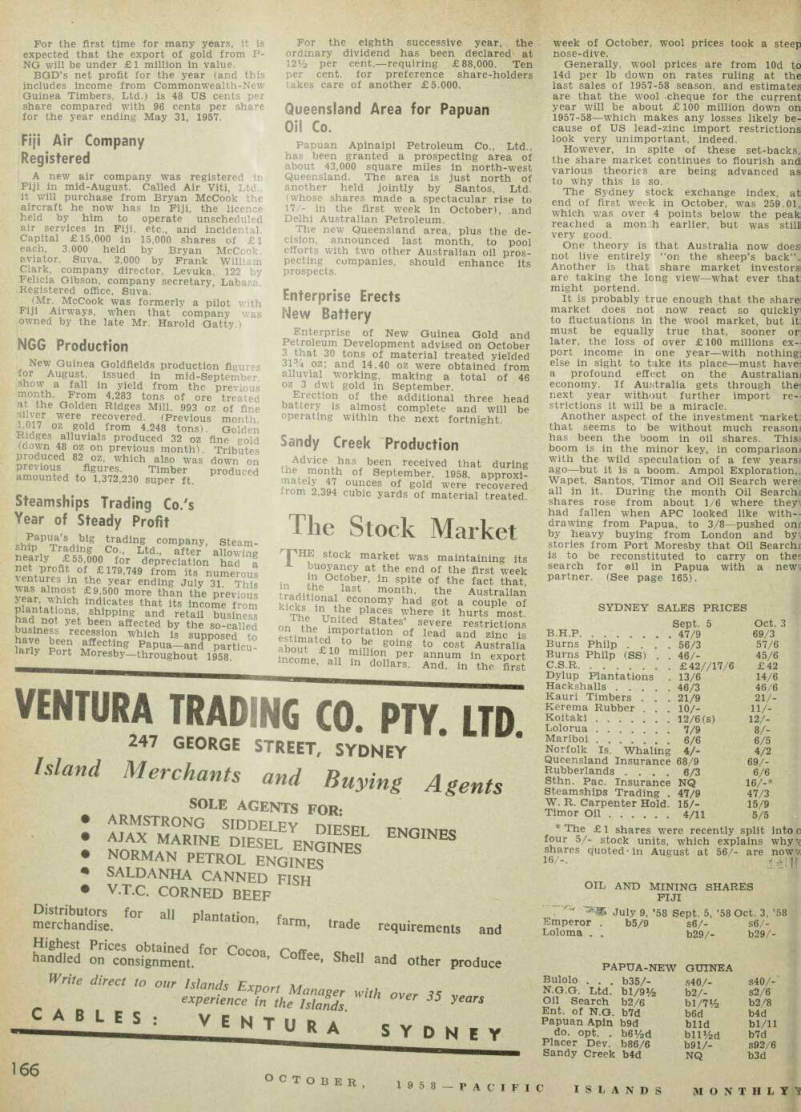
For the first time for many years, it is expected that the export of gold from P NG will be under £1 million in value.
BGD’s net profit for the year (and this includes income from Commonwealth-New Guinea Timbers, Ltd.) is 48 US cents per share compared with 96 cents per share for the year ending May 31, 1957.
Fiji Air Company
Registered
A new air company was registered in Fiji in mid-August. Called Air Viti, Ltd. it will purchase from Bryan McCook the aircraft he now has in Fiji, the licence held by him to operate unscheduled air services in Fiji, etc., and incidental.
Capital £15,000 in 15,000 shares of £1 each, 3,000 held by Bryan McCook, aviator, Suva, 2,000 by Frank William Clark, company director, Levuka, 122 by Felicia Gibson, company secretary, Labarr Registered office, Suva. (Mr. McCook was formerly a pilot with Fiji Airways, when that company was owned by the late Mr. Harold Gatty.)
NGG Production
New Guinea Goldfields production figures for August, issued in mid-September , show a fall in yield from the previous month. From 4,283 tons of ore treated at the Golden Ridges Mill, 993 oz of fine silver were recovered. (Previous month, ° Z „ gol - d , from 4 ’ 248 tons ) • Golden Ridges alluvials produced 32 oz fine gold (aown 48 oz on previous month!. Tributes produced 82 oz, which also was down on previous figures. Timber produced amounted to 1,372,230 super ft.
Steamships Trading Co/s
Year of Steady Profit
-f api^’s b ig trading company, steam ship Trading Co., Ltd., after allowing 55 i°°2J or de had I vp^tnrp c fit i °{v,' £179 ’ 749 from its numerous ventures in the year ending July 31 This was almost £9,500 more than the previous DlantJSS 1 in d. ica tes that its income from had ro v : shipping and retail business had not yet been affected by the so-called hnvi lB^3 recess ion which is supposed to larlv A/r ffeCt l ng p apua—and particu larly Port Moresby— throughout 1958.
For the eighth successive year, the ordinary dividend has been declared at 12% per cent. —requiring £BB,OOO. Ten per cent, for preference share-holders takes care of another £5,000.
Queensland Area for Papuan
Oil Co.
Papuan Apinaipi Petroleum Co., Ltd., has been granted a prospecting area of about 43,000 square miles in north-west Queensland. The area is just north of another held jointly by Santos, Ltd. (whose shares made a spectacular rise to 17 - in the first week in October), and Delhi Australian Petroleum.
The new Queensland area, plus the de cision, announced last month, to pool efforts with two other Australian oil pros pecting companies, should enhance its prospects.
Enterprise Erects
New Battery
Enterprise of New Guinea Gold and Petroleum Development advised on October 3 that 30 tons of material treated yielded 31 4 oz; and 14.40 oz were obtained from alluvial working, making a total of 46 oz 3 dwt gold in September.
Erection of the additional three head battery is almost complete and will be operating within the next fortnight.
Sandy Creek Production
Advice has been received that during “ of Se P tem ber, 1958, approxi mately 47 ounces of gold were recovered from 2,394 cubic yards of material treated.
The Stock Market
'T'HE stock market was maintaining its buoyancy at the end of the first week in iL° COb f’ in spite of the fact that, traditirmoi laSt month ' the Australian }hp C 0 ? omy h t d got a couple of ThP where it hurts most, on *th P ®t ates severe restrictions on the importation of lead and zinc is abo‘S at |V“ ft going “> c ° st Australia income £ «?i per annum In export income, all in dollars. And, in the first
week of October, wool prices took a steep nose-dive.
Generally, wool prices are from lOd to 14d per lb down on rates ruling at the last sales of 1957-58 season, and estimates are that the wool cheque for the current year will be about £lOO million down oni 1957-58—which makes any losses likely be cause of US lead-zinc import restrictions look very unimportant, indeed.
However, in spite of these set-backs,, the share market continues to flourish andl various theories are being advanced as to why this is so.
The Sydney stock exchange index, ati end of first week in October, was 259.01,, which was over 4 points below the peak reached a mon:h earlier, but was stilll very good.
One theory is that Australia now does not live entirely “on the sheep’s back”..
Another is that share market investors are taking the long view—what ever thatJ might portend.
It is probably true enough that the share: market does not now react so quickly: to fluctuations in the wool market, but itJ must be equally true that, sooner or later, the loss of over £lOO millions ex port income in one year—with nothing; else in sight to take its place—must have: a profound effect on the Australiani economy. If Australia gets through the: next year without further import re strictions it will be a miracle.
Another aspect of the investment marketd that seems to be without much reasoni has been the boom in oil shares. This: boom is in the minor key, in comparison! with the wild speculation of a few years: ago—but it is a boom. Ampol Exploration,, Wapet, Santos, Timor and Oil Search were: all in it. During the month Oil Search! shares rose from about 1/6 where they:, had fallen when APC looked like with drawing from Papua, to 3/8 —pushed onr by heavy buying from London and stories from Port Moresby that Oil Search! is to be reconstituted to carry on thes search for ©il in Papua with a newv partner. (See page 165).
* The £ 1 shares were recently split into o four 5/- stock units, which explains shares quoted-in August at 56/- are nowv; 16/-. j*ilf
Sydney Sales Prices
Sept. 5 Oct. 3
B.H.P
47/9 69/3 Burns Philp . . . 56/3 57/6 Burns Philp (SSi . 46/- 45/6
C.S.R
£42//17/6 £42 Dylup Plantations 13/6 14/6 Hackshalls . 46/3 46/6 Kauri Timbers . . . 21/9 21/- Kerema Rubber . . . 10/- 11/- Koitaki 12/6 (S) 12/- Lolorua ... 7/9 8/- Mariboi 6/6 6/5 Norfolk Is. Whaling 4/- 4/2 Queensland Insurance 68/9 69/- Rubberlands ... 6/3 6/6 Sthn. Pac. Insurance NQ 16/-* Steamships Trading . 47/9 47/3 W. R. Carpenter Hold. 15/- 15/9 Timor Oil 4/11 5/5
Oil And Mining Shares
Fiji
July 9. ’58 Sept. 5. ’58 Oct. 3. ’58 Emperor . b5/9 S6/s6/- Loloma . . b29/b29/-
Papua-New
Guinea
Bulolo . . . b35/s40/s40/- N.G.G. Ltd. bl/91/2 b2/s2/6 Oil Search b2/6 bl/7 J /2 b2/8 Ent. of N.G. b7d b6d b4d Papuan Apln b9d blld bl/11 do. opt. . b6Vad bllVad b7d Placer Dev. b86/6 b91/- S92/6 Sandy Creek b4d NQ b3d