Sports Review
p. 155 · Read in the full issue
Some Lively Sport on
Vulcan's Shoulder
From R. W. Robson HAVING seen the Rabaul of late 1937, and the horrible yellow heap of pumice left on the west shore of the harbour and called Mount Vulcan, I was intrigued by the new “Vulcan Racecourse” of the new Rabaul Amateur Turf Club.
The racecourse is constructed on the southwest slope of Mount Vulcan, right alongside the spot where a volcano seethed a bare 20 years ago. It is quite a pleasant place—the hideous volcanic deposit now is completely hidden beneath a light jungle growth.
The men who run this Club and who have re-established the ancient sport (patrons J. T. Allan and Justice Kelly; president M. B.
Foley; vice-presidents N. W. Lee and R. H. Moxham; treasurer G.
White; secretary E. B. Young; Com mitteemen F. Chow, T. Hennessy, L. Croyden, J. B. Sedgers, A.
Richardson; trustees Father Dwyer and W. R. Paul) have done a re markably good job. There is a 5-furlongs race-track, a 2-storey grandstand and a stretch of green lawn.
About a score of more or less competent gallopers have been brought in from South, and are owned and trained by a handful
of planters and traders, and ridden by a small group of eager amateurs.
There were five 5-furlong races on the September programme (which I thoroughly enjoyed) and, to make that programme interesting and diversified, the organisers had to create some interesting combina tions and permutations of the hard worked horses and jockeys. But both bookmakers (a small group, but venturesome) and totalisator provided plenty of liveliness.
In that situation, there was of course, a cool breeze from the southeast. It added its quota to the day’s enjoyment; but what it, plus the immeasurable pumice dust, did to the home going multitude at the conclusion of the day’s sport represents another kind of story.
He’ll Leave It to
The Experts
From Norman Baxter, In Suva FJI to Spain is a far cry, yet this little British Colony in the Pacific has an indirect link with the Spanish national sport— bullfighting.
Oscar Wright, a member of a well known Fiji family, and now living in Majorca in the Mediter ranean, recently adopted the role of matador—or is it toreador?—and has since decided that the game is not for him.
The bulls he used in training were no lightweights. They tipped the scales at 1,500 lbs, about twice as heavy as a young beef steer. When it came to the real thing, in the bull ring, Oscar fortified himself, apart from the usual accoutrements, with a bottle and a half of cognac.
He thrilled the crowd in his first fight, so much so that they gave him one of the bull’s ears. Second time up he had a tougher bull, which forced Oscar to retire, the rear of his trousers missing, and otherwise half naked.
A real champion slaughtered the bull for Oscar, but the Fiji man had so won the hearts of the crowd that he got another ear. So with out his trousers, but with his trophies, Oscar has decided to retire
from bullfighting
No Bare-fisted
Fight for Lave
KITIONE LAVE, the Tongan heavyweight boxer, and an Englishman Hugh Burton, preparing to engage in a fight-to the-finish bare-fisted contest at Doncaster, Yorkshire, were brought before a UK court in mid-September and warned that what they pro posed to do was illegal.
They were each bound over for one month for a sum of £5OO, forfeitable if they committed a breach of the peace by engaging in the contest.
The magistrate pointed out that a prize fight was totally different to a properly conducted boxing contest. Later, the British Boxing Board of Control suspended Lave for six months for planning to take part in an unlicensed bout.
The Game is
The Thing
THE Polynesians took to cricket from the beginning. Tonga, probably first of the islands to see it, became so attached to the game in the early days that it threatened to become an economic danger, as the players neglected their plantations to take to the cricket field. Nor was it eleven a side then —but often as many at 70.
So it was merely a matter of turning back the Polynesian clock when in September, A t a f u Islanders, in the Tokelaus, north of Samoa, got stuck into a real cricket match —of three teams, 40 a side.
The game was part of three-day centenary celebrations of the LMS Church at Atafu Among the players were some visitors—New Zealand and British astronomers at the atoll awaiting the October solar eclipse.
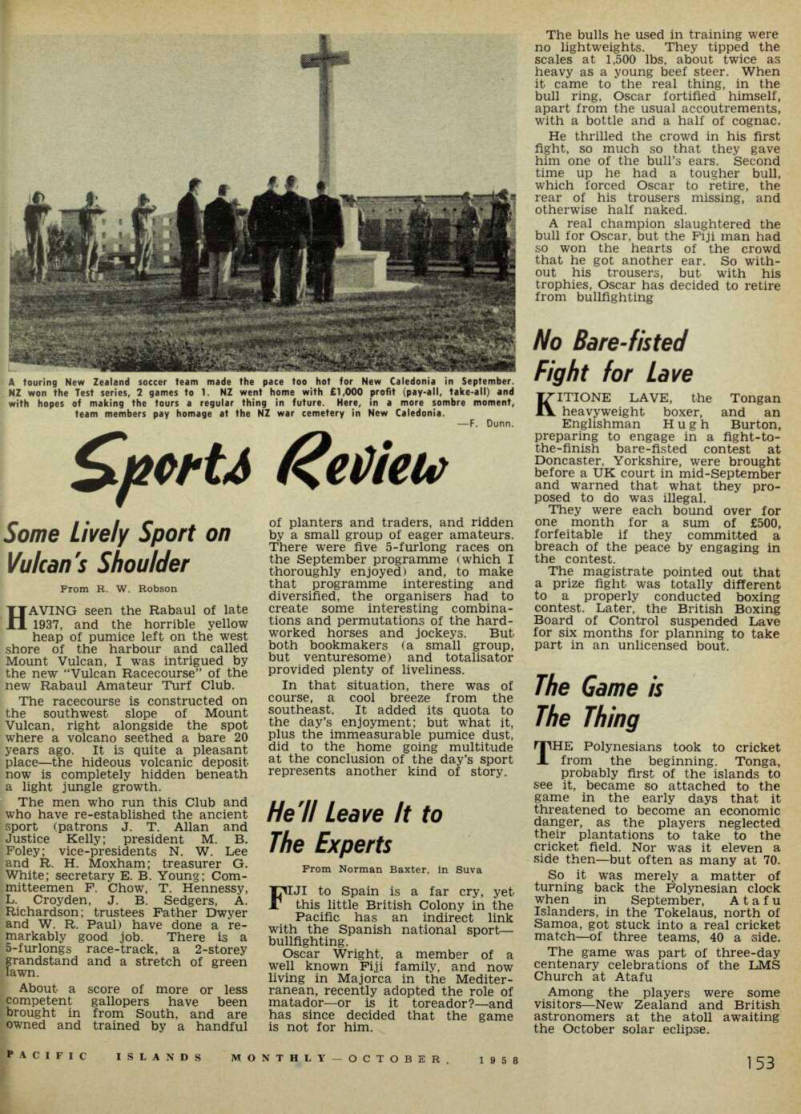
A touring New Zealand soccer team made the pace too hot for New Caledonia in September.
NZ won the Test series, 2 games to 1. NZ went home with £1,OOO profit (pay-all, take-all) and with hopes of making the tours a regular thing in future. Here, in a more sombre moment, team members pay homage at the NZ war cemetery in New Caledonia.
F. Dunn.