Virtually Disappeared
p. 89 · Read in the full issue
The Papuan Lakatoi Has Virtually Disappeared
By William Gasson, AAP-Reuter Correspondent in Port Moresby.
The crab claw like sails of the Papuan lakatois are a sight rarely seen along the coast of Papua.
At one time fleets of these three lulled craft—“Toi” means three — [sed to play up and down the coast nth the seasonal trade winds, arrying clay pots to be traded nth natives from the Gulf area or sago.
With the increasing services of team trading vessels, the huge akatois gradually faded from oastal waters.
Nowadays the two-hulled craft hat continue sailing along the oast are commonly referred to as akatois instead of their proper lame, pua puas.
The lakatois, which were a amiliar sight in Port Moresby larbour during the 1920’s and 930’s, are seen by most people hese days only in the design of the ./- postal stamp of P-NG.
For many Europeans in Port Moresby, the last genuine lakatoi een in these waters was during he visit of the Duke of Edinburgh n 1956, when two canoes were specially made for the occasion.
The lakatois’ smaller brother, the ?ua pua, is a graceful looking
craft under full sail. Papuans along the coast bring produce into Koki, Port Moresby, to trade with the town natives every week.
Their white squares of sail make a beautiful sight against the blue of the sky and sea as, in threes or fours, they come over the horizon heading for Koki.
In Koki, the natives live on their canoes and cook their meals from fires kindled on board. The sails are draped over the boat to pro vide shade from the sun and shelter at night.
One of the most romantic scenes around Port Moresby is to see on a moonlight night the cocoon-like sail-shrouded shapes of the pua puas riding at anchor, with their fires gleaming red while the sil houetted palm trees complete the picture of the imaginary tropical paradise.
But while the pua puas look clean lined and graceful at sea with their sails gleaming in the sunlight, huddled together at Koki during the day they present a disappoint
ingly miserable picture of a slum on the sea.
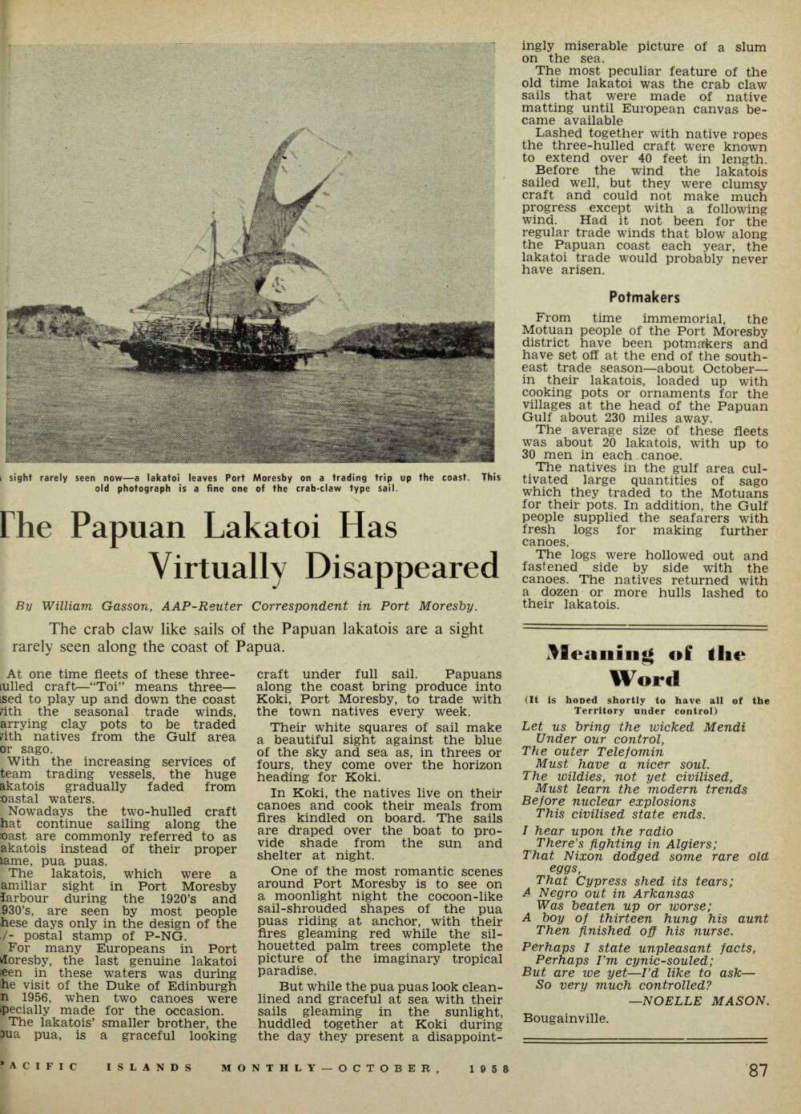
The most peculiar feature of the old time lakatoi was the crab claw sails that were made of native matting until European canvas be came available Lashed together with native ropes the three-hulled craft were known to extend over 40 feet in length.
Before the wind the lakatois sailed well, but they were clumsy craft and could not make much progress except with a following wind. Had it not been for the regular trade winds that blow along the Papuan coast each year, the lakatoi trade would probably never have arisen.
Potmakers
From time immemorial, the Motuan people of the Port Moresby district have been potmarkers and have set off at the end of the south east trade season—about October— in their lakatois, loaded up with cooking pots or ornaments for the villages at the head of the Papuan Gulf about 230 miles away.
The average size of these fleets was about 20 lakatois, with up to 30 men in each canoe.
The natives in the gulf area cul tivated large quantities of sago which they traded to the Motuans for their pots. In addition, the Gulf people supplied the seafarers with fresh logs for making further canoes.
The logs were hollowed out and fastened side by side with the canoes. The natives returned with a dozen or more hulls lashed to their lakatois.
sight rarely seen now—a lakatoi leaves Port Moresby on a trading trip up the coast. This old photograph is a fine one of the crab-claw type sail.