He Started The Niue Basket Trade—
pp. 85-88 · Read in the full issue
The Problems of Dr. William Lawes
He Started The Niue Basket Trade— And He Was Moresby’s First Citizen
An address in Lawes Road, Port Moresby, is quite a good thing to have; it is one of the longest and highest roads in the town and it crosses completely the neck of Paga Point from Ela Beach to the Konedobu side.
Probably the majority of the people who live in the road know that it was named for Papua's first European resident, the Rev. Dr.
William George Lawes, but few present Moresby dwellers know much about this man who, in his time and with reason, was a famous figure in Australia and his native England for what he accomplished in British New Guinea —today Papua —not only as a missionary, but as a pioneer.
In the earliest days he and his wife WERE Port Moresby —or all of the European population of it.
Only the very oldest old-timer could remember Lawes in Papua; he left the Territory in 1906. He settled in Sydney and 18 months later died of pneumonia, in his 70th year. He was survived by his wife and two sons, Dr. Charles and Fred.
Fred had two children but they died young. Charles had four sons — Dr. Frank, Dr. Charles, Dr. Allan (all now in practice in Sydney), John (an executive of W. D. & H. O.
Wills), and a daughter Marjory, now Mrs. McKenzie, of St. Ives.
Mrs. McKenzie is the custodian of many of the books and papers of her grandfather and it is from these that many of these notes are taken. £3,000 a Year in Niue Hats FOR Lawes, 1860 was a big year in his life: He came of age, married, was ordained and sailed from England for the South Seas in John William 11.
Although associated with Papua (where there is a college named for him, a monument to his memory and, of course, Lawes Road), his first missionary efforts were for the natives of Savage Island, which to day we call by the less fearsome name of Niue.
The Lawes couple landed there in 1861 —after a voyage of about nine months. Less than 10 years before it had been described by another missionary as “in much the same barbarous state as Cook found it”. Lawes worked there until 1872.
As soon as he arrived he set about learning the language and translat ing the scriptures into Niuean —the work of printing them being hampered at first by the fact that they had only one mail a year.
He overcame this in typical Lawes fashion—as he did later in Papua—
and became his own printer. When stuck for type he carved the wooden letters with a knife.
Lawes ministered to more than the spiritual needs of the Niueans.
The tourist who today buys a Niue fine hat, or a basket, has Lawes to thank for the beginning of the now famous plaited-ware industry. After he had left Niue, Lawes wrote: “The people, when we first knew them, imported nothing and ex ported nothing. One woman had a cotton dress; and a very few men had cotton waist-cloths. When we left the whole population was decently, and in some cases, grandly clothed. . . . The traders have in creased to seven; the imports last year were £B,OOO and exports £7,651.
One of the teachers’ wives who went to Tokelau learned from the women
(he named both for his father, Admiral Sir Fairfax Moresby). This fact was fortuitous for the London Missionary Society, which had re ceived a set-back in its advance on New Guinea, in that the first at tempt to establish a station (with Polynesian missionaries) on the mainland at Redscar Bay had failed because of the unhealthy location.
Moresby seemed to offer better prospects.
In 1872, Mr. and Mrs. Lawes left Niue for furlough in England and when they returned it was to Papua.
They sailed from England in April, 1874, but it was the end of that year before they were ashore in Moresby, where Mrs. Lawes and her small son, Charley, greatly excited the natives.
They had never seen their like be fore and the small house was crowded all day by curious Hanua badans and others. “Fortunately”, recorded Lawes, “the natives are afraid of the dark, so we can reckon on a little peace then,”
Lawes was soon recording other impressions of his new parishioners.
“So far as our lives are concerned, we feel tolerably safe; but we shall most likely lose all we possess for all the people are inveterate and incorrigible thieves and beggars.”
And a little later: “All are still heathen. . . The teachers have not been able to teach any one the letters of the alphabet. The children
there how to make hats This in dustry has so developed that it now represents £3,000 a year. Niue is one striking instance where the Gospel did not ‘reduce the people to idle ness.’ ”
They Felt "Tolerably Safe' 7 "
In February, 1873, Captain Moresby discovered what we now know as Port Moresby and Fairfax Harbour
want to be paid for every letter they learn.”
The natives were probably not original in thinking that they should be paid for listening to sermons; they were just more candid about it.
“Well, we’ve listened,” they would say. “When do we eat?” When there was no food forthcoming, they stopped going to church.
On the first day ashore, a posi tion was picked for the mission
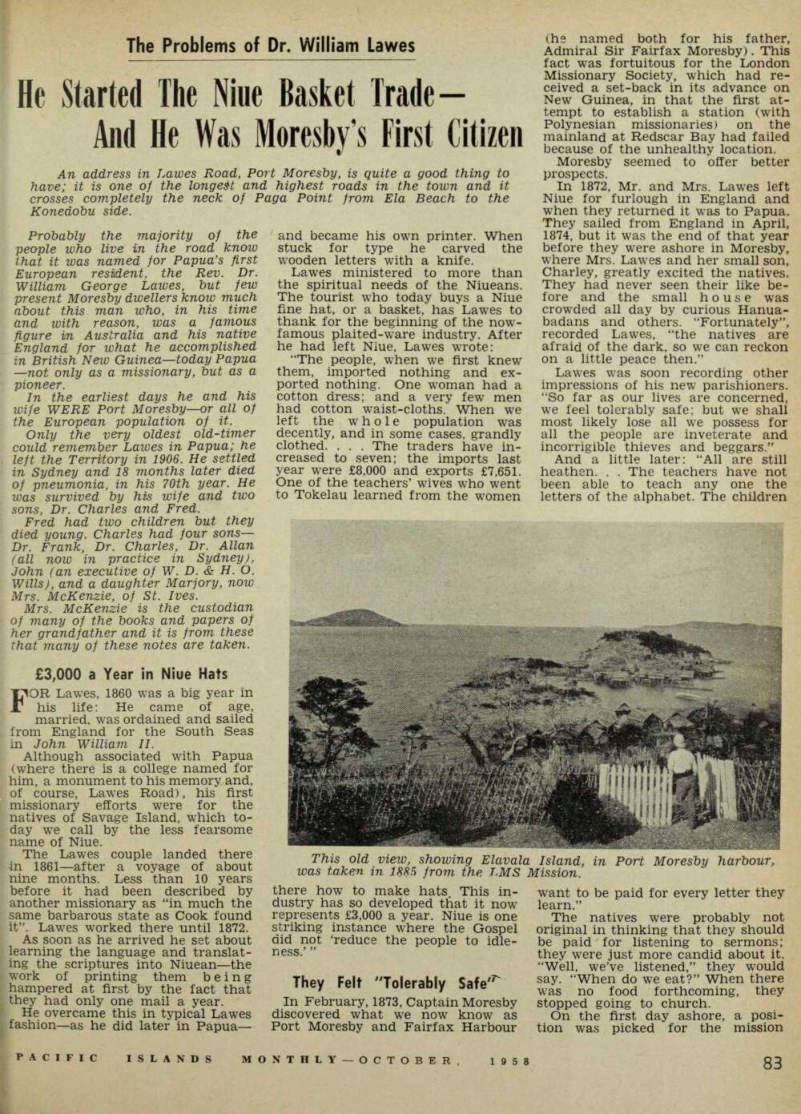
This old view, showing Elavala Island, in Port Moresby harbour, was taken in 1885 from the LMS Mission.
house—“A more beautiful spot would be difficult to find in any P&rt of the world.” It lay between the villages of Hanuabada and Elavala, near the sea on a ridge of land that “rises to an elevation of 110 to 113 feet. At each end is a little hill, and behind all around are hills and valleys of various shapes and sizes.
House that Jack Built
First there was a tent; then the crews from the mission ships John Williams and Ellangowan erected m short order, “the first house of foreign design.” As it was built by sailors it was known for years as The House that Jack Built.
Lawes himself referred to it as our shanty.”
By the second year of residence, it seemed that the missionaries had not improved matters by moving to Moresby. First there was the matter of food; and, more important, there was the prevalence of malaria, which for awhile seemed as though it would wreck the whole plan.
Both Captain Moresby and the missionaries first saw Port Moresbv m the wet season, when that usuallv dry area is green and lush y The ? rst a PP ear ance of the place ailed to prepare the mission party food tho nn a H Ct would grow little food, and that even the natives imported their staple food from the sago swamps of the Papuan GulL The Lawes, accustomed to the found
Sealed "the°i?
nn??f«!L fro “ London in late 1875, one of the mission directors with a wit unusual in Victorian church men said: “What a terHble place
you have got yourself into. Nothing to eat, and certainly (judging from photographs) nothing to wear!”
Lawes was urged to change his head quarters to Yule Island and not to spend another wet season in ‘‘that sickly corner”.
The move was not made, and later Roman Catholic missionaries estab lished themselves on Yule. In those days, the connection between mos quitoes and “fever and ague” was not known; it is unlikely, of course, that a move to Yule would have benefited the missionaries’ health.
The Flag Thrice Hoisted
It was probably conversations be tween Sir Arthur Gordon (Governor of Fiji from 1875) and Lawes, that led to the annexation of what is now Papua. When the Lawes family returned to Port Moresby after furlough in 1881, they found them selves with a box seat at the political performances that occupied the years to the end of 1884.
When Sir Thomas Mcllwraith jumped the gun in April, 1883, by sending Mr. H M. Chester to Moresby to hoist the flag, it was the mission flag-pole that was used and Lawes translated the proclamation and led the prayer in Motuan. Eight Europeans then sat down to an official dinner at the Mission House.
But it did no good; the whole thing was repudiated—for the time Late in 1884, acting on a cable from Lord Derby that a Pro tectorate was to be proclaimed, Mr.
Romilly arrived from Cooktown, and again with the help of Mr. Lawes
and the mission flag pole (for there was, of course, no other in Moresby) hoisted the flag. But even this was not the end.
On November 22, Commodore Erskine sailed in on HMS Nelson, with instructions to proclaim the Protectorate and do the hoisting.
Discounting Mr. Romillys efforts, he proceeded—assisted, of course, by Mr. Lawes and the mission flag-pole!
Moresby Town Planned
In 1890, George Lawes and James Chalmers, of the LMS, entered into a covenant with the Rev. George Brown, of the Methodist Mission, and the Rev. Albert Maclaren, of the Anglican—the latter two just newly arrived in Moresby for spheres of mission influence.
The Anglicans were to operate in the north-east district; the Methodists in the Louisiade an dl D’entrecasteaux groups; and the LMS, in all the south coast exclud ing the portion taken up by the Society of the Sacred Heart (which had settled into Yule Island some years before.) Also in that year, Lawes had built at Port Moresby, the first church for.
English residents.
“A town was gradually being de veloped around the Government] Offices, to which the name of Gran ville West had been given; and int a prominent and central position, on land leased to the LMS, a neat] wooden structure was erected.”
Old maps of Port Moresby show, that the town planners were busy\ early and had laid out streets inr
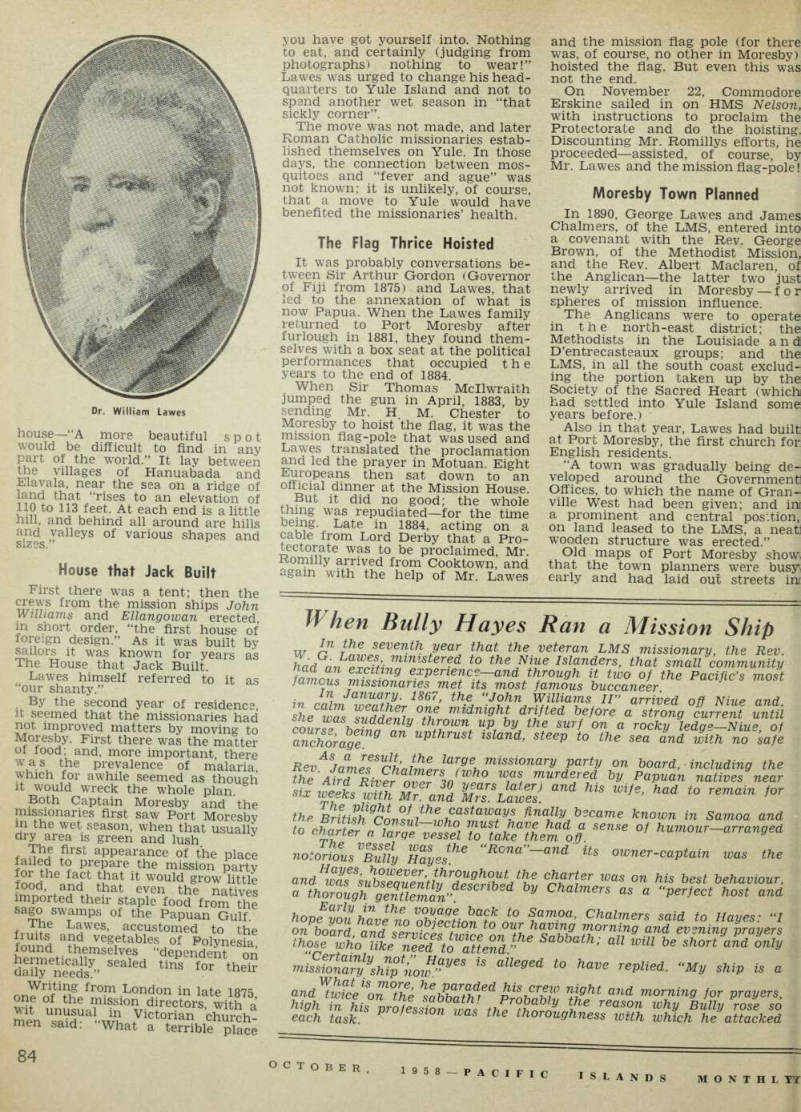
Dr. William Lawes
two sections, one labelled Granville West and the other Granville East.
Granville West included Ela Beach, and the town on the saddle between Paga Hill and Tuagura; and Gran ville East—an extensive area of planned streets—from about the present Newtown, or eastern end of Lawes Road, to the present govern ment offices at Konedobu.
Why these areas were called Granville we do not know; the only Granville mentioned in those early days was a Dr. Granville, who accompanied Sir Peter Scratchley, the first administrator, to Port Moresby, in 1884. He does not seem to have distinguished himself; but at all events neither of these areas is now know as Granville.
In 1894, the Lawes left Port Moresby and for the rest of their life in Papua they were at Vatorata, a few miles inland from Kapakapa, in the Rigo area. Here Lawes de voted most of his energies to train ing native teachers and to his trans lation work. It was in these years he enjoyed the friendship of Sir William Macgregor, first Adminis trator after the proclamation of British sovereignty in 1888 (previ ously it had been a Protectorate and in 1906 it became an Australian Territory).
It was Sir William who was in strumental in having the honorary degree of Doctor of Divinity con fer re d on Lawes by Glasgow University; and it was Macgregor who gave to Lawes a special inter leaved Greek Testament to help in his translation work. (This Testa ment is now in the possession of Mrs.
McKenzie).
Now Part of History Lawes lived in the great missionary age when a missionary was more than a saver of souls. He was, as well, an administrator, a bringer of the law, an explorer; he was a teacher and a healer of the sick; he introduced industries and brought the first glimmering of civilisation to the benighted; he influenced politics and was recognised as an authority on his particular territory.
Lawes was, of course, all these things. But in many respects he was a man ahead of his time. In all his dealings with the natives he exercised sound common sense and was not led astray by many of the visions of latter day workers in the Lord’s Vineyard. He did not see his rcharges as Fuzzy-Wuzzy Angels. He expected little, and when he got it, was not set back.
It is impossible, of course, to think of Dr. Lawes work apart from that of his wife. A lady of “unquenchable cheerfulness, strenuous activity and sound common sense” was how Sir William Macgregor saw her—a skilful housekeeper, devoted wife and affectionate and sensible mother whose home, to the natives, was an object lesson of a happy family life.
(Continued over the page)
The pioneering days in Papua have long since past. Moresby residents whizz out to the Laloki River and up to Sogeri in their high-powered cars, not remembering that when Lawes went that way 80 or more years ago, it was an ex pedition almost comparable with the efforts of Dr. Livingstone in Darkest Africa.
"Thieves and Beggars"
Mrs. Moresby Housewife, when she backs her car out into paved Lawes Road, and drives down into Ela Beach to pick up Junior at the Pre-School Centre, does not re member that it was no bad thing that the task of first living among the “inveterate thieves and beggars” of Port Moresby was entrusted to a couple with the stature of Dr. and Mrs. Lawes.
Prophets without honour? No.
Dr. Lawes and his wife were greatly honoured in their lifetime.
They now have passed into history.
The fact that it is sometimes for gotten history really matters little: It is all down in the records.