Fiji Talanoa
pp. 39-43 · Read in the full issue
Vakatawa Talks
Of This And That
The Third Fiji Hibiscus Festival in September was damped by the polio outbreak that has extended over two months now, and the marked shortage of money for entertainment. But although the festival did not produce a riotous spirit of carnival, it was a successful affair nevertheless.
BIG crowds turned out for nearly every event and one or two new features —a searchlight tattoo by the combined forces, for instance — were particularly popular.
Fiji had its first experience of the marching girls cult that has gained such a hold in New Zealand. The disciplined, intricate manoeuvres of the Sargettes, a team from Welling i ton, were certainly impressive.
The festival suffered somewhat from following so closely after a similar affair, Hospital Week, staged for the first time this year in aid of the Colonial War Memorial Hos pital in Suva.
In these things the burden of work falls often on the same people and !it is doubtful whether a town of the size of Suva can sustain two major carnivals a year.
It is even more doubtful whether it should.
The Hibiscus Festival might, with benefit, be held in alternative years at Lautoka, and the spectacle—and the effort—spread.
The Bula Shirt
Goes Respectable
The Hibiscus Festivals have done one thing, if nothing else; They have conferred a status of respectability in Fiji on the bula shirt, which any where else would probably be called a beach shirt.
The request during the first festival, two years ago, that bula shirts should be worn to work, was greeted in elevated circles with the sort of shocked disapproval that would be given the idea of a black tie with tails—and a ready-made tie at that.
But the appearance of the Gov ernor and Lady Garvey in brightly coloured “bula” garb during that festival, and the somewhat self conscious wearing of gay shirts
(usually borrowed from the office boy) by senior government officers, began to break down resistance.
Last year, the custom had become more established and even very senior gentlemen—though not the princes of commerce or banking or law—appeared in their offices in
their own bright bula shirts, with determined nonchalance.
This year, all the marks of time hallowed custom were present.
In some offices, a standard uni form was adopted, bula shirts being specially ordered to a common pat tern. There was even talk of, “Why don’t we do this more often?”
There is no doubt that the rise of the bula shirt in popularity (and respectability) is due largely to the great improvement in the shirts themselves.
There was a time when those on sale in Suva shops were cheap rayon articles imported from Hongkong or Japan, with crude designs and odd spelling.
Now, good fabrics of attractive de sign are being used, and to an in creasing extent the shirts are being made in Fiji. (Over)
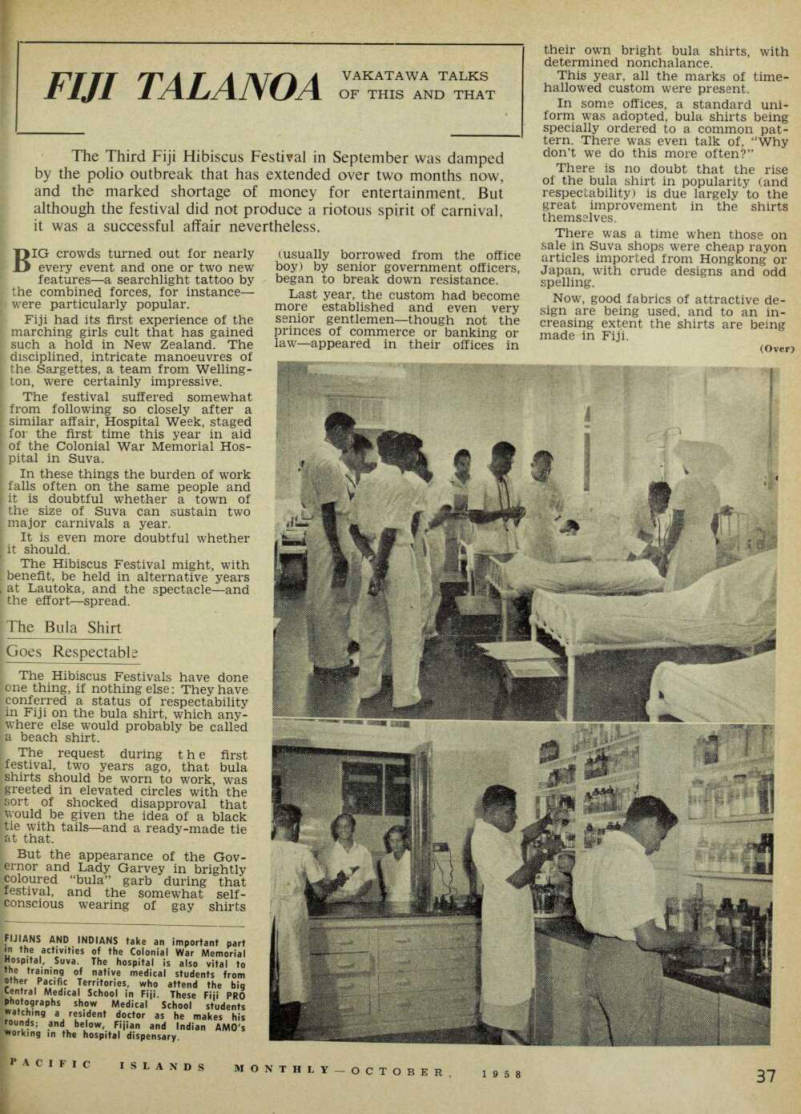
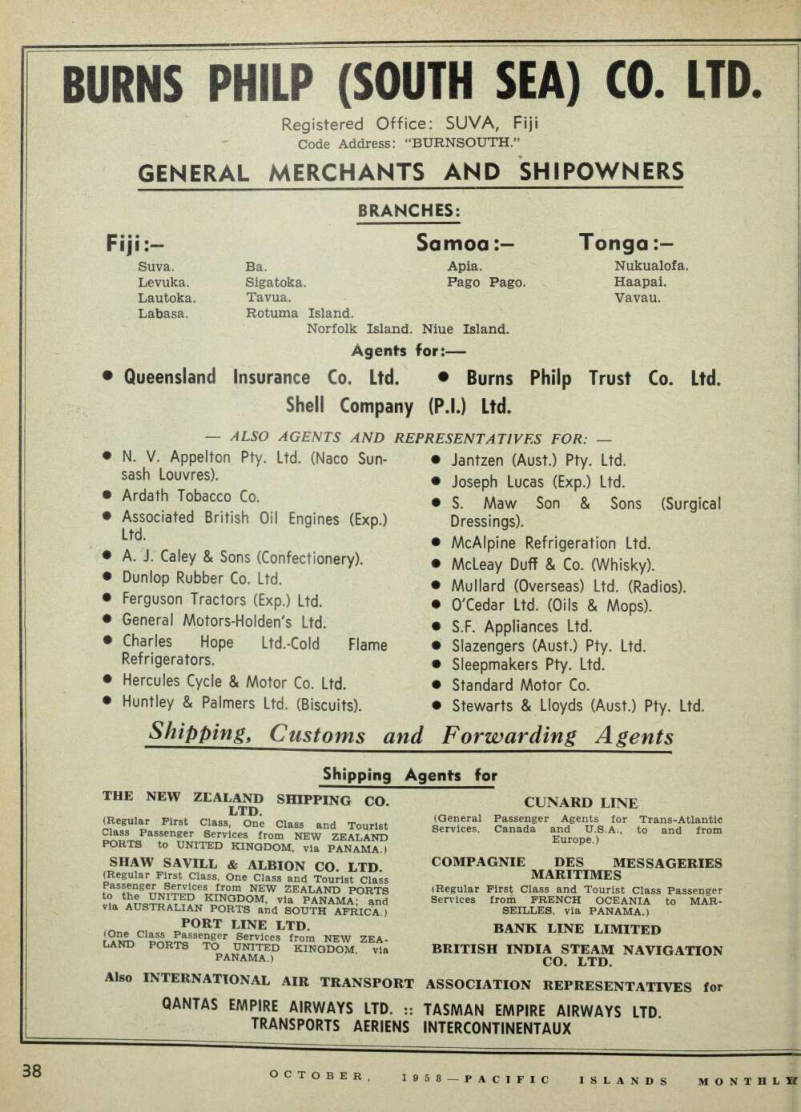
FIJIANS AND INDIANS take an important part in the activities of the Colonial War Memorial Hospital, Suva. The hospital is also vital to the training of native medical students from other Pacific Territories, who attend the big Central Medical School in Fiji. These Fiji PRO Photographs show Medical School students watching a resident doctor as he makes his rounds; and below, Fijian and Indian AMO's working in the hospital dispensary.
Need for Mokogai
May Soon be Over The prediction by Dr. P. W. Dill rßussell, Inspector-General of the South Pacific Health Service, that the Fiji Leprosy Hospital at Makogai will not be needed in another 15 years, shows how rapidly leprosy is declining as a public health problem in the South Pacific. The horror of the disease which has come down from Biblical and knedieval days still remains in many jminds, although, in the past ten years, much of the justification for that fear has faded.
I There was a time when the only possible response to leprosy was isolation. This was the time of the bell and the cry “Unclean”. It was :the time, too, of Father Damien and stories of martyrs who risked cer tain infection and eventual death by working among lepers. [ When Makogai was established as a clearing house for lepers of the 'South Pacific there was still a good deal of hit and miss about methods of treatment. Many cases were dis covered late and there was no pos sible hope of recovery. One of the wards at Makogai was appropri ately named the “moribund ward”.
I Then the chaulmoogra oil treat ment was discovered but frequently pig injections of the oil were painful, [and they brought improvement in (only a proportion of cases. [ In the chaulmoogra oil days, medical men would not use the word
fcure”.
[ “Arrested” was as far as they would go, although many discharged patients showed no signs of recur rence of the disease, and lived happy, liseful lives in the outside world.
I The situation was dramatically [changed ten years or so ago when (the sulphone drugs were discovered. [ Almost immediately, treated patients began to improve. External fleers disappeared and no others [developed. It was evident that the pealing process was going on [throughout the body, i General health improved and, tentatively at first and then with more confidence, the doctors began to speak of “cures”. It is one of the lesser publicised dramas of modern medicine. f These changes in treatment, the greater certainty of cure, early de jection of cases because of improved medical services, population in creases and political development are all working together to reduce the importance of Makogai as the central leprosy hospital for the South Pacific.
The Solomons have their own hospital system and the Gilbert and Ellice Islands colony is to follow suit. t So, as Dr. Dill-Russell says, an institution of world-wide reputa tion is likely to become unnecessary and to close not so long hence.
Lolohea’s Success
in Japan
The unshakable dignity with which older Fijians comport them selves, even in unusual circum stances, is familiar to all who have had experience among them.
So it was no surprise to find that Lolohea Waqawairi was a great suc cess at the Pan Pacific and Asian Women’s conference in Atekio, Japan, recently. She is a woman of much character and has long been a leader among her own people.
For many years her husband, Timoci, was headmaster of the Fijian District School at Vunidawa, and Lolohea was infant mistress.
Between them they ran a modern school, with a first-class spirit among the pupils.
Freedom of Speech
in Black Man’s Hell
Fiji readers of Time magazine read with astonishment in the Sep
tember 22 issue, a letter describing Fiji as a “white man’s paradise and a black man’s hell”.
The writer of it has been obtain ing some determined self publicity by similar effusions in Fiji.
He is a Fijian who first drew at tention to himself by turning Muslim.
Then he began to write inflam matory documents in which he de clared that the Fijians’ only hope for the future lay in Communism, and that he himself would like to go to Russia or China or Egypt to live.
He was at this time a civil servant.
His fate if he had written the same sort of stuff in reverse, while a Russian civil servant, is obvious.
But one of his bitterest complaints about his Motherland is that there is no freedom of speech!
Recession Hits
Copra Areas
Two of the bigger inter-island trading vessels in Fiji, the Ai
Sokula and the Komaiwai have been laid up in Suva for lack of cargoes.
The Fiji copra industry is feeling the effects of a long drought and of the hurricane which swept through Lau earlier this year.
As a result of the prolonged dry weather the nuts are not falling and in some cases they are said to bo sprouting on the tree.
Unfortunately, the effect is likely to last into next season as well, and copra planters’ fingers are crossed particularly hard in the hopes that this year will bring no hurricane.
It is bad luck that production is so low at present, because prices are high. In September, the weekly price offered by Island Industries Ltd., the principal Suva millers, for hot air-dried copra climbed to over IF6O a ton.
And Disquieting Signs
on Economic Front There are other disquieting signs on Fiji’s economic horizon. Drought in some of the main sugar areas, particularly in Ba and Rakiraki, will reduce this year’s crop and probably next year’s as well.
The banana industry is still wobbling after the blows delivered by New Zealand early this year.
New gold bearing areas have been found at Vatukoula, but they are deeper, and so more costly to mine than before.
Manganese prospects are opening up and production ought to increase steadily, but the American recession and the halt in stock-piling of minerals has pushed the manganese price down.
There is much talk of unemploy ment in the Colony generally, but there is no machinery for calculat ing the number of unemployed with any degree of certainty.
Meanwhile, the population—especi ally of the Indian community— continues to grow, and the heralded Commission on Population and Re sources is apparently still coming into leisurely being in the deepest recesses of an indifferent Colonial Office.