It’s ‘Unservicable'—or
pp. 25-151 · Read in the full issue
Two Points of View on Noumea's Airport
It’s ‘Unservicable'—or Perhaps it’s ‘Just Perfect’
Those immediately affected by
the surprise Qantas announce ment that its Sydney-Noumea ser vice would be suspended from end of September, were the delegates to the South Pacific Commission’s 18th session which commenced on September 26, and was expected to last for several weeks.
Delegates who normally go home via Sydney will have to go by ship, or through Brisbane by the French airline, Transports Aeriens Intercontinentaux.
Reason for the suspension of the Qantas service—which is expected to apply for at least two months —is stated to be due to the stage reached in reconstruction of Tontouta, Noumea’s international airport, about 30 miles out of the town.
The Australian Department of Civil Aviation has pronounced the
runway unserviceable, which, as far as Qantas is concerned, is the last word. Although the Australian DCA has no jurisdiction over foreign airfields, it can prevent Australian airlines from using them, and in the case of Tontouta, it has exercised its prerogative.
It will be remembered that, some years ago, when Qantas changed over from flying-boats to land planes on its Islands seryices, the airstrips in the New Hebrides were pronounced unsafe by Australian DCA. Qantas stopped flying to the New Hebrides, and has never gone back.
After a break of a year or so, TAI commenced a service between Tontouta and Vila and Santo, with DC3 planes.
Tontouta is "Perfect"
A spokesman for TAI, in Sydney, on October 2, said that the whole thing was incomphehensible. So far as TAI was concerned, Tontouta was “just perfect”.
TAI was using DC3’s and DC6B’s —which are much bigger than Qantas’ Skymasters without any trouble at all, and would continue to use them. The only construction work that was going on was the lengthening of a runway, which “didn’t interfere with operations in the least”.
Airline patrons who are incon venienced by this sudden suspension of the Qantas service, will have to
(Continued on page 149)
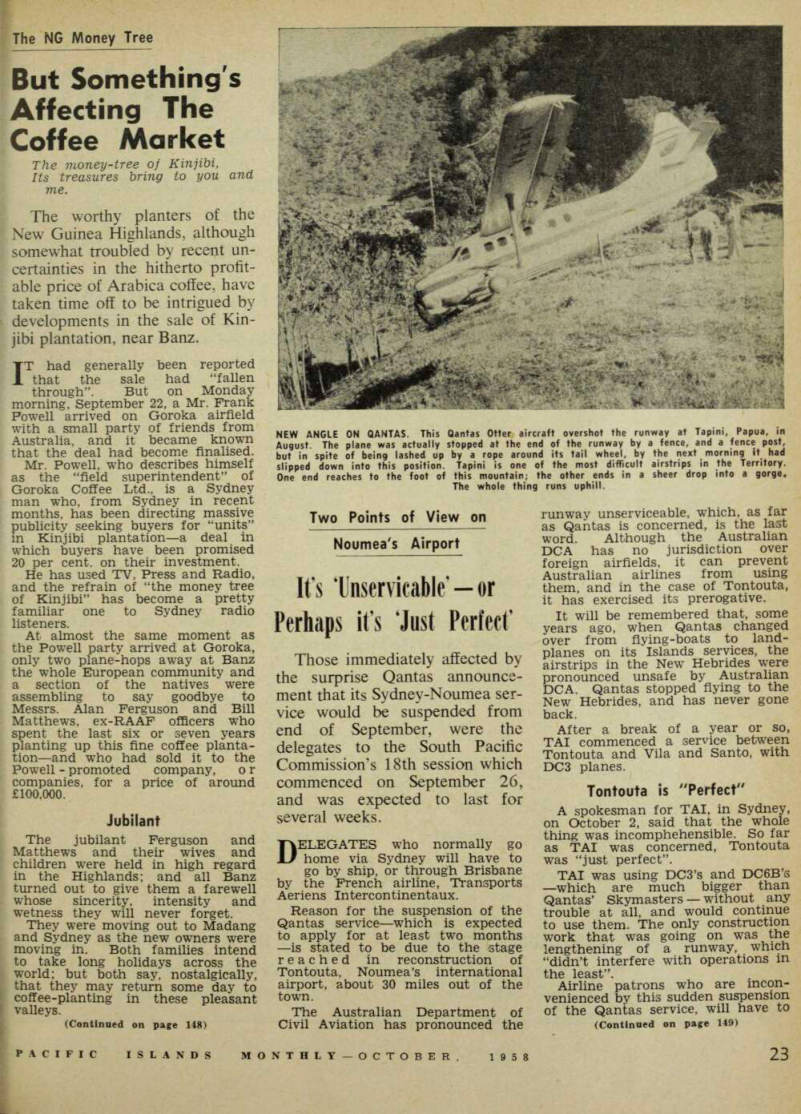
NEW ANGLE ON QANTAS. This Qantas Otter aircraft overshot the runway at Tapini, Papua, in August. The plane was actually stopped at the end of the runway by a fence, and a fence post, but in spite of being lashed up by a rope around its tail wheel, by the next morning it had slipped down into this position. Tapini is one of the most difficult airstrips in the Territory.
One end reaches to the foot of this mountain; the other ends in a sheer drop into a gorge.
The whole thing runs uphill.
weigh the extraordinary good safety record that Australian airlines have certainly had (others have a good record, too, of course) against what sometimes seems the unncessary officiousness of the Australian DCA, and arrive at an individual answer.
A report from PlM’s Ntmmea correspondent states that it is the abruptness of the shoulders of the airstrip that are at fault the danger lying in the fact that, in the unlikely event of a plane run ning off the strip, it would cause it to tip.
New Caledonians, he says, find it hard to understand why Australia has stopped its planes from using the strip when the French authorities find it fit to use for DC6 and DC7 aircraft. Just before the ban, both Qantas and PA A were using big planes at Tontouta, during the fuel trouble at Nadi.
Who Mixed that Gas?
This occurred at Nadi in late September.
For over a week the airport was without the high octane aviation fuel needed by Super Constellations and Pan-Am.’s new DC7-C’s, be cause, on the way to Piii, a tanker load of aviation gas had become contaminated with motor spirit.
The difficulty was expected to be overcome by October 2, when a tanker of the right fuel was due at Nadi.
The companies concerned got over the difficulty in various ways.
On northbound flights, Qantas took on enough fuel in Sydney to fly to Canton with a stop at Nadi; south bound, they stopped at Nadi and then went to Tontouta to refuel for the last hop to Sydney.
Both Qantas and PAA used freighters to fly aviation fuel to Nadi.
Hitch to TAI Services In October, Transports Aeriens Intercontinentaux were using a local surface vessel and a Catalina flying-boat for the Bora Bora- Papeete stage of their new New Caledonia-Papeete air service. These temporary arrangements had to be made when the Bermuda flying boat, which was to provide the 130 mile link, and which was recently purchased from Sir Gordon Taylor, became unserviceable.
This temporary set-back to TAl’s new service is expected to be of short duration.
Apart from the increased mail and passenger connections provided between French Polynesia and the outside world, TAl’s introduction of a tourist class service has had the highly satisfactory effect of en couraging TEAL to adopt a similar
passenger facility, not only for through bookings from Fiji to Tahiti but for all intermediate sectors of its Corial Route service.
The TEAL Solent, recently in Auckland for a major overhaul, has had the two front cabins on the lower passenger deck converted to tourist class by removing the tables between the seating and re-arranging the latter to seat 14 instead of the previous 12.
This leaves seating in the aircraft for 28 first class passengers.
The introduction of tourist class seems likely to raise some technical problems in the matter of seating, however, as it is anticipated that there will be heavy tourist class bookings on the Fiji-Samoa-Fiji shuttle service, where a great part
of the custom is from low-income bracket clients, while the majority of customers on the Piji-Tahiti bookings are first class travellers.
Alteration of seating in a Solent is not quite as simple as in the more modern land-planes which have been designed with this sort of problem in view, For one thing, the Solent is divided up into small compart ments by permanent bulk-heads which are a safety feature in case of hull fracture when on the water.
These bulk-heads restrict spacing adjustment of seats, etc. Other problems are also involved. How ever these will no doubt be ironed out by TEAL once it is seen just what the demand for tourist class seating is.