Australia’s Education Record In
pp. 24-149 · Read in the full issue
Been at it for 30 Years, Yet—
Australia’s Education Record In New Guinea Is Pitiful
The biggest single problem in Pacific Islands Administra tion, and a damning reproach upon Australia’s Islands record, is the continuing mass illiteracy among the natives of Papua and New Guinea.
AUSTRALIA has been there, in full panoply, since 1921.
Since 1945, she has spent nearly £100,000,000 on the country— £7o,ooo,ooo of it being Australian grants.
As a result, we have a very large —and very efficient—public service; innumerable public works; a credit able medical service; a very
prosperous trading community—and, among 1,700,000 natives, the merest sprinkling who can understand— much less speak—simple English.
Australia is not in P-NG because she loves Papuans and/or New Guineans, or has any hunger for colonialism.
She is there because, with 1,200 millions of Asians looming on her northwest horizon, her future as a South Pacific nation is insecure, and it is considered better that she should occupy this barrier of islands, and try to make a united nation out of the mass of disunited primitives (who speak 510 separate languages) rather than that the generally empty islands should be taken and held by the thrusting,
land-hungry Asians.
So she has given certain guarantees to the United Nations, and has been for 30 years busy upon the task—upon which she has spent £96,675,088—and today you may go from end to end of the vast Territory, and you will not meet more than five native men capable of discussing the future of then- people, in simple English. In the hotels, you must order your meals by numbers. If you wish to instruct your wash-boy or taxi dnver in something off-routine, “{L s Peak Pidgin, you can only babble and gesticulate.
Too Few Teachers In Lae, this writer went through n Sf ent l y ' equip P ed technical school. Three hard-working teachers a £ lass of four or five, where there should have been at to incfJ?S2 re nr were tryin S painfully SS«Sf tl S ct v t £ e eager students, in SSSIf ®?Shsh. It was an uphill ' / mally > 1 heard one teacher pfJTf. away’—he swung into Pidgin, and immediately the light fl.?» andlng s P read across the f ™o f two puzzled students.
T hl0 u e were apprentice types who ‘tooPSh some sort of m-fte h ) 001 ’ and could read and write, up to a point. But for allowed y + pur Poses they had ’been 5 t use Pidgin, with its ment sffect I .u. pon the develop- S cUfae “wp qUal ‘ tIeS of sch ola--ship elih^ Cl ti reports quote figures te the 1?, mereasing numbers tne schools. The numbers
probably are correct. But there can be no real progress until all these Independent communities can be brought together per medium pi a common tongue—and that tongue must be simple English.
Ever since Australia went into P“ eae glands, has been apparent tnat the provision of a common medium of communication and instruction should have first priority. Instead there has been tumbling and uncertainty in educa tlon ’ and an increasing dependence Pidgin unworthy and inadequate Yet this paramount, crying need for a common tongue has been recognised by everyone, Here, for example are extracts from state ments by Minister Paul Hasluck, * ® has made himself the dictator of Papua and New Guinea in recent years, and therefore must take full responsibility for the Administra tions failures: I would want to see develop ... a society with a common language. t , hat the Christian religion and the English language can become two great unifying forces. fn s e . mov ® to the acceptance of the following administrative purposes—(a) To I ? ass liter acy—that is to say, to mpt , to teach all native children to read and write in a common language ... ro? er L also is a forr nal declaration i^f ad , dress at Summer School, Australian Institute of Political Spence, Jan.,, 1958) by Dr. John Gunther, Assistant Administrator, and now probably the wisest and
(Continued on page 147)
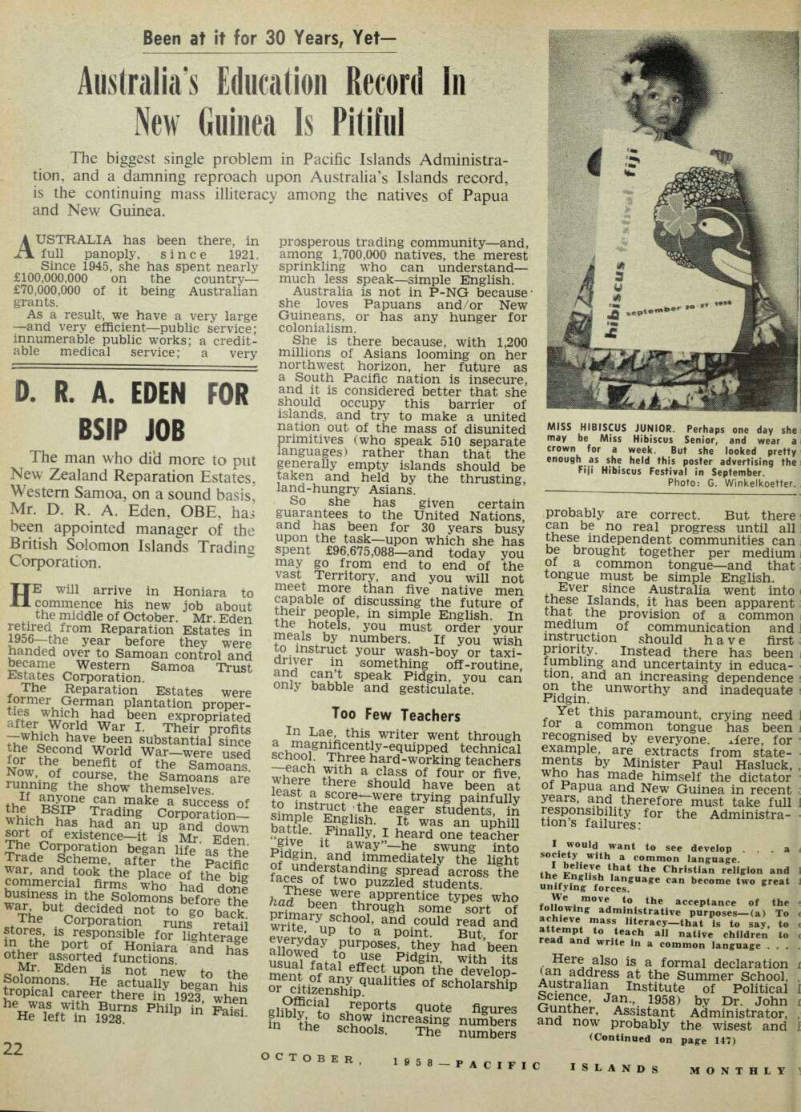
MISS HIBISCUS JUNIOR. Perhaps one day she may be Miss Hibiscus Senior, and wear a crown for a week. But she looked pretty enough as she held this poster advertising the Fiji Hibiscus Festival in September.
Photo: G. Winkelkoetter.
certainly the most energetic man engaged in P-NG administration; These people have a dominant desire to achieve the riches of our living, to emulate us. The most universal demand is educa tion . . .
Teach them English, English, and more English—this is what they want. I would condemn those who do not use English In every teaching technique. There is a cry ing need for mass education, and those who persist in using Pidgin English or “Police Motu” are thoughtless, or are con ceited in thinking they are bi-lingual. or there may even be some wicked enough to wish to slow down the development of the people.
If those extracts represent the thinking in high places, why in the name of commonsense has so little been done to establish simple English as a common tongue among all the villages in controlled areas?
Why should it be necessary for Father John Dwyer, a leading missionary-educationalist, to make this protest at the P-NG Legco
sitting on September 17:
Twelve years after the war the Ad ministration and the Missions together are giving primary schooling to one out of every eight children of school age in the Territory.
The number of children in attendance at approved schools is 47,000—30,000 of
these in Mission schools, 17,000 in Ad ministration schools.
Teaching these children there are 1,500 registered teachers; 500 of these are Euro peans and 1,000 are natives; and of these qualified teachers 700 belong to the Ad ministration and 800 to the Missions.
In addition to the 47,000 children at approved schools, there are approximately 150.000 other children who have some con tact with literacy through Mission teachers, many of whom will soon be granted permits to teach.
An estimated 200,000 children of the Territory in controlled areas have no con tact whatever with any form of schooling.
To the work of education in the Terri tory over the last few years, the Adminis tration has given an ANNUAL grant of approximately £1,000.000. Of this, £BOO,OOO has been spent on secondary schooling In Australia and on European schooling within the Territory. Approximately £200,000 has been given annually to the Missions by grants-in-aid and also for schools. The remaining £500,000 has been used on salaries and administration and native education.
The Missions can and do train native teachers to Administration standard and can and do maintain qualified native teachers and European teachers at one quarter of the cost of the Administration’s own teachers.
At this rate of progress it will be (as Mr. Chatterton wrote recently in the newspapers) another 50 years before we get around to giving schooling to the 400.000 children of the Territory.
Education’s greatest need In the Terri tory is this: Instead of 1,500 there must be 12,000 teachers in the field, to give primary education to 400,000 children.