The High Court Sits In A
pp. 19-152 · Read in the full issue
Seeking the Truth of the Tolai Shootings
The High Court Sits In A New Britain Kunai Shark
By R. W. Robson, in Rabaul
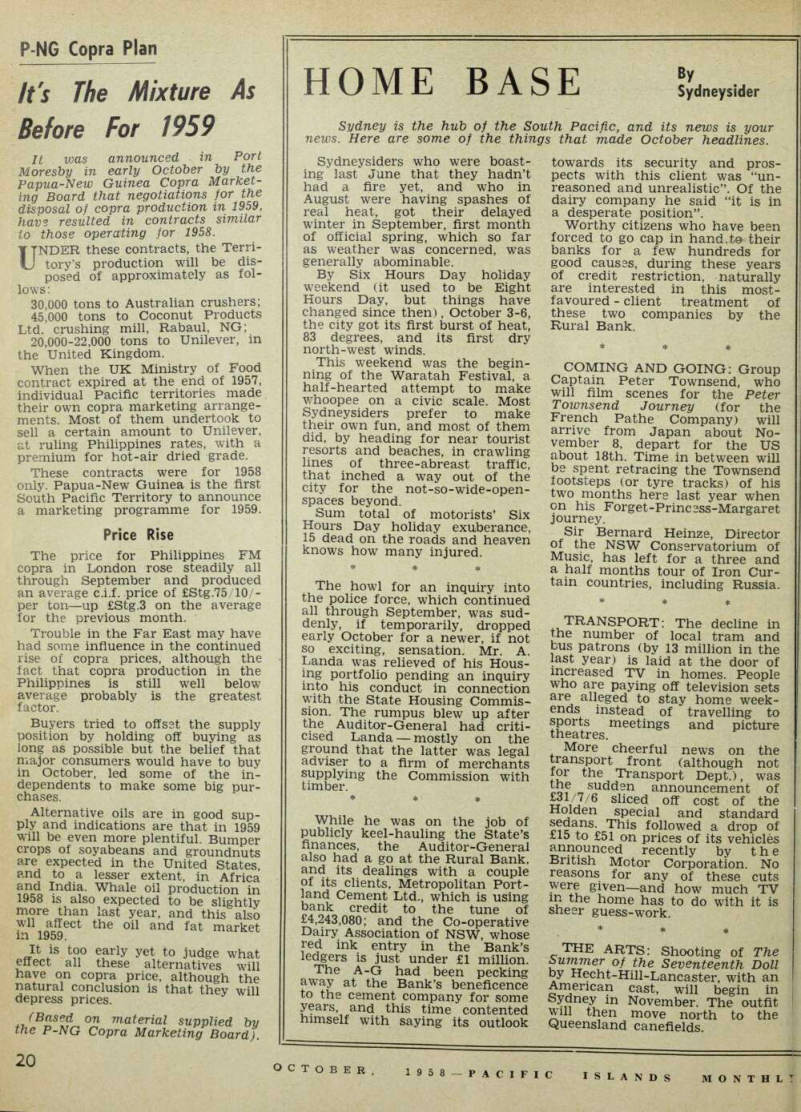
The Chief Justice, wearing robe and wig, stood outside the kunai shack in which he had constituted his Court of Inquiry (on September 1) and stared thoughtfully at the dark-brown men who squatted in a tight-packed half-circle before him.
HIS obvious, primary purpose was somehow to make these villagers of Navuneram understand that he —the leading judge of Papua and New Guinea—had been sent to them directly by the Governor-General of Australia, to ascertain the how and why of the fatal shooting that occurred there on August 4.
Slowly, most carefully, the judge explained his mission. He said that his Commission of Inquiry was not a court of law and was not con nected in any way with the Admin istration. He wanted the whole truth of the shooting incident. He begged their co-operation and help in considering the laws which had led to the shooting.
His explanations and his plea were translated slowly into Tolai by a big, handsome, New Guinea school teacher, Tibilee (or Jubilee).
The judge’s plan was to try to capture the interest of a primitive people, presumably striving for European standards.
I watched that circle of dead-pan faces for 20 minutes, and I saw no reaction whatever. They never missed a syllable, but they were motionless and expressionless. A tough, grim people, the Tolai.
"Nothing Like It"
I had never seen anything like this, in any country. The anxiety of this highly-placed judge to somehow make contact with the minds of the
Tolai villagers—already known, over the years, for their readiness to defy the Administration authority—was impressive.
Especially emphatic was his assur ance that he had not come among them as part of the Administration machinery, with which they had clashed. Mr. Foldi (District Com missioner) , Mr. Flower (District Officer) and Mr. Emmanuel (ADO) —all probably well known to the villagers—were in the background group of officials, barristers and re porters, who listened to Mr. Justice Mann.
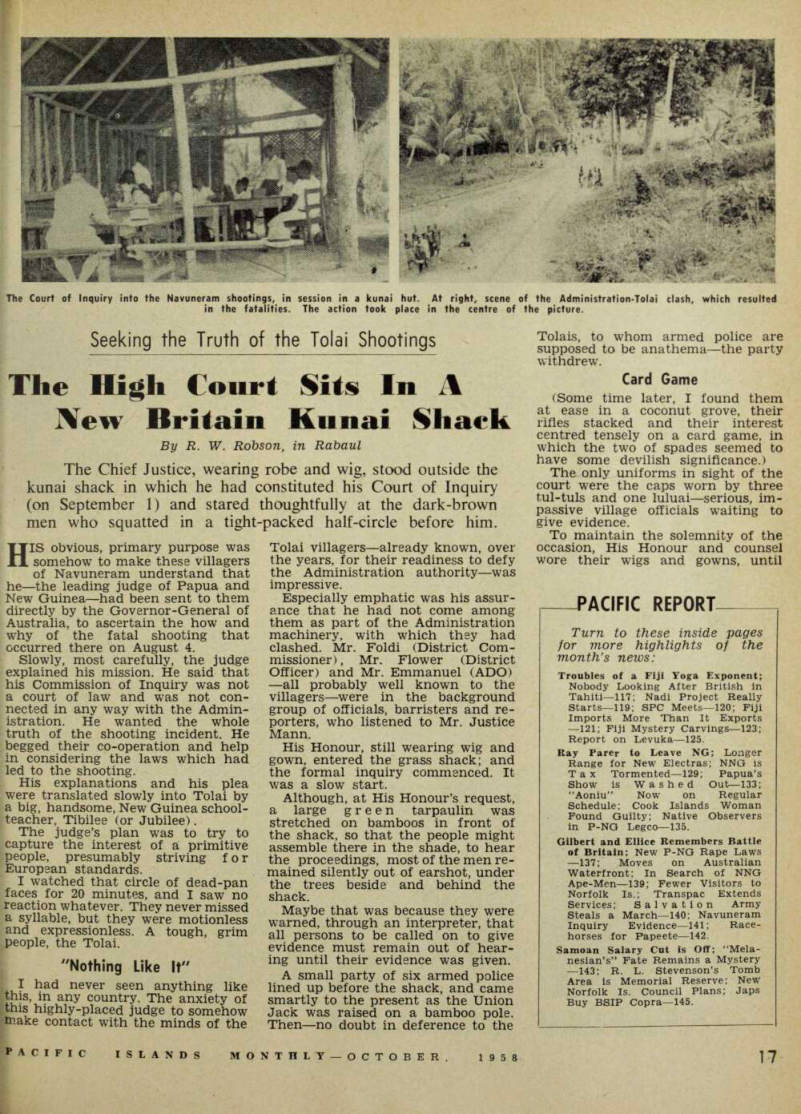
His Honour, still wearing wig and gown, entered the grass shack; and the formal inquiry commenced. It was a slow start.
Although, at His Honour’s request, a large green tarpaulin was stretched on bamboos in front of the shack, so that the people might assemble there in the shade, to hear the proceedings, most of the men re mained silently out of earshot, under the trees beside and behind the shack.
Maybe that was because they were warned, through an interpreter, that all persons to be called on to give evidence must remain out of hear ing until their evidence was given.
A small party of six armed police lined up before the shack, and came smartly to the present as the Union Jack was raised on a bamboo pole.
Then —no doubt in deference to the
Tolais, to whom armed police are supposed to be anathema —the party withdrew.
Card Game
(Some time later, I found them at ease in a coconut grove, their rifles stacked and their interest centred tensely on a card game, in which the two of spades seemed to have some devilish significance.) The only uniforms in sight of the court were the caps worn by three tul-tuls and one luluai —serious, im passive village officials waiting to give evidence.
To maintain the solemnity of the occasion, His Honour and counsel wore their wigs and gowns, until
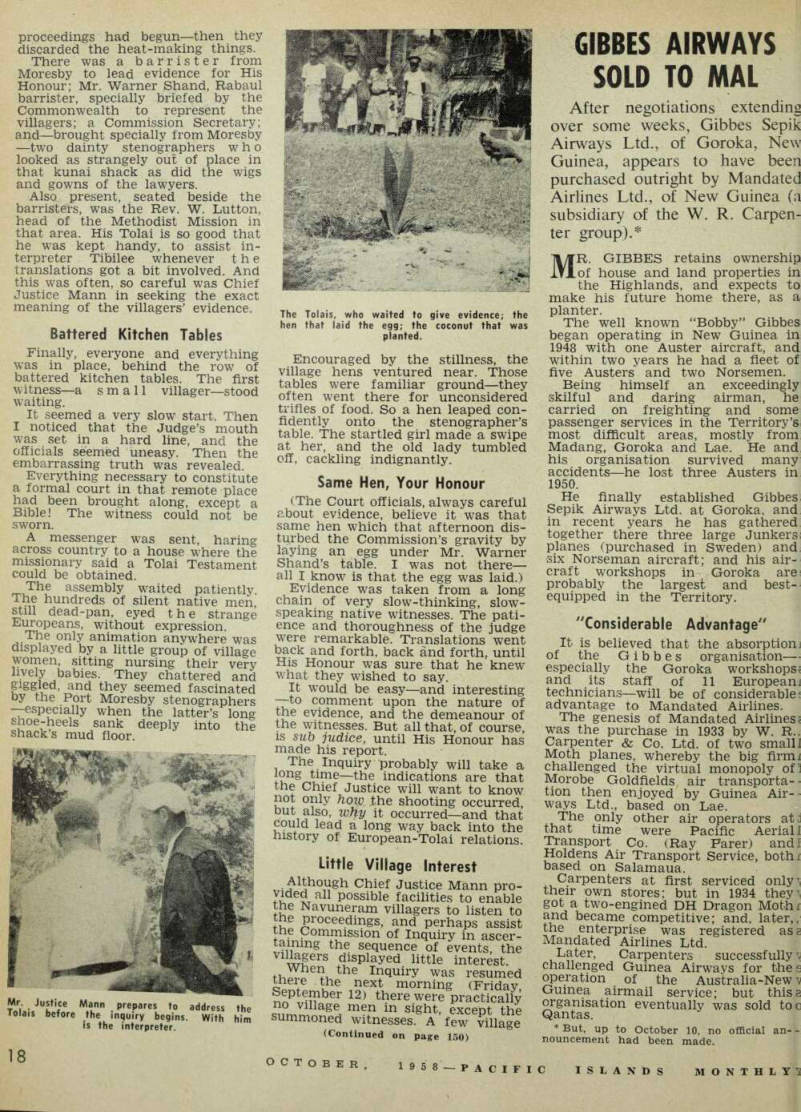
The Court of Inquiry into the Navuneram shootings, in session in a kunai hut. At right, scene of the Administration-Tolai clash, which resulted in the fatalities. The action took place in the centre of the picture.
proceedings had begun—then they discarded the heat-making things.
There was a barrister from Moresby to lead evidence for His Honour; Mr. Warner Shand, Rabaul barrister, specially briefed by the Commonwealth to represent the villagers; a Commission Secretary; and —brought specially from Moresby —two dainty stenographers who looked as strangely out of place in that kunai shack as did the wigs and gowns of the lawyers.
Also present, seated beside the barristers, was the Rev. W. Button, head of the Methodist Mission in that area. His Tolai is so good that he was kept handy, to assist in terpreter Tibilee whenever the translations got a bit involved. And this was often, so careful was Chief Justice Mann in seeking the exact meaning of the villagers’ evidence.
Battered Kitchen Tables
Finally, everyone and everything was in place, behind the row of battered kitchen tables. The first witness —a small villager—stood waiting.
It seemed a very slow start. Then I noticed that the Judge’s mouth was set in a hard line, and the officials seemed uneasy. Then the embarrassing truth was revealed.
Everything necessary to constitute a formal court in that remote place had been brought along, except a Bible! The witness could not be sworn.
A messenger was sent, haring across country to a house where the missionary said a Tolai Testament could be obtained. _., The assembly waited patiently.
The hundreds of silent native men, £ffill dead-pan, eyed the strange Europeans, without expression.
The only animation anywhere was displayed by a little group of village women, sitting nursing their very lively babies. They chattered and giggled, and they seemed fascinated by the Port Moresby stenographers especially when the latter’s long shoe-heels sank deeply into the shack’s mud floor.
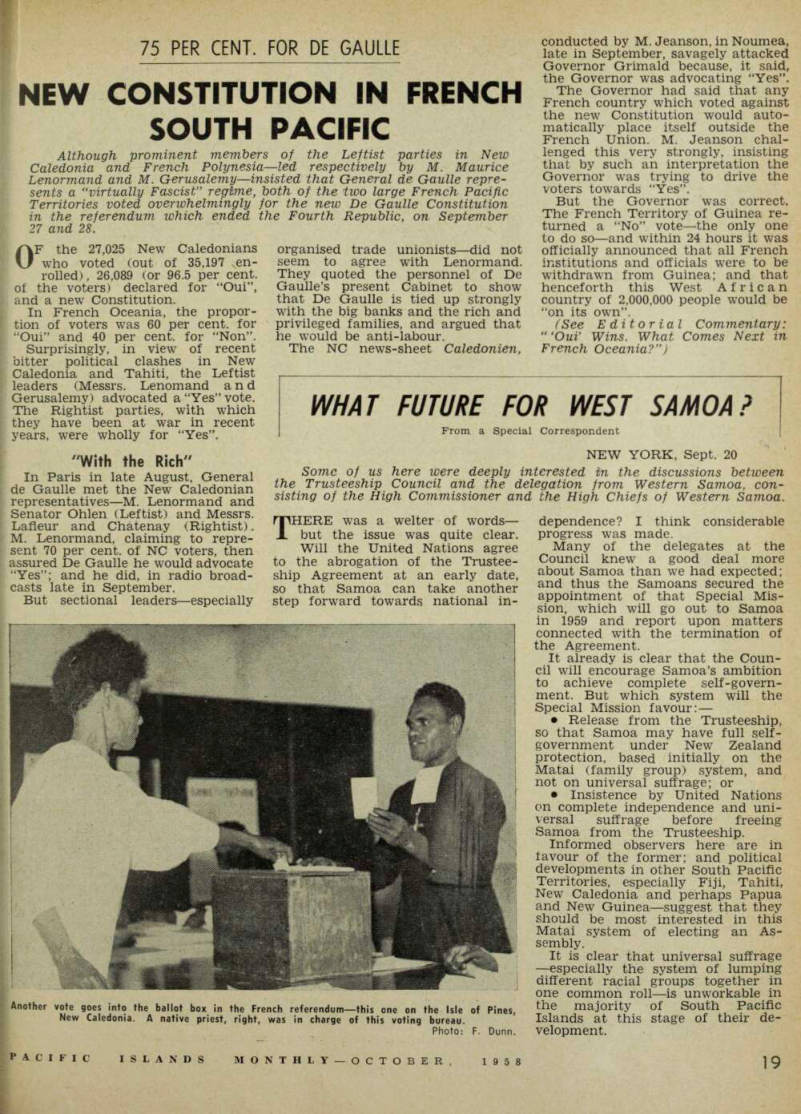
Encouraged by the stillness, the village hens ventured near. Those tables were familiar ground—they often went there for unconsidered trifles of food. So a hen leaped con fidently onto the stenographer’s table. The startled girl made a swipe at her, and the old lady tumbled off, cackling indignantly.
Same Hen, Your Honour
(The Court officials, always careful about evidence, believe it was that same hen which that afternoon dis turbed the Commission’s gravity by laying an egg under Mr. Warner Shand’s table. I was not there — all I know is that the egg was laid.) Evidence was taken from a long chain of very slow-thinking, slow speaking native witnesses. The pati ence and thoroughness of the judge were remarkable. Translations went back and forth, back and forth, until His Honour was sure that he knew what they wished to say.
It would be easy—and interesting —to comment upon the nature of the evidence, and the demeanour of the witnesses. But all that, of course, is sub judice, until His Honour has made his report.
The Inquiry probably will take a long time—the indications are that the Chief Justice will want to know not only how the shooting occurred, but also, why it occurred —and that cpuld lead a long way back into the history of European-Tolai relations.
Little Village Interest
Chief Justice Mann pro possible facilities to enable the Navuneram villagers to listen to proceedings, and perhaps assist tne Commission of Inquiry in ascer taining the sequence of events, the Villagers displayed little interest.
In( l uir y was resumed mere the next morning (Friday, September 12) there were practically me ? in Sight ’ eXCe P t the summoned witnesses. A few village
(Continued on page 150)
Mr. Justice Mann prepares to address the Tolais before the inquiry begins. With him is the interpreter.
The Tolais, who waited to give evidence; the hen that laid the egg; the coconut that was planted.
women sat under the green tar paulin.
Another of the Judge’s purposes, probably, in holding the Inquiry in the village, was to avoid bringing into Rabaul (nine miles away) the several Navuneram villagers whom he intended to question.
After that, if Navuneram village does not wish to listen in, he probably will hold the remainder of the sittings in Rabaul.
Although they were unsmiling and silent, there was no indication around the court of active native hostility towards Europeans. It was hard to believe that, only five weeks before, there had been savage demonstrations, stone-throwing and rifle-shooting, on that very spot.
But some things could be noticed.
For example, that grass shack had been used mostly as accommodation for the Kiap, when he visited the village; and the open space before it was, traditionally, common ground, where official visitors met the people.
But very recently, holes had been dug symmetrically across the open space, and young coconuts planted therein—there was one right in front of the judge’s table, as he sat there in the shack.
"Village Land, Now"
The old hands said it was the villagers’ way of saying: “There is no longer a meeting-place between Tolais and Europeans in this village.
This now is village property, and planted up as coconut land.”
The incident now being investi gated occurred at Navuneram Village near Rabaul, on August 4. The Tolais had consistently refused to pay the new head-tax of £2 per head, and a large official party, pro tected by armed police was finally the t tax lt m an attempt to collect The villagers were defiant, and
there was some stone-throwing, and some shooting; and, in the course of these happenings, two men, rovatuna and Touverette, were killed, and one man, Tolilial, was wounded.
It is generally considered that matters gravely affecting the future relationship between the Europeans and the natives of the Rabaul dis trict generally are involved; but these matters may not be discussed until Chief Justice Mann has re ported to the Australian Govern ment, in accordance with the terms of the Commission he has accepted.
Scores are Sent to Gaol
Meanwhile, because of the natives’ refusal to pay the taxes, other in cidents of some importance are occurring.
In the fortnight following th opening of the inquiry at Navir naram, 46 Tolais were sent to gai for one month for refusal to ps the local Council tax, and a furtluj large party from the Duke of Yoi Islands were similarly punished.
A deputation of five men fro:< the Tolai villagers interviewe Chief Justice Mann, and asked f« the suspension or the removal < the threat. He explained to theif that the tax was lawful; and, whii the law existed, it must be obeyee The 46 villagers thereupon electa to go to gaol, rather than pay.
It is not clear whether matters are or are not the subjeis of Chief Justice Mann’s inquin They seem to call for comment; bn comment at this stage might be re' garded as contempt of court.
EXPLORER'S FUNERAL. Som of the hundreds of people, including the Governor of NNG, w[?] atte nded the funeral of Dutch explorer-author, Jan P. K. van Eechoud, near Hollandia in Sop tember. The service was led by the Bishop of Hollandia. For detailed report, see page 49.