Pacific Report
pp. 119-151 · Read in the full issue

The month’s round-up of news and pictures of people and events, from PIM correspondents in the South Pacific.
They Sell Each
Other Groceries
Because of the slump in the nickel industry, Noumea’s small shopkeep ers report a drop of 30 per cent, in turnover during the last few months.
It is certain that in the coming months this percentage will be greater.
According to the latest news from Europe there is little chance that the nickel situation will improve in the near future.
Latest figures of commercial activity in New Caledonia show an astounding situation. For every ten persons in the town of Noumea, there is one shopkeeper. In the country districts there is one shop keeper for every 25 persons. Visitors to Noumea have always been amazed at the number of epiceries in the town. These epiceries sell mostly foodstuffs and the casual visitor often expresses his astonishment at the amount of food seemingly con sumed as the epiceries must sell to exist.
For the year 1958, 4,351 com mercial licences have been issued.
A feature of this year’s figures is that they show fewer Viet shop keepers.
In 1955 there were 443 Viets hold ing commercial licences (greatest ever) whilst in 1958 the number has fallen to 247—which is still too many in the general opinion of New Caledonians.
BSIP: They Dress for
Dinner or Plane Crashes
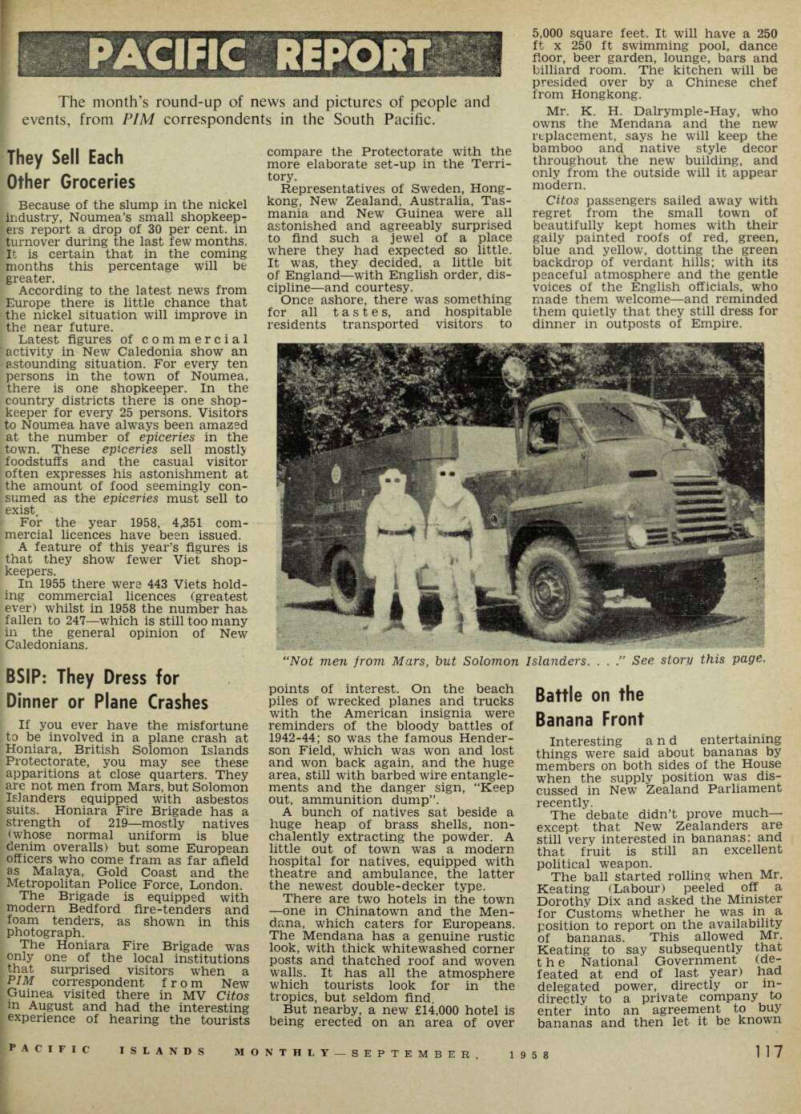
If you ever have the misfortune to be involved in a plane crash at Honiara, British Solomon Islands Protectorate, you may see these apparitions at close quarters. They are not men from Mars, but Solomon Islanders equipped with asbestos suits. Honiara Fire Brigade has a strength of 219—mostly natives (whose normal uniform is blue denim overalls) but some European officers who come fram as far afield as Malaya, Gold Coast and the Metropolitan Police Force, London.
The Brigade is equipped with modern Bedford fire-tenders and foam tenders, as shown in this
photograph.
The Honiara Fire Brigade was only one of the local institutions that surprised visitors when a PIM correspondent from New Guinea visited there in MV Citos m August and had the interesting experience of hearing the tourists
compare the Protectorate with the more elaborate set-up in the Terri tory.
Representatives of Sweden, Hong kong, New Zealand, Australia, Tas mania and New Guinea were all astonished and agreeably surprised to find such a jewel of a place where they had expected so little.
It was, they decided, a little bit of England—with English order, dis cipline—and courtesy.
Once ashore, there was something for all tastes, and hospitable residents transported visitors to
points of interest. On the beach piles of wrecked planes and trucks with the American insignia were reminders of the bloody battles of 1942-44; so was the famous Hender son Field, which was won and lost and won back again, and the huge area, still with barbed wire entangle ments and the danger sign, “Keep out, ammunition dump’’.
A bunch of natives sat beside a huge heap of brass shells, non chalently extracting the powder. A little out of town was a modern hospital for natives, equipped with theatre and ambulance, the latter the newest double-decker type.
There are two hotels in the town —one in Chinatown and the Men dana, which caters for Europeans.
The Mendana has a genuine rustic look, with thick whitewashed corner posts and thatched roof and woven walls. It has all the atmosphere which tourists look for in the tropics, but seldom find.
But nearby, a new £14,000 hotel is being erected on an area of over
5,000 square feet. It will have a 250 ft x 250 ft swimming pool, dance floor, beer garden, lounge, bars and billiard room. The kitchen will be presided over by a Chinese chef from Hongkong.
Mr. K. H. Dalrymple-Hay, who owns the Mendana and the new replacement, says he will keep the bamboo and native style decor throughout the new building, and only from the outside will it appear modern.
Citos passengers sailed away with regret from the small town of beautifully kept homes with their gaily painted roofs of red, green, blue and yellow, dotting the green backdrop of verdant hills; with its peaceful atmosphere and the gentle voices of the English officials, who made them welcome —and reminded them quietly that they still dress for dinner in outposts of Empire.
Battle on the
Banana Front
Interesting and entertaining things were said about bananas by members on both sides of the House when the supply position was dis cussed in New Zealand Parliament recently.
The debate didn’t prove much— except that New Zealanders are still very interested in bananas: and that fruit is still an excellent political weapon.
The ball started rolling when Mr.
Keating (Labour) peeled off a Dorothy Dix and asked the Minister for Customs whether he was in a position to report on the availability of bananas. This allowed Mr Keating to say subsequently that the National Government (de feated at end of last year) had delegated power, directly or in directly to a private company to enter into an agreement to buy bananas and then let it be known
“Not men from Mars, but Solomon Islanders. . . .” See story this page.
.surreptitiously that the Government supported the agreement. ; That was no way to conduct trade relations, he said. The Government should negotiate and make agreements. It should not delegate its functions to private companies which operated to serve their own interests.
I This company had entered into a five year agreement with Fiji to take up to 750,000 cases of bananas.
No regard was had for the pro duction of Samoa. 1 The obvious thing was to protect production in those areas which presented no currency difficulties.
That was precisely what the previous Government had not done.
Fiji had not been able to meet its commitments, and the bananas would come from elsewhere and in sufficient quantities to meet the heeds of New Zealand.
I Mr. Edwards (Labour) pointed out that no regard has been paid to the production of Western Samoa,
a United Nations Trust Territory controlled by New Zealand. The agreement with Fiji would expire on March 31, 1959. It was questionable whether Fiji could this year supply New Zealand’s demands at the 1956 level. In 1956 Fiji had supplied New Zealand with 225,654 cases of bananas, but up until June, 1958, only 83,361 cases had come into New Zealand. The previous Government should have concentrated on obtaining bananas from the Dominion’s dependencies.
Mr. Kinsella (National) said that there was no foundation for the allegation that the previous Govern ment was responsible for the importation of less bananas from Samoa than were received from Fiji m past years. The increase in production of Samoan bananas was of recent date and was due to the drive towards more production that had taken place. It would be unwise to rely entirely on Samoa
for the supply of all the bananas New Zealand required which amounted to anything from 1 million to U million cases per year, It was the policy of the British Government to encourage increased production of bananas with a view to building up the confidence of the Fijians in the British Administration. It was true that in 1956 only 240,000 cases of bananas came from Fiji, but there was a considerable drop in production that year because of floods. The normal production in Fiji was around 390,000 cases a year. A lack of rain was affecting the quantity of the crop this year. To destroy the market in Fiji bananas would not only destroy the industry but would also retard the efforts of the Fiji Administration to assist the Fijians.
Mr. Boord (Minister of Customs) said that statements made by Opposition members were in accurate, particularly the allegation that the import cut of 25 per cent. in Fijian bananas meant that the income of the Fijians was cut in half. When the announcement of the cut was made there were immediate protests from Fiji, After consideration the Govern ment had decided to increase the quota to 100 per cent, of 1956 importations.
The Government was committed to the agreement made by a private company, apparently with the approval of the National Govern ment. which did not terminate until March 31, 1959. It would be interesting to know whether any notice was taken of New Zealand’s position with regard to Samoa
under the United Nations’ Trustee ship when that agreement was made by the National Government.
New Zealand had a trust to look after the Samoans but apparently that instruction was ignored when the Fiji agreement was made. Samoa could supply 750,000 cases of bananas to New Zealand in 1958, and accordingly there would be no shortage of bananas.
The delegation from Fiji had been satisfied and reassured as a result of their visit as evidenced by a report that, on the information available, the Government of Fiji saw no reason, why those engaged in the banana industry should not continue to produce and to plant in the normal way.
The NZ Government had done its best to assure to Fijian growers a share of the New Zealand market in 1959. Beyond that it could not ?o, because of its responsibilities to New Zealand’s island territories.
He hoped that a mission would be sent to Fiji for the purpose of naking a mutual trade arrangement )r of increasing trade between the ;wo countries so that the balance )f trade, which was all in favour )f Fiji, might be adjusted and trade )n both sides increased.
they Won't Hang
to Often in GEIC
Under the new Homicide Or linance No. 4 of 1958, which came nto force on July 1, jurisdiction n all homicide cases in the Gilbert ind Ellice Islands Colony is with drawn from Native Courts and Jlaced under the control of the [udicial Commissioner in the High ;ommissioner’s Court.
The United Kingdom Homicide \ct becomes applicable to people of ill races and the death penalty for nurder, except in those few cases ipecified in the Act, is thus kbohshed.
Preparing for the
Big Blackout
Although the IGY’s only total icnpse of the sun was not due to ake Diace until October 12 (October ■o, Australian time), the astrono mers, geomagnetic observers and >ther scientists associated with the ranous observations which are foing to be made, were already on «he move in August.
The Japanese team left Yokohama >n August 5 (see Shipping Notes). >n August 29, Mr. I. L. Thomsen,
hrector of Carter Observatory,
Wellington, and Mr. R. r. Dibble, ii ,^ w J Zealand seismologist, left J-uckland on the first stage of their ourney to Atafu atoll, Tokelaus e y were to be joined United Kingdom trio, Dr. ind Mrs H. von Kleuber and Dr. .H. Jarrett, all of Cambridge University observatories. This party
was to be flown to Atafu by an RNZAF Sunderland flying-boat.
Their heavy equipment was going up from Apia by ship.
While the British team at Atafu roughs it in tents borrowed from the NZ Army, an American team, operating at Fukapuka, Northern Cooks, will live aboard a US naval craft in relative comfort, away from that atoll’s hordes of notorious mosquitoes, and shuttling between ship and shore each day, not in seme very capsizable native canoe but in a Naval helicopter.
There is no satisfactory ship anchorage at Fukapuka and the base ship will be alternatively drifting off and cruising up to the island for a month or so, as it will take some time to set up, adjust,
and later dismantle all the equip ment.
There is also a report that an Australian group is to make some observations from Aitutaki, although this island is apparently south of the rather narrow belt in which the eclipse can be observed in totality.
This tapering belt extends from a point well north of New Guinea to a point somewhere down towards Easter Island.
According to earlier reports another American group was to make observations from Mopelia, French Oceania, Much of the work will be duplica ted from the various observation sites, not merely for comparitive purposes but mainly to ensure that if the sky is overcast for the vital
{three minutes or so at one site it may be clear at another. \ The eclipse will take place at about 1956 GMT on October 12 1(7.56 a.m., October 13, Suva time).
The Tolais Took
A Sydney Tour
' History of some sort was made in August when six representatives of the New Britain Tolais flew from Rabaul to Sydney to see how Aus tralian industry works.
This has been done before, but this group are all cocoa growers, and several are members of local government councils in New Britain.
It was the first Sydney visit by a group of native producers with a particular economic interest.
One aspect of their visit —an in spection of chocolate factories —gave them an insight into what happens to their product after it leaves Rabaul.
Their respective councils paid their air fares, and the boys paid for their own board and lodging and had some spending money.
The Administration helped out with arrangements.
The natives—To Mari, Koniel, Jack Kanit, Pelis, To Vuna and To Longoma—arrived in Sydney by air on August 16, accompanied by Mr.
Jack Lamrock, Regional Agricultural Officer from Rabaul Their many-sided look at Sydney
began immediately after their arrival, when Mr. Lamrock and PO Ken Hanrahan, of ASOPA (where they stayed), accompanied them on a trip to Manly, one of Sydney’s famous beach resorts.
That afternoon they watched a Rugby Union football match at Woollahra, another suburb.
In the next few days they went to Taronga Park Zoo (where the elephants were regarded with awe and amazement), inspected a steel fabrications factory, took a launch trip on Sydney Harbour, had their first look at television (which they regarded as a miniature version of “haus bilong piesa”).
They were shown over a motor mower factory at Silverwater, Syd ney, inspected a plastics factory at Bankstown.
The various processes there were explained to the visitors by Mr. Phil
Mackenzie, a company officer, who speaks fluent pidgin as a result of several years stay in the Solomons and New Guinea before and during World War 11.
The Tolais were entertained at lunch at the Bankstown Golf Club.
Factories and other establishments visited during the week included two chocolate factories, a shipyard, a motor factory, a radio factory, a Sydney newspaper office and a tele vision station.
At the last-named they were tele vised on the “Sydney Tonight” pro gramme. To Longoma spoke in pidgin in response to the introduc tion by the compere.
Then they were taken to a drive in theatre, where they saw a war time submarine film and had their first taste of popcorn.
On Saturday morning they went to a Sydney department store, one of Sydneys biggest, which they compared with Rabaul’s Saturday “bung”.
There they saw a photographic exhibition, were vastly intrigued by the lifts, and bought sports coats and sweaters. (They had felt the cold of what to Sydneysiders was mild winter weather).
There was quite a crowd at Mascot Airport to see the visitors off on August 23 —ASOPA and De partment of Territories officials, patrol officers, and some fellow- Tolais living in Sydney who had visited them at Mosman.
Mr. C. D. Rowley, principal of ASOPA, said that the visit had illustrated the needs and objects of the three parties concerned —the Administration, the Sydney business firms which had co-operated, and the Tolai cocoa growers them selves.
“The Administration is, of course, anxious to give these people the educational opportunity involved, and to help them realise that they have a stake in the wider Australian community,” he said.
“The firms concerned had good business reasons for assisting, as well as, to a certain extent, express ing general goodwill on behalf of the Australian community.
“The Tolai cocoa growers had a very real interest in seeing what happens to their product at the processing end. They are interested in prices, and therefore in quality.
They seem to have come a long way just to push a motor mower. But at a Sydney golf dub, where they were entertained at lunch, the visiting Tolais happily obliged for a pub licity picture.
Great Greens from
Little Peanuts Grow
The humble peanut often has some very disparaging remarks passed about it, but like the un humble coconut, is worth its weight in gold—or, as Lae bowlers are an ticipating worth its weight in
bowling greens.
The bowlers, in possession of land but few funds, have decided to plant the 2-acres with peanuts, and from the harvest lay two new greens.
Tasmanian sporting clubs have, for many years, planted potato crops to augment club funds, but we think this might be the first time peanuts nave been called upon to do the Job.
New Guinea peanuts have been ‘etching reasonable prices in Aus
tralia recently, but heavy rains in Lae during the last few months have caused a lot of damage to crops. No doubt, during the next few months the bowlers, with one eye on the weather and the other on the peanuts, will not be playing their usual standard of bowls.
G&E Had a
Wetter 1957
Almost all of the 33 meteorological reporting stations of the Gilbert and Ellice Islands Colony, extend ing from Christmas Island in the East, to Ocean Island in the West, had more than their average quota of rainfall in 1957.
Little Makin in the extreme north —the wettest area—topped the poll with 163.91 inches, and Canton in the centre of the Colony had the least, 49.98 inches.
Ocean Island, with a normal rain fall of 40-50 inches had 111.61 inches.
All these islands are noted for the wide variations in rainfall from year to year.
Trouble All Round
For Shell Industry
Pacific planters who once re garded trochus as a profitable side line; and natives who regarded it as a chief means of livelihood, are all feeling the effect of the slump in this commodity.
The development of plastic but tons, and, particularly, of plastic buttons that look like pearl-shell, is the cause of the trouble.
Trochus, over the years, has ex perienced alternate slumps and booms —three or four years ago the industry was enjoying the biggest price boom ever—but this time the slump looks as though it could be permanent.
There have been alternatives to pearl buttons before, too; but never alternatives as attractive as the present plastic buttons.
A nominal Australian price of £3OO to £350 per ton has been ruling for some time; but merchants, when asked, usually have the same tale to tell —there is little trochus coming in, and few or no inquiries for it.
In Papua-New Guinea, many Native Co-operatives base their operations on trochus fishing and these are having a particularly lean time. In August, the Registrar of Co-operatives said that for the first nine months ending March, 1958, the value of trochus production was only £53,909; in the same period last year, the value of the industry was £269,258.
Trouble has been experienced also in New Caledonia where during August the price fell again.
Meantime Australian pearlers operating out of Darwin are also having a lean time. Many, fore seeing the collapse of the market
Rabaul's 'Grand
Old Man'
The smiling face belongs to Sgt.
Maigugu, of Finschhafen, NG, who in Rabaul in August was presented with the Police Long Service and Good Con duct Medal by the Administrator, Brig.
D. M. Cleland.
The Police Commissioner, Mr. C.
Normoyle, and the District Com missioner, Mr. J. Foldi, were also there.
Sgt. Maigugu, known and respected widely as a "grand old man", first enlisted in the NG police in 1922, and early in his career won the Police Valor Medal for his part in arresting a native at Wewak.
He served in Wewak during the war until captured by the Japanese. But after two years he organised an escape from Mushu Island, with other police.
He was then able to help the American forces in the Wewak cam paign, and was awarded the Loyal Service Medal.
are already withdrawing from the industry. Most trouble seems to be in disposing of second-grade MOP which has been stock-piling since 1956 and is still waiting to be sold.
Little Red Schoolhouse
That Wasn't
Pitcairn Island —which gets a lot of its revenue from the sale of postage stamps—has found an error in its current fourpenny. It carries a picture of the school-teacher’s house but it is labelled “Pitcairn Island School’’.
On November 5 it will be replaced by a new stamp—carrying the same ’illustration but with correct caption.
When the new stamp arrives, the old will be withdrawn. It is too soon yet to know whether this will be one of these “valuable mistakes”.
Probably not, as there are no doubt many of them in circulation.
SRC Meets to
Review and Plan
A review of progress in the three fields of social, economic and health development, and plans for the 1959 programme will be the main task at the 18th session of the South Pacific Commission which ppens in Noumea on September 26. ! Representatives will attend from |the six member nations, Australia, France, the Netherlands, New Zealand, United States and United Kingdom.
Delegates will also discuss final arrangements for the fourth South Pacific Conference, scheduled to begin at Rabaul, New Guinea, in April, 1959. Over 70 delegates from 19 Pacific territories are expected to attend this get-together of Pacific peoples. This is the first time that New Guinea has been host to such a gathering. Fiji was host to the first and third South Pacific Con ferences; Noumea to the second.
Pearl Culture
for Hong Kong
• Though Australia is belatedly showing interest in establishing a culture pearl industry in the north, no interest whatever has been shown in the possibilities in South Pacific territories or if such interest has been shown, it has certainly not reached the active ptage.
Early in August the Hongkong Legislative Council was dealing with a Bill designed to ensure the pro tection and orderly development of such an industry in local waters,
f The Attorney-General, introducing
the Bill, said that a successful pilot project had been established in Tolo Harbour in 1956 by private enterprise. The local Penguin or Wing oysters had been seeded and lair quality pearls obtained.
The Government had watched experiments “with interest” and the Fisheries Division reported that conditions in Hongkong waters seemed favourable for the establishment of a new and important culture pearl industry.
This seems to suggest that there is a definite market opening for such pearls, additional to those
Industry* was deveFoped bfthe iTtl
Kokichi Mikimoto.
Under the new Bill, the Hongkong government is, of course, going to have its “whack” of what private enterprise produces.
There is provision for a fine of up to $lOO,OOO (£A7,800) or twelve months imprisonment for anyone cultivating pearls in local waters without a license, and a strict control will be maintained over the areas where such pearls may be cultured and the sizes of oysters which may be involved,
Fall in Nickel Demand
Cj.:|| Dn^rlc*c reiSISTS The International Nickel Com pany announced a fall of nearly 68 million dollars in its revenue
for the first 6 months of the current year, compared to a corresponding period last year.
This represents a fall of nearly 35 per cent, in sales.
The persistent fall in nickel : orders and the growing stockpile I held by the cartel, has forced it to [apply a third cut in production. ‘ This went into effect during July.
It is bad news for New Caledonia whose economy is strongly tied to the nickel industry.
Many of the small mines, which were enjoying a boom a year or 18 months ago, have already closed down.
New Service Links East
With all SW Pacific
A new shipping service which will [connect the Territories of the South- West Pacific and link them with the Far East will commence in October.
The China Navigation Company (which owns the New Guinea Aus tralia Line) will run the service.
To inaugurate it, the 6,000 tons Chengtu will leave Japan on October 9 and call at Hongkong, Borneo, New Guinea ports, Noumea, in New Caledonia, Vila and Santo in the New Hebrides, Suva in Fiji and perhaps Lautoka, then Australian ports and return to the East.
It is quite a new route and would no doubt interest many travellers.
But passengers will not be carried on this service, it will be cargo only.
Sydney agents will be Swire and Yuill Pty. Ltd.; in Papua it will be Steamships Trading Co. Ltd.; in New Guinea, Colyer Watson (NG) Ltd. (except in Kavieng, where agents are the New Guinea Com pany Ltd); in Fiji, Morris Hed strom Ltd., in Noumea Etablisse ments Ballande; and in New Hebrides, Les Comptoirs Francais de Nouvelle Hebrides (CFNH).
In Nauru, One
Teacher for 15 Pupils
The Nauru Education Department now has a staff of 10 Europeans, including the Director of Education, and 21 Nauruan teachers one of whom has been trained at Sydney Teachers’ College.
This total of 30 teachers for a total school enrolment of just below 500 gives a teacher/pupil ratio of
about 1 to 15, which should make the State Education Departments of Australia and the State teachers employed in those Departments really envious.
Nauru maintains the following schools — (1) European Primary School 42 pupils (2) School for Gilbertese Children 31 pupils (3) Nauruan Secondary School (to Victorian Intermediate Cer tificate) 51 pupils (4) Nauru Primary School (in one building except for District Kindergar tens) 363 pupils The Education Department also conducts some adult classes (English, Trade Mathematics, Cook ing, etc.); maintains limited super vision of the Sacred Heart Mission school; and makes guidance sugges tions for 35 Nauruans at secondary schools and other institutions in Australia.
Features of the Department are close supervision of Nauruan teachers by trained European staff, and concentration on special techniques of language teaching.
Mr. H. G. Coppock, a Senior Education Officer on the Head quarters’ staff of the Commonwealth Office of Education at Sydney, will take over the duties of Director of
Education for Nauru, during tl absence of the substantive Directc Mr. G. Pittman, on nine montl recreation leave commencing October, 1958.
Mr. Pittman was appointed the position five or six years ai when he was a member of tl professional staff of the Commoi wealth Office of Education. j Nauru, Mr. Pittman has givi special attention to methods teaching English to Nauruans.
Mr. Coppock, a University gradi ate in Arts, was a major in tl Australian Army Education Servi, during the war,' prior to which I was teaching in a private school Queensland. After the war I joined the Commonwealth Office Education (with which the Un versities’ Commission is associate*
and was in charge of the Brisban Office before transferring to Sydnea Here he was associated with tM administration of the Educatio Scheme for Migrants, in that cor* nection having given special atter non to special methods of teachin English which have been develop©* for migrant instruction in Australia Mr. Coppock has a son who is i Forestry Officer in the Papua an New Guinea Public Service.
Another NZ-N. Cal.
Student Exchange
A selection committee, meeting : Auckland on September 14, was choose 25 post-primary studenn from a list of some 40 applicant lor another student exchange viai H ew Caledonia this summer.
The scheme is sponsored by tE: Department of Education which h;r made it clear that it does not looc on the event as a holiday for ttt New Zealand students. It is—am you can take it as official— nmshing course in conversationn French. . The children will speak nothin but French and they will T scattered throughout New Caledonn as individuals in the homes French hosts and will thus spens their six weeks in a wholly Frenor atmosphere.
The children of the French hosac will, at the same time, be in NoP
Zealand and scattered amongst the homes of the visiting New Zealanders. The New Zealand party Rill leave Auckland about December 18.
Samoa's Public Servants
Unhappy About Salary Cut
Public servants in Western Samoa pH get their salaries cut by 10 per cent, in 1959—if the intention of the Government, notified some months ago, is carried through.
The reason for the cut is the financial difficulties in which Western Samoa has found itself in the past year.
The public servants themselves vere, naturally enough, not consulted ibout it, but they appeared to be going quietly. However, in August, 1 meeting of the PS Association de bated the cut and subsequently sent a strong protest to the Government about it.
The Association considers that the Government has acted in an “un constitutional manner” and that in the interest of the public service as a whole the decision should be re considered,
Coastwatchers Memorial
Lighthouse Soon Now
Admiral William Halsley, Allied Naval Commander-in-Chief in the Pacific during the last war, once said that “Australian Coastwatchers saved Guadalcanal and Guadalcanal saved the Pacific”.
I Now these Coastwatchers are a
little nearer being commemorated through that memorial lighthouse, to be constructed at Madang, New Guinea.
Funds for it were raised years ago, plans for the 80 ft lighthouse drawn and approved. In September, there were signs that the Common wealth Government was within an ace of letting the contract—the Minister for Shipping and Trans port issued a satement about it.
Although what Admiral Halsley said about them was appreciated by the Coastwatchers, most of them would regard themselves as Aus tralians only incidentally. They were in fact, Territorians and residents of the BSIP, first; and the story of the job they did is now part of history.
It was decided some years ago that the memorial lighthouse should
be near Madang, New Guinea. It will be built in reinforced concrete, with a powerful light and will be of attractive design as befits its dual purpose of memorial and shipping beacon.
Cooks Importing Oil
From Tahiti
As a result of increased costs in New Zealand, and reduced costs in Tahiti, following the establishment of bulk oil storage facilities there, petrol in drums can at present be imported into the Cook Islands from Papeete at about £2 per 44-gallon drum less than from New Zealand.
As a result, according to a Rarotonga report, a local vessel has lately been running regular ship ments across.
Suva Port Busy
July was a booming month for the port of Fiji. Passenger liners brought in a total of more than 4,000 visitors. To the week ended August 1, 30 ships had arrived in Suva, 10 of them from overseas. Occasionally the wharf look on a congested look, as this PRO photo graph shows.
Geological Survey
of Tonga
The Fiji Government is making available its Chief Geologist, Mr.
N. H. Guest, to carry out a two months’ geological survey of some of the Tongan islands, probably in September-October.
The reconnaissance will be con fined mainly to volcanic islands, which offer best possibilities of commercially valuable mineral deposits, such as manganese. Islands likely to be surveyed are Eua, Ata, Tofua, Kao, Vavau, and Niuato putapu.
The Geological Survey Office in Fiji has recently been compiling a collection of papers resulting from surveys of Tonga by various people in the past.
Mend-it-Yourself on
Coral Route
Repairs and replacements of the radio navigational aid equipment at Aitutaki, the breakdown of which Interrupted TEAL’s Coral Route service in August-September, were being carried out by TEAL in August, under contract.
The equipment belongs to NZ Civil Aviation Administration, whose [responsibility it is to maintain such aids on the route, and for the use of which TEAL pays landing fees.
A good deal of the Aitutaki equipment was war surplus material from the American occupation.
Some of it is believed to be from the former US Navy LORAN radio navigation station at Atafu, Tokelau Islands.
TEAL had the equipment flown to its Auckland workshops by an RNZAF Hastings where it was given priority.
At the end of the first week in September it was to be flown back, together with some new equipment and seven engineers to carry out the re-installation job.
Other engineers had been working on some of the new heavy equip ment at Aitutaki in the interim.
New Wharf or Less
Rain for Lae?
Whether Lae’s frequently abom inable weather (it is a drought if they get less than 150 inches a year) is the cause of wharf conges tion in that New Guinea centre; or whether the wharf itself is at fault in that it isn’t big enough, was exercising the minds of local residents in August-September.
In August, Lae really dis tinguished itself in the amount of rain it produced (see elsewhere).
Shipping was delayed because of this; and then there was the matter of “priorities”. Lae’s wharf will accommodate
only one ship at a time, and due to this priority system, the ships that regularly trade between Aus tralia and New Guinea take the berth if they arrive at the same time as a vessel trading from the East or elsewhere. Even if the Eastern ship is at the wharf, half way through discharging, when one of the priority vessels arrives, it has to move out and make room.
Again, there are half a dozen vessels on the Australia-New Guinea service now but due to circumstances beyond anyone’s control their de partures and arrivals cannot be equally spaced and they sometimes pile up, all following roughly the same schedules close together.
An attempt to remedy this state of affairs is successful to a degree by routing them after they leave Moresby in different directions around the group—that is, with Lae
first port of call after Moresby or Samarai; or last, before returning to Australia.
In Lae, in August, shipping was in an even more than usual com plicated situation. The Australia- West Pacific motor vessel Citos, arrived in Lae on August 6 and commenced discharging; on August 9, with 400 tons of cargo still to load she had to move out to make way for the Shansi. Instead of hanging about, the vessel then left for Rabaul, and Honiara, BSlP— then returned all the way to Lae to finish loading before proceeding south to Brisbane.
During the first 17 days of August, when Lae was daily being deluged, seven overseas ships called at the port. „ , The local Collector of Customs, Mr. J. Goad, when discussing the complaints that have recently been
He Just Takes Life as it Comes Born nobody knows just when, and still going strong—that's Tui Malila, Tonga's oldest inhabitant. He is supposed to be getting on for his third century, but in any case he arrived in Tonga no later than the 1770'5, when Captain Cook dropped him off.
He's been battered around a bit in his time, what with bushfires and horses getting in his way, but life seems easy enough these days in the grounds of the Royal Palace, at Nukualofa, seen in the background. He's treated with the deference due to his chiefly rank, but that isn't to say he gets things alt his own way. When I asked Vaia, the Queen's Aide, if I could see him, Vaia obligingly got a gardener to scour the grounds.
A shout from one corner announced the old Chief had been found, and a few moments later he was plonked down —quite unceremoniously—in front of the camera and a friendly Palace Guard.—S.l.
made about wharf congestion, said that any move for an extension of the wharf would have to be sup ported by figures setting out delays.
In his opinion, it was rain and not the size of the wharf that caused biggest delays.
It is likely that he is right. At the same time, it is also undeniable that if Lae’s wharf were twice as big, it could work twice as many ships when the weather was fine.
Inquiry into "Melanesian"
Disaster
The Commission of Inquiry appointed to investigate the dis appearance of the RCS Melanesian in BSIP waters in July, with the loss of 61 lives, will comprise these members: M. J. C. Saunders —Senior magis trate of Fiji, Chairman.
Captain E. W. Harness —Harbour Master Fiji—who has had wide ex perience throughout the Pacific and was concerned with the Joyita inquiry.
A. E. Palmer—planter, Butete, Russell Islands Central Solomons— who has considerable knowledge of Protectorate waters and shipping.
Deputy Superintendent of Police, British Solomon Islands, Mr. D. S.
Walford, will act as secretary Commission will be held in Honiara and proceedings are ex pec t e d to commence on Sep tember 23.
They Really Did
It, That Time
• H seems that the effects from the American Johnson Island high
altitude nuclear tests of August 3 and 11 were in fact considerably more widespread than effects from some earlier tests in the Pacific, and of an entirely unexpected nature—except perhaps to scientists involved.
For the first time in history a man-made aurora was produced and was visible up to at least 3,000 miles away.
This ionised layer of glowing gases had the effect, just as a natural polar aurora has, of reflecting radio waves, and of interrupting the normal pattern of reflection from the ionisphere.
The height of these reflecting layers controls long range radio communications. The layers rise and fall with sunlight or darkness, and their height decides the distance over which radio signals of any particular frequency may be received.
Thus at ni g. ht > as / s w^ 11 known radl ° stations in the broadcast band are f received over much greater than in daylight-not be because it is dark, but because the i( J, nlsph ! .reflecting layers have changed their height and are con ntly f re^ ec ®* gl als n the nhsnrhina tv?em dlff6ront angle ’ or al >sorbmg them.
T ex Pjp slon of the Johnson £ S o^ nd *v?° mb *r a^- a v s ry Sreat height held the effect of cresting B,n J? ms ® d ] ayer of gases at what might be called an “unnatural” height, and over a wide enough area of the Pacific to completely alter the normal pattern of radio wave reflections—something that, up to now, has probably been considered Quite impossible to do.
The military significance is very great.
It means that in time of war—or
Leprosy is not the scourge it was, and the old idea of banishment from home and family has gone, too. At Aitutaki, in the Cooks, the Government has established a new treatment centre where positive cases can live close to their families, in ideal conditions. A school at the centre has a roll of 120 children, who live at home, most of them only suspects or con tacts. This photograph shows the school (right), headquarters building in the centre, and one of the sleeping huts (at left).
the launching of a Pearl Harbour type blitz —the enemy’s vital radio lommunications, including probably ;ertain navigational aids, could be completely disrupted over wide areas :or days.
It could also mean that secret short - range very - high - frequency iransmissions of the enemy could )e audible at very great distances.
This is what has been demon itrated publicly. There may be nany other effects.
Immediately the first bomb was ixploded, trans-Pacific radio com nunications were seriously disrupted m all frequencies. Aircraft in flight rere unable to make contact with ertain ground stations.
In the Cook Islands the Honolulu roadcast stations, normally very fell received, faded right out and emained out for days.
Communications within the Cook slands group were either completely lacked out or seriously disrupted or days after the explosion.
At the same time stations on very fgh frequencies, including tele ision sound stations in Honolulu, Jgan to come in at great strength t Rarotonga. Even trans-Tasman idio communications were dis ipted, and there were similar "ects all over the Pacific.
No auroral effects were seen from ie second explosion of August 11, Lit there were again serious radio Isturbances, still evident at arotonga over a week later.
The bomb-scientists have re peatedly assured “everyone” that high-altitude bomb tests offer slight radiation danger as it takes years for the by-products to descend as they gradually circle the earth.
On this basis it seems very likely that the Johnson Island radiation cloud may effect radio communica tions for some time as it drifts slowly round the world causing abnormal radio reflections.
Costs More to Smoke
Now in Cooks
Most of the increased duties levied in New Zealand’s austerity budget will not apply in the Cook Islands. This was made clear at a Rarotonga Island Council meeting in mid-July by the Resident Com missioner.
Tax, however, will be increased (though to a lesser extent than in New Zealand) on New Zealand tobaccos and cigarettes. The in crease will amount to about 3d on a packet of 20 cigarettes and about 4d on a 2-oz packet of tobacco.
All beer, and also other liquor imported from New Zealand, but of overseas origin, will not be effected; nor will the increased rate on petrol apply in the Cooks.
It was pointed out, however, that the price of all imports from New Zealand is likely to rise soon due to the overall increased costs of cargo handling in New Zealand, partly due to the rise in the price of petrol there.
Small Surplus in
the Tongan Budget
The Appropriation Bill passed by the Tonga Legislative Assembly in August provides for an expenditure of £744,649 in the 1958-59 financial year. Of this, £130,500 was to come from surplus reserves, and the re mainder from taxation. A small surplus is estimated.
Those Uninvited
Niue Guests
[ The 1957-58 report on Niue Island, tabled in Wellington late in August at the current parlia mentary session but not yet printed, Reports that 731 Niueans have departed for New Zealand over the past five years and that very few nave returned. [ The report says that the depar ture of native people from the Island is restricted, in that travellers must show that they are going to I job and that they have suitable accommodation to go to. They must Mso be in good health.
These measures, says the report, are designed to protect not only the emigrants but also the Niueans living in New Zealand who often find themselves the reluctant hosts to new arrivals, as an obligation under Polynesian custom.
A Legislative Assembly
Soon for Cooks
I As recommended in the Belshaw- Stace Report on the economic ievelopment of the Cooks, made in 1955, and as announced by the last New Zealand Government, the Cook Islands are to be advanced another ft-age in self-government this year.
An enlarged 26-member Legis lative Assembly will replace the Legislative Council of 23 members in 1946.
The Assembly will consist of 14 native members elected by universal suffrage—four at Rarotonga, two at Aitutaki, and one each at Atiu,
Mangaia, Mauke, Mitiaro, Manihiki, Penrhyn, Rakahanga and Pukapuka.
Voters at Manuae and Nassau will be included in neighbouring con stituencies.
Another member will be elected by European voters. In addition some Island Councils will elect members from their own council members —four in Rarotonga, and Aitutaki, Atiu, and Mangaia, one each.
The remaining members will be the Administration Secretary, the Treasurer, and two other members elected by the Resident Com missioner. These will, presumably, be departmental heads in the Administration.
Elections for the new body are scheduled for November, and the elections will be immediately followed by the first annual meeting at Rarotonga.
"Pom Pom" No. 2 Awaits
Expert Report
Just three years ago a special sub-committee of Cabinet was set up by the then NZ Government to consider plans for a replacement for Island Territories Department’s 3i-year-old, 1,215-ton Maui Pomare.
A decision had just .then been made to spend a considerable sum on the old ship to keep her in ser vice on the Cook Islands-New Zea land run for another four years, by
which time a new ship was sup posed to be ready to take over.
With one year left to go, that ship is still in the dream stage.
Late August, 1958, the Minister of Island Territories reported that replacement was “still under negoti ation”. Shipping experts in London would make their firm recom mendations to the Government very soon, the Minister said. After that, tenders would be called.
Of would they? With the present belt-tightening in New Zealand it will be no surprise at all if the whole scheme is shelved for another year or two, especially as an in creasing number of small refriger ated vessels are now plying the Pacific with meat to the US and vacant cargo space on the run south. They carry few or no passengers but are designed for the fruit trade. This year the Govern ment has been making full use of such vessels to uplift Cook Islands produce which has required ship ment between the visits of the Maui Pomare and the Union Co.’s trans-Pacific freighters (which are not fitted for fruit carriage) If the meat trade to the US is to be an expanding one, the Gov
These were some of the delegates who attended a study centre for the Junior Red Cross, held in Port Moresby in late July. The members came from all parts of the Territory. —Papuan Prints.
fernment might well consider the idea of building a ?ship of its own, with its heavy .capital cost and its operating losses fen this route, and spend the mohey ;on facilities for local Island ship ping—harbour improvements, etc., ;and on cool-store facilities at Raro tonga and perhaps elsewhere.
Local vessels might then run the fruit from the outer islands to Rarotonga for uplifting at a central point by overseas vessels.
Such a plan is opposed by outer island people on the grounds that it involves trans-shipment of all cargo at Rarotonga, with added costs and added damage.
But a freight subsidy might be cheaper than the present milk-run 'system operated by the Maui IFomare. f Such a plan would not provide ■or the passenger requirements on Ithe NZ-Cooks run, however.
Safeguarding the
Mail Order People
A Bill before the Tongan Legis lature in August sought to rectify the situation whereby Tongans cannot be sued for debts—a situa tion which also exists in some other South Pacific territories.
The Bill would provide that, where reciprocal legislation is enacted in the country of the foreigner seeking redress, it would in future be possible for a person overseas to bring an action against a Tongan. This would meet the situation where unknowing over seas firms or persons have done mail-order business with a Tongan individual or business house, and have failed to receive payment.
Now the Navy
Hunts Whales
The Navy added another varia tion to its peace-time chores in August when HMNZS Lachlan , re charting Nukualofa Harbour and its approaches, was asked by the Tonga Government to report any whales sighted.
The Government has been making a survey of whale migrations in this area with the idea of estab lishing a whaling station, and has Deen tagging such whales as its survey teams could get sufficiently Slose to.
Well, Lachlan not only spotted a lumber of whales but also asked *) be issued with a special tagging ifle which fires a small numbered cylinder into the whale. From then pn, to the end of the recharting lob the Navy’s fast launches and :heir crews were “in the fun”.
Lachlan was commanded by Corn hander F. W. Hunt, MBE.
PlM'c Annlnnipc tn nivi b Mpuiugies to
tho Rinnolle
mo Dignoiib
During the Month, Mrs. Mavis Bignell, wife of Captain Charles Bignell, of the New Guinea ship Kokoda, came into PlM’s Sydney office, and in the nicest way possible, took us to task for a serious omission from the Brett Hilder story of Captain Bignell in June
Pim, P. 78.
The inference in that story was that at the time of her death in NSW a few years ago, Kathleen Bignell, a well-known NG resident in the 1930’5, was still the wife of Captain Bignell. This was not so, they were divorced many years ago.
In 1948, at Ballina, NSW, Captain Bignell married Mrs. Mavis Marr, a
widow. Because her young sons were still at school when Captain Bignell returned to the Territory in 1951, she no £ immediately join him there - But sh <r went to Port Moresby in 1956 and since then she and Captain Bignell have acquired a seven-acre block six miles out of Moresby.
The June story, with all the emphasis on the first Mrs. Bignell, Kathleen, and no mention of Cap tain Bignell’s second marriage, naturally has caused her embarrass ment.
The mistake probably occurred because Captain Hilder knew the Bignell family when it was estab lished in the Solomons before the war, but met Captain Bignell again only recently when the Kokoda was chartered for a six months’ survey
The Portrait Sitter
The features of Mr. Rudolph Berking have been known in Western Samoa for 50 years, but not often are they portrayed in oils. But when Mr. Berking travelled back to Apia aboard the “TofUa" recently, after a trip to New Zealand, a fellow-passenger, NZ artist Heather Parkinson, got him to sit for he—with this excellent result. Mr.
Berking is an Apia planter, but he wasn't always. The old Cyclopedia of Samoa, pub lished in 1907, said of Mr. Berking, who was then Collector of Customs in what was German Samoa: "He fills the position with credit to himself and with advantage to the Government. The courteous manner in which he at all times discharges his duties has made him very popular with the general public”. Mr. Berking, now 86, is still courteous and still popular.—S.l.
of phosphate resources in the Solomons.
Mrs. Mavis Bignell has been spending several months in New South Wales, while the Captain is away on this charter voyage. One of the purposes of her visit was to attend the wedding of her eldest son.
Expenditure, Revenue is
Rising in Cooks
The 1957-58 report on the Cook Islands indicates that expenditure and revenue are rising steadily year by year.
Total expenditure in the Group in the financial year just ended was £787,909 (1956-57: £622,745). Revenue derived within the Group was £444,391 (£305,940,i.
Exports for the current and previous years were valued at £540,925 (£485,117) and imports £788,048 (£769,210). Government aid to the islands totalled £390,962 (£275,000).
Expenditure on health was £114,989 (£95,751) and on education £134,648 (£128,471).
The number of Post Office Savings Bank depositors was 7,949 (7,671) and the amount held to their credit £197,729 (£193,839). There are no private trading banks in the Cook Islands.
Doctor to the Islands
in a New Post
Rarotonga-born part-Polynesian Dr. Tom Davis is now Director of the Division of Environmental Medicine at the US Army’s Fort Knox Medical Research Laboratory.
Not much has been heard of Dr.
Davis and his New Zealand-bor wife and family since they left tf Cooks in 1952 to sail the yacl Miru from Wellington to Boston vi Peru and Panama, and the sull sequent appearance of the boc “Doctor to the Islands”.
The book caused a stir i Rarotonga and Wellington with i. sharp criticism of Administratic policy in regard to Cook Island health.
Dr. Davis was then taking a pos' graduate course at Harvard Schoi of Medicine, having completed term as Chief Medical Officer in tb Cooks.
The next report of Dr. Davis can in the sensational section of tH Australian press, followed a visit H a Boston correspondent who four him locked in an ice chambi shivering in a pair of shorts, carr; ing out a research project on tM effect of cold climates on the bod His present position appears be a continuation of this researc: Dr. Davis has written a numb< of important scientific papers o this subject.
Big Boosts for Big
Salaries in BSIP
The long awaited revision salaries for Government employes throughout the British Solomo
Islands Protectorate has at last been approved by the Secretary of State.
I The Government have not as yet issued anything concrete, and figures quoted below are taken from the Civil Servants’ Association -circular, recently issued to members.
Five salary ranges have been in troduced to replace the one general scale in operation since the Ramage Report of 1956. An officer’s salary scale now depends more on his position and qualifications. The scales are as follows: Super Scale — for Heads of Departments; Scale A
r-Frofessional and Administrative;
Scale B—Sub Professional; Scale C — Technical-Executive; Scale D — Clerical. f Comparisons of old and new scales are;—
The heads of Departments have obtained rises generally of from £645 to £825, whilst the lower in
■ome brackets have to be content pith a maximum increase of £6O.
To take an example from Scale ) —the clerical officers who have >een hardest hit-officers on a resent salary of £1,050 get only a 29 increase. According to some {SIP reaction, it’s just a joke, for hose with a sense of humour.
Points requiring clarification are he possible changes in leave mtitlements that will go with the evision and the elimination of sea ravel to and from the Protectorate. . The rise, which is back-dated to worker”, called an Irishman’s Rise, mr already rumours are strong hroughout Honiara that essential pryice charges, e.g., electricity, rent ind garbage, will be increased to ake the plum from the pie.
Magellan Will Soon
Be On Way Again
The Catalina aircraft Spirit of Magellan, which has been grounded at Rarotonga since last February, when it suffered a serious engine breakdown in the course of a flight round the world, should be back in the United States by the time this appears.
Mr. G. R. Crouch, a pilot mechanic, arrived at Rarotonga with anew engine aboard the trans pacific freighter Waitemata early in August.
The aircraft is owned by Clyde A.
Young, of Bellflower, Cal., and was
under charter to Magellan Produc tions, an American feature film company. The round-the-w or 1 and party was headed by Mr. Stuart Jewell.
Following the mishap, the camera man returned home by regular air lines from Aitutaki and the air craft was left parked on the Raro tonga airstrip awaiting the spare engine. ( PIM, April, p. 87).
The Case of the
Well Bred Pigs
Breeding carried no weight in the case of four pedigree pigs bound for Mang a i a from Auckland aboard
Old Scale Revised Scale £ £ Super Scale . 1.800-2,820 2,445-3.645 Scale A 1,050-2,160 1,151-2,565 ,Scale B . 1.050-1,920 1,151-2,325 Scale C . 1,050-1,536 1,151,1,950 Scale D . .. 714-1,074 773-1,113
Maui Pomare late in August.
The ship was on point of sailing at 1 p.m. when the crew lodged a protest with the Master, Captain J.
Hare, concerning stowage of the pigs near their quarters and near the galley.
Anyone familiar with NZGS Maui Pomare will know that when that vessel is ready for sea there is usually very little choice of stowage left for pigs or anything else.
However, that argument, or the breeding of the pigs, were set at naught by the crew. “Talks” were prolonged, but the pigs were re moved and went on by a Union Line freighter.
Big Yate Dam Begins
Producing Power
New Caledonia’s £lO million Yate dam is nearing completion after only three years—which is quite an effort.
In August the first two turbines began supplying current to Noumea and to the smelters. The dam is now filled to three-quarters of its ultimate capacity and should be entirely filled early next year, when the third and fourth turbines will begin to turn, bringing output to 70,000 kwts.
The nickel smelters are using two electric furnaces powered by the dam, and are looking forward to the time, not far off now, when the coal tribute they are paying to Australia will be greatly diminished.
Changing of the Guard
—By Air
The French Army has begun using TAI airline planes to trans port its servicemen to and from New Caledonia. It has found it costs little more than if they were sent by sea, for then they are
immobilised for two months, bi still draw pay.
In August, a DC6 from Franc brought 50 men in and took anothc 50 out. A week later a DC7 —large; aircraft ever to land in Ne 1 Caledonia —brought in 60.
Australia's Huge Grants:
£13m. for P-NG
The announcement that the g companies are withdrawing froi Papua, after spending £30 million (at the rate of £2 millions pe annum, in recent years) on a searc for oil, was an economic shock fo the Territory.
But the good citizens of Papu need not despair—not, that is, whiJ Australia remains in its presen generous mood.
A few years ago, we thought Aus. tralia’s annual subsidy to Papu and New Guinea, of around £ millions, was generous, compare with a very few thousands befor the war. Today, the annual gram have reached a fantastic sum. ■ 111 his Budget speech in Augus the Federal Treasurer said ths.
Papua and New Guinea this yes were being given £12 millions, com pared with £11 millions in tH previous year.
An examination of the Budgt; figures shows that Australia’s tottd grant to Papua and New Guinea £13 millions, for 1958-59. There a direct grant to the Administration of £12 millions; and then, throug§ various Australian Department which carry on their own activitiei there, another million is spent m
the Territory.
. Here , are the figures—probable incomplete—taken from the officid document, with 1957-58 figures gives for comparison: 1957-58 1958-1-
Territories Dept. £ 290,612 £ 293,04) Papua-N. Guinea 11,374.040 12,136,0'0 Loans, Ex-servicemen Lighthouses — 250,04) Equipment . . 4,377 3,0(0 New Building New Guinea Civilian 3,552 27,04) War Pensions 15,040 16.0(0 Education. Medical 42,407 39,5€.
Shipping Subsidy 100,000 100,0*0,
{School of Pacific Ad f ministration . . . 27,559 34,000 f Superannuation Grant 78,791 86,000 ' In addition, the Territory’s “local revenue” (proceeds of taxation) is between £4m. and £sm. per annum, all of which is spent in the Territory.
Minister Hasluck estimates an Administration expenditure in the Territory in 1958-9, of £17,090,600 which is £3sm. larger than that of 1956-57.
He estimates that the exports in the current year will be £12,253,000 and the imports about £l9 m.
A Bad Week for
the Officials
Fire completely destroyed the District Commissioner Western’s office at Lautoka in August. The wooden building, on high ground near the hospital, was burnt out within half an hour.
Four days later, fire also broke out in a small annexe to the District Dfficer”s office at Ba, 20 miles from Lautoka. Local people extinguished the fire before the DO’s office caught tout some files were destroyed or damaged, and the annexe was abutted. Fiji police began investiga tions into a possible connection be tween the two fires.
When is Trade Tobacco,
Tobacco?
Black twist tobacco—as we have oointed out in PIM on numer ous occasions recently —is more ;han a habit; it is also a medium of trade. The Papua-New Guinea Department apparently be leves that it is all trade and no imoke. Either that, or they take i poor view of the native inhabit mts of the Territory.
Our old Islands-trader friend, marles Sullivan, rang up recently md asked had we seen page 15 of :he Quarterly Bulletin of Trade Statistics. We hadn’t, but we looked, tobacco imports are listed under wo heads: “Trade Tobacco” and Tobacco manufactured for human consumption.” Charlie reckons that
this clearly indicates that the P-NG Administration believes that people who use Trade Tobacco aren’t really human.
We can’t have that. But the figures themselves are interesting. In the nine months to March, 1958, Trade Tobacco to the value of £625,025 was imported; while that designed for “human consumption” was valued only at £93,508.
If P-NG natives didn’t smoke, or trade, think what a lot of overseas exchange would be saved!
The Photogenic Highlands
of New Guinea
A well-known architect, Mr.
Laurence T. Rayner, who travelled extensively in New Guinea, showed
a series of excellent photographs to illustrate a lecture, “Mountaineering in the Central Highlands of New Guinea”, before the members of the Pacific Islands Society, in Sydney, on August 28.
Most of the Islands of the Pacific provide endless subjects for the keen photographer, but the High lands of New Guinea, in that respect, have a special charm and interest —the more so because the colours are so vivid and the swarming natives still adhere to their old ways of life.
New Appoiintments
In the Cooks
The appointment of new Resident Agents for two of the Southern
Group islands of the Cooks was announced from Rarotonga in July.
Mr. I. Robertson has been appointed to Atiu, replacing Mr, Ronald Thorby who was transferred to Aitutaki last year on the resignation of Mr. R. M. Gladney.
Mr. Robertson has been employed by A. B. Donald & Co., Rarotonga, over the past two years.
He in , all - theatres with the 2nd NZEF during the Second World War, and later established a fruit and poultry farm in New Zealand. Married with two children, he is aged 40.
Mr. Johnny H. Webb, Jnr., at present on leave in New Zealand,
has been appointed to Mangaia, succeeding Mr. W. L. Tylor who resigned some time ago.
Born in the Cooks, Mr. Webb has served in a relieving capacity on several islands in recent years, lately at Aitutaki. He will take up the appointment in November, Mr. and Mrs. Webb are an extremely popular young couple and are already well known at Mangaia. ...
Former Fill Girl
On Bbc Tv
Billed as “Carmita” on a BBC
Saturday night Black and Whit Minstrel Show programme, a gi:i who was born and brought up ii Fiji appeared on TV in England ii mid-August. She is Miss Iw Rodan, aged 23, whose mother, Mn F. Terry, lives in Auckland whei Ivy took her secondary schoolim and training as a singer.
Ivy’s singing career began on tli advice of Miss Gladys Moncries who heard her in Suva at the ag of 12.
Following training under Siste Mary Leo, of St. Mary’s Convene who has produced a number of top ranking singers, Miss Rodan wo the John Court Aria Contest s Auckland in 1954 and afterwaro went to England to sing in nigH clubs.
Miss Rodan is of a leading Fijiae family on her paternal side, and hsj Maori blocd on her maternal sidfc
New £1 Stamp for
Solomons
The long awaited £1 stamp complete the present issue ( Solomon Islands stamps now in usj will be available from November In two colours, vignette black an. border blue, the stamp features tHd Protectorate’s Coat of Arms, tHd Royal portrait and St. Edward)' Crown, the value in figures and f caption, “Coat of Arms”.
Fiji Indians Celebrate Free
Speech and Independence
The 11th anniversary of tld independence of India was celh bra ted on August 15 in Suva when citizens—most of them Indians bd with representatives of other cone munities—gathered in the Paridi
Hall, to sing paeans of praise to Mother India.
The Indian High Commissioner in Fiji, Mr. K. D. Bhasin, who was guest of honour, began the round 3f speeches. He said: “We, in India, have always stressed the value of friendship and contacts among peoples and understanding and reconciliation among diverse modes Df life. The Indian religion, philosophy and social organisation ire based on the acceptance of the principle of unity in diversity. In nany ways, India is an epitome of ;he world and if through the last fve or six thousand years we have slowly evolved in India a principle )f live-and-let-live, we are con ident that the same principle will »day enable us to live in friend ship in the larger context of the nodern world”.
The Rev. L. D. Fullerton, of the idethodist Mission, was reported to lave said that Westerners admire Pandit Nehru, Indian Prime Mini ster, as today’s greatest statesman, md for his “boldness, calmness,
visdom, understanding and great
sontributions to world peace and iolerance”.
Mr. A. D. Patel compared the Bdia under British rule and the India since its re-birth in 1947”
British India, he said, had been in instant suffering, socially, politic ly and economically. Millions of ►eople perished of disease and lunger because they were neglected ►y the administrators. Today, he aid, the story is different. India las not only re-constructed the dilapidated edifice”, which was landed over with Independence, but las developed in all spheres of life md is ever advancing forwards its [olden destiny democracy in bought, word and deed. , (We can wonder, of course, how ar. Patel can bear to keep living n Fiji, although what he said is ild-fashioned stuff; most Piji- Ddians gave up this line seven or
eight years ago. But if Mr. Patel is no student of history, he knows when he is on safe ground with the peculiar British. In some countries we could mention, he would have had his head cut off for indulging in this kind of free speech.)
No Rosy Glow
From W. Samoan Finances
The picture of the Western Samoan financial position, as dis closed at the second 1958 meeting of the Legislative Assembly (it commenced on August 28), did not show any more rosy a glow than at the first meeting earlier this year.
An estimated increase in Govern ment expenditure in the current year will be only partly covered by an
increase in estimated receipts. The difference will have to be met from Treasury Cash balances which will be left at a perilously low level.
In his financial statement, made at the beginning of the meeting, the Acting Financial Secretary, Mr.
H. A. Levestam, stated that the revised estimates of receipts showed increases from export duty on bananas and cocoa, and in import duty; but showed reductions in export duty collections from copra,, and from income tax.
The increases resulted from the greatly increased banana exports this year, and continuing high prices for cocoa.
The serious decline in copra pro duction was the cause of copra duty not coming up to expectations; and the trade recession in 1957 adversely affected the estimates of income tax to be received in 1958.
On the expenditure side, an additional £16,500 will be spent on development while another £25,350 will be needed for maintenance.
The development expenditure is earmarked for reading and water supplies.
The Acting Financial Secretary announced that the Government would introduce, later in the session, a motion to raise and use a loan of up to £30,000 from the New Zealand Government for read ing and harbour development.
They Cater for
Hungry Islanders
When Mr. F. E. T. (Tex) Rose, and his wife, Tere, visited Raro tonga in 1951, they were quick to notice the non-existence of a home cookery business catering for the Island people.
Rarotonga’s atmosphere appealed to them, and they settled at Avatiu, where they established a small home cookery, general merchants and
aerated water manufacturing busi ness.
Their business prospered, and in 1956 they started to build larger premises almost opposite the LMS church in Avarua, which were opened eighteen months later.
They cover approximately 3,000 square feet.
To the rear of a spacious shop facing the main road are storage rooms, a chilling room, a workshop, and living quarters.
Equipment includes modern ovens, a deep freeze and dough mixing machinery.
Tex Rose ihas lived for many years in America, in the Philippines, the Hawaiian Islands, and is well known throughout the Pacific.
He has been self-employed for the last 30 years, and his business enterprises have been as varied as his places of residence. He has con ducted a restaurant, been a florist, been engaged in the clothing trade, and has taught music intermittently for 30 years.
Tex next plans to manufacture Cook Islands curios for local sale.
The Man With a
Red Moustache
Suva man Peter White, who tool over as Secretary of the Fiji Visitors Bureau from Bob Hewlett, a fev months ago, was selected by thj Sydney Daily Mirror in Septembe? as the first subect in a new series called “Real People”. Here it is written by John Pearce: Peter White, secretary of thx Fiji Visitors’ Bureau, twists hii tremendous RAF-type moustache and the band plays.
He has only had the job for sil months but, in that time hat learned more “public relationsa than the New South Wales Touris Bureau.
This former RAF pilot, form© BBC announcer, runs two office and two girls on only £lO,OOO pe year. He believes in his job. lot of Australians could learn fron him.
Fiji gets more visitors (they donr like the word “tourists”) even year then New Zealand.
What has it to offer? Rottes roads, a stinking polluted cansj which runs right through thi middle of the city of Suva, ann a wet season which grows fungus oo everything including, probably White’s own magnificent res moustache.
There are no hotels of ttl standard needed to attract Ameri cans.
As each tourist ship arrives—thei * in Au g usti —the 25-piece bam ot the Fiji militarv Forces on the wharfside. Girls meee tourists with hibiscus.
White’s uptown office guide!: shoppers, helping them to the beie bargains, sheltering them froio being robbed by dock s i db marketeers.
If you have the time, White poflo you into his station sedan am drives you to the hotel outsioi which stands an armless court' missionaire. He used to dive inn the harbour for the tourists—unto
one day he dived into the jaws of a shark.
He tells you stories of women who call turtles out of the water so the native men may catch them for the pot.
Back to the ship and the band farewells you with Isa Lei, traditional song of farewell. And soon it’s back to Sydney to be welcomed by taxi drivers multiple hiring at the dockside.
You’ve travelled 2,000 miles back from Suva. It only took four days.
But it seems a very long way from a man, a moustache, and a brass band.