Pacific Shipping And Cruising Yachts
pp. 103-117 · Read in the full issue
Biggest shipping blows of the year have fallen on the British Solomon Islands Protectorate which has lost not only Mela nesian, in completely mysterious circumstances, {PIM, August), but also the smaller Betua, which went on a reef during the search for Melanesian.
THE 66-ft Betua was built about 1950 for the BSIP Medical Department and has been en gaged in patrol duties in Protec torate waters ever since. ■ In the early stages of the Mel anesian search in July, Betua was despatched to help and in attempt ing to enter Manawai Harbour, on Malatia, in darkness, went up on a reef at the entrance.
There was a heavy surf running at the time but the crew managed to get ashore safely.
She went high on the reef and ivas holed on the port side. Re peated attempts to get her off failed, although she was stripped of every thing including engines, and air tight drums were loaded into her.
By the beginning of August the hull fc-as breaking up fast.
Loss of these two ships has put the Protectorate Government in a difficult position. Even with the two lest ships, the smallships’ fleet was just able to cope with all the work required.
• New Dog Watch: The Dog
Watch for 1958 is now on sale (for 1 6 Australian). This annual of the Shiplovers’ Societies of Australia is, as usual, full of interesting stories of the ships of a bygone day, mostly by the men who sailed in them.
In this issue there is a well known description of the memorial service
that was held for the lost Pamir (ones a well known visitor to Spencer Gulf), at Port Victoria, South Aus tralia, on October 6, 1957.
The idea was that if Mr. E. Norris, of Adelaide, who in 1939 sailed be fore the mast in Pamir. The sur prising total of 300 persons attended the ceremony—many of them had travelled great distances to be pre sent.
The service was conducted by a Lutheran pastor and after it, those who attended reassembled at the end of the jetty and cast their floral tributes into the sea. (There are Shiplovers’ Societies in Victoria, New South Wales —including the Newcastle Shiplovers’ Society —Tasmania, South Australia and Western Australia. The Annual Dog Watch is produced by the Victorian Society on behalf of all the others. The address is Box 1169 K, GPO, Melbourne. • COST OF AONIU : Beating of chests and tearing of hair over the bargain price of Tonga’s new Aoniu in comparison with Fiji’s new Ra Marama continued into August in Suva.
As pointed out in August PIM, the $64 question was whether the £Stg.B7,ooo that Aoniu was said to have cost, included the cost of de livery from Holland.
The Ra Marama cost £5t.66,000 delivered.
The arguments waxed so hot in
Suva that the Fiji Government took an unprecedented step and issued a statement on the subject. The statement said that Aoniu belonged to the Tongan Copra Board and not the Tongan Government. The Tongan Copra Board had stated that the cost of Aoniu was: Basic cost of ship, £Stg.B7,ooo; preliminary estimates of delivery, including en gagement of and flying home of crew, £Stg.B,ooo; echo-sounding and other gear, approximately £Stg.2,ooo.
This makes £5tg.97,000. “To the total cost of Aoniu might also be added the cost of visits to ship yards and marine consultants in the United Kingdom and Europe in 1956, which covered a period of six months.”
The Fiji Times, which had said a lot about the comparative cost of Aoniu and Ra Marama, did not seem to think much of the Fiji Gov
ernment’s statement. That news paper said that Prince Tungi had assured them that the cost of de livery and extras would not cost more than £5,000. , . , ... (When discussing the subject with Australian shipping interests some months ago, PIM was told that de livery costs would “not be a penny
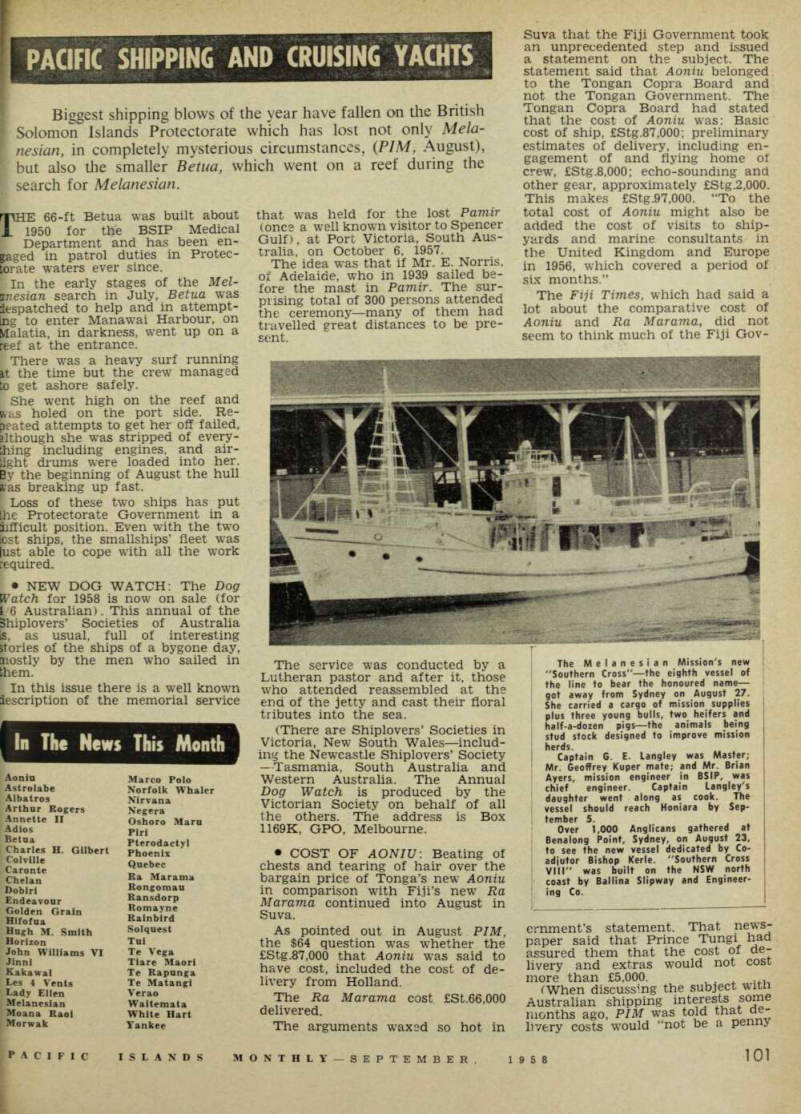
The Melanesian Mission's new "Southern Cross" —the eighth vessel of the line to bear the honoured name — got away from Sydney on August 27.
She carried a cargo of mission supplies plus three young bulls, two heifers and half-a-dozen pigs—the animals being stud stock designed to improve mission herds.
Captain G. E. Langley was Master; Mr. Geoffrey Kuper mate; and Mr. Brian Ayers, mission engineer in BSIP, was chief engineer. Captain Langley's daughter went along as cook. The vessel should reach Honiara by Sep tember 5.
Over 1,000 Anglicans gathered at Benalong Point, Sydney, on August 23, to see the new vessel dedicated by Co adjutor Bishop Kerle. "Southern Cross VIII" was built on the NSW north coast by Ballina Slipway and Engineer ing Co.
less than £10,000.” £AIO,OOO is approximately £Stg. 8,000).
• History Was Not Made:
The Tonga Copra Board’s trim new Aoniu finally arrived at Tonga horn a Dutch shipyard under the Netherlands and nbt the Tongan flag.
Thus what was expected ta be an event of considerable nautical in terest—the first appearance of the Tongan merchant flag in the Atlantic—did not eventuate. There were undoubtedly very good tech nical reasons involving maritime law, employment of a Dutch de livery crew, etc., governing this de cision, and as the same circumstances are likely to apply to the new Hifofua it appears that this par ticular contribution to maritime history will not be made in the forseeable future.
Or may we suppose that some day the huge tankers of the world will bear Nukualofa on their sterns, just as today they bear the ports of registry of such places as Mon rovia and Amman?
• Of Shoes And Ships: Cap
tain Fred K. Klebingat, retired Master of Pacific steam and sail and tireless collector of Pacific maritime history, writes to say that he will soon, at the instigation of an American publisher, sit down and write a book on his sea experi ences in such well known vessels of the past as the barquentine SN Castle which traded to Papeete and the Marquesas: the steamer Beulah, once familiar in the Line Islands, and others.
• Astrolabe Wreck: Re
ferring to recent articles on the be lieved discovery of the Astrolabe wreck on Vanik o r o, Captain Klebingat mentions an old and little-known book by Captain George Bayly entitled Sea Life Sixty Years Ago, published in London in 1885. It was Captain Bayly who pur chased the sword-hilt at Tikopia. • ALBATROS IN UK: Captain Klebingat, now living in San Pedro, California, also sends along'some in teresting clippings on other subjects.
One of these reports the safe arrival in the Thames of Ernest K. Gann’s elegant brigantine-yacht Albatros in early July.
This craft was advertised in PIM a year ago, but when unsold Gann, writer of the best-sellers ( The High and the Mighty, etc.) deemed to cruise to Europe. Last year the Panama-registered 97-ton craft was employed in the filming of Gann’s Twilight for the Gods in Hawaiian waters.
• Problem For Yankee’S
NEW OWNER; Another clipping re ports that the American Merchant Marine Institute lodged a protest in July against a bill then to be con sidered by the US House of Repre sentatives, whereby the 114-ton
brigantine yacht Yankee, so well known in the South Pacific, would be permitted to be documented as a US vessel, with full coastwise privileges. The objection was on the grounds that Yankee was built out side the US.
The Institute opposes the applica tion as part of its policy of pro tecting the US ship-building in dustry.
Although the clipping does not make this clear, it would seem that Yankee’s new owner, Mr. Reed Whitney, plans to use the brigantine as a commercial vessel on coastwise cruises, rather than as a yacht. The Irving Johnsons handed over Yankee
last May on completion of her latest world cruise with cost-con tributing crew. Yankee No. 2—the Johnsons had another craft be fore World War II —is very similar to Albatros. ® DEEP RIVER: With high speed atomic submarine merchant ships in the offing—submarine tank ers are already on the drawing boards—a knowledge of the deep currents of the ocean will soon be of great importance to mariners.
One of the fruits of the IGY has been an increased knowledge of such a current, first discovered four years ago by those untiring United
After completing the above work both vessels headed south to bunker at Papeete.
Horizon then resumed her IGY oceanographic survey work and Hugh M. Smith headed north to the Marquesas to carry out the seventh and last investigation into tuna fishing possibilities Which F & WS has been making in that area over the past two years.
Charles H. Gilbert, on similar work> had arrived back at Honolulu n ff pr fhrpp mrmfbc in fbp orpa rm May 2 months ln ttle area ’ on Results of the survey will doubt less be Published soon, but from the separate interim cruise reports it would see m that albacore, the best variet y of tuna - ha s been scarce, and “
“ummer ar^n S ths iS 'SSSTa^local
°of Thi^bait-flsh^as'been
successfully introduced to Hawaiian
coastal waters during the Marquesas survey - Long-lining-in the Jap “* ProVed o a HANDSOME SHIP: A ship’s profile is often governed by purely utilitarian factors, but in the case of the GEIC Wholesale Society’s new Hongkong built Moana Raoi a photo of which appeared in the builder’s advertisement (p. 33) last month—designers and builders have surely produced as handsome a vessel as any trading in the South Pacific Islands area today. (Over)
States Fish and Wildlife Service re earch vessels of the Pacific Ocean fishery Investigation unit based at lonolulu. ,In June the F & WS vessel iugh M. Smith, and the Scripps institution's vessel Horizon teamed ip to add to the knowledge of this ast-flowing submarine river which weeps across the equatorial Pacific t a depth extending from the 25athom level down to about 75 athoms.
Heading south from Honolulu the esearch ships took soundings and leep-current readings along longi lide 140 W and 4 N to 4 S. Buoys fere anchored in depths of 2,000 o 2,250 fathoms and instruments Jwered.
The findings: a 3-knot current to be eastward below the west-flowing • outh Equatorial Current. Now lamed the Equatorial Undercurrent, bis stream was found to be 100 o 200 miles wide. fOn the basis of such knowledge re may expect some day that, just ® , air today, submarine essels will be navigated at various *vels, depending on their routes.
In Vavau Harbour, Tonga, in late July, were the 48 ft. ketch "Windsong", on a year's cruise from Melbourne with owner skipper Jack Walker and four male com panions; and the 44 ft. cutter "Meridian" (in the background) with American husband and wife team, Richard and Abbie Stafford, who left Panama in 1956 on a world cruise in easy stages. Both yachts later went on to Fiji, where they are now. "Windsong" will head for the Cooks soon, and "Meridian" will go the opposite direction, towards Australia.
Before the vessel cleared Hong kong on delivery to Tarawa, Cap than Vic Ward supplied some re vised details of the ship. Earlier information —in June PlM —h a d given the tonnage as 470 gross and 260 d.w. This is now given as 504 tons gross, with a copra capacity of about 300 tons and tankage for 35 tons of fresh water and 50 tons of diesel oil, giving the vessel a cruising range of 6,000 miles at 10 knots cruising speed.
In addition to the passenger accommodation for six first-class and eight second-class passengers, there are the cabins for master, three mates, three engineers, 22 crew —and 2 officer cadets.
Unlike many ships of greater size, Moana Raoi has fresh water piped to hand basins in all cabins.
Navigational and other equip ment is as listed in June but with the addition of that very handy in strument, the Chernikeeff electric log. In addition to the two life boats there are inflatable rafts to accommodate 50 persons.
The vessel was built under Lloyds’ survey and in excess of require ments.
I Captain Ward, who has the com mand, first went to the Pacific in 1946 as mate in John Williams V, and later was master in John Williams VI. In 1953 he joined GEIC’s Tuvalu (since sold), and transferred later to Tungaru. f He served his time in the Eller man Lines of Liverpool and was twice “ditched” during the war.
With him, as chief engineer in the new vessel, is Mr. Joe Florian, of Fiji, who has been in GEIC service since 1953, and Mr. Tetia Redfern, a former sergeant in Fiji First Battalion, in GEIC ships since the war, is mate. • IGY ACTIVITY; September jvill see a deal of IGY activity round central Polynesian waters.
Hokkaido University’s Oshoro Maru, 616 tons, cleared Yokohama August 5 with a 17-man team of scientists to observe the total eclipse of the sun on October 12 (9.04 a.m.) at New Zealand’s Suwarrow atoll in the Cooks.
The 31-year-old craft (signal letters JLMJ) was due at Raro tonga for clearance on September 17 and should arrive at Suwarrow September 21, according to infor mation obtained by a PIM shipping correspondent in Japan in July.
The early arrival allows time for the setting up and testing of all the equipment prior to the big event. The party should leave Suwarrow on October 20 and reach Yokohama via Honolulu about No vember 2.
Meanwhile an American vessel will be transporting other astronomers of various nations to Mopelia, in French Oceania, and Pukapuka in the Northern Cooks. It is believed that the US Navy will handle this project.
New Zealand astronomers are understood to be reaching Atafu, in the Tokelaus, on the same project per RNZAF Sunderland flying-boat. ,/-\ yj *
• Hmnzs Endeavour: Almost
a sister-ship of that ill-fated Sea Pearl —prior to heading for the Antarctic in December, will make an Islands cruise on mainly IGY duties. She was to clear Auckland on September 5 with an oceanographer aboard and will take ocean samplings en route to the Kermadecs, Fiji, the Tokelaus, Southern and Northern Cooks. Weather observation stations will be supplied, and medical and scientific observers shuttled about the islands prior to her return to Auckland in mid- October.
• RNZAF TUI will also be out and about with other oceanographers aboard. She will carry out a more extensive IGY project of soundings, samplings, and checking of deep currents along the Tonga Trench and the Raoul-Suva-Apia-Auck iand C i rC uit. This will be New Zea land-s last mari ti me expedition of the IGY series • NAME CHANGE: Southern Cross Shipping Co.’s 469-ton tanker has taken on a name more in keep ing with her Island port of registry, The name Verao has replaced Rans dorp.
Though the ship is registered in Suva, the company is registered in Vila—and Verao is the name of a small island off the north coast of
Efate. (Verao is also known as Moso.) The little ship seems to be filling a need in the Tasman trade. In addition to running molasses from Queensland, she has recently up lifted whale oil from New Zea land’s only active whaling station at Tory Channel, Cook Strait.
• Ownership Change;
Norfolk Island Whaling Co., owners of the successful station on Norfolk Island and the 217-ton Ballina-built year-old whale chaser Norfolk Whaler, purchased the assets of the unsuccessful Hauraki Whaling Co of Auckland in July, and plan to resume operations at the Great Barrier Island station outside Auck land in the season now opening.
The well-equipped modern station includes the converted 112-ft Fair mile whale-chaser Colville, which causes a good deal of interest as she lies idle in Auckland. i * P OP ?J : Societe le Nickel’s 10-year-old, 3,660-ton ore carrier
Quebec, bound coastwise from Noumea to Thio, struck a rock at midnight on August 7 when about four miles from Thio. The same company’s Caronte was called to help free Quebec. There was
apparently no serious damage am Quebec arrived back at Noumea fc survey on August 11. • STILL THEY COME: Ever sine PIM was born, its pages have re corded with monotonous regularitJ the birth of some new expeditior in search of Cocos Island (Pacific: treasure. Best known treasure tl come out of the Costa Rican Islam so far has been the collection o books explaining the failures of thr various searchers. (One of the bes these is Sir Malcolm Campbell’] My Greatest Adventure) , Latest to try his luck is a 300 year-old Scot named lan Lilburn— equipped like the others with thr standard set of ancient charts wel: marked with blood-stained fingen prints, but plus “geiger counten and mechanical shovels”—and nine companions, “some of them my ginj friends”, according to a London news despatch. There’s no mention of how the Lilburn outfit is travelf f ln f» b ut with mechanical in the luggage, the finance involves m transport alone should be conn siderable. Whatever the luck with) the gold, the story should make ; dandy television film. * TRANSIT: Two little shipq on delivery voyages passed through Papeete in July. First was the fishri
The Santo Scene
The 1,000 tons "Santo Maru" (left), whic belongs to the South Pacific Fishing Compan (NH), Ltd., of Palikulo, Santo, New Hebrides The vessel does the round trip between Sant< San Francisco and Japan in about eight week —carrying frozen tuna and other fish on th northbound journey, and frozen bait and o on the southbound voyage.
"Milos" (below) was the first of th Australia-West Pacific Line vessels to call a Santo, New Hebrides, to pick up frozen fis for the Japanese market. The photo shows he alongside the wharf of the South Pacific Fish ing Company (NH), Ltd., at Palikulo. The cor veyor and crusher that feeds ice into the tun fishing ships is shown extreme left.
Photos: B. Milder
ing trawler Golden Grain, purchased at Brixham by Wellington fisher man Arthur Dickenson. She had left England on April 24.
The 57-ft craft with 44 hp motor arrived at Wellington early in August.
The other vessel was the new steel tug Wooree, 210 tons and 107-ft overall, with a crew of 11 under Captain A. A. Baxter, of England.
She was on delivery from an English builder to her owners, Waratah Towing Co., Sydney, and had departed Newcastle-upon-Tyne on June 12, Of hydroconic hull type, never be fore seen in New Zealand in this class of vessel, the tug caused great interest in Auc k 1 a nd, shipping people coming from all over the country to witness demonstrations of her manoeuvrability.
• Papuan Vessel For Cook
ISLANDS: Back from his ruminat
: Ing trip to the Far East (June PIM ) Captain Hugh Williams, of Rarotonga decided not to take up his option on the well-known Tas inian explosives vessel Piri.
Instead, he has purchased Dohiri, a small vessel—but certainly more suitable for his purpose as she will tie up alongside the Avarua wharf
at Rarotonga.
Dohiri has been owned and operated for some years in Papua by the Australasian Petroleum Com pany. She was built in Noumea during the early war years and owned by a member of the Mercier family. She was sold to the New Guinea Lutheran Mission after the war; then belonged to an oil com pany, and finally, to the APC.
Dohiri is 80 ft long, has a single Gardner engine and is capable of carrying 80 tons of cargo. The sale to Captain Williams was made through Captain W. L. Kennedy,
Sydney shipbrokers.
When the deal went through, Captain Williams’ old sailing mate, Engineer Livingstone, was lured from his Rarotonga furniture factory, packed his sweat-rags and took off for Sydney. Both he and Williams have been in Port Moresby since early August and expect to sail from there, direct to Rarotonga, at the end of that month.
As we understand it, advertisements in Sydney newspapers have been the means of acquiring the crew, who will sail on a sort of working holiday basis. Several men have flown up to Port Moresby to join the expedition. Captain Williams thought that he might, as well, get a few native crew members in Port Moresby. But as the P-NG Administration is not fond of letting any
of its wards out of its sight, the chances of this seem pretty slim.
The vessel is capable of making the Port Moresby-Rarotonga voyage non-stop—in a minimum of three weeks. And this evidently is Cap tain Williams’ plan though it sounds dull for the working tourists. • another ttot?
And Another For South.
Captain Kennedy has sold another t^ie ve ?. s . el ?> . a * s ?, Negera. She will join the fleet of the Queensland firm, Hayles Cruisers Pty. Ltd., which operates services between Brisbane, Cairns and Townsville and off-shore islands, Negera was built in the UK as a Harbour Defence Motor Launch and was imported from there to Australia after the war. She was
shipped on a freighter at a cost of £2,000). Subsequently she was bought by APC and sailed by that company to Papua, f She was used as a personnel vessel —all accomodation, no cargo space.
She is powered by twin Gardner xliesels.
• Apc Is Not Selling Its
SHIPS: Following reports of APC withdrawing from oil prospecting operations in Papua, there have been numerous inquiries from prospective purchasers of the Co.’s vessels. But APC has no plans for disposing of its fleet at present. Dobiri and Negera were surplus to APC require ments, and would have been dis posed of in any event. • ON THE LIMP: The USS Co. fcrans-Pacific freighter Waitemata, 7,264 tons, experiencing engine trouble soon after departure from the US Pacific Coast in July, made the run south at reduced speed for repairs in New Zealand rather than put back. At Rarotonga the vessel loaded the largest shipment of copra, 350 tons, to leave the Cook Islands for many years. • MANY HANDS: Captain Omer parr’s handsome 242-ton steel passenger schooner Te Vega, believed to be the only vessel under the Liberian flag regularly trading in the South Pacific, was out on another luxury cruise from Papeete to the Cooks in July-August. The two-masted gaff-rigged, 134 ft vessel carries a crew of 19, which seems a lot for a vessel of this size, though some are assigned to the care of
the passengers.
[ Te Vega had a full complement of 12 cabin passengers on her latest cruise and a programme of native dancing was specially arranged for their entertainment at Rarotonga.
Captain Darr is probably the first man ever to demonstrate that this kind of Island cruise can be operated successfully. A very sub stantial sum was invested in fitting
out the schooner and fares are very definitely in the luxury class.
• Another With A Pedigree:
A two-masted schooner whose fares provide more for the ordinary mortal, and which is not adverse to carry ing some cargo, is Tiare Maori, lately busy on the Papeete-Rarotonga run.
Captain Fred, K. Klebingat, of San Pedro, provides some further details of this 168-ton vessel’s history, correcting some earlier in formation.
The schooner was designed by Lee and Brinton, of California, and built by J. H. Madden, of Sausulito for that once well known car manu facturer, Clifford Durant. From him she passed successively to other prominent American owners—lrving T Bush, Lewis Stone, Scripps In stitution as a research vessel, the US Navy Electronics Laboratory, again to Scripps, then to the film company to appear as Henrietta in Around the World in 80 Days— fitted out as a side-wheeler.
This film should therefore be of
particular interest in the Cooks and French Oceania —when it gets there.
Owner Walter S. Johnson acquired the schooner after this. She once had topmasts and bowsprit. She is built mainly of Philippine mahogany, with some iron floors. Present registry is said to be Nassau, Bahamas.
• Eastern Circuit: John
Williams VI, 419-ton London Missionary Society courier, was to
Adventure Bound!
The American schooner “Utopia” made the kind of dash ing picture every amateur yachtsman dreams about as it left Suva harbour in July, headed north. Owner-skipper Fred Peterson had on board a crew of six, four of whom were recruited from Suva during the schooner’s call there en route from NZ. See August “PIM” for a photograph of the skipper and crew. —Stinsons.
clear Suva in mid-September on her annual circuit of the Cook Islands Diission stations, the cruise taking the better part of two months. Calls are scheduled at every island ex cept uninhabited Suwarrow and privately owned Manuae,
• Schedule Upset: Arthur
Rogers, English Brixham work-boat in which Tom and Diana Hepworth have been earning a living in the Mew Hebrides, arrived back in Auck land on August 18 for slipping. The ketch sprang a leak in heavy con ditions north of Auckland in June while northbound after partial re fit. She again went on the slip, and after further work is done will sail for the Solomons. • G & E’s MA UREEN FOR SALE; renders were called for the purchase of the Gilbert and Ellice Islands BO ft, 60 gross ton Maureen in ft-ugust. They close with Secretary of Government, Tarawa, on No vember 30.
The sale of this vessel is probably due to the fact that the Govern ment has just taken delivery of a new vessel from its Hongkong build ers—see elsewhere, this section alt hough in view of the BSIP’s trouble over shipping it might be thought that Maureen could be used in that other part of the Western Pacific High Commission kingdom.
Maureen was built at the end of
the war, of NZ kauri pine. She has a hold capacity of 960 cu ft, has accommodation for the master and one passenger on upper deck and two two-berth cabins below, aft.
Crew accommodation is below decks, forward. She was recently overhauled. Prospective purchasers
may inspect her—at Tarawa. And she will be handed over in the same place—although she will be de livered elsewhere if delivery costs ana crew repatriation expenses are paid.
• Hifofua’S First Job: The
second Tongan vessel to be built in Holland, the new sea-going tug Hifofua, will be launched shortly and is expected to arrive in Tonga “about Christmas.” One of the first jobs she will undertake will be to tow Hifofua I and Aoniu I to Suva, where both will be offered for sale.
The new Hifofua will be of all steel construction. She will be used for general cargo work, for towing barges and also for berthing over seas ships when necessary.
• Soochow In Tow; The New
Guinea Australia line motor vessel Soochow became disabled with an engine breakdown about 250 miles north of Sydney on August 30. She had sailed only that noon from Sydney carrying cargo and 25 passengers to Papua and New Guinea ports.
The weather was, unfortunately, calm, and the 3,000 tons ship just drifted safely in the vicinity of her breakdown until a sister ship, Fengning, arrived and took her in tow on September 1. They reached Brisbane on September 3.
Fengning was also northbound, and had arrived in Brisbane only at 5 p.m. Saturday. She left again 11 hours later for her towing chore.
The fact that Fengning was north bound decided the company to use her for the tow, rather than send another ship and tow the disabled vessel back to Sydney.
In early September it was un known how long Soochow would be held up in Brisbane; but it was
Popular American couple Richard and Abbie Stafford, of the cutter "Meridian” (see August RIM), take life very much as they find it on their Pacific cruise, which started in 1956 In Fiji now, they hope to get to Australia "in real easy stages". In late July they were in Vavau, Tonga, where Stuart Inder photographed them.
hoped that the delay would be only of two or three days.
• Raft-Drifter Killed:
News was received early September of the death of Eric de Bisschop, due to an accident in Tahiti Nui II somewhere in the Cook Group, de Bisschop was leader of the unsuc cesful attempt to drift from Tahiti to South America last year. In April this year he and his com panions left Callao in Tahiti Nui II —described as a “ketch-r igg e d raft” of Chilean cypress logs to drift to Polynesia. (See elsewhere for
further details.)
News of Cruising Yachts
• TE RAPUNGA, that veteran German yacht owned by George Dibbern, which came to grief near Greymouth, NZ, last year, is on the move again. After being dismasted and then stranded on the Tasman crossing from Tasmania. TE RAPUNGA underwent repairs at Grey mouth. In July the yacht cleared there for Wellington and, perhaps, Polynesia.
No details available as yet. • WHITE HART’S owner, Tony Reeves, having received insurance settlement on the salmon fisher-cum-yacht which was destroyed by fire north of Auckland some months ago, departed Auckland for Canada by air on August 18. Tony will probably return and settle in the Cook Islands in 1959. 4 KAKAWAI of Dunedin, NZ, looping back homeward after a cruise to Polynesia, departed Rarotonga August 5 direct for her home port. The yacht left Auckland last April 22. • NIRVANA of Sydney cleared Penrhyn, Northern Cooks, July 8 for Honolulu in continuation of her cruise to the US. • RONGOMAU is the correct spelling of Roy Lidgard’s Auckland yacht which PIM has recently been calling RONGOMAI. • MORWAK, dimensions unknown, with Fred Bretoniere and wife aboard, cleared the Seine on a world cruise in April, so may show up in Polynesia next year. • LES 4 VENTS and Marcel Bardiaux are due back at France about now, com pleting a notable west-bound world circum navigation via the Horn. • JINNI of San Diego has not sur rendered and is not in distress. Those white flags flying from the rigging are merely baby Billy Schallenberg’s diapers out drying. Dad got the idea that fitting them with brass gromets and running them up on the signal halliard would be a neater way of handling the laundry situation. This 41-ft. San Diego cutter should be at Papeete from Honolulu by now—if the H-bombs in the Johnson- Christmas area have not scared them off course too far. • TE MATANGI, 35-ft. ketch of Nevada, USA, with Jack and Jacque Ferguson aboard, should also be in Papeete ere this. They cleared Honolulu July 20, sailed out smartly with that new suit of sails long-expected from the UK. They were weeks late, because of the sail hold-up, and had expected to be in Papeete for the July 14 festivities. JINNI and ANNETTE II cleared Honolulu about the same time. • ADIOS of Newport, Cal., 32-ft. ketch, with John and Janet Steele aboard, which cleared Acapulco March 11 last, has been In Papeete for some time past. • CHELAN, which we reported in January, 1954, as preparing to head for the Islands from California with Vera Hideout lone-handing it, may yet get there “-but under another name and owner. The 20-ft. gaff ketch, now named MOONMIST and owned by Don Johnson at San Diego, Is fitting out for an early departure for Honolulu. No news of Vera.
• ROMAYNE. a steel ketch of about 37ft., originally shipped out from Germany, cleared Vancouver for Hawaii and the South Pacific late July under command of owner Chisholm. • PTERODACTYL—wearing a fearsome pterodactyl figure-head—was also scheduled to clear Vancouver for the Islands in August. The owner-skipper of the 33-ft. schooner, whose name we await, is a professional musician, formerly well known at the Forbidden City nightclub in Van couver. • RAINBIRD, Tahiti ketch of Van couver, ready to clear that port for the South Seas these past 10 years, is again reported as showing signs. Owner Bob Admans just can’t quite make up his mind. • MARCO POLO, bound for Denmark from Auckland, made Rarotonga in mid- August. • LADY ELLEN, 73-ft. luxury Tasmanian ketch with 270 hp diesel and valued by sheep-farmer owner Derek Horn at
£A30,000, cleared Whangarei, NZ, for Papeete August 16 after a week in that port. Also aboard: Mrs. Horn and New Zealanders J. Connell and R. Whimp. The ketch will be offered for sale on arrival at California. • SOLQUEST, which was wrecked off Honolulu last year has now apparently been repaired. In early August, Mr. Len Staples left Honolulu for San Francisco to try to sell the vessel (in which he and his family sailed from Australia). The family remained in Honolulu. The Staples’ request for VS citizenship has not yet been granted. • PHOENIX was still at Kwajalein in early August while her owner Dr. Earle Reynolds, who was arrested on July 1 when he sailed 65 miles inside the Eniwetok Bomb-test area, has made a quick trio from Honolulu to San Francisco and re turn for legal advice. Meantime, Dr.
Reynolds’ son Ted and a Japanese crew man, plan to sail PHOENIX back from Kwajalein to Honolulu.