The Month S New Reading
pp. 90-101 · Read in the full issue
With Judy Tudor
There have been fewer than usual books offering this month —and most of the few have come in the hard variety. This is probably a lull before the flood designed for the Christmas trade —most popular authors and their publishers now being sold on the idea that even if people do not read more books at Christmas, they certainly buy more.
Peoples’ reading habits are chang ing, too. There is now only one big circulating library in Sydney— Dymocks, which alone is still weathering the storm. Angus and Robertson’s big library has closed, and the NSW Bookstall Library, which was an institution for generations, folded up a few years ago.
The suburban, 2/6-down-and-3d a-book libraries are now few and far between.
TV is blamed for some of this; but the modern development of the attractive paper-back is probably more to blame. These come in dozens of varieties, and these days, with most authors, it is only a matter of a couple of years between the expensive, bound library edition costing anything up to 25/- or 30/-, and the paper-jacket edition at 3/9 to 5/6.
Some authors still hold out, with profit, against the cheap edition.
We haven’t yet seen a Nevil Shute in a paper-jacket.
Doc Vernon Was
the Real Angel
ALTHOUGH Australians in two World Wars have experienced misery on many front s Gallipoli, France in 1914-18; Greece, Crete, Tobruk in the Second War— the Kokoda Trail has the honour now to mean, in the annals of Aus tralian military history, the apotheosis of the war-time horror stretch.
In all, the Kokoda campaign lasted only from July, 1942, until the remnants of the Japs, starving and abandoned, were exterminated bv November of the same year.
Nor, at any one time, were vast numbers of troops employed—the fact that the retreat and later the offensive were made along a narrow native trail over incredible mountain peaks, precluded that. But at one time and another most of the Aus tralian units then available, had a taste of the Trail, and no one who feught there, in retreat or advance is ever likely to forget it.
The campaign back and forth across the Kokoda Trail has been covered in official War Histories but War Histories are, at best, cold documents into which personal
opinion or comment are seldom per mitted to seep, These sins of omission certainly cannot be left on the doorstep of Raymond Pauli, in Retreat From Kokoda, a full length and detailed history of the campaign, and as well, an indictment of those re sponsible for Australia’s unprepared ness and conduct of military matters m the first year of the Pacific War.
Australian official thinking, in this period, was conditioned by the knowledge of its frightful inadequacy to defend the mainland. Conse quently, where a policy of throwing
everything into preserving N Guinea would have been the b< and courageous course, there w instead, timid dithering from m unfitted for the task of big c cisions, who could think no furtt than keeping their experienc troops at home to defend the s called Brisbane Line.
But they still wanted a little ea way; in case. So untrained, unru undisciplined Militia troops, avera age about 19, were sent to defe] Papua.
Fortunately the Japs did not see to know this, and by the time th had got around to landing at Gor with a view to crossing the Owi Stanley Range to take Port Mores! in the rear, some stiffening had be» infused into thinking and Pc Moresby became to be regarded £ after all, perhaps defendable.
Advance, Retreat, Advance
Experienced AIF troops were sei to Papua in the second half of 194 But the Kokoda Trail campaign hs shocks for these men, too. The fighting had been done in tU deserts of the Middle East.
Pauli’s story is, of course, primarij of an Australian military task. Bu
it could not help but be, as well, of intense interest to all residents of Papua-New Guinea, many of whom were intimately concerned with the events of the period.
As members of Angau, and other forces, we meet many old friends in Mr Pauli's book —planter Herbert Kienzle of the Yod d a, Tom Grahamslaw, now Chief Collector of Customs for P-NG, Alan Champion, are just a few. And throughout the whole narrative, in a way that will please old Papuans, is a very sincere tribute to the late Doctor G. H. Vernon, medical man, planter and Papuan old-hand, who min
istered to the men on the Trail, soldiers and carrier lines.
The Fuzzy Wuzzy Angel business w as so done to death during the early phase of the New Guinea hghting, that the natural reaction has been to discount much of what the natives actually achieved—or perhaps, more accurately, what they were driven to achieve.
Many were coastal natives, un used to the cold wetness of the fountains. Yet they were kept con tinually on the road, supplied only with one blanket between two or food 6 em ’ anc * ina dequate The farther forward the troops advanced, the more difficult it be came for the supply line. The armv was so raw to Papuan bush condi
tions it had not then learned that the longer and slower the carry, the larger becomes the proportion of the carrier’s load that must be devoted to his own supplies, and the less for the goods he is trans porting.
The retreat from Kokoda saved the complete disintegration of the carrier line —and handed the same problem of attenuated supply lines to the Japs. When the Australians advanced again, much supplying was done by air drops.
Mr. Pauli had access to Doctor Vernon’s diaries, quotes largely from them and altogether gives an ex cellent pen picture of the old Doc, whose efforts on behalf of others had a dedicated quality, but who yet could view life with philosophical commonsense; and who, in the midst of the miseries of the Kokoda cam paign, could write of the beauties of a moonlit night.
Bullets Bound to Miss I still think that the best thing ever written about the Doctor, was done by John Wilkinson, and pub lished first in the PIM many years ago, and later in the collected stories, Where the Trade Winds Blow. John, who lives in the Milne Bay District of Papua, still writes an occasional story for PIM.
He and the Doctor were old friends and their admiration was mutual. After the first battle of Kokoda, Vernon’s diary tells how Wilkinson helped to operate on Lieutenant-Colonel Owen, who had received a mortal wound; and others; “Wilkinson held the lantern for me, and every time he raised it, a salvo of machine-gun bullets was fired at the building. This particular enemy machine-gun was a little be low the edge of the escarpment. . . so its range was bound to be high, and while the roof was riddled, those working below could feel reasonably safe. I was very glad to have Jack Wilkinson with me. He had been an old friend on Misima, and thanks to his exoerience in Greece and Crete, I felt every confidence in him.”
My own acquaintance with the Doctor began about this period, when I had first come to work on the Pacific Islands Monthly. We began a pen friendship—about split infinitives, I think, which, unlike Churchill, “up with which he would not put”.
I shall always cherish the memory of a luncheon with him, around 1944 probably, at the Australia, in Sydney. On his head he wore a very battered and very wide AIF slouch hat, and on his feet the clonkiest field boots. He had refused to be evacuated from Papua at the outbreak of hostilities and had gone to war with what he could hurriedly grab. His uniform, on this luncheon occasion, between the field boots and the hat, looked as though it had
been acquired in the same hasty fashion.
He was as deaf as a post—from an injury at Gallipoli—and the conversation must have been pretty one-sided, but I was more than satisfied with it.
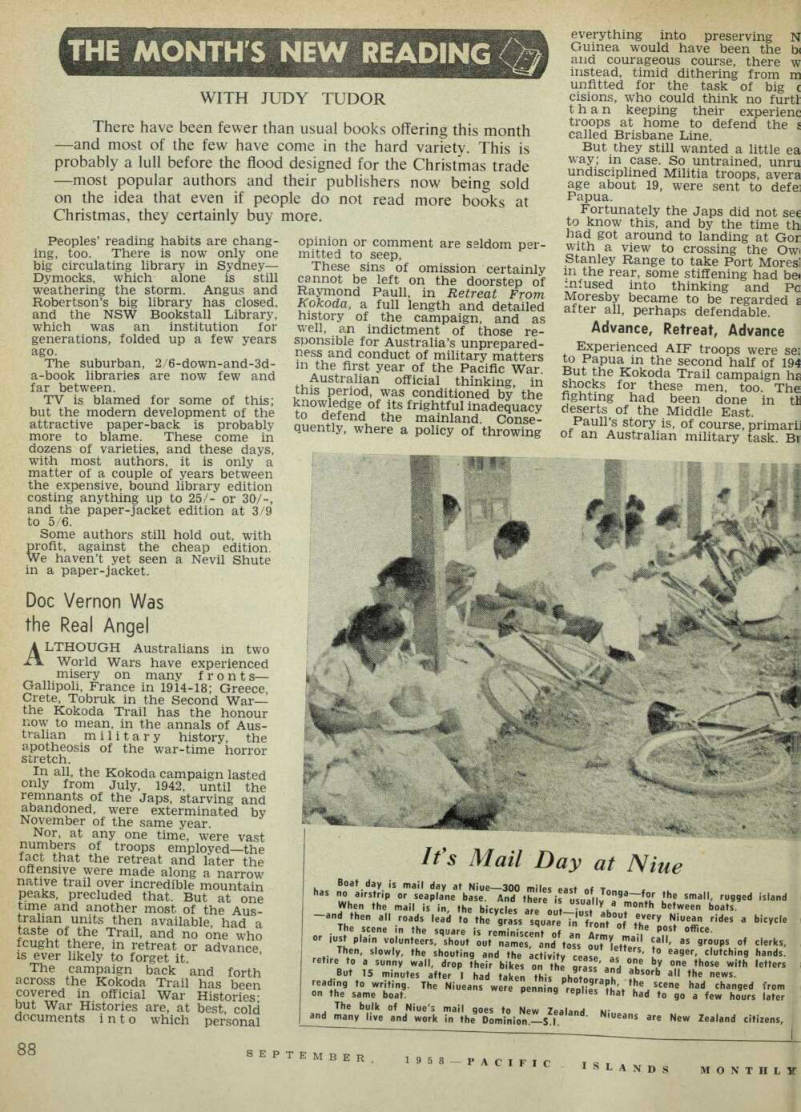
Pauli describes Vernon’s return to Kokoda in November of 1942, with the now victorious Australians. He was worn out from his exertions and suffering from low fever. Then he came on a derelict Japanese bicycle. It had no tyres and only one pedal, but his boys induced him to g^t i )n - v “ So> by his ex cited, whooping Papuan orderlies, vernon made his own triumphal re turn to Kokoda.”
Except in the hearts of people who knew him, Doc Vernon has only one memorial—the Vernon Memorial
Hospital, erected by his friends Eva and Harry Standen on the Bamu River (the Mission in the Mud) in Western Papua. (RETREAT FROM KOKODA. Published by Wm. Heinemann. Australian price, 30/-.)
Transition in
Nigeria
IT is obvious, now that newly literate nations have begun to produce novelists, that we are going to have to learn to read m another dimension. As anthro pologists are fond of telling us about native people—they aren’t in ferior, they’re just different. That is true of their writing, also.
A couple of months ago we had
a West Indian of African ancestoc writing about a Mau Mau. In Thim Fall Apart, Chinua Achebe writ about his own people—Nigerians but at the end of the last centui when the remoter tribes were be ginning to feel the first impact Christianity and Western ideas law and order.
The author, 28, is himself the soj °f a missionary teacher, a gradual of the University at Ibadan, Niger; 1 and a staff member of the Nigeria
Broadcasting Commission,
The odd title, for once in a whii bears a relation to the story. FaL ing apart was w T hat things were di mg for the tribe in the state transition in which the authr leaves them.
He is at present at work on segue!, dealing with the descendant of the characters in Things Fo Apart, as they are in present-dsJ Lagos. It will be interesting to s<£ what he makes of that; and if H can retain the almost detached laoj Prejudice which is the moc notable feature of his first novel..
Wm TH Jr NGS PALL APART - Published Wm. Heinemann. Australian price, 18/J\
Colonial's Dream
of Home
IF your appreciation of Englisi verse stopped about the era • Upert ? rooke > and you say thsr you cannot understand moderj poetry you may have your appetri by S ollected Poems am
Hamilton’ by George
ncthmg about the’ autho?, except
a bat w IS Slr Geol ’ge, 70 years o
vf!» h ? 3 been writim
verse a very long time and bar iancf reputation in his native Engr poe'trv r .n m f a i kable thin S about fs th Jf 1? I s we are concerned —-withmif be ? asiJ y understooDi —without taking it to Lima Pant tortint adil^ g back wards in the disi our troublP^f^ is possible on that we were raises; smith y El6gy and ° liver Goldbl th ° f S?icS? llecti 2 n ’ the last sectionc freauen^iv r Q^ S because the y an/ -anri amusing and to the poimi The first fi l S .V Sectlon ’ a PPeal mosat Retroanppf action, Childhood an.n most b ! c ?f se representte C om? la1 !! ldeas of the Homes' lessfv al^ h 0 t° da y it is hopesc ifsh 0f date ’ Hedgerows, Enggi fish lanes, a governess-cart ... llig h * o’ w erif ° ry children - j°£ betweeim of green elms and hedge-topped wall!*; e y®bright from the grassaa And wS?l Ck J°;S OWI:r a ” d s,raeslinE stitcMo M JlS, WhfA c ? °"‘ of res ‘ crda ?
They the aLtt * *t e * hoTns ’ unghostly, strajfK daft birds, too dignified to shoioi
Approaching wheels, at the last moment run, Swerving now left, now right, wings trailed before us All helter-skelter in an outraged chorus, While mocking them along safe hedges flit Ihe chaffinch and the sideways-peering tit. [ Sir George, it is early revealed, is a lover of nature —he probably nrrites letters to The Times to record the arrival of the first harbinger of Spring; and he is a man strong on family, as his album of family
portraits shows;
Nobody knew whether from East or West, Pole or Equator, Uncle Cyril would come, Ihe eager step and the high-pitched voice in the hall, And the favourite Zula walking stick, with its handle Carved to a red baboon. And nobody knew What season of the year, what day, what hour Uncle Cyril would come; but when he came, I wind blew into the house, and nothing was the same.
Uncle Aubrey, on the other hand, stood in his favourite position ‘Back to the fire-place, with arms [ behind him Looping his long black tails . .
And
Aunt Meredith, I’d heard the family
say, Was poor as a church mouse . .
But best of all, was Great Aunt
Augusta:
\ room of chintz and glass and crackling fire, I cuckoo-clock, and bowls of yellow jas mine, Ind by the mantelpiece in oval frames Black ancestors; there, nodding like a queen, Sat with her crystal ear-rings and lace cap Great-Aunt Augusta, tiny in her chair: But as a rose spreads outward in its scent, So did her essence fill each nook, each ornament.
Part three of the collection,
Epigrams and the Like, are mostly
bright snippets:
The New Peer
Reward for service? W'ider scope?
Or dare they, even now, to hope Removal to “another place”
Would save our country and his face? ! Or in “The Lack”: It was no edible fungus that I ate.
Death knew, it seems, I lacked one doctorate.
D.D.. D.Litt., D.Phil. I hadn’t got any D.80t., nor even a pass degree in botany.
Some, however, are in more seri
ous vein, such as “Epitaphs in
Greece”, written in April, 1941:
I. A Greek Soldier
Go. Stranger, tell the English w r e lie here Servants of freedom, as our fathers were.
11. An English Soldier
Go. countryman, tell of a stranger’s pride, Who shared your heritage and served and died.
111. An Australian Soldier
Of English stock, but on Hellenic tree Grafted, I fell in famed Thermopylae.
I One could wonder, of course, if Hamilton has penned a verse or two an the Englishman and the Greek as they now find themselves on Cyprus.
I (Collected Poems And Epigrams. Pub
lished by Wm. Heinemann. Australian price, 26
5,000 Years of
Men and Ships
[IKE good things coming in small * parcels, unobtrusively with modest title, there appeared Shis month The Sea Story, an ex jellent piece of writing by Captain frank Knight.
Captain Knight’s story is not so nuch one of the sea, as of the rehicles which man made in order ;o journey upon it; and of the men Mho so journeyed, adventured and liscovered.
He began his story with the Hinoans of Crete, who about 3000 3C were probably the first men to jroduce ships capable of trading icross large expanses of sea; and Mith the story of the Argonauts, Mhich was old when Homer wrote )f these legendary heroes about 1100 BC.
The Minoans knew the long ships [-the galleys, which relied mostly )n oars for propulsion, although bey also carried a square mainsail; fnd the round-ship, the Mediter •anean cargo carrier which gener illy used sail. So did mediaeval Europe know them.
Both types of vessel remained itatic in design, not for centuries, >ut for thousands of years. 1 They were flat bottomed for ease ff pulling up on the beach, and this ack of keel failed to prevent side fays drift. The square mainsail did lot permit of anything much better han sailing' before the wind —and, lays Captain Knight, it is not until ibout 1400 AD that there is any widence of an attempt being made ;o sail with the wind abeam or ilightly ahead.
I In the 50 years after 1400 AD, acre advance was made in efficiency tf rig, than in the previous 5,000. [ It was no accident that this period law the beginning of the age of dis sovery. ; The Moors gave the first fore-and ift rig to Europe with the lateen sail—a vast area of sail rigged on I long curved yard on one side of the mast.
It was the first rig that permitted use of beam winds—but it was :umbersome in that tacking and wind change necessitated lowering the whole yard and sail. It was finally abandoned in the Medi terranean—but made use of by northern seamen as an auxiliary on the mizzen mast to assist in steer ing and keeping the vessel’s head into the wind.
In the late 13th Century AD the single mast became two or three,
for greater manoeuvrability; the fore and aft castles—fighting towers that had been superimposed on mediaeval ships in bow and stern— became permanent fixtures, moulded ing the design of the ship; the aftercastle became the high, square, often elaborately-decorated stern of the Elizabethan and post-Elizabethan era; and the size of ships increased —to 100 or 200 or even more tons, In these vessels men set out to discover the world.
Knight’s history of ships extends from those of the Minoans to the end of the era of sail—at which point, of course, we quit the time of romance for that of the technician.
And his stories of the men who sailed these ships cover the same
period. If in your youth you learned to recite Admirals All For England’s Sake (“h ono u r be yours, and fame. . .”). Or Drake He Was a Devon Man, you will find it interest ing to meet the gentlemen again, shorn of the flights of poesy, but now become personalities, And the other nautical heroes of history, Dutch, Spanish, Portuguese and French, who went out and dis covered that the world was round, then pushed out east and west, and almost to the both poles: de Gama and Diaz; Colombus, whose America was the West Indies which, he in sisted, until the end, were part of Asia; and Amerigo Vespucci, who gave his name to the continent, but who is usually forgotten; Hawkins;
lendana; Captain Cook. All stare oldly or timidly out of the pages I Knight’s story, to add their part I this saga of ocean voyaging.
Knight calls his book a Guide to autical Reading, and has supplied, ith each chapter an extraordinarily Stalled bibliography. Unfortunately, I embark on reading all the in vesting books he suggests, would fiifine one’s reading to things ex lusively nautical for the rest of a fe time. [(So far as the Guide to Nautical leading is concerned, Captain might has scored a direct hit with Dur reviewer. A quinquareme is a Bliley which rowed five banks of irs. presumably one above the ther. The only other time the term as been encountered is in Mase eld’s Cargoes —“Quinquareme of ineveh, from distant Ophir..l’ve Iways imagined that the line re ared to a Middle Eastern
[tentate!)
[(THE SEA STORY. Published by Mac lllan and Co., Ltd. Australian price, p 9.)
oldfields Drama—
!Z in 1861-62
[THE “gold rushes” of Victoria, [ California, South Africa, Queens [ land, New Guinea, have a pretty pinite place in history—not only ( stories, but as extraordinary ictors in establishing the economy r new European colonies.
But not many people know of the entral Otago (New Zealand) gold ish of 1860-61. In many respects— pecially in richness and in dif- Dulty of access—it resembled the msational Bulolo-Edie Creek find ! the 1920’5. In one month (August, 161) no less than 5,000 ounces came it to Dunedin, carried by pack )rses and lumbering waggons, over [credible tracks.
The full history is told, in truly ramatic fashion, by H. A. Glasson, [a new book, The Golden Colnveh. he gold in places was unbelievably ch; and almost the whole of the rrain was extremely difficult. It is lountain-and-desert country, torn id twisted by the glaciers and )oded rivers of a million years. The liners were either burned by a aring sun, or frozen stiff by in inse cold.
There was no air transport to live the communications problem, 5 was done eventually in New •uinea. Every pound of tucker had i be carried in by toiling men over le razor-backs. Scores of isolated liners simply starved to death, Ithough their bags contained irtunes in gold-dust.
The book is packed with drama, ftiat a picture Dunedin harbour lust have been, as every kind of filing ship came jostling in, dis liarging cargoes of men—some ex ferienced, some “mugs”—all mad to et into the interior before the best laims were gone.
Among the eager seekers was last century’s most picturesque Pacific character, Captain Bully Hayes; and Mr. Glasson has a fascinating story of what Bully accomplished in an earthen building in Arrowtown in 1862.
(The Golden Cobweb, By H. A.
Glasson. Published by Otago Daily Times Co., Ltd., Dunedin, NZ, 21/-.)
He Wished for
the Ice-Works
THE Sydney Morning Herald for sook art and settled for tradition when it awarded the first prize to the Australian novel, The Sunlit Plain, in one of its sporadic com petitions about a year ago.
Nothing could be more traditional —redolent of gum trees and rabbits —than author H. D. Williamson’s story of NSW’s north-west (around Coonamble), although what is de scribed is not in the least typical these days of the circumstances of the average Australian.
Over 60 per cent, of Australians live in cities, and of the other 40 per cent, who don’t, few live as the characters in this novel. But—and we have said this before —most Aus tralian writers make a better job of writing about the traditional, if exceptional, angle of Australian life than they do when they adopt art forms which are usually dull copies of something similar from overseas.
If this were the story of poor whites in the American South it might be regarded as some sort of classic; as it is a story of poor whites in the north-west of NSW, the fear usually is that it might give people overseas a “wrong idea of Australia”.
Eddie West was a small piece of human flotsam washed up by the flood in which his parents were drowned. He was “adopted” by Deborah Tindall, who had been de serted by her ne’er-do-well husband, and who lived in a humpy at the edge of the town, with her son and her daughter. What Eddie does soon becomes of considerable importance to the family, because unlike Leo, the real son, Eddie soon proves him self different.
He makes only a pretence of being one of the boys of the town; he is not particularly interested in cut ting out his cheque by drinking at the pub; and he so far deviates from the norm as to go to the assistance of the local police trooper when he is in danger of being beaten to death by the proprietor of a travel ling buckjumping show.
Within the scope of his environ ment, Eddie becomes a successful businessman. He first buys out the rabbit-skin merchant (illegal possum skins as a side line); and then becomes the proprietor of a lonely cross-roads hotel. As a kid the lode-star had been a-hankering to own the local ice-works.
This sort of writing is understood by Australians: Although 60 per cent.
live in the cities aforesaid, no Aus tralian is urban as (say), Londoners are urban. Scratch any of them and you will find an acquaintance with a background similar to those Williamson writes about. (THE SUNLIT PLAIN. Published by Angus and Robertson, Ltd., Australian price, 18/9.)
What's New in
Paper Jackets
These Pan and Fontana reprint novels, in cheap paper-backed editions, have re cently been released and should be avail able at your local bookstore:
God Protect Me From My
FRIENDS, by Gavin Maxwell. This is the story of the “most notorious outlaw of our time”, Salvatore Giuliano, a sort of Sicilian Scarlet Pimpernel who for seven years, until his violent death in 1950, was one of the most talked about men in Italy.
It is said that he robbed the rich to give to the poor—but this, of course, is not particularly original for a bandit. What was original was his secession movement: that Sicily should be annexed to the United States. His letter to President Truman about this project, in 1947, opens this story of Giuliano. written by an Englishman, who has done much research on the subject. (Pan Giant).
CASUALTY, by Robert Romanis. For those who like stories about hospitals, doctors, nurses and sick and injured people, this is the dish. It describes all the problems—all of them human that turn up on the doorstep of a great London hospital. (Great Pan).
THE MOON IS DOWN: John Steinbeck’s well-known story of the Nazi invasion of Norway and how a small town—the Mayor, the doctor and post master, the policeman, the 12 regular troops stationed there, and other ordinary men and women— adopt their own methods of dealing with it. (Great Pan).
Down In The Drink, By Ralph
Barker. Stories of the Caterpillar Club (those who bailed out of planes in para chutes) has been followed by these stories of the Goldfish Club, members of which are survivors who ditched their aircraft in the sea or bailed out into it. Pre sumably members of the Caterpillar Club are frequently eligible also to be Goldfish. (Great Pan).
UNDER THE INFLUENCE, by Geoffrey Kerr. After a few drinks Harry Browne could tell what other people were thin
Ing, This led to all sorts of complications, especially with women—because Harry did not always keep his big mouth shut. But the biggest complication was when, through this strange power, he learned of a murder shortly to be committed. This hilarious piece of nonsense is a thriller with a difference. (Great Pan).
I THE PHOENIX, by Lawrence Bachmann.
This story has now been made into a picture by United Artists starring Jeff Chandler. Martine Carol and Jack Palance.
Bachmann, a Hollywood scriptwriter, stayed in Berlin after the war and watched the new city grow from the ashes »f the old. His observations of conditions, immediately after the peace, are the basis if this story of six men employed in the lisposal of deadly bombs. Their pact, that the last to survive shall take the savings if all, provides the right atmosphere for Intrigue and suspense. (Fontana).
GOD’S LITTLE ACRE, by Erskine Cald well. Eight million copies of this novel lave been sold since the author first itruck pay dirt with it w r ay back in 1933. rhis particular edition is probably pro luced now because of the film soon to be •eleased by United Artists. It is the zany, larthy folk-tale type of writing that is the leculiar talent of some American writers.
[Great Pan).
' LORD JOHNNIE, by Leslie T. White is i period piece—“a lusty novel of the 18th ientury”. Lord Johnnie escapes the noose n London by a whisker to sample ad renture in the New World. It has all the ngredients—love, lust, brutality, fighting md fast pace—for this sort of escapist Iterature. (Pan Giant).
UNEASY TERMS, by Peter Cheyney. [he amazing Callaghan finds himself in volved with three beautiful sisters all at mce when their bad tempered step-father ;ets himself murdered in his own manor louse. There seems plenty of reasons for nurdering him. But Callaghan copes with he sisters and sorts it all out. (Fontana).
WAR IN THE AIR, by Gerald Bowman, rhis is what one might imagine from the itle: a survey of air power in two World Vars and what we might expect when we lave the Third. As well as a history of ,ir warfare, a special section at the end if the book lists the types of aircraft hat were used by Britain, America, lermany and Italy in the two last wars, [■here is also an extensive index to the object matter. (Great Pan).
THE NUTMEG TREE, by Margery Sham.
Phis story of the incautious Julia whose implicated entanglement with six trapeze irtists at the same time that she was rying to keep up with the high standard et by her daughter, is still funny dthough it first appeared in 1937. (Fon ana).
THE PAPER CHASE, by Julian Symons.
Jo-education is not universal in England o perhaps that is why the author decides 0 give this mystery story that setting.
Phe “co” part of the double-barrelled work teems to be more important that the ‘educational” —but Whodunit readers will lave nothing to complain about, either. 1 murder takes place in the school the irst night the hero takes up residence.
Ifter that the clues and the complications bllow thick upon one another. (Fontana).
A Murder Is Announced, By Agatha
Christie. Miss Marple knits clouds of pale due wool while she unravels the most iomplicated of the plots that Agatha has sver set her. We do not know whether Hiss Christie has pensioned off M. Hercule Poirot, or not; but Miss Marple these days leems to get the lion’s share of the work, loth are getting very long in the tooth— mt Miss Marple, at any rate, retains her letecting faculties unimpaired. (Pan). fOur copies of above books from Wm. tollins (Overseas), Ltd.)