If Fire Bug Don't
p. 81 · Read in the full issue
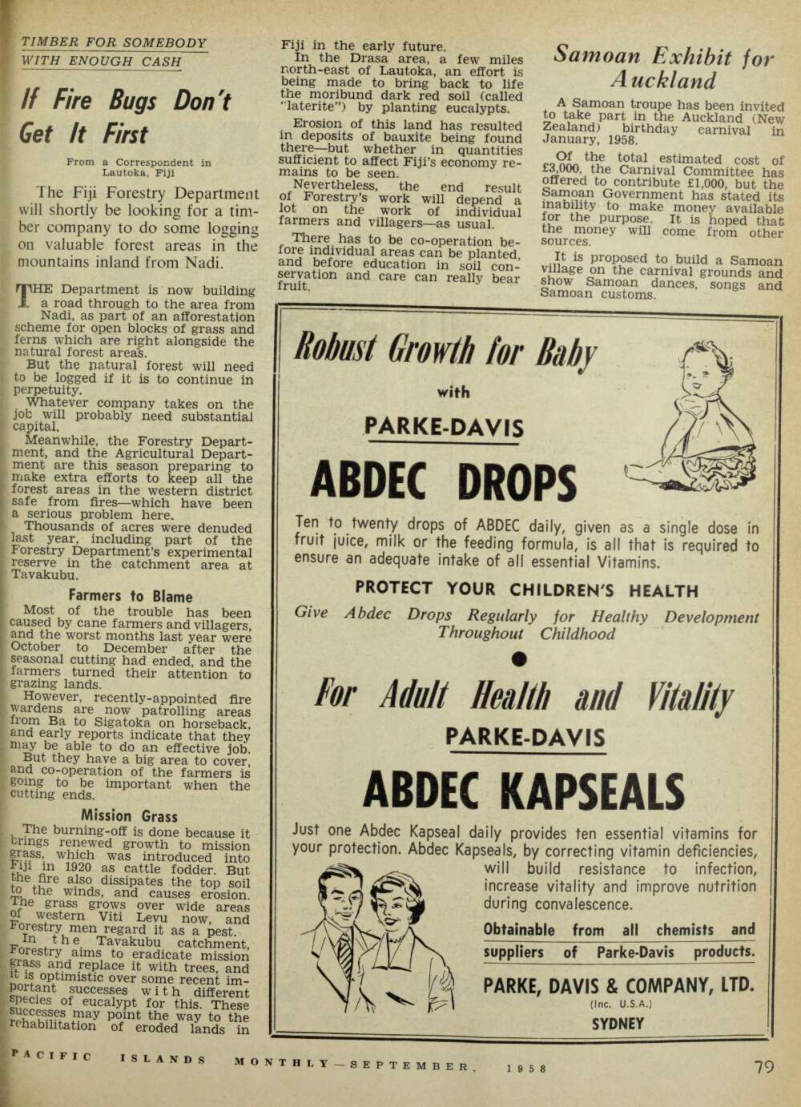
Timber For Somebody
With Enough Cash
If Fire Bug Don't Get It First
From a Correspondent in Lautoka, Fiji
The Fiji Forestry Department
will shortly be looking for a tim ber company to do some logging on valuable forest areas in the mountains inland from Nadi.
THE Department is now building a road through to the area from Nadi, as part of an afforestation scheme for open blocks of grass and ferns which are right alongside the natural forest areas.
But the natural forest will need to be logged if it is to continue in perpetuity. . Whatever company takes on the job will probably need substantial
capital.
Meanwhile, the Forestry Depart ment, and the Agricultural Depart ment are this season preparing to make extra efforts to keep all the forest areas in the western district safe from fires—which have been a serious problem here.
Thousands of acres were denuded last year, including part of the P'orestry Department’s experimental reserve in the catchment area at Tavakubu.
Farmers to Blame
Most of the trouble has been caused by cane farmers and villagers, and the worst months last year were October to December after the seasonal cutting had ended, and the farmers turned their attention to grazing lands.
However, recently-appointed fire wardens are now patrolling areas from Ba to Sigatoka on horseback, and early reports indicate that they may be able to do an effective job.
But they have a big area to cover, and co-operation of the farmers is going to be important when the cutting ends.
Mission Grass
The burning-off is done because it brings renewed growth to mission grass, which was introduced into +v! J 1 i ll 1920 as cat tle fodder. But the fire also dissipates the top soil to the winds, and causes erosion, fhe grass grows over wide areas of western Viti Levu now, and Forestry men regard it as a pest. a. k e . Ta vakubu catchment, Forestry aims to eradicate mission grass and replace it with trees, and ic is optimistic over some recent im successes with different species of eucalypt for this. These ? ay po . lnt the wa y t 0 the rehabilitation of eroded lands in
Fl ln l th? Bras? few miles north-east of Lautoka, an effort is being made to bring back to life the moribund dark red soil (called “laterite”) by planting eucalypts. . Erosion of this land has resulted in deposits of bauxite being found there—k ut whether in quantities sufficient to affect Fiji’s economy remains to be seen.
Nevertheless, the end result of Forestry’s work will depend a lot on the work of individual farmers and villagers—as usual f raere has to be co-operation beand be“ldu^n a in be so P ii an co e n-’ serration and care can really bear
SamOUH Exhibit for
/% Li j ' F±UC KlUflU * o f * Samoan troupe has been invited (N< in January, 1958 carnival in *■ *. i .. , *? tal . estimated cost of the Carnival Committee has to contribute £l,OOO, but the SShSSfi Government has stated its to make jp one y available rpo? fi Tt 18 l loped that WIU COme from other villLe 'T?£ Sed to bu . ild a Samoan
aSd
Samoan customs.