Whales, Tourists And Bananas
pp. 71-73 · Read in the full issue
The Copra Trade Has Gone
Now Levuka Has Hopes Of
By a Staff Writer
Lwwfca carfsfs on its past glory and its present copra trade—it is the chief copra shipping port of Fiji. But if, or probably when fi%auffi%to°the d™t“ P> perhaps the glory that was Levuka V will fall
SO said Judy Tudor, writing in PIM, at the end of 1945. Now, almost 13 years later, the copra boom has folded for old Levuka, on the island of Ovalau, Fiji.
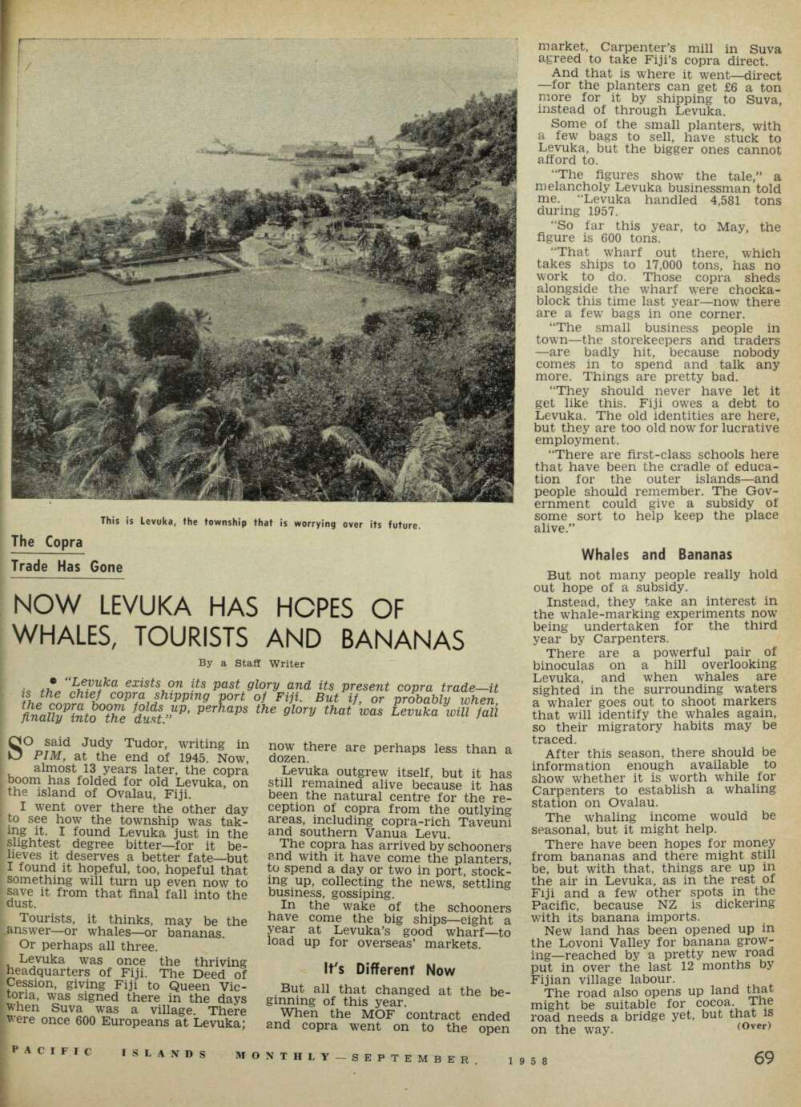
I went over there the other day to see how the township was tak ing it. I found Levuka just in the slightest degree bitter—for it be lieves it deserves a better fate—but I found it hopeful, too, hopeful that something will turn up even now to save it from that final fall into the dust.
Tourists, it thinks, may be the answer—or whales—or bananas.
Or perhaps all three.
Levuka was once the thriving headquarters of Fiji. The Deed of Cession, giving Fiji to Queen Vic toria, was signed there in the days when Suva was a village. There were once 600 Europeans at Levuka;
now there are perhaps less than a dozen.
Levuka outgrew itself, but it has still remained alive because it has been the natural centre for the re ception of copra from the outlying areas, including copra-rich Taveuni and southern Vanua Levu.
The copra has arrived by schooners and with it have come the planters, to spend a day or two in port, stock ing up, collecting the news, settling business, gossiping.
In the wake of the schooners have come the big ships—eight a year at Levuka’s good wharf—to load up for overseas’ markets.
It's Different Now But all that changed at the be ginning of this year.
When the MOF contract ended and copra went on to the open
market, Carpenter’s mill in Suva agreed to take Fiji’s copra direct.
And that is where it went—direct —for the planters can get £6 a ton more for it by shipping to Suva, instead of through Levuka.
Some of the small planters, with a few bags to sell, have stuck to Levuka, but the bigger ones cannot afford to.
“The figures show the tale,” a melancholy Levuka businessman told me. “Levuka handled 4,581 tons during 1957.
“So far this year, to May, the figure is 600 tons.
“That wharf out there, which takes ships to 17,000 tons, has no work to do. Those copra sheds alongside the wharf were chocka block this time last year—now there are a few bags in one corner.
“The small business people in town—the storekeepers and traders —are badly hit, because nobody comes in to spend and talk any more. Things are pretty bad.
“They should never have let it get like this. Fiji owes a debt to Levuka. The old identities are here, but they are too old now for lucrative employment.
“There are first-class schools here that have been the cradle of educa tion for the outer islands —and people should remember. The Gov ernment could give a subsidy of some sort to help keep the place alive.”
Whales and Bananas
But not many people really hold out hope of a subsidy.
Instead, they take an interest in the whale-marking experiments now 7 being undertaken for the third year by Carpenters.
There are a powerful pair of binoculas on a hill overlooking Levuka, and when whales are sighted in the surrounding waters a whaler goes out to shoot markers that will identify the whales again, so their migratory habits may be traced.
After this season, there should be information enough available to show whether it is worth while for Carpenters to establish a whaling station on Ovalau.
The whaling income would be seasonal, but it might help.
There have been hopes for money from bananas and there might still be, but with that, things are up in the air in Levuka, as in the rest of Fiji and a few other spots in the Pacific, because NZ is dickering with its banana imports.
New land has been opened up in the Lovoni Valley for banana grow ing—reached by a pretty new road put in over the last 12 months by Fijian village labour.
The road also opens up land that might be suitable for cocoa. The road needs a bridge yet, but that is on the way. (Over)
This is Levuka, the township that is worrying over its future.
Bananas and cocoa notwithstand ing, the road to the Lovoni Valley might yet be useful to raise income from tourists.
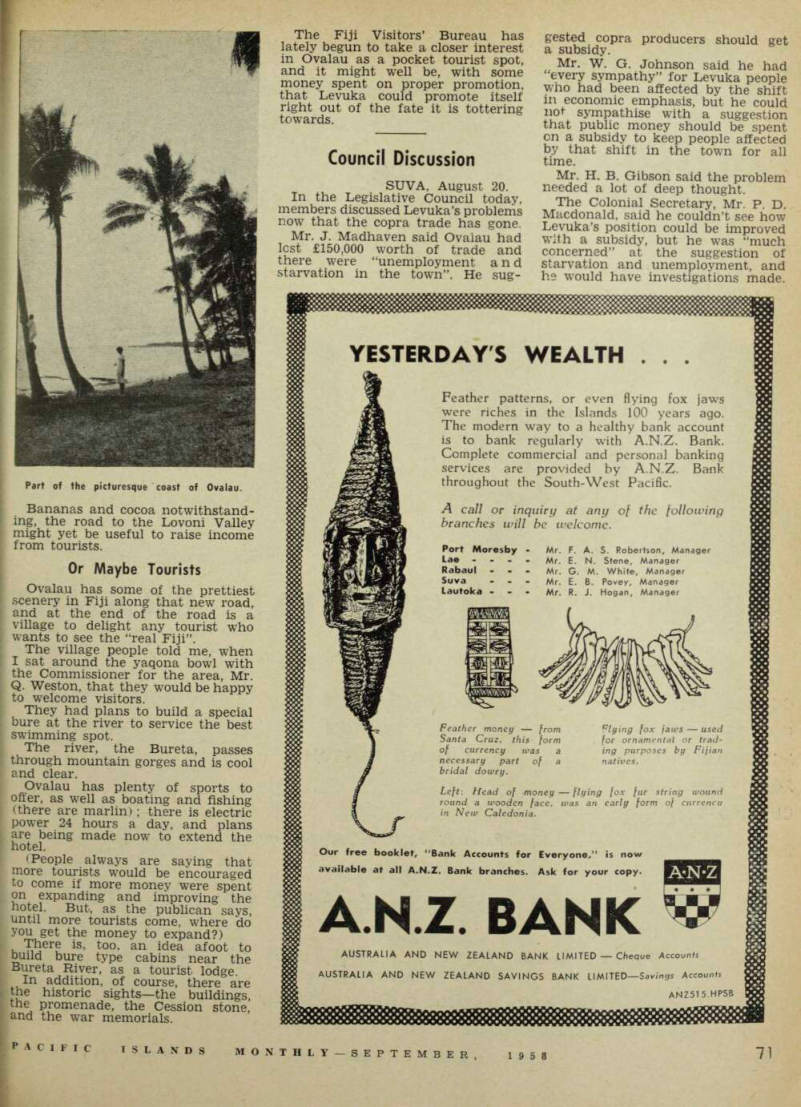
Or Maybe Tourists Ovalau has some of the prettiest scenery in Fiji along that new road, and at the end of the road is a village to delight any tourist who wants to see the “real Fiji”.
The village people told me, when I sat around the yaqona bowl with the Commissioner for the area, Mr.
Q. Weston, that they would be happy to welcome visitors.
They had plans to build a special bure at the river to service the best swimming spot.
The river, the Bureta, passes through mountain gorges and is cool and clear.
Ovalau has plenty of sports to offer, as well as boating and fishing (there are marlin); there is electric power 24 hours a day, and plans are being made now to extend the hotel. (People always are saying that more tourists would be encouraged to come if more money were spent on expanding and improving the hotel. But, as the publican says, until more tourists come, where do you get the money to expand?) There is, too, an idea afoot to build bure type cabins near the Bureta River, as a tourist lodge.
In addition, of course, there are the historic sights—the buildings, the promenade, the Cession stone, and the war memorials.
The Fiji Visitors’ Bureau has lately begun to take a closer interest in Ovalau as a pocket tourist spot, and it might well be, with some money spent on proper promotion, that Levuka could promote itself right out of the fate it is tottering towards.
Part of the picturesque coast of Ovalau.