Death Of An Adventurer
pp. 39-41 · Read in the full issue

Captain Eric de Bisschop in Fatal Raft Drift
To die as one lived is probably the peculiar satisfaction of the adventurer, and this boon came to Captain Eric de Bisschop, noted French explorer and adventurer, who died on August 31, as the result of injuries received at the end of a drift voyage from South America.
DE BISSCHOP’S raft, Tahiti Nui II was wrecked on a reef off Rakahanga, in the Northern Cooks. His four companions got ashore safely but he died of injuries he received.
This raft left Callao, on April 13 this year. At the time, it was described as being made of cypress logs and being “ketch rigged”.
Little has been heard of the drifters since—but reports seem to suggest that somewhere on this journey the original raft was rebuilt into something smaller, and that having failed to drift precisely where they wanted to go, those on board were virtually out of provisions. It was because of their privations that they made the attempt to shoot the reef into Rakahanga—with fatal results for the leader of the expedition.
Soldier, Sailor, Rich Man,
p M roor man De Bisschop has been in and out of PIM pages for the last 25 years, but his early life has always remained something of a mystery.
Apparently he served on sailing ships in his youth; and it is also said of him that he was a midshipman in the French Navy; captain oi a mine sweeper; an airman; police chief; an adviser to the unmese army and a commander of
French forces in the former French Colony of Indo-China.
This must all have happened be fore he went to the Pacific. For the last 25 years, in one way or another, he has been interested in marine affairs in the Tahiti-Hawaii area.
He once owned a 40-ton junk, Fou Po, in which he sailed from China in 1935 and was wrecked on Formosa in a typhoon. He then built another much smaller junk, Fou p o 2, at Amoy, and in this craft cruised extensively in the Western Pacific, calling at Port Moresby amongst other places, A photo of this junk on a slip way at Port Moresby and a story of that cruise appeared in PIM of April, 1935, p. 58. This junk was lost in the Hawaiian Islands later in that year.
Also about 1935 he completed a remarkable voyage from Honolulu to France across the Pacific, Indian Ocean and round the Cape of Good Hope, in a twin-hulled Pacific island sailing canoe. He was accompanied b Y one companion, In November, 1956, he set out with a crew of four on a bamboo raft from Papeete, with the purpose of drifting to South America and re turn to prove that contrary to the Kon Tiki theory of Polynesian colonisation from South America, Polynesians could have drifted to
South America and also have re turned.
The drift on the Humbolt current from South America to Polynesia had already been undertaken suc cessfully by the Kon Tiki and Seven Little Sisters.
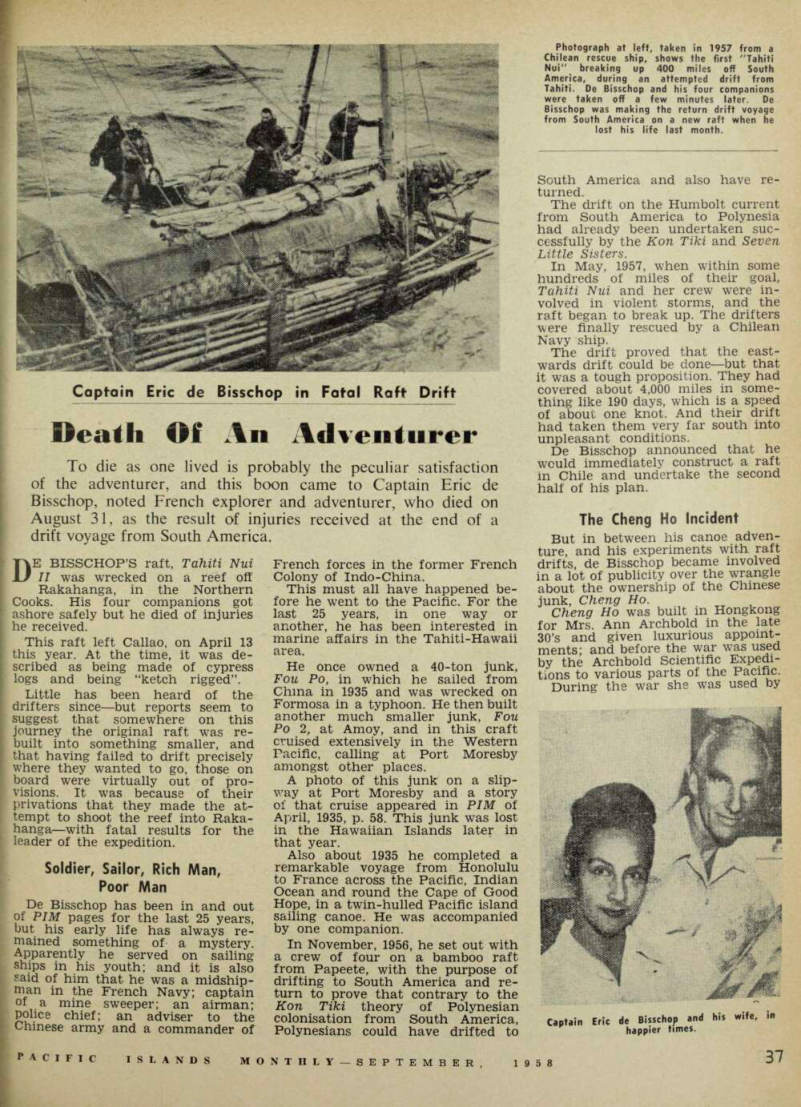
In May, 1957, when within some hundreds of miles of their goal, Tahiti Nui and her crew were in volved in violent storms, and the raft began to break up. The drifters were finally rescued by a Chilean Navy ship.
The drift proved that the east wards drift could be done—but that it was a tough proposition. They had covered about 4,000 miles in some thing like 190 days, which is a speed of about one knot. And their drift had taken them very far south into unpleasant conditions.
De Bisschop announced that he would immediately construct a raft in Chile and undertake the second half of his plan.
The Cheng Ho Incident
But in between his canoe adven ture, and his experiments with raft drifts, de Bisschop became involved in a lot of publicity over the wrangle about the ownership of the Chinese junk, Cheng Ho.
Cheng Ho was built in Hongkong for Mrs. Ann Archbold in the late 30’s and given luxurious appoint ments; and before the war was used by the Archbold Scientific Expedi tions to various parts of the Pacific.
During the war she was used by
Photograph at left, taken in 1957 from a Chilean rescue ship, shows the first "Tahiti Nui" breaking up 400 miles off South America, during an attempted drift from Tahiti. De Bisschop and his four companions were taken off a few minutes later. De Bisschop was making the return drift voyage from South America on a new raft when he lost his life last month.
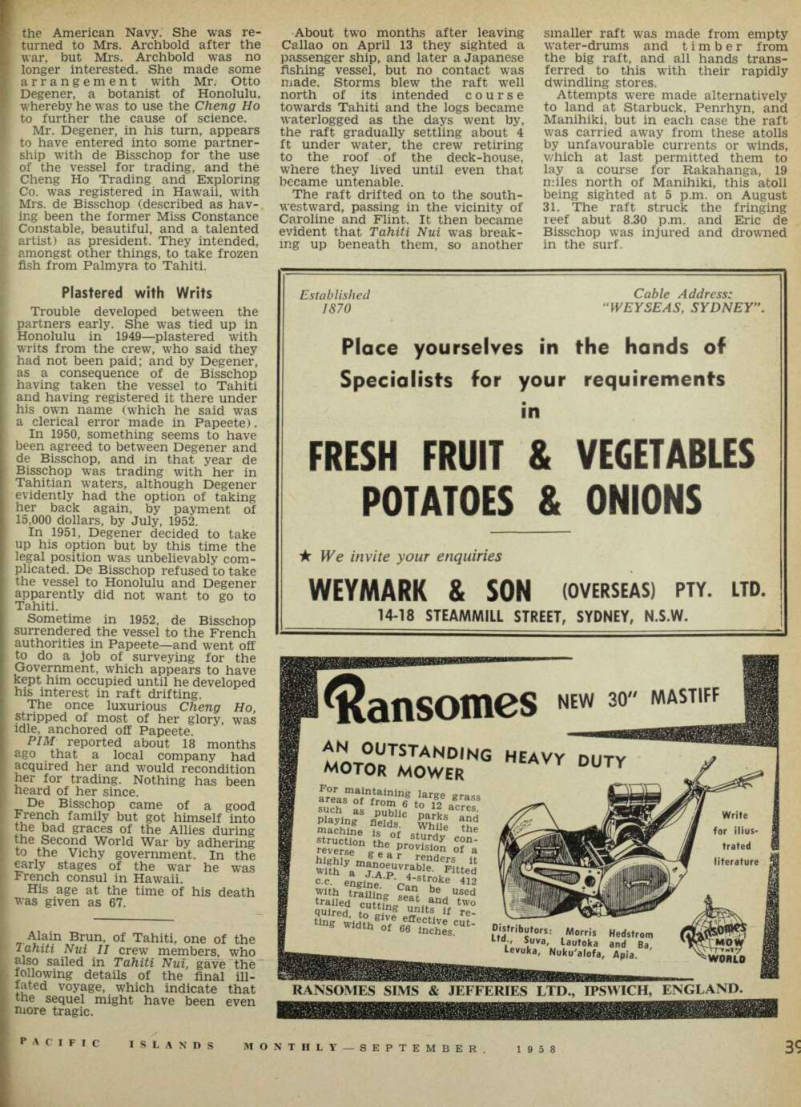
Captain Eric de Bisschop and his wife, in happier times.
the American Navy. She was re turned to Mrs. Archbold after the war, but Mrs. Archbold was no longer interested. She made some arrangement with Mr. Otto Degener, a botanist of Honolulu, whereby he was to use the Cheng Ho to further the cause of science.
Mr. Degener, in his turn, appears to have entered into some partner ship with de Bisschop for the use of the vessel for trading, and the Cheng Ho Trading and Exploring Co. was registered in Hawaii, with Mrs. de Bisschop (described as hav ing been the former Miss Constance Constable, beautiful, and a talented artist) as president. They intended, amongst other things, to take frozen fish from Palmyra to Tahiti.
Plastered with Writs Trouble developed between the partners early. She was tied up in Honolulu in 1949 —plastered with writs from the crew, who said they had not been paid; and by Degener, as a consequence of de Bisschop having taken the vessel to Tahiti and having registered it there under his own name (which he said was a clerical error made in Papeete).
In 1950, something seems to have been agreed to between Degener and de Bisschop, and in that year de Bisschop was trading with her in Tahitian waters, although Degener evidently had the option of taking her back again, by payment of 15,000 dollars, by July, 1952.
In 1951, Degener decided to take up his option but by this time the legal position was unbelievably com plicated. De Bisschop refused to take the vessel to Honolulu and Degener apparently did not want to go to Tahiti.
Sometime in 1952, de Bisschop surrendered the vessel to the French authorities in Papeete—and went off to do a job of surveying for the Government, which appears to have kept him occupied until he developed his interest in raft drifting.
The once luxurious Cheng Ho, stripped of most of her glory, was idle, anchored off Papeete.
PIM reported about 18 months ago that a local company had acquired her and would recondition her for trading. Nothing has been heard of her since.
De Bisschop came of a good French family but got himself into the bad graces of the Allies during the Second World War by adhering to the Vichy government. In the early stages of the war he was French consul in Hawaii.
His age at the time of his death was given as 67.
Alain Brun, of Tahiti, one of the lahiti Nui II crew members, who also sailed in Tahiti Nui, gave the following details of the final ill fated voyage, which indicate that the sequel might have been even more tragic.
About two months after leaving Callao on April 13 they sighted a passenger ship, and later a Japanese fishing vessel, but no contact was made. Storms blew the raft well north of its intended course towards Tahiti and the logs became waterlogged as the days went by, the raft gradually settling about 4 ft under water, the crew retiring to the roof of the deck-house, where they lived until even that became untenable.
The raft drifted on to the southwestward, passing in the vicinity of Caroline and Flint. It then became evident that Tahiti Nui was break- Ing up beneath them, so another
smaller raft was made from empty water-drums and timber from the big raft, and all hands trans ferred to this with their rapidly dwindling stores, Attempts were made alternatively to land at Starbuck, Penrhyn, and Manihiki, but in each case the raft was carried away from these atolls by unfavourable currents or winds, which at last permitted them to lay a course for Rakahanga, 19 miles north of Manihiki, this atoll being sighted at 5 p.m. on August 31. The raft struck the fringing reef abut 8.30 p.m. and Eric de Bisschop was injured and drowned in the surf.