A New Set-Up In Fiji
pp. 23-24 · Read in the full issue
Six Vital Years Have Been Wasted
Whitehall's Plan For A New Set-Up In Fiji
Pmhahle new steos in the revision of Fiji s governmental n-ODaoie new Stcpb m uici i^ in , P m P nt hv machinery and policies were indicated m an announcement D\ fhe retiring Governor of Fiji (Sir Ronald Garvey) m the Legisme rearing J v lative Council there on August id.
rHE British Colonial Office, he said, is going to appoint a Com mission of Inquiry “from the Jnited Kingdom” which, probably in 1959. would “examine the surveys Df the Colony’s natural resources >nd population trends and, having regard to the need to ensure the maintenance of a good standard of living for all sections of the com munity, recommend how the de velopment of the Colony and its re sources should proceed.”
He said the Secretary for the Colonies now was seeking suitable persons to be chairman and mem bers of the Commission.
Editorial Comment
This, of course, is all to the good —it is a move which Fiji citizens and newspapers have been advocat ing for a long time.
But, consider the appalling slow ness of the procedure. It was in 1952 that Fiji Legco, on the motion of Mr. Maurice Scott, resolved: That this Council urges that a Com mission of Inquiry from the United King dom be appointed FORTHWITH to inquire into and advise as to what steps should be taken to ensure that this Colony will not suffer from over-population, to the detriment of the standard of living of all races in the Colony.
Since that resolution was adopted, six years ago, asking for immediate action, the Fiji population has grown from 312,000 to 375,000 —by no less than 16h per cent.—and it is unlikely that the Commission of Inquiry will really get into action before 1959.
Then the Commission will travel around, in the usual leisurely fashion, taking evidence and examining documents and compiling a report.
There is little hope of the report reaching the Colonial Office before 1960, and being acted upon before 1961 or 1962.
By then the Colony, with 400,000 people, will be bursting at the seams.
Seeking "Basic Information"
Realising, doubtless, that there has been an embarrassing waste of time, the Governor said that before the Commission of Inquiry could be established, it must be provided with “certain basic information on the economic potential in various fields in the Colony”—the inference apparently being that the appoint
ment of the Commission has been delayed while this data is being com piled.
The plan to appoint the Commission (he cpntmued) had caused certain other important plans—and, notably one to eiffarge and the control over native lands, through the Native Land Trust Board to be deferred.
He said that “some of these proposals had been enshrined in draft legislation, but that legislation must now await consideration by the Commission, as the substance of it will be fundamental to the task of tne Commission.
“There is every prospect,” the Governor said, “that the Commission’s recommendations will, in effect, give you a blue print for future policy.”
It is known, of course, that some “surveys” have been made, and that others are in progress—something of the kind by a Professor of Geography from Australia is either under way , or pending.
But even that does not explain the appalling delay that has occurred.
The Governor seemed to dismiss, liohtly, the embarrassing problems created by Fiji’s extraordinary in crease in population—it has nearly doubled in the last 20 years—by say ing that “Fiji’s population problem is only part of a world-wide problem”—that the population of the world generally was growing at a staggering rate.
That, of course, is true; but what His Excellency seemed deliberately to ignore is that few, if any, countries have Fiji’s peculiar set-up — namely, most of the lands vital to the country’s subsistence are held by the indigenous race, while an industrious and ambitious immigrant race, now considerably outnumber ing the indigenes, cannot get ready access to the land.
It is—to say the least—very un wise to treat this as “only part of a world-wide population problem”. (His Excellency’s own words). It cannot go into that category while the Fijians hold the land, and the more rapidly increasing Indians are clamouring for it. (Over)
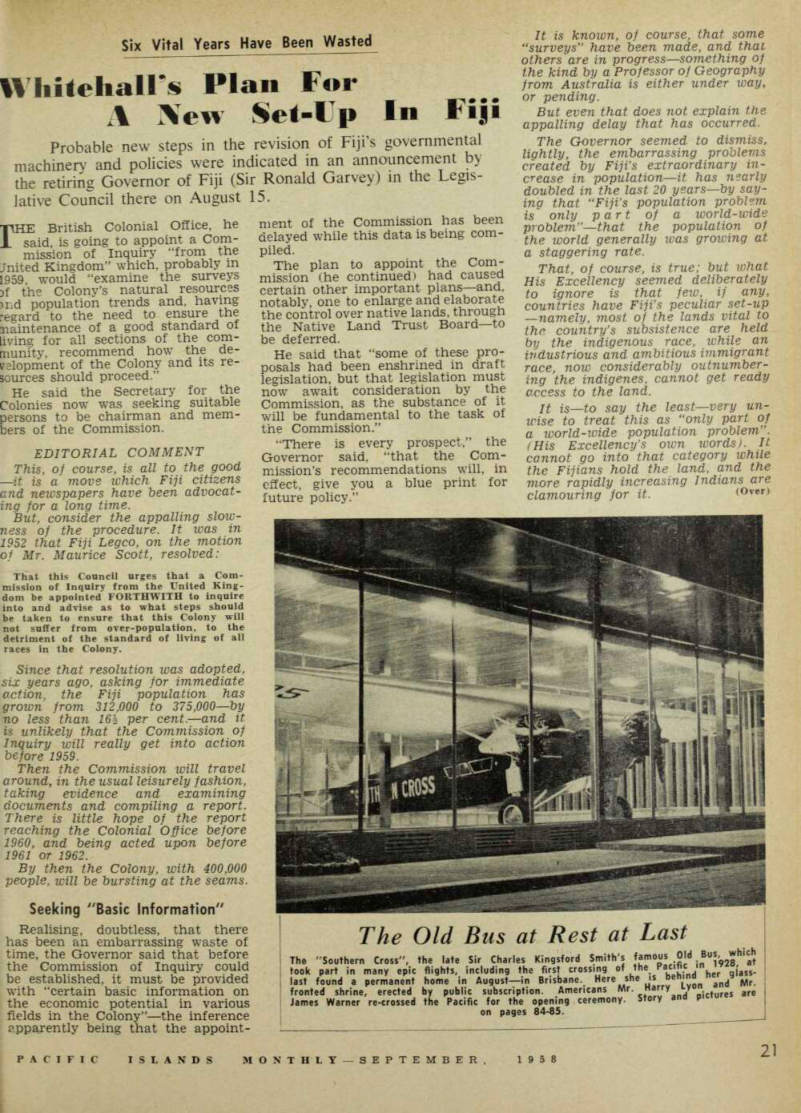
The Old Bus at Rest at Last The "Southern Cross", the late Sir Charles Kingsford Smith's famous Old Bus, Which took part in many epic flights, including the first crossing of the Pac ific in 1928 at last found a permanent home in August—in Brisbane. Here she is behind her glass fronted shrine, erected by public subscription. Americans Mr. Harry Lyon and Mr.
James Warner re-crossed the Pacific for the opening ceremony. Story and pictures are on pages 84-85.
We are sure that Sir Ronald Garvey, during his six years of office, did his utmost to grapple with this problem. We fear that in this section of his speech he was seeking excuses for the dilatoriness of the British Colonial Office, which all his urgent representations had failed to remove.
Rians for Development
The Governor, in his address to the Council, dealt at some length with developmental possibilities, and made these points; • Following conferences of ad ministrative officers, the Govern ment favoured the policy of build ing more feeder roads for the open ing up of undeveloped country, while slowing down on main de velopmental roads from which no early economic return could be ex pected. • The idea of opening up new country between Matavatacou and Viti Levu Bay was favoured, even if in this case a new development road was required. • New staff had permitted additional work in geological map ping, and the encouragement of hopes that new industries could be developed, based on impressive new deposits of bauxite uranium and other valuable metals. • Although a large hydro-electric plan based on Navua had been abandoned, and the plan based on Monosavu was not encouraging, he still felt that investigations should continue, seeking some means of harnessing the abundant water from the central mountains of Viti Levu. He suggested Waiga Gorge as a possibility.
£350,000 p.a. More Taxation
Both the Governor and the Financial Secretary (Mr. Davidson) gave details of plans for raising another £350,000 per annum by new taxation—a vital need in view of tne Colony’s present position. These plans included: • Reintroduction of port and customs service tax on imports. • Increased taxes on goods and commodities not in general use in the community. Higher taxes on whisky, gin, rum and brandy. • Reduction in the public service staff—only 20 of 166 posts which had recently become vacant were being filled. & • Reduction in capital works which normally would be financed out of revenue.
In the 1957 financial year, Fiji’s accounts showed an actual deficit of £500,000, while the Colony’s reserves decreased by £871,000.
It was proposed to reduce capital expenditure in 1959 from £3i million to £2l million.
It was planned to add £1 million to reserves in the next couple of years, to bring them back to £IJ million, which was the lowest figure regarded as safe.