Tonga Renews Its Treaty Of Friendship
pp. 19-20 · Read in the full issue
Honours, Gifts and Old World Diplomacy
And Protection With Britain
The oldest of the Pacific monarchies, Tonga, renewed its 57-year-old Treaty of Friendship and Protection with Britain, at a colourful series of functions at Nukualofa on August 26.
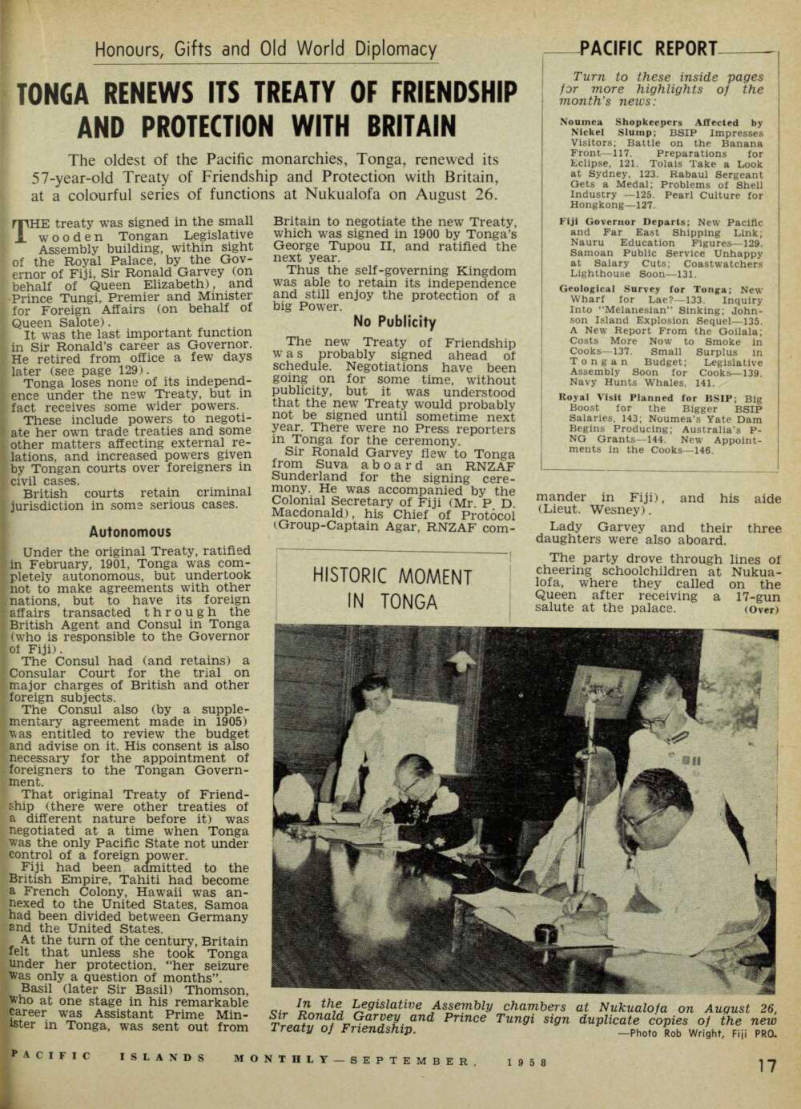
THE treaty was signed in the small wooden Tongan Legislative Assembly building, within sight of the Royal Palace, by the Gov ernor of Fiji, Sir Ronald Garvey (on behalf of Queen Elizabeth), and Prince Tungi, Premier and Minister for Foreign Affairs (on behalf of Queen Salote).
It was the last important function in Sir Ronald’s career as Governor.
He retired from office a few days later (see page 129).
Tonga loses none of its independ ence under the new Treaty, but in fact receives some wider powers.
These include powers to negoti ate her own trade treaties and some other matters affecting external re lations, and increased powers given by Tongan courts over foreigners in civil cases.
British courts retain criminal jurisdiction in some serious cases.
Autonomous Under the original Treaty, ratified in February, 1901, Tonga was com pletely autonomous, but undertook not to make agreements with other nations, but to have its foreign affairs transacted through the British Agent and Consul in Tonga (who is responsible to the Governor of Fiji).
The Consul had (and retains) a Consular Court for the trial on major charges of British and other foreign subjects.
The Consul also (by a supple mentary agreement made in 1905) was entitled to review the budget and advise on it. His consent is also necessary for the appointment of foreigners to the Tongan Govern ment.
That original Treaty of Friend ship (there were other treaties of a different nature before it) was negotiated at a time when Tonga was the only Pacific State not under control of a foreign power.
Fiji had been admitted to the British Empire, Tahiti had become a French Colony, Hawaii was an nexed to the United States, Samoa had been divided between Germany and the United States.
At the turn of the century, Britain felt that unless she took Tonga under her protection, “her seizure Was only a question of months”.
Basil (later Sir Basil) Thomson, who at one stage in his remarkable career was Assistant Prime Min ister in Tonga, was sent out from
Britain to negotiate the new Treaty, which was signed in 1900 by Tonga’s George Tupou 11, and ratified the next year.
Thus the self-governing Kingdom was able to retain its independence and still enjoy the protection of a big Power.
No Publicity
The new Treaty of Friendship wa s probably signed ahead of schedule. Negotiations have been going on for some time, without publicity, but it was understood that the new Treaty would probably not be signed until sometime next year. There were no Press reporters in Tonga for the ceremony.
Sir Ronald Garvey flew to Tonga from Suva aboard an RNZAF Sunderland for the signing cere mony. He was accompanied by the Colonial Secretary of Fiji (Mr. P D Macdonald), his Chief of Protocol (Group-Captain Agar, RNZAF com
mander In Fiji), and his aide (Lieut. Wesney).
Lady Garvey and their three daughters were also aboard.
The party drove through lines of cheering schoolchildren at Nukua lofa, where they called on the Queen after receiving a 17-gun salute at the palace. (Over)
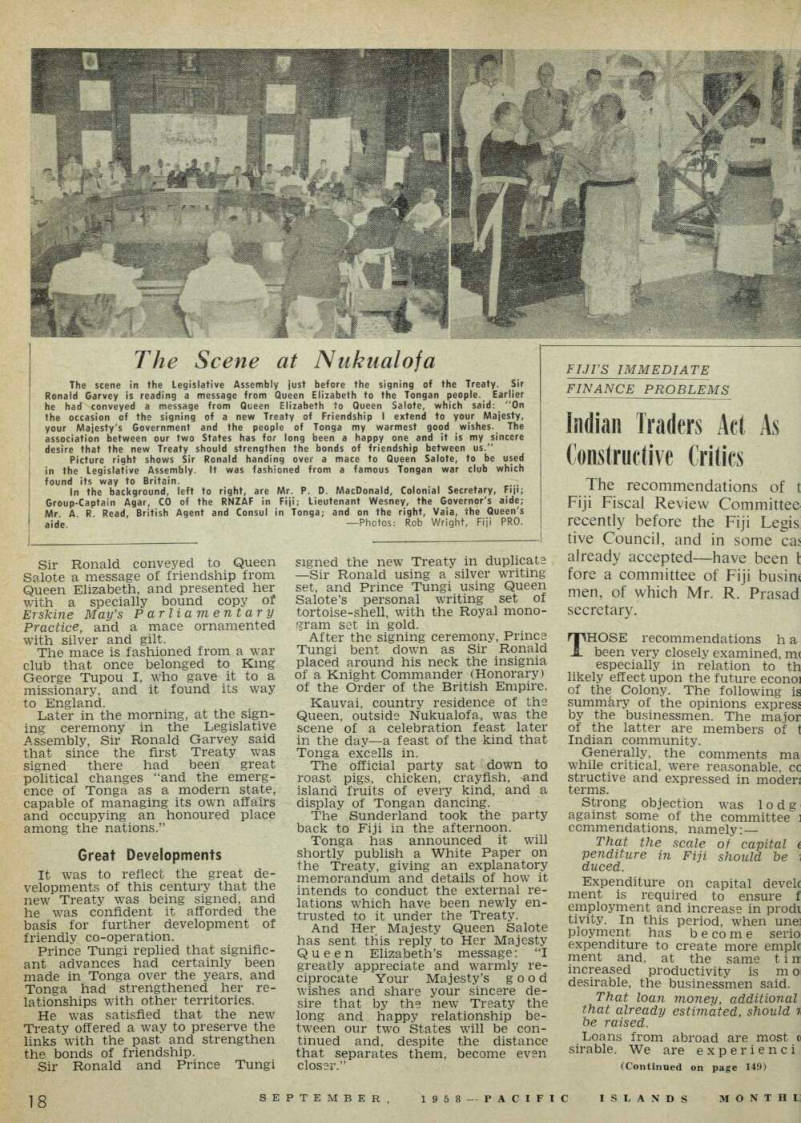
Sir Ronald conveyed to Queen Salote a message of friendship from Queen Elizabeth, and presented her with a specially bound copy of Erskine May’s Parliamentary Practice, and a mace ornamented with silver and gilt.
The mace is fashioned from a war club that once belonged to King George Tupou I, who gave it to a missionary, and it found its way to England.
Later in the morning, at the sign ing ceremony in the Legislative Assembly, Sir Ronald Garvey said that since the first Treaty was signed there had been great political changes “and the emerg ence of Tonga as a modern state, capable of managing its own affairs and occupying an honoured place among the nations.”
Great Developments
It was to reflect the great de velopments of this century that the new Treaty was being signed, and he was confident it afforded the basis for further development of friendly co-operation.
Prince Tungi replied that signific ant advances had certainly been made in Tonga over the years, and Tonga had strengthened her re lationships with other territories.
He was satisfied that the new Treaty offered a way to preserve the links with the past and strengthen the bonds of friendship.
Sir Ronald and Prince Tungi
signed the new Treaty in duplicate —Sir Ronald using a silver writing set, and Prince Tungi using Queen Salote’s personal writing set of tortoise-shell, with the Royal mono gram set in gold.
After the signing ceremony, Prince Tungi bent down as Sir Ronald placed around his neck the insignia of a Knight Commander (Honorary) of the Order of the British Empire.
Kauvai, country residence of the Queen, outside Nukualofa, was the scene of a celebration feast later in the day—a feast of the kind that Tonga excells in.
The official party sat down to roast pigs, chicken, crayfish, and island fruits of every kind, and a display of Tongan dancing.
The Sunderland took the party back to Fiji in the afternoon, Tonga has announced it will shortly publish a White Paper on the Treaty, giving an explanatory memorandum and details of how it intends to conduct the external re lations which have been newly en trusted to it under the Treaty.
And Her Majesty Queen Salote has sent this reply to Her Majesty Queen Elizabeth’s message: “I greatly appreciate and warmly re ciprocate Your Majesty’s good wishes and share your sincere de sire that by the new Treaty the long and happy relationship be tween our two States will be con tinued and, despite the distance that separates them, become even closer.”
The Scene at Nukualofa
The scene in the Legislative Assembly just before the signing of the Treaty. Sir Ronald Garvey is reading a message from Queen Elizabeth to the Tongan people. Earlier he had conveyed a message from Queen Elizabeth to Queen Salote, which said: "On the occasion of the signing of a new Treaty of Friendship I extend to your Majesty, your Majesty's Government and the people of Tonga my warmest good wishes. The association between our two States has for long been a happy one and it is my sincere desire that the new Treaty should strengthen the bonds of friendship between us."
Picture right shows Sir Ronald handing over a mace to Queen Salote, to be used in the Legislative Assembly. It was fashioned from a famous Tongan war club which found its way to Britain.
In the background, left to right, are Mr. P. D. MacDonald, Colonial Secretary, Fiji; Group-Captain Agar, CO of the RNZAF in Fiji; Lieutenant Wesney, the Governor's aide; Mr. A. R. Read, British Agent and Consul in Tonga; and on the right, Vaia, the Queen's aide. —Photos: Rob Wright, Fiji PRO.