tropicalities
pp. 87-88 · Read in the full issue
Pacific Islands Monthly
Magazine Section
Fiji is Using New Guinea
Clouds
ALTHOUGH it is not customary for clients to lie on their backs on the floor when they visit travel booking-offices to buy airline tickets, that is what some of them may be inclined to do in Tasman Empire Airways’ new office in Suva.
TEAL has put the mural—a large map of the Pacific with assorted damsels representing various regions —on the ceiling, for the lack of solid walls to put it in a more normal position.
Most of the wall-area is glass, and the only solid piece is taken up with a huge enlargement of a photograph of clouds. Clouds are appropriate enough for an airline office, but the odd and the interest ing about these particular clouds are that they belong between Port Moresby and Lae, New Guinea, and not in Fiji at all.
That’s not to say, of course, that Fiji cannot produce a cloud or two of its own, when put to it; but those brewed amongst the 15,000 ft peaks in the Territory can be classed among Nature’s spectacles, and are designed to appeal to photographers. New Guinea does not mind loaning Fiji a cloud or two, anyway.
The photographer responsible for the clouds in TEAL’s Suva office is Mr. Leo White, a Kiwi, editor publisher of White’s Aviation, and the best-known aerial photographer in the South Pacific. He made a photographing visit to Papua-New Guinea some years ago.
Mashed Potatoes—No Gravy
ALL my New Guinea language difficulties these days are con fined to battles with hotel dining-room boys who are used to guests ordering by number from the nienu, without any deviations or flights of fancy.
Most of the tussles concern my desire to have mashed potatoes instead of the boiled-in-oil variety; and NO gravy. Either dining-room bcjys are dumber than most, or my 1 Pidgin—and even straight English —are worse than I thought.
My extraordinary requirements in
lood have had more extraordinary results—a plate swimming with gravy and nothing else; or a plate oi roast potatoes, and nothing else; and sometimes a pile of meat, and
nothing else. Never exactly what was required—except once.
I was PTiinfT through the usual 1 was going tnrougn me usual rigmarole in the Hotel Cecil in Lae one night—all about me no liking gravy; and the potatoes should not be cooked one-time grease but in water and later “fought”, and all the rest of it—but instead of the native waiter’s mouth falling open in dumbfounded amazement, as was standard at such sessions, this particular one said: “Yes, Sinabada.
You want mashed potatoes and W “ h yOUr r ° aSt beBf ’ bUt had e st r fye?to°m?b a th P e? P^ a d n e, Who But even on the New Guinea side, Pidgin is going out in some quarters. A few months ago, old Territorian H. T. (Blue) Allan, who now lives in northern NSW, went back to NG, to, amongst other things, open the Rabaul Natives’
Ex-Servicemen’s club house. In July, back home again, he received a letter from Samison Gila, the Hon. Sec. of the Rabaul branch of the Native Ex-Servicemen’s Assn.
It began:
Dear Master Blue, The President and Committee have asked me to write and thank you for your kind donation of a Banner to our Branch.
We are all very happy to receive such a good Banner and to let you know that it was used for the first time at the recent Naturalisation Ceremony held at the RSL Club.
We know that you will be pleased to hear that our Club House is being used by many of our Members since you have opened it and also that we have had many visitors from Australia to have a look at it.
The form of address —Dear Master Blue—would probably annoy some of our more zealous reformers who would regard it as a hangover from slavery. But I dare say Samison Gila feels like I do —that it is a mark of respect to a guy who was highly regarded by both Europeans and natives in the days of peace; and was a fine soldier in two World Wars. —JT.
What Makes a Lady?
THE fund of stories in the repertoire of Captain A. S.
Fitch—“Gappy” Fitch to all old time Papuans—is as long as the history of his successful trading company, Steamships Trading Co., of Port Moresby. But some of the best of them concern the early days when “Gappy”, a young and am bitious, post-War I master-mariner, took the old steamship Queenscliff to Papua, hoping to make his way in the world. (Over)
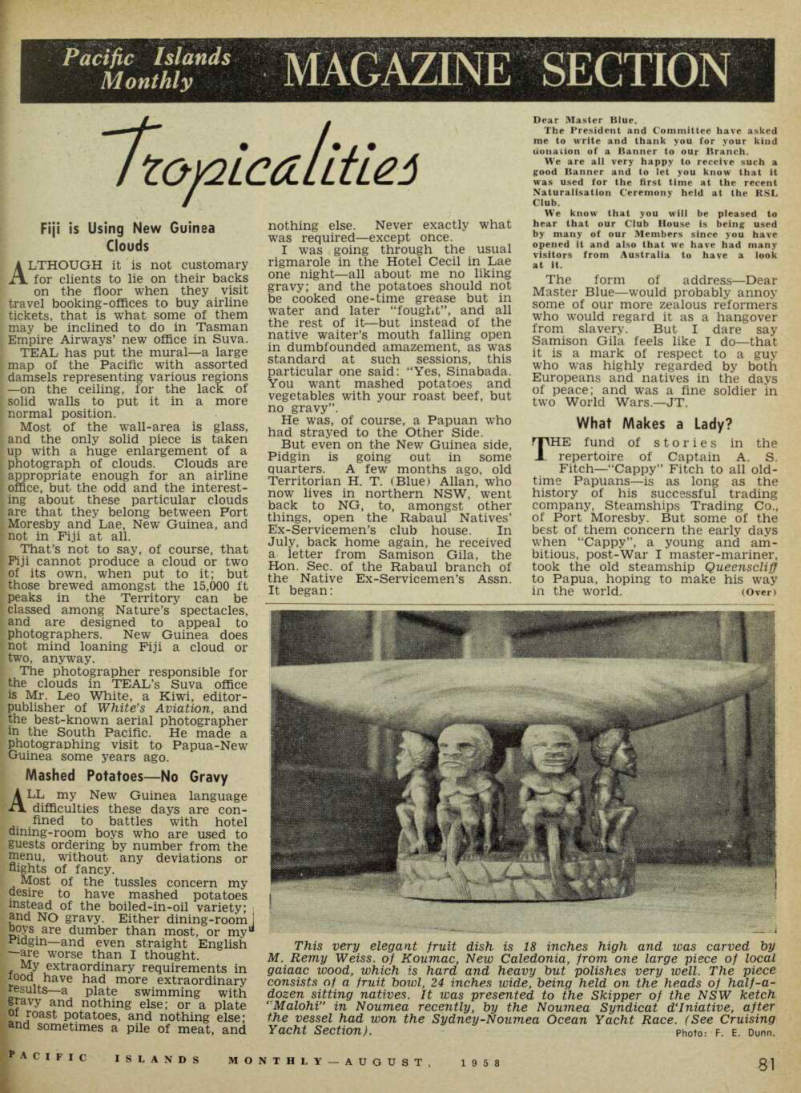
This very elegant fruit dish is 18 inches high and was carved by M. Remy Weiss, of Koumac, New Caledonia, from one large piece of local gaiaac wood, which is hard and heavy hut polishes very well. The piece consists of a fruit howl, 24 inches wide, being held on the heads of half-a dozen sitting natives. It was presented to the Skipper of the NSW ketch "Malohi” in Noumea recently, by the Noumea Syndicat d‘lniative, after the vessel had won the Sydney-Noumea Ocean Yacht Race. (See Cruising Yacht Section), Photo: F. E. Dunn.
Papua was still tough in the early ’20’s; and so were finances. For a while, it was touch-and-go with “Gappy” and his Queenscliff.
However, Fitch and his mate took life in Papuan waters as they found it, observed, said little, and learned a lot.
On one trading trip east of Moresby, they anchored off a trad ing station one day, hopefully, and in due course a boat containing two seedy-looking Europeans, with a native “wife” apiece, rowed out to do business.
“Gappy” and partner got out the enamel pannikins and the bottle of rum, put them on the table and told their prospective customers to go ahead.
Then, after a while, perhaps sensing that someone was looking askance at the bare-from-the-waist up wives, one of the traders observed: “These here are good women.”
“Yes?” said “Gappy”.
“Not like ordnary village women,” supplemented Trader No. 2.
“No?” said “Gappy”.
“No,” said Trader No. 1, “they’re refined”. Then, in a conspiratorial voice, over the back of a raised
hand: “They wear drawers!’