Fiji Talanoa
pp. 59-63 · Read in the full issue

Vakatawa Talks
Of This And That
Fiji is still worried about its banana industry. No matter how you look at it, the New Zealand market —the only one at present —is uncertain. So attention has turned again to the possibility of processing the fruit, for wider sale.
JUST after the war, Mr. Bernard Proweller set up a factory in Suva for drying bananas. They were put up in attractive plastic film wrappers and sold either as straight out “dried bananas” or “banana figs”.
Whatever the name, they were an excellent product. They kept indefinitely and could be eaten as they were, or used for cooking.
Mr. Proweller formed a company called Suvana Products to handle the bananas, and got large orders from the United States, with the promise of more in Europe.
He also found that sales could be made in New Zealand, where Samoan “banana figs” were also stocked in grocers’ shops.
Then there were disputes about the price to be paid for locally processed bananas, and in addition, Suvana Products ran up against the regular buyers of the fresh fruit.
These buyers then wanted all they could get for sale in New Zealand, and they had a buying monopoly.
So the dried banana venture ended for want of fruit for the factory.
Now that New Zealand has little interest in fresh bananas from Fiji the possibility of reviving the dried fruit industry should be looked into.
A factory at Nausori, where cane land will be available when the mill closes in 1960, or at Levuka, where there is now a road into the fertile Lovoni valley, could be supplied with good fruit from close at hand, and would provide much needed jobs.
In Cans from
Africa
Mr. Arthur Groom, veteran Suva advocate of local enterprise, is very interested in the idea of processing bananas.
He recently got his son to send him some canned bananas, imported into New Zealand from South Africa (before Mr. Nash’s import restrictions) and published a para graph in the Fiji Times inviting all interested to join him at the Garrick Hotel one morning, to sample them His argument—which seems to have something—is that if South African packers find that it pays to can such things as bananas and guavas and pawpaw, why can’t the same thing be done in Fiji.
Quick Work
at By-election
The result of the Fiji Legislative Council by-election (the Seat be came when Mr. Maurice
Scott became Speaker) which put Mr. R. G. Kermode into the Council was announced on the night of the election.
This wouldn’t mean much in Australia or New Zealand, but it is the first time it has happened in Fiji.
The Colony’s electoral law re quires all ballot boxes to be collected at a central point and all opened at the same time by the returning officer. There is no such thing as a preliminary count, or a provisional result.
The delay in announcing the results of elections is not as great as it used to be, when there was no internal air service and the reading system was not as extensive as it is now.
But even at the last general election, in 1956, it was nearly a
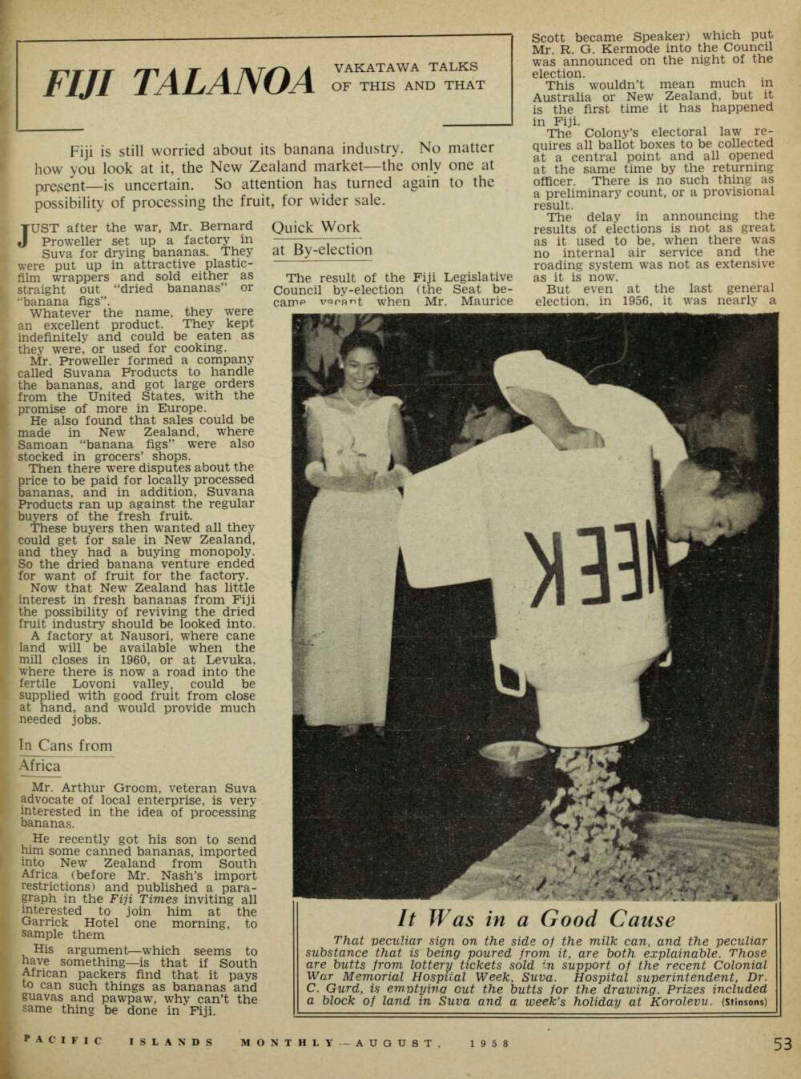
It Was in a Good Cause
That peculiar sign on the side of the milk can, and the peculiar substance that is being poured from it, are both explainable. Those are butts from lottery tickets sold in support of the recent Colonial War Memorial Hospital Week, Suva. Hospital superintendent, Dr.
C. Gurd, is emptying out the butts for the drawing. Prizes included a block of land in Suva and a week’s holiday at Korolevu. (Stinsons)
week before all results were declared.
To cater for voters on remote islands, a Government vessel goes on a polling trip during the week before the main election day.
One Man,
One Vote Mayney Gray, once well-known as a Customs Officer in Fiji and now living in Sydney, still talks about a trip he once made as an itinerant electoral officer.
His ship arrived at an island in Northern Lau, and Mayney carted the heavy ballot box ashore in a tossing dinghy. He then had to shoulder it a considerable distance before he was able to put it aboard a truck which took it, and him, to the homestead of the owner of the island—the sole, registered voter.
A round of drinks was particularly welcome, and then the host set about the task of voting.
He studied the two names on the ballot paper and crossed out the first one with the comment, “He’s no good”.
Then .he looked at the second name and said, “I don’t like him, either”. So that name was crossed out, too.
The invalid ballot paper was then put into the heavy box, which the hapless, temporary official put back on his shoulder, took to the truck, then from the truck to the dinghy, and finally to the ship, from which, so far as the result of the election was concerned, he need never have taken it
Happy, Happy
Fiji Planters
The Fiji Copra Board has been formally dissolved.
It was set up, like others in the Pacific, to buy all the copra pro duced in the territory and to ship it to the British Ministry of Food under the nine years’ guaranteed price scheme.
After the contract with the Ministry ended last December there was a good deal of talk among Savusavu and Taveuni planters about continuing control through a board which would be financed from public funds and controlled by the planters.
The talk came to nothing, mainly because ideas of organisation were vague, and a ready-made local market was available, anyhow.
There is no doubt that, at least under present conditions, Fiji pro ducers are lucky in being able to sell to Carpenters’ mill in Suva.
They have no storage, financing or overseas marketing problems.
They are paid as soon as their copra reaches Suva.
They have no losses to face through shrinkage or deterioration during long voyages or long periods awaiting shipment.
A firm price is offered by the mill week by week. It moves with the world market and, so far, it has been appreciably higher than the amounts paid for equivalent grades to growers in other Pacific territories.
The gap will be closed to some extent when in other Copra pro ducing territories adjustments are
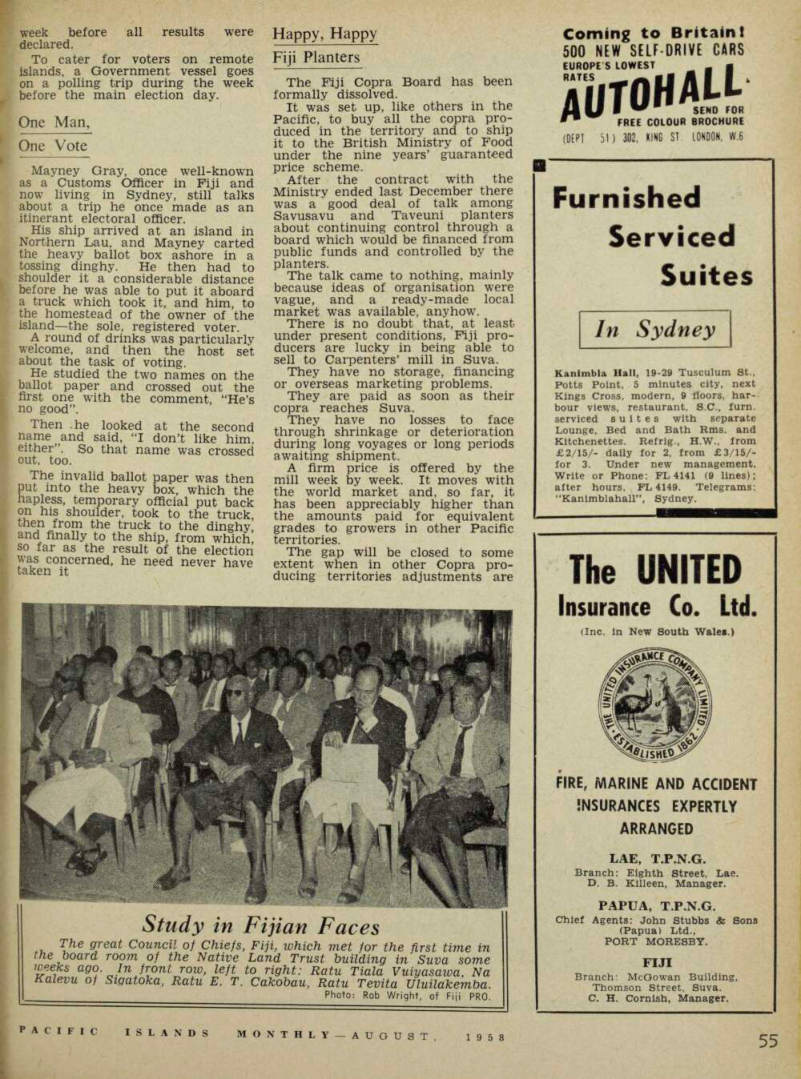
Study in Fijian Faces
The great Council of Chiefs, Fiji, which met for the first time in the board room of the Native Land Trust building in Suva some weeks ago In front row, left to right: Ratu Tiala Vuiyasawa, Na Kalevu of Sigatoka, Ratu E. T. Cakobau, Ratu Tevita Uluilakemba.
Photo: Rob Wright, of Fiji PRO.
made and bonuses paid from temporarily witheld receipts later in the year, but the economies of local milling must still give Fiji a price advantage. Carpenters estimate that it will be about £3 a ton.
There is, of course, the further point that while bonuses are accumulating with Copra Boards elsewhere, Fiji planters are getting the use of the extra money with out delay.
This process works only when prices remain steady or have a rising trend, but this year, at least, Fiji producers have been lucky.
More Grist for the Carpenter Mill Carpenters are interested in two other possible sources of oil in Fiji.
They are experimenting with oil palms near Nausori, and from all reports prospects of establishing the crop in Fiji are bright.
Then for the third successive season, they are studying the ways of humpback whales in Fiji waters, trying to trace the route they follow on the journey from the tropics to the Antarctic and back again.
Levuka is the centre of the whaling watch, and Koro planter Ron Ricketts is in charge of operations.
Behind his Levuka home, up one of Levuka’s most formidable flights of steps—which is saying something —a look-out has been built.
Here, throughout the daylight hours, a constant watch is kept across the waters towards Wakaya and Makogai, and a careful note is made of the progress of every whale that comes in sight.
One of the aids to watching is a pair of giant Japanese field glasses, mounted on a swivel stand. The glasses, which were used for artillery spotting by the Japs on Bougain ville. were captured by the Fijians during the war, and brought back to Fiji by Ratu George Cakobau.
A radio telephone system connects the Levuka watchers with another set on Wakaya, commanding yet more of the Koro Sea.
Shuttling between the two is a small but fast vessel, the Adi oovatdbua, which, under the name ot Anchovette, was one of Harold Gatty’s fishing research ships in the days of South Sea Marine Products.
Captain Bill Sinclair is in com mand. When a whale, or a group of whales, is sighted it is his job to get as close as possible and fire a numbered marker into each one.
The markers, which are fired from a modified twelve-bore, shot gun, are metal tubes about nine inches long The marking process is not as easy as it sounds.
Whales have a disconcerting habit of changing direction under water, so that after a long dive they
frequently appear where the Adi Sovatatma isn’t.
When the ship does get close, the marksman on the heaving bow has only a few seconds to fire into the curving back of the whale as it surfaces in its forward motion.
Any Whale
Will Do Tui Johnson, Carpenters’ manag ing director in Fiji, is very interested in the whale marking and every now and then takes a trip to Levuka to give a helping hand.
His best story is of a near-miss, that wasn’t one. He fired at a whale but his aim was high. How
ever, that didn’t matter, because as the marker was passing over the back of the target animal another rose from behind, just in time to collect the marker and add one more success to Tui’s record.
Whenever a hit is scored, the time and place and the number of the marker are recorded and sent in due course to the British Museum, which has been chosen as an international clearing house for whaling research data.
When the marked whale is caught, the numbered cylinder is sent to the Museum and one more migra tion fact is added to the growing pile of information about the migratory habits of whales.