Jlal ’S Coral Route Is "On", Again
p. 23 · Read in the full issue
Last Minute Save JlAl ’S CORAL ROUTE IS "ON", AGAIN
TEAL’s six-years-old Coral Route was unexpectedly brought to its death bed at the end of July—but before the last heart beats had faded away, some quick surgery miraculously revived the patient.
BY early August, the service had been declared fit for at least another two years.
First news of the trouble came as a surprise.
The future of the service had been in doubt for some time prior to July, because of long drawn-out conferences between the Australian and New Zealand Governments on the future of the jointly-owned TEAL services generally.
But chairman Sir Leonard Isitt and general manager F. A. Reeves, speaking in Suva and elsewhere at the beginning of July, had given a broad indication that the Coral Route would be continued, whatever alterations would be made to other TEAL routes.
The situation undoubtedly was, as far as TEAL executives felt, any way, that the Coral Route would somehow be kept going (between Auckland and Tahiti, via Fiji, Samoa and the Cooks) until suit able landing grounds could be built, and the flying-boats replaced by conventional aircraft.
Navigational Aids Out
This, TEAL felt, would probably be within two years.
But then, at the end of July, came the unexpected announcement by New Zealand’s Civil Aviation Administration that radio and navi gational aids at Aitutaki and Raro tonga, in the Cooks, were below safety requirements and would be closed down in a week or two.
Thus TEAL found itself unable to run its aircraft any farther than Samoa.
The company announced that its last Solent would leave Papeete on the final return journey on August 12. Thus would come to an end the Coral Route.
The announcement brought dis may along the route.
The Governor of French Oceania, M. Camille Bailly, said the news had been received by the French “with great regret.”
Then, surprisingly, came an an nouncement by the NZ Minister in charge of Civil Aviation, Mr.
Mathison, saying NZ Cabinet was considering ways of maintaining the Coral Route, including the use of a land plane.
As everybody knew, use of a land plane involved many thorny problems that could not be solved overnight, so the statement caused confusion.
TEAL meanwhile announced that from September 3 it would operate a fortnightly flying-boat service be tween NZ, Suva and Samoa—thus at least continuing Samoa’s air link.
It meant that only the Cooks would be left out on a limb, because the French international airline, TAI, had already announced that it would start a weekly land plane service in September from Paris to Bora Bora (near Papeete), via Aus tralia, New Caledonia, New Zealand and Nadi.
It was then that the TEAL patient was revived.
Following some high-level activity, the Civil Aviation Administration announced that it had arranged for the radio aids in the Cooks to be brought up to standard again as “quickly as possible”.
TEAL simultaneously issued a statement saying it would keep the Coral Route going.
It announced some temporary plans (Involving a two months’ over haul for the Solent, and use of a chartered flying-boat meanwhile).
But then, on August 14, it was able to announce that the Coral Route would quite definitely start again on September 18.
It would fly Suva-Samoa-Aitutaki- Papeete, and then return to a fort nightly frequency with a two-and-a half day stopover at Papeete.
The service would be operated with Solents, as before.
To Reap Benefit of Enterprise"
In Auckland, Mr. Reeves said: Aviation decision means that New Zealand, which has in vested a good deal of money and many years’ effort pioneering and developing this route, will remain to reap the benefit of its enter prise.
“Oyer the last three years, the Coral Route financial results have improved rapidly, and we expect the returns for the year just ended will be better than ever.
“Taking into account the effect on traffic which the route gen erates on TEAL’s Auckland to Nadi service, it can already be considered a break-even operation. Without the Coral Route the financial results of pur operations between New Zea land and Fiji would be less satis factory, “While we dislike losses of any kind, a modest loss on one route is not untoward when nett profits on others exceed £200,000 sterling annually.”
Mr. Reeve added that “in due course” the Coral Route had to be come a land plane operation, but in the meantime it “should be able to operate successfully” with Solents.
After the previous few weeks of nail biting, there were many along the Coral Route ready to pray that he is right.
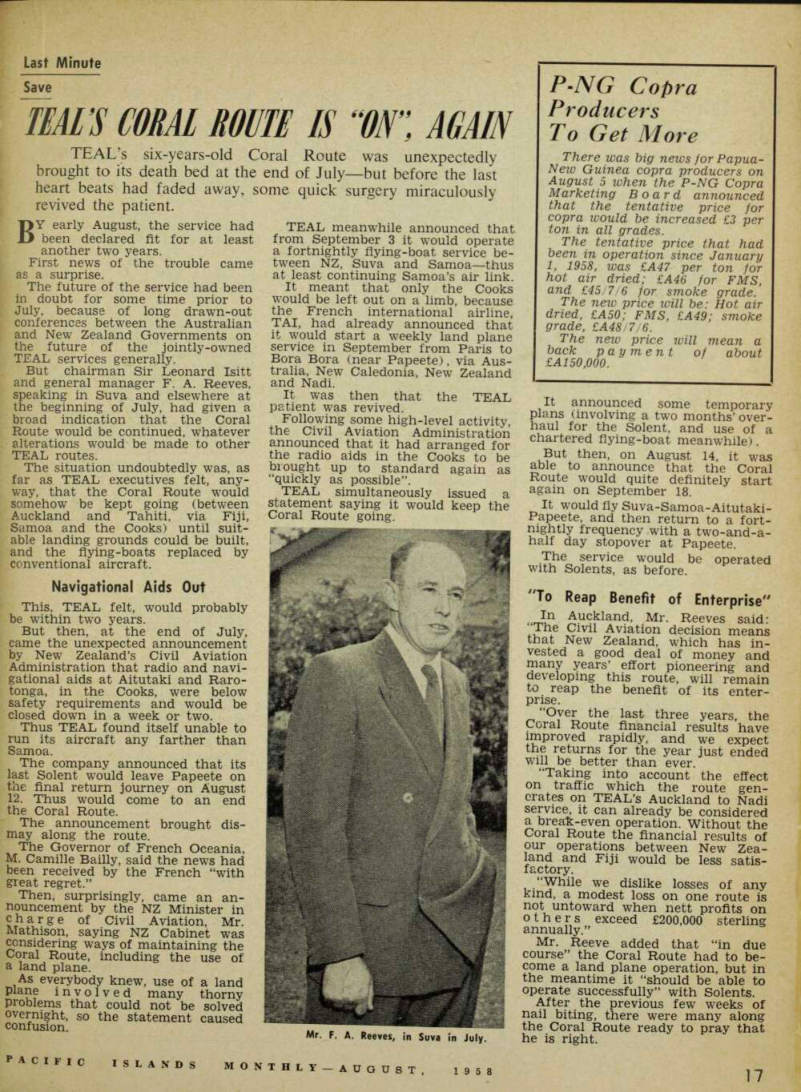
Mr. F. A. Reeves, in Suva in July.