Pacific Shipping And Cruising Yachts
pp. 109-123 · Read in the full issue
The idea that charity should begin at home—so far as lip building and ship buying is concerned, is an idea that >pears to be getting around in some parts of the Pacific. Par
mlarly in Fiji.
You Can Buy Them
\PER: In June the furore ; Ra Marama (see June PIM ) not died down when it be known in Suva that the Fiji rnment was in the market for ler overseas ship—this time a cement for the Public Works rtment’s Jill-of-all-Trades, I, which is now very long in 100th. ; new vessel, which will be I Degei 11, is already nearing letion in Hongkong and is ex d to cost in all about )00—£F11,000 of which will be conversion to PWD yequire -5 and delivery to Suva. Thus, omewhat less than paid for Jarama, Fiji will be getting ship but somewhat fewer s. en Degei II arrives in Suva a x-berth cabin will be converted two two-berth cabins for pas rs. i will be used for Government es, lighthouse servicing and duties. ; present Degei will be offered tie by tender when Degei II is for service.
Marama has, it appears, as ed those who have been per il aboard, by the elegance of of her fittings. , of course, is a watery y, nonetheless the number of > that can now be reached by ship have decreased since dvent of internal airways in and people seem to think the time has passed when the fitting-out of a governor’s was a justifiable expense, •eover, useful small ships can
be built in Fiji at a fraction of the cost of Ra Marama. Two examples are the Adi Maopa and the Vuniwai, both adequate for the jobs they do.
One of the first tasks of the new yacht was to take an official party
to Lakemba, in the Lau Group, for the funeral of Ratu Sir Lala Su kuna. A fortnight later she left for the Yasawas and Rotuma to take the Governor, Sir Ronald Garvey, on a month’s farewell tour.
Ra Marama did the 5,883 mile journey from Singapore to Suva in 31 days, averaging 9.9 knots. She carried a crew of two officers and 13 ratings. She has a displacement of about 92 tons. She is 87 feet long.
The permanent crew will be made up of men chosen from the Fiji Naval Volunteer Reserve.
The master’s cabin and a two berth cabin for officers will be aft on the main deck. There is ample room in the saloon for the officers and several passengers.
• Millionaire Quality At
HALF PRICE: To provide more fuel for sour taxpayers, shortly after Ra Marama reached her new home port, Suva was visited by a 78-ft diesel cabin-cruiser called Kuru ( PIM , June), owned by Mr.
Robert D. Fraser of California.
Kuru was beautiful to look at,
luxuriously fitted inside (including air conditioning) and caused even more interest when it became known that the owner could be per suaded to part with her for a mere £25,000.
Why didn’t the Fiji Govt, buy Kuru, instead of the expensive Ra Marama, asked everyone who has public finance at heart —which is just about everyone.
One reason, undoubtedly, was that when the order for Ra Marama was placed, the Govern ment did not know that Mr.
Fraser was going to bring Kuru to its front door and offer to sell her. Another thing —Kuru was
built back in 1930 and a 28 year old motor cruiser is unlikely to be worth the same as one built last month—even if the former has got air-conditioning.
But there was no one in Fiji with £25,000 for a pleasure cruiser, anyway, so Kuru sailed back to San Francisco via Honolulu, and owner Fraser and his wife flew back to the United States from Nadi.
Kuru is described as a 78 ft flush main deck, round bottom, deep sea going yacht, of good design and exceptionally heavy construction throughout.
With a fuel capacity of 2,500 gallons in her three welded steel tanks and a water storage capacity of 1,500 gallons in her five water tanks she can sail safely on any seas. She is powered by a 135 hp Washington Estep engine and has a cruising speed of 8h knots.
She was once owned by American author, Stewart Edward White.
She is equipped with Raytheon 110 volt 35 watt radio, plus a 250 watt emergency set, a direction finder and a fathometer.
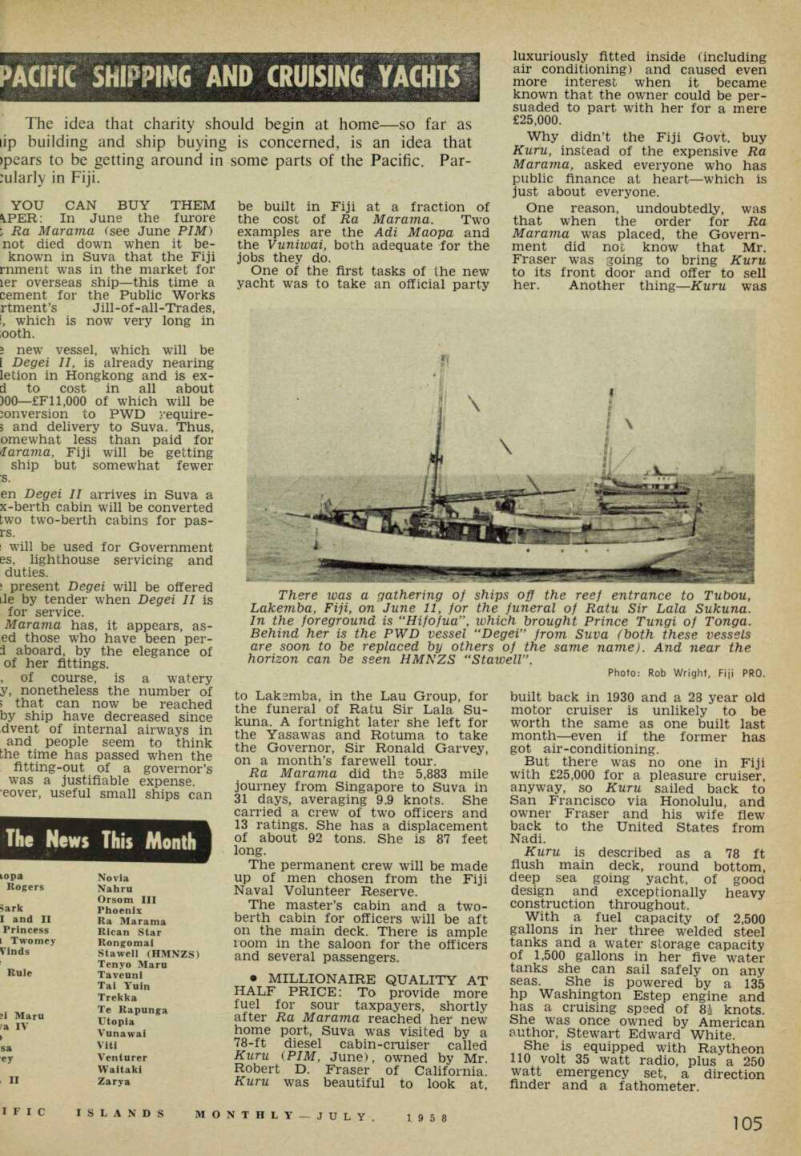
There was a gathering of ships off the reef entrance to Tubou, Lakemba, Fiji, on June 11, for the funeral of Ratu Sir Lala Sukuna.
In the foreground is “Hifofua ”, which brought Prince Tungi of Tonga.
Behind her is the PWD vessel “Degei” from Suva (both these vessels are soon to be replaced by others of the same name). And near the horizon can be seen HMNZS “Stawell”.
Photo: Rob Wright, Fiji PRO.
UN-TIED: Tied up and for in Sydney since she arrived with a cargo of dynamite the US in December, 1955, 195-tons ex-yacht Rican Star it last found new owners. Re d to have once been the yacht lillionaire Cornelius Vander she now will go down in world considerably—and be the mother-ship for Queens prawn trawlers, bough she had already had a ;ered career sines she moved ?h New York society, she was considered too luxurious foi ling and many of her expen fittings were stripped from before she found her new *s. ording to PlM's notes on her ivember, 1955, she was built in as the Eleanor, was later ac i by the US Hydrographic y Dept, and later still by the in which she served as a ship on the US east Coast I the war. was acquired by Canadian s in 1948, registered in Costa and used as a refrigerated la boat before her trans c venture in 1955. broke a crankshaft in one of ngines shortly before arriving ydney and then apparently ; trouble with the Australian rities who demanded an ex re hull survey. Her owners itly decided that it was less e to tie her up. And this did off Rozelle.
LED: The ex-Fiji ship Viti owners seemed to be having d battle a few years ago, but recovered, was again having ession” in June and has been p for a spell in a Tasmanian Some of her crew were back to New Zealand re was built in Hongkong for ’iji Government before the and became the Fiji Navy : it. After the war she was
purchased by a group of ex servicemen who operated as the Tasman Steamship Co. She was fitted with refrigeration equipment and her main chores have been carrying frozen food —fish, peas, beans, etc., between Tasmania, Australian mainland and New Zealand.
The present tie-up is probably seasonal, but may be influenced to an extent by import restrictions and the assorted moans of fisher men and farmers on both sides of the Tasman.
• Princess Aground:
Fijian Princess operated by Hurley’s Shipping Agency, Suva, went aground near Nabouwalu, Vanua Levu on June 15. She was without radio assistance as her equipment had been left in Suva for overhaul.
Unconfirmed reports said she was on a mudbank in sheltered waters about seven miles north of Nabouwalu. Efforts were made to send messages to her by adlis lamp.
• Wharves Mean
TOURISTS: With the advent of the great Orient and P and O Line ships into the Pacific, Suva has taken on an important role as a regular calling point.
Also regular callers at Suva are the two luxury Matson liners Mariposa and Monterey.
Two schools of thought exist in Suva about facilities for these ships and others like them.
One is strongly in favour of resurecting the now abandoned £3,000,000 dock scheme for the port: and the other, is equally strongly against.
The die-hards who oppose the scheme contended that the port should be able to manage for many years to come with the present facilities.
The liberals, on the other hand, paint a gloomy picture of huge passenger liners lying in the stream because there are no berths
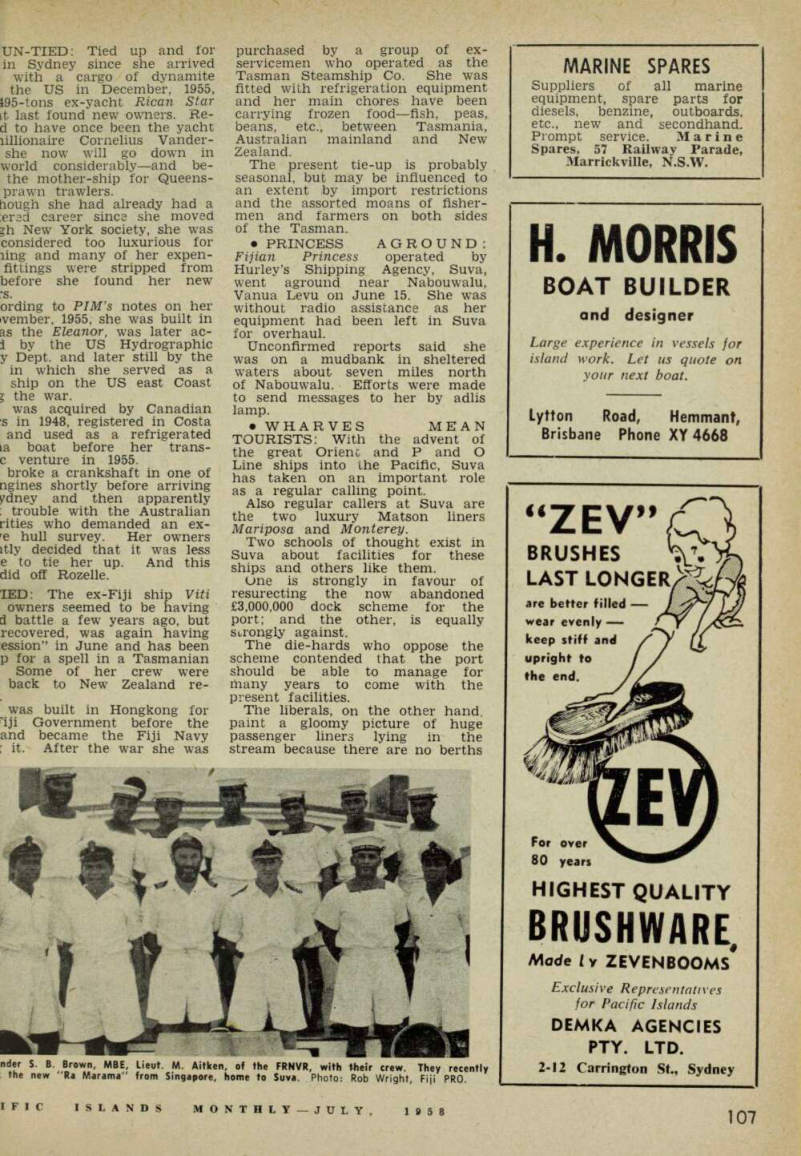
nder S B. Brown, MBE, Lieot. M. Aitken, of the FRNVR, with their crew. They recently the new "Ra Marama" from Singapore, home to Suva. Photo: Rob Wright, Fiji PRO.
able, and con able damage : done to the ly’s tourist aings as a quence. sent plan is Dmpletely ate the pre £ing’s Wharf, make some insi o n s. A dus dredging ie is also planned, to e the new i-ton liners n the Pacific i 1960, to use jrths.
! new dock scheme for ka, in the sugar area, is to lead as soon as tenders are ted. At present, as it has for half a century, the only there is owned by the ial Sugar Refining Company, wharf is only 135 feet long 3 wholly inadequate, as much se and time is lost through having to either move for or backwards to keep hatches ig continuously, when (repeat, when) the is complete it will relieve stion in Suva as well as ka, and according to one nown Lautoka business man; >ka would encroach on i position as the Colony’s t city.”
Tacked Up In Suva
Suva port strikes many periods and then times of Jt. For days the main pier, > Wharf, will be completely of overseas shipping. Then lut comes and there is not b space at the wharf for all which have to berth, m there is the spectacle of standing out in the road waiting for a liner to leave, at the middle of June the osa, northward bound, the inella with New Zealand :s and the Beaverhank took the available space.
Matua, from Island ports en to New Zealand, arrived 4 pm the same day and had it until the Mariposa left.
Wanganella, normally on the Tasman run, brought 400 Zealanders. She was the first ship to come from New id since the end of the war.
Uva Sees Two Jap
5: Japanese fisheries mother- Tenyo Maru, of 1,000 tons, i in Suva in June to take nkers and water for her fleet ' south of the Equator, crew swarmed over the city graphing everything that came range of their cameras, but ie of the water restrictions /a at the time, she was per i to take on only a percent-
age of her normal water require ments.
Also in port on the same day —an unusual occurrence in Suva —was the Japanese scrap metal carrier Kin Kei Maru.
An old coaster still showing signs of her dingy coal burning days, she loaded about 900 tons of scrap before proceeding to Noumea to load mor'\
• One Of Their Flags Was
MISSING: That Russian non magnetic research schooner Zarya, described here at some length in June, called at Perth, WA, soon after. (Over)
The trading vessel "Gazelle” which went on a New Guinea reef in June (see page 115).
e vessel attracted considerable ition especially from two is who later souvenired the l’s 18 ft flag and flew it from flagpole at the Fremantle s oval. was discovered by the care , returned to police and later :wo young men were charged the theft of the flag.
ERSONAL: Jim Shortall, who is re ble for most of this section of PIM, normal way, is currently taking a icr course. He is Radio Offlcer/Third on the delivery voyage of ex-Union ship Co.’s WAITAKI, to her new s, Ta Hsing Shipping Co., of ig. Formosa. Now renamed TAI the 20-year-old. 2,000 tonner was iney loading scrap and copper sul in June. Although she looked as i she could have been the pattern for asefield’s . British coaster with caked smoke stack”, we are assured he is all she should be, and that gh she arrived in Sydney, ex gton. in the middle of a cyclone, ad made the Tasman appear as is an island lagoon. Anyway. Red and other contingencies permitting, 11 is expected to be back on the ound September. The vessel made expected call at Rabaul for water y 4.
Nspire In Trouble: Tied
•r the last year because the Islands Administration re to renew her licence under shipping regulations, the ex am trawler Inspire was in trouble at end of May when sank at her moorings at i Harbour, Rarotonga. ;mpts were to be made to i the ketch sufficiently to ; her to be beached. Owned >y Mr. D. C. Brown, she was out from England some ago by Hugh Williams who I with her in the group selling her.
Aveuni Also: Mr. Dick
l was having trouble all with his ships in May. r that month, he had got his rs-old Suva-built Taveuni f Auckland only by signing laration that the ketch was vate yacht. Whether this that Mr. Brown was not id with a licence to trade i the Cooks when he got her to the Cooks—and whether ms the tightening up of all me regulations in that Group have not yet learnt, e the Joyita affair there has i general tightening of ship safety rules all over the i —and not before time—and i Cook Islands some vague lished standards have been shed by the Administration. ;e standards are admini by the Collector of Customs •otonga, a man who normally have no technical knowledge Dping surveys. He looks the wer before she sails, checks mg gear, sails, and the more s points likely to concern her
seaworthiness. He may hold up the vessel until certain work is done.
Last December he notified the owner of Taveuni that certain repairs must be carried out. As there are no repair facilities in the Cook Islands, the vessel had to go either to Papeete, Suva, or Auckland. The latter port was eventually chosen and that is probably where Mr. Brown made the fatal mistake.
Ahead of the ship went a despatch from the Collector of Customs to Island Territories Department, Wellington, asking them to see that the ship was surveyed.
The word “survey” may have a very loose meaning in Rarotonga,
but in the Marine Department at Wellington, to whom the matter was referred, the meaning is very precise indeed. In general, Taveuni was treated as though she were a coaster trading in NZ waters, and ths Marine Dept., literally threw the book of regulations at her.
To the NZ Marine Dept.—indeed to any Marine Dept, in any of the countries with a well founded maritime reputation—there is no provision for “looking a ship over”.
The requirements of an official survey are set out precisely in the handbook—and there is no getting around them.
Many of the vessels trading in islands groups could not possibly fulfil these requirements, and that
the rock on which Mr. Brown’s !s foundered. weuni was unfortunately built out the watertight bulkheads divide vessels into compart ts —something that is required 11 vessels built in NZ—and this the first matter which caught ittention of the surveyors. With and other work that was re ed as necessary, the repair bills expected to be in the vicinity he price paid by Mr. Brown the vessel a few years ago— naturally he wanted nothing to ith it. (Lack of bulkheads was inised as a potential future lem when Brown purchased uni from Burns Philp (SS) Co. t three years ago, but the >r who negotiated the deal as ined that these could be put i Suva, for well under £1,000). len it was suggested that the >le could be got over—and the I got out of NZ—by giving an nation in writing that she was ivate yacht, there was a deep of relief from all concerned, is to be hoped tfiat what hap i to Toveuni was; all a mistake ise if NZ surveys 'are to be en d, it would mean the end to te shipping in the Cook ds. at seems to>be called for in the 5 just now is an arrangement jby qualified-technical men can ade available to administer a f reasonable safety regulations h os those applying in Fiji ; Vaveuni is registered and ; she operated for years. (The that she is registered in Suva ot place her outside the iuris n of the NZ Marine Dept., i Shipping and Seamen Act, hose of other Commonwealth ries, makes provision for this of circumstance). ;re will always be disputes and tment while the technical sur unction falls to a technically ilified Collector of Customs.
I Taveuni gone to Papeete in of Auckland, it must be as i that the certificate of a ,e marine surveyor there would jally have been accepted in onga.
Ncreased Cargo Space
Matson Ships: The
irey and Mariposa are to have refrigerated cargo space in id from 28,000 to 42,600 cu. meet the increased needs of
alasian shippers,
orations will commence on Drmer in September, and the in August, but only the 5t 17 sailing from San isco of the Mariposa will be lied. sengers affected by this will ovided for on the Monterey x, from San Francisco, July le Mariposa sailing on Sep r 10 or on subsequent es if they so desire.
Matson Line is to open new
offices in Auckland towards the end of August to handle its NZ business, previously dealt with by Henderson & Macfarlane Ltd., since before the turn of the century.
Passengers on Matson “reducedfare voyages” this year can now spend four weeks in America. (Previously these special voyages have been a round-trip on the one ship, with a five-day stopover in Cniifnrnin'i , . * xx, . , Reduced fares for these special voyages begin at £A4IB/10/-, for Sydney-back-to-Sydney and offer savings of £ABB or more.
• Stork In The Offing:
Island trader, ex-yacht Arthur Rogers, with owners Tom and
Diana Hepworth, left Auckland for the New Hebrides via Whangarei on June 20. it is reported that That Bird has been seen in the AR’s rigging and that an addition to the crew is expected after her return to home waters, FRENCH lOY k^earch. ab <>ut in the SW Pacific re cently has 136611 Orsom ///, the French oceanographic research ship based on Noumea. She carries three scientists on board and is engaged in a long-range pro gramme of research into oceanic conditions. A special study is being made of plankton, as the distri button of plankton has a direct bearing on the distribution of fish.
recent cruise was carried out rt of the French contribution le International Geophysical (which has now run exactly nths of its 18 months course) s part of an investigation of oral and Tasman Seas which soon be the subject of a CO conference in Sydney m Australia, New Zealand 'Jew Caledonia.
Oniu For Home: Prince
, of Tonga, expected to go ;o Pago, American Samoa, on 2 to pick up his new dream- Aoniu which has been built land. The vessel left London d-May, via Panama. She 1 be in Nukualofa about L 4. :e has not been such a degree iblic excitement in Tonga the visit of Queen Elizabeth be Duke of Edinburgh.
Azelle Wrecked: A
men, including the European r, Captain Axel Evensen, )icked up off a sandy island Ottilien Reef, Witu Group,
north of New Britain, on June 17.
They had been there since the 57 ft trader Gazelle had gone on the reef on the previous Saturday.
They were taken to Madang in the motor-vessel Sorengana and ap peared to be none the worse for their experience. The captain later flew to Rabaul where an inquiry will be held.
Large-scale sea and air search was made for the vessel after she went on the reef—and affairs were complicated for a time when it was believed that she had gone up near Lolobau Island which is about 160 miles from Ottilien Reef. This mistake seems to have been caused by the very weak signals that Gazelle was able to put out. She was located finally by a Mandated Airlines plane.
Rabaul shipwright, Francis Choi, left there on June 19, with a large quantity of salvage gear, and the intention of getting Gazelle off if possible, however, after inspection the attempt was abandoned and she has been written off as a total loss.
The Gazelle was built in Bris bane about four years ago. from the yard of the late C. E. Crowley, and was designed for the New Guinea timber trade. She is owned by the Gazelle Timber Co., of Rabaul,
• Bombs Blast Wewak:
Wartime bombs are being used to blast a bigger passage in the reef off Wewak, New Guinea, This will still not allow large vessels to tie up at a wharf—there is no wharf, anyway—but it will allow them to get in closer to shore and allow larger boats to bring the cargo from the ships to the landing. (Over)
uzzwell, and "Trekka" (see page 117).
Photo: Sea Spray.
Nz Minesweeper’S Busy
lAN CRUISE: HMNZS Stawell hed in Auckland on June 19, t a busy cruise to Fijian ers. t the request of the Denham ily, of England, a party was to e inspected and tidied up the re of Fleetwood James Denham, le delivering stores to Raoul nd. le 16-year-old lad died at sea HMS Herald, commanded by father, Capt, H. M. Denham, e engaged on survey in the .fic in 1854. It was the Herald carried Governor Hobson i Australia for the signing of treaty of Waitangi in 1840, and esented the RN at this historic sion. hile in Fijian waters, the veil made an emergency trip i Suva to Kadavu on June 2, bring back Mr. W. Goodsir was seriously ill. r. Goodsir, well-known Fiji lent, is managing director of Kadavu Timber Co. i official party from the mine ver was present at the funeral Ratu Sir Lala Sukuna at rniba, on June 11.
Mission Launch Off At
T; The Melanesian Mission h-rigged auxiliary Fauahu mey, the gift of the NZ Leper it Board, left Auckland on ‘ 19, for her station in BSIP, r ing on June 26. le vessel, delayed since her ching, more than a year ago, itting-out problems, was under command of an Auckland tsman, Mr. Mark Anthony, a crew of 4. atures of the vessel are a en mast of tubular steel which
also serves as an exhaust pipe, and copper hull-sheathing as protec tion against the Solomon’s marine borer.
Two sister ships, the Ozama Twomey and the Mala (native abbreviation for Malaita) Twomey are yet to be completed.
• New Vessel For Hebrides:
A new 50-ft islands vessel (so far un-named) has recently been pur chased by M. Henri Colliard, of the New Hebrides. The vessel is a new one, built in the yard of Mr. R.
Gordon, Sydney shipbuilder, and sold through the agency of Captain W. L. Kennedy.
This vessel has been fitted for the purpose of carrying prospecting
parties and their gear around the New Hebrides —there is currently considerable activity in minerals, especially manganese and phosphate —and the hold-space has been used for this purpose. The vessel could, however, be converted easily to straight cargo carrying.
There is also cabin accommoda tion for Europeans. The vessel has twin screws, and can maintain a steady 10 knots —a high speed for this type of craft.
• New Honiara Wharf In
USE: A vessel with the somewhat extraordinary name of Amonea (spell it how you will, it still sounds the same) made history in the Solomons recently by tying up at Port Cruz, at the new wharf which is only partly completed. (See Pacific Report, this issue).
Under charter to the Solomon Salvage Co., she loaded 750 tons of scrap for Hongkong after negotiat ing the hazardous Pelope Shoal at the entrance to the port and came alongside without much difficulty piloted by local man Mr. J. Symes.
Amonea, previously the NZ Wainui, 1,600 tons, is now used in the Far East and sails under the Panamanian flag of convenience.
News of Cruising Yachts
• Sydney - Noumea Yacht Race:
Bad luck dogged this event. The big yacht KURREWA IV was withdrawn before the race as a mark of respect to the skipper, Ronald Robertson, who was washed over board and lost in incredibly bad weather conditions off Sydney in mid-June. The four other entrants got away on the after noon of June 28 in the face of another cyclone which was then forming off the NSW coast. In the gales that followed two of the yachts—the 57-ft. cutter SOLO, and the small Melbourne sloop FOUR WINDS —were so battered that they were forced to retire and beat their way back to the NSW coast. The other two, the 54 ft. UK yawl KOCHAB and 38 ft. sloop MALOHI, were carrying on in very bad weather conditions. (Over)
well-known Fiji provincial vessel, "Adi Maopa", lost its white paint for the funeral of Sir Sukuna (see elsewhere). Here she is, black to the waterline, photographed off Lakemba.
In the launch, Lieut. J. Quinn, of HMNZS "Stawell".
The first photograph of Tonga's new "Aoniu", which was due home in Tonga early this month (see page 115).
I TREKKA, John Guzzwell’s 20 ft. yawl ich was thought lost in the first of stralian East Coast June cyclones, ned up unscathed in Moreton Bay. eensland, on June 15 (June PIM, p. 19), azed that an air-sea search should re started for him automatically and h a new slant on carrying two-way radio lich he does not).
I have strong views on it,” he said, 0 many people radio for help when y don’t need it”. There is something what he says, of course. But not much, fortunately there are few countries that e yet got to the stage of abandoning •epid yachtsmen to their fate—although, doubt, many would like to. Sea and drill operates when a yacht is overdue s it did in the case of Guzzwell. It is d to believe that a radio message from EKKA. when the search was at its fht, to say that Guzzwell was still OK, ild not have been to advantage.
The American Couple, John And
gy Bourke, whose 50 ft. schooner was eked off the Queensland coast in the ie gale that blew Guzzwell out to sea, e stated their intention of buying ther yacht and continuing their voyage tid the world. The vessel was a sturdy nd to the Bourkes, but her untimely settled at least one thing: It isn’t ig to matter any more whether her ie was VENTURA or VENTURER, oughout her history the yacht has both, impartially, although the latter upposed to be correct. PIM has stuck VENTURER, except in last issue when , stop-press item we fell for VENTURA.
Grant, who is still having skin grafts an Auckland hospital following the osion on VE TEGA in the Hebrides ths ago, was at one time John rke’s companion on VENTURER. fTURER has been in and out of PIM ;s for years, but now departs. We 1 the Bourkes will not.
NOVIA, 34 ft. San Diego ketch was leave Auckland at the end of June, this time comfortably stowed aboard veteran Panamanian cattle ship, USHA, following her owners Lee and Gregg home to San Diego. The coal 1 CATUSHA was to bunker in Auck after loading, at Tauranga, the first I of a total of 10,000 head of steers h are being shipped to the North rican market. This shipment of live Ie to the States will be worth about tO,OOO to NZ.
TE RAPUNGA, dismasted on passage irt to Auckland last December and ■ stranded on the west coast of NZ, Greymouth, has almost completed a at that port. Veteran skipper G. ern will take the 32 ft. ketch first Wellington and then on to Auckland. maybe the islands. TE RAPUNGA d in the 1954 Tasman Race from ;land with an all girl-crew.
PHOENIX, with owners Dr. and Mrs.
Reynolds sailed from Honolulu on leg of voyage back to Japan on June Their route lay near the Eniwetok ;ar test zone and there was some as to whether this would be per ;d or not. Finally decided that Dr. olds could do as he liked.
But not so GOLDEN RULE, with ist owners Bigelow and Huntinton on 1. They have been cooling their heels lonolulu under a restraining order d by a US court.
UTOPIA, the good-looking 65 ft. yacht d and sailed by Mr. Fred Peterson merica, was in disfavour with im ition and customs authorities in Fiji une. Instead of first calling at a of entry, on his way into the Group Tonga, he called at Moala, in Lau, 1 is not legal. The laws of the iv are strict about these things, and are good reasons—one of them being ardent desire to keep Rhinoceros
beetle out of the copra producing areas of Fiji. There probably is not sufficient publicity given to these prohibitions—but most yachtsmen should know that one cannot these days cruise around Pacific islands without first attending to the formalities. For future reference yachts men should know that the three ports of entry in Fiji are Suva. Lautoka and Levuka. UTOPIA has been overhauled and fresh painted at Suva, and will sail for New Guinea and Singapore. • RONGOMAI, owned and sailed by Auckland boatbuilder Roy Lidgard was in Fiji waters for a winter cruise in May.
He had a crew of three and was joined in Fiji by his wife who flew from Auckland. • FOUR WINDS, being sailed by owner and skipper E. R. Cross and crew left Honolulu in June after a shakedown cruise.
They are heading for Palmyra, Johnson!
Fanning, and Canton Islands, then to Tahiti and back to Honolulu by November.
• JINNI, with the Schallenbergs aboard left Honolulu on June 14 for Hilo, then on to Tahiti. They plan to cruise the South Seas for a while then on to Australia. • NAHRA, Tahiti ketch, tied up at Honolulu for a while, left for French Oceania on June 14 sailed by Pete and Jo Byam, just newly married. • MAHINA 11, to have been delivered from Auckland to Suva (see March PIM) has now been sold to Mr. L. Lysaght of Tauranga, and in early June was sailed to that port where she will be used for local cruising. • CUTTY SARK, 60 ft. v 12 ft. 6 in. x 8 ft. 8 In. Bermudan cutter, will not now make the Island cruise forecast in April PIM, owing to poor health of skipper Burnie Jones, and he and Mrs. Jones will shortly leave Auckland to return to the South Island.