Feudalism Can Live Happily
pp. 87-105 · Read in the full issue
Tonga Shows How
With A Welfare State
By J. Edward Brown
11HE day was overcast and humid, . with a hint of rain, making it uncomfortable for guests and officials arrayed in uniforms.
School children lined the route from the Royal Palace to the House of Parliament, a distance of a quarter of a mile, and hundreds of Tongans stood on the public park between the Palace and Parliament House watching the scene.
It was the day of the closing of Parliament.
For of course Tonga is unique amongst the various Trust Terri tories, Condominiums, Colonies and Protectorates of the Pacific, and is a constitutional monarchy of 56,000 souls, ruled over by Queen Salote, with the help of Parliament.
And Parliament is opened and closed with all the pomp and cere mony accorded much larger Parlia ments in far bigger countries.
At 10-15 a.m. the Tongan police band with gleaming instruments marched between the school child ■en, followed by the Royal Guards n their white uniforms, black caps r;ith red bands and sloped rifles.
Fhe band lined themselves up on me side of the entrance to Parlia nent House, the Royal Guards on he other.
Anybody can have themselves in cited to the opening or closing ;eremonies by writing to the Pre nier’s Office, but not many Ton :ans seem to avail themselves of he opportunity. The guests were nostly Europeans.
The invited guests moved inside Parliament House, which is only a *rge one-roomed building, and were down to their seats.
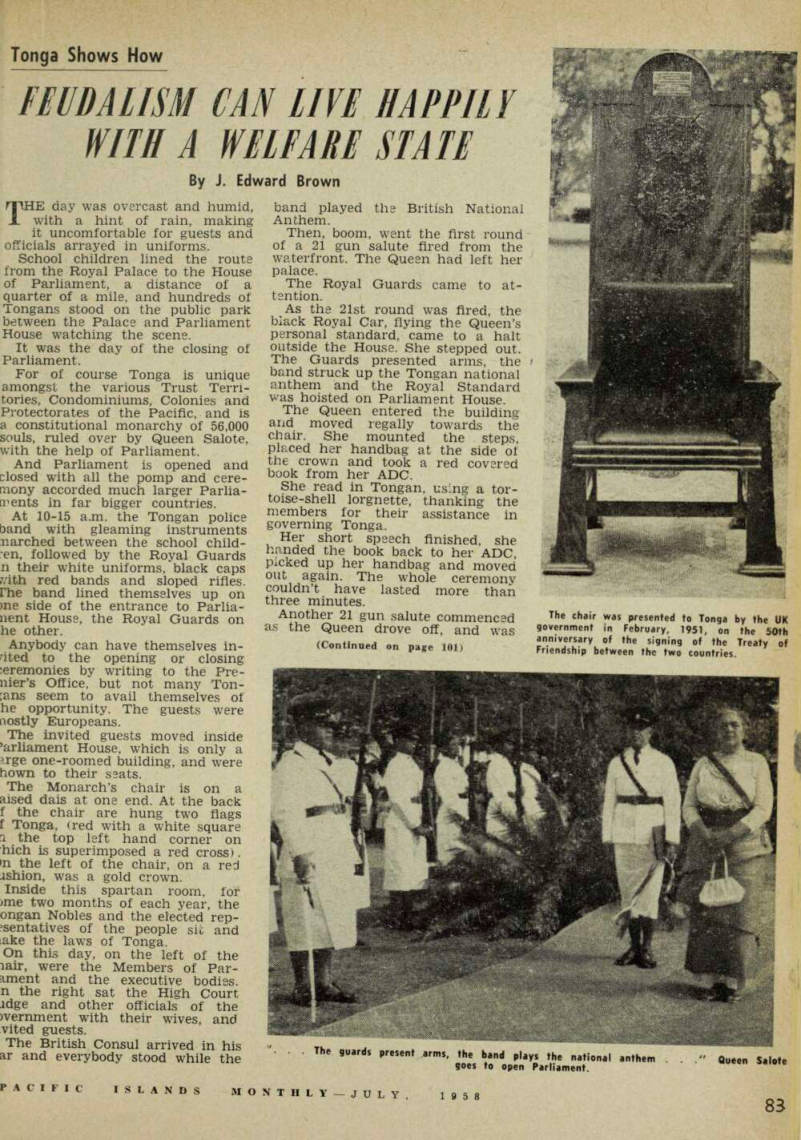
The Monarch’s chair is on a aised dais at one end. At the back f the chair are hung two flags f Tonga, (red with a white square 2 the top left hand corner on hich is superimposed a red cross). m the left of the chair, on a red ishion, was a gold crown.
Inside this spartan room, for >me two months of each year, the ongan Nobles and the elected rep ssentatives of the people sit and sake the laws of Tonga.
On this day, on the left of the lair, were the Members of Par ament and the executive bodies, n the right sat the High Court idge and other officials of the rvernment with their wives, and vited guests.
The British Consul arrived in his ar and everybody stood while the
band played the British National Anthem.
Then, boom, went the first round of a 21 gun salute fired from the waterfront. The Queen had left her palace.
The Royal Guards came to at tention.
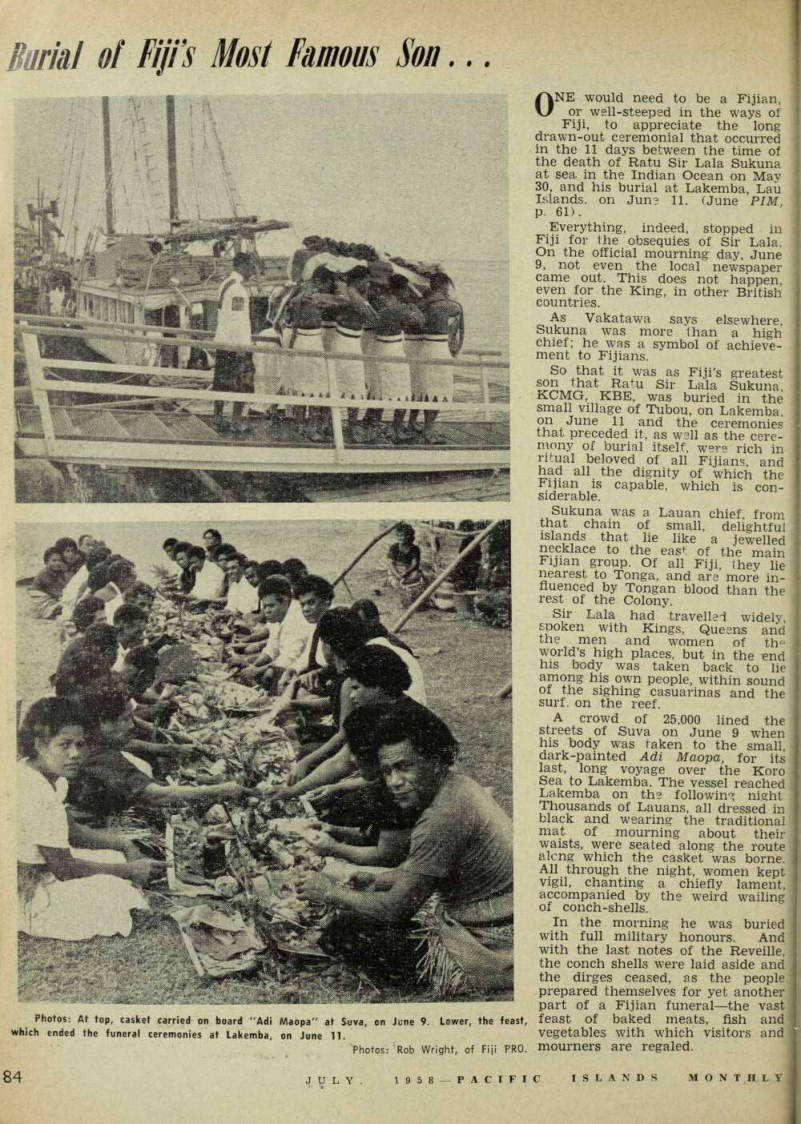
As the 21st round was fired, the black Royal Car, flying the Queen’s personal standard, came to a halt outside the House. She stepped out.
The Guards presented arms, the band struck up the Tongan national anthem and the Royal Standard was hoisted on Parliament House.
The Queen entered the building and moved regally towards the chair. She mounted the steps, placed her handbag at the side of the crown and took a red covered book from her ADC.
She read in Tongan, using a tor toise-shell lorgnette, thanking the members for their assistance in governing Tonga.
Her short speech finished, she handed the book back to her ADC, packed up her handbag and moved out again. The whole ceremony couldn’t have lasted more than three minutes.
Another 21 gun salute commenced as the Queen drove off, and was
(Continued on page 101)
The chair was presented to Tonga by the UK government in February, 1951, on the 50th anniversary of the signing of the Treaty of Friendship between the two countries.
"...The guards prsaut arms, the band plays the national anthem ..." Queen Sal.le goes to open Parliament.
led to finish as the Queen ar id at her palace again. ’he members could now disperse their home islands, and the Gov ment Despatch Vessel Hifofua Dd by, ready to take them home the next session.
Feudal Tonga
’hough Tonga governs itself, it not done on democratic prin ts, for Tonga is a feudal king i. Democratic is something that iga is most definitely not. ut never-the-less there’s no : or general wish to change their ;em of government, bnga’s day-to-day administra i is along lines introduced by British Colonial Service away k, in an era of uniforms and Tds. Its government printed ns are based on those used in tish Colonies. Though nowadays, only man in the Tongan Ad ustration who belongs to the tish Colonial Service is the Sec iry to the Government who is led for a term of three years dee. he present system of govern it consists of a Parliament corn ed of seven nobles elected by ir peers, seven ministers ap ited by the Queen, and only hi, elected, People’s Representa s. i addition to the Parliament re are two executive bodies. One he Privy Council over which the ;en presides in person, and the er is Cabinet over which Prince igi, the Queen’s eldest son and iga’s Prime Minister, presides. ; chief executive body is the ry Council, the members of ch are appointed by the Queen. ; Cabinet performs certain :utory duties and makes deci is on executive matters of less tortance.
Not Passionate for Politics
he elections for the People’s >resentatives are held every 3e years, and only Tongan males r the age of 21 are allowed to here are no organised political ties, all seven elected members iding as independents. But there an unorganised political party >wn as the Democratic Party, s is a group of a few radicals ) wish for full representation of people, instead of the present ;em of Parliament heavily biased favour of the “ruling class”, he Democratic Party is also dly anti-European—or more nfically, anti the Europeans who le to work in the Public Service three years. ventually, there wll be no Euro ns in the Tongan government,
but their replacement is being car ried out slowly as the Tongans be come qualified to take over the top positions.
The European heads of depart ments don’t have a free hand to day either. Except for the Minister of Finance, all the Cabinet Minis ters are Tongans, and departmental heads are subject to the Minister holding the appropriate portfolio.
Qualified Tongans emerging from the universities in Australia and New Zealand are taking over top positions.
Tonga now has a Tongan Chief Medical Officer, the first Tongan to qualify as a doctor. The govern ment auditor is also a Tongan with a 8.C0m., and other men are training overseas to take over various jobs now occupied by Euro peans.
The people have few political passions. They don’t have a demo cracy, so they can’t do anything about it, and they wouldn’t want to anyway. They love their Queen and they wouldn’t want to change.
In their own way they have their cwn version of a Welfare State.
The Welfare State
All male Tongans are entitled to 8. 1 . acres of land when they reach the age of 16, and this is sufficient to grow their food crops and to produce copra to sell for cash.
Every male 16 years of age and over pays an annual poll tax of 32/- which has nothing to do with his land grant, but helps to support the free dental and medical care scheme which every Tongan is en titled to.
There is no need for pensions.
Polynesians have the perfect pen sion schemes, for nobody from the youngest baby to the oldest grand parents is unwanted. Children look after their aged parents as a mat ter of course, and youngsters are loved and wanted everywhere.
Queen Salote has to assist her in the goverment of the country (in addition to Parliament and asso ciated bodies) 33 hereditary nobles.
The first titles of nobility were bestowed by King George Tupou I, in 1875, and as with British Royalty, the titles have some association with history. Though hereditary, approval to succession is required from Queen Salote. The Queen is present at the kava ceremony when the new noble receives his title.
With all the hereditary titles, go villages and lands, and the people who live within the boundaries of a noble’s hereditary lands, owe al legiance to that noble.
Some nobles are benevolent; some are not. As in olden times in Eng land' My Lord of the Castle could do as he liked with his people, so
can a Tongan noble, within broad limits, do as he likes with his, sub ject to the all embracing rule of Queen Salote.
Being a Noble's No Fun Some nobles are autocratic. They say they want this and they want that. One might have a feast, and might say to 50 people, “I want a pig off each of you.” To another 50 he says, “I want a chicken off each of you.” He tells others to bring baskets of yams, taro and other food for the feast.
But being a noble has its respon sibilities.
A European in Tonga is married to a woman of royal blood, and during the absence of a Noble overseas, he being a close relative by marriage, took on the job of looking after this particular Noble’s interests.
He came to the conclusion, at the end of his stint, that being a noble is no sinecure. He may have many acres, and many coconuts — but he needs them all, in order to break even, so many are the calls upon him.
Nobles are supposed to be on call at any time to their people. This particular European who was act ing as locum tenens for his in-law was once awakened at 2 a.m. by his v/ife. “Give me £5 please”, she said.
One of the Noble’s people had died.
His body was on a truck outside and his relatives wanted the money for the funeral expenses.
It is a lucky noble who can sit back with a sigh and say, “I’ve got a thousand pounds in the bank and no debts”. As likely as not every thing will be mortgaged. He may be making money from his copra, but he probably owes much to the stores for bread and bully beet which he had to buy for funerals and similar events, and for his plantation workers.
He has relations, workers, and villagers, all depending on him for hand-outs, and for giving a lead in every day activity.
Some Noble’s live well; some don’t. Some live in what are little more than hovels to our eyes. One had his home next door to the government bachelor quarters where I lived.
This Noble’s town house is a bro ken down European type house with sagging verandah and roof, entirely without paint, containing two rooms. There is no glass in any of the windows, and they are covered with rusty wide mesh screens.
But perhaps he is not typical, because his hereditary lands, which go with his title, are not around Nukualofa, but in distant islands of the Kingdom.
So though they have rights and privileges which few people of ruling classes‘have today, they also have weighty responsibilities to their people.