Japanese Are Catching Fish For
pp. 73-79 · Read in the full issue

t's Not Always the Right Kind, but-
The New Hebrides
By Brett Milder
• About five years of work and worry have gone into the project since Mr. Don Gubbay of Santo, New Hebrides, got the idea of estab lishing a fishery there, based on Japanese fishing techniques and niter the style of the successful Van Camp venture in American Samoa. The worries are not over yet—like all infant industries it is having its teething troubles—but the wharf and buildings are there so are the Japanese, and they are catching fish. All this in spite of the fact that at one time it seemed that a good idea was going to be nipped in the bud through prejudice.
l/|OST of the Japanese expansion rJL of tuna-fishing through the Pacific and Southern Oceans )es on without our seeing much of at close hand.
We get the occasional fishing -ssel putting into some remote >rt with an injured man, and an ;casional one running on a reef, hey mostly work in fleets with mother-ship, and we sometimes e them at night as a blaze of jhts over a very large area.
As their lines are miles long we e obliged, by international law, keep clear of them. We there re have no idea of the conditions ider which they work, for this pe of fishing can only be com ired with small British trawlers ’ saying that for a quarter of the y they work three times as hard conditions as bad as the slaves Mediterranean galleys two thou nd years ago.
The actual fishing vessels belong co-operative societies in the dif rent Prefectures of Japan, and e fishermen are paid in shares for the fish caught, whether tuna other deep-sea varieties.
They are out to catch fish, in der to earn their living and help e family at home.
Aboard the fishing vessels they keep alive, and anything else would be regarded as a luxury.
Such things as eating, sleeping and washing are barely permitted by the exigencies of the trade, and neither time, money nor space can be spared for them.
The seven vessels long-line tuna fishing out of the Santo base in the New Hebrides, are between 80 and 150 tons, carry an average of 20 men and catch 40 tons of fish in about three weeks.
They work in unknown fishing grounds up to 600 miles away from base, keeping in touch with each other and the base by radio, but trying to prevent rival fishing vessels from Samoa and other bases from knowing how the fish are biting in their area. 21 Hours Work—Three for Sleep The lines are generally streamed once a day, either at dawn or sun set, when the fish are believed to be most likely to snap at the bait.
The bait consists of good mack erel pike, sent deep-frozen from Japan, and it apparently takes two pounds weight of bait to produce one tuna of 100 lbs.
One ton of bait therefore pro duces 50 tons of tuna, but not by sleight of hand.
Besides the ton of bait we have to add the cost of upkeep and de preciation of a vessel worth £30,000; 50 tons of crushed ice; 12 tons of diesel fuel, and 8,000 man hours Of Work. (Over)
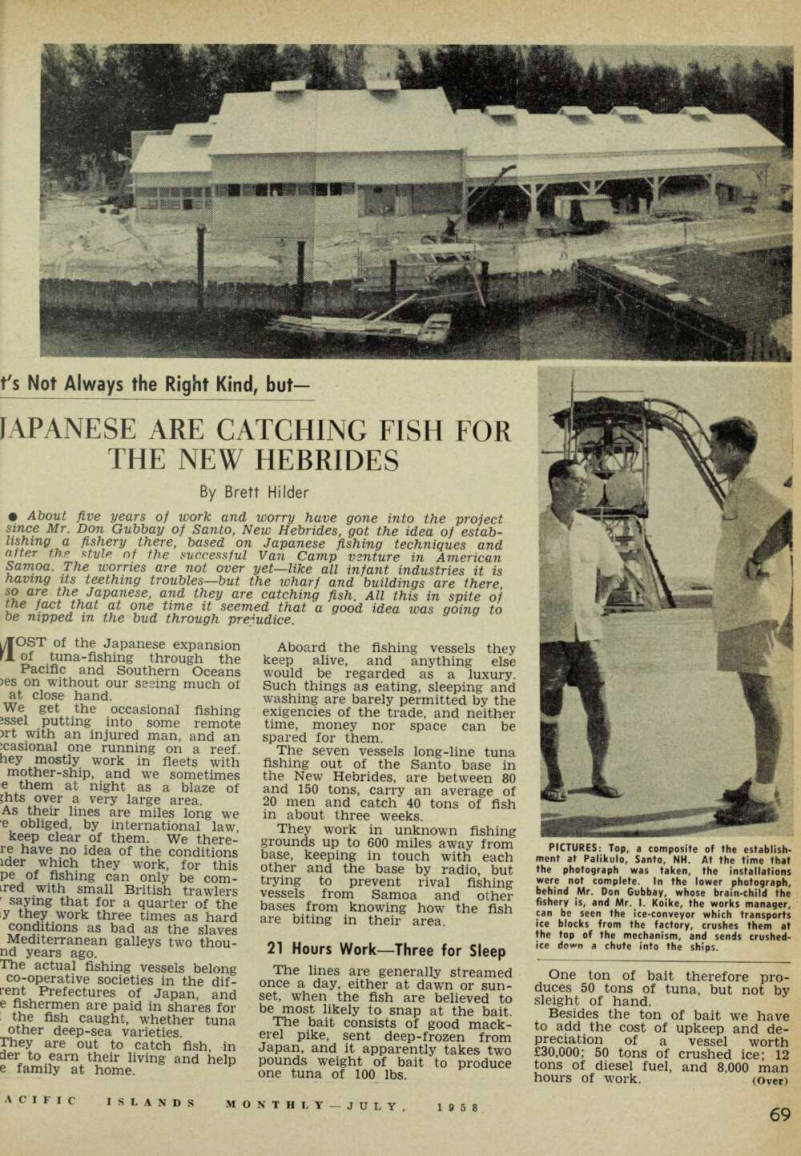
PICTURES: Top, a composite of the establish ment at Palikulo, Santo, NH. At the time that the photograph was taken, the installations were not complete. In the lower photograph, behind Mr. Don Gubbay, whose brain-child the fishery is, and Mr. I. Koike, the works manager, can be seen the ice-conveyor which transports ice blocks from the factory, crushes them at the top of the mechanism, and sends crushed ice down a chute into the ships.
The long lines used add up to about 40 miles in length, as there are drop-lines every 50 yards which carry the bait at an average depth of 50 fathoms.
The lines take 4i hours to stream, they are given 21 hours to catch their fish, and then it takes 13 hours to haul them in and collect and stow the fish in the ice-holds.
After that the men are free to drop into a sleep of utter exhaustion for three hours, when it is time to set the lines again. This goes on for three weeks as a rule, by which time the hold is full and the vessel can return to base.
If the vessel holds 40 tons of fish, their well-earned rest at base consists of 24 hours, during which time all the fish are landed, weighed and stowed in the freezer; the vessel is then given her fuel, another supply of ice, and off she goes for another three weeks of toil, in fair weather or foul.
If the catch from a big vessel amounts to 90 tons, it gets two days in port, for the catch has to be handled and frozen in two lots.
An Idea Five Years Aqo
, 3 At Santo the fishery wharf has three berths: one for unloading the fish, which travels on conveyor belts to the freezer doors: an inside berth for loading the crushed ice and fuel oil: and an outside berth for overseas ships, bringing oil fuel f^7on r ?f,n n * wi an taking away LfJnH il 0r f the f Amencan io!^5 nd other factor y Products to The wharf has a frontage of about 130 feet, with a depth alongside of 30 feet. It is situated in the most sheltered part of Palikulo Bay, in the south-eastern corner of Espiritu Santo Island in the New Hebrides. It is just north of the eastern entrance to Segond
Channel, which today forms the port of Santo, The Santo fishery establishment was planned in 1953, but held up for some time by political objec tions from Australia, mainly from ex-servicemen.
Under the present scheme I can’t see that the Japanese can do any harm, and on the other hand their industry is a welcome item in the economy of the New Hebrides, It may be of much more value later, while keeping the Japanese interests and personnel to a mini mum.
At present the base employs 34 Japanese ashore, helped by 35 natives and five local Europeans, The 34 Japanese will be slowly replaced by natives, if it proves possible to keep them long enough to train.
The fishing base has been built and put into operation during the last three years by a combination of interests under the name of the South Pacific Fishing Company < NH > Pty., Ltd.
There are at present four com panies interested, Daiichi Bussan Kaisha (Premier Trading Co.); Nanyo Boeki Kaisha (South Sea Trading Co.) ; the Washington Fish and Oyster Corporation of USA, and the chief local organiser, D. J. Gubbay & Co. Pty. Ltd of Santo.
These four interests are to be joined by the Compagnie Fran coise des Pecheries du Pacifique, which is being registered in Vila to build a cannery at the base to can the tuna for sale to Pacific Islands and overseas countries, ex cept America, The duty is too high on canned tuna into the States, except from American territory, and it is for this reason that all the tuna from the Santo base is shipped to USA as frozen whole fish. (Over)
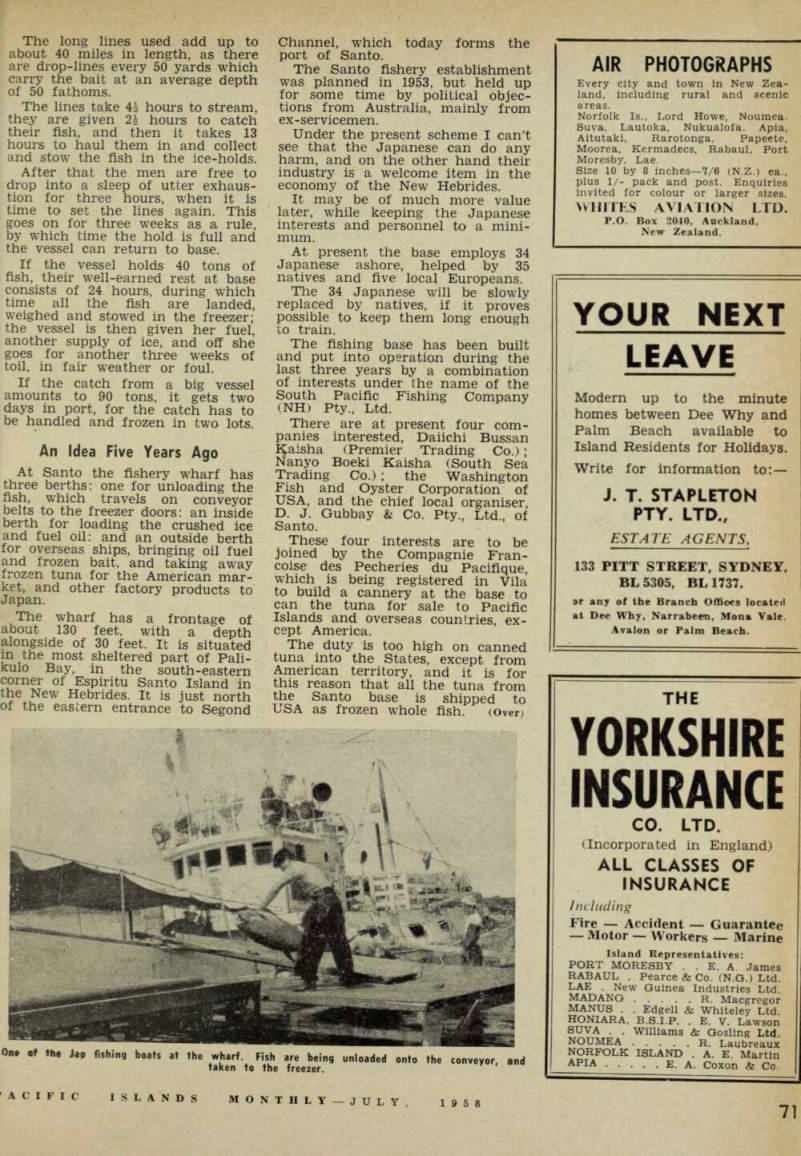
One of the Jap fishing boats at the wharf. Fish are being unloaded onto the conveyor and taken to the freezer.
Albacore, the Wanted Fish Most of the tuna caught belongs o the three species, Yellow Fin, Big-Eye, and Albacore. Only the atter is sent to the USA, and all hose fish over 100 lbs in weight .re cut in half as fillets.
A lot of the fish are as big as man, six feet long and 200 founds, dead or alive.
Besides the tuna there are other arge fish caught, such as Black larlin, Kingfish and Spanish lackerel. These are sent frozen to apan.
Lesser breeds of fish caught must 11 be accepted by the factory, for be fishermen are paid by weight f catch.
These lesser breeds are treated rst by being cut into small fillets, ext by boiling, then by smoking ver slow wood fires, and then assed by carbon-dioxide before bipment to Japan.
This is hardly a profitable pro uct of the factory, owing to the erce competition in Japan The fact that all fish must be urchased when only the Albacore ; wanted, does in fact, constitute real challenge to the economic orking of the establishment. This roblem is only likely to be solved hen the cannery is in operation.
The Set-Up
The Santo establishment is iperintended by a works manager, tr. I. Koike, and consists mainly t a freezer capable of holding bout 700 tons of fish. It is built at le wharf, with the fish unloading srth pointing at the main freezer x>rs.
The fish is firs: stacked in racks for 24 to 36 hours depending on size, to get it frozen hard, before stowing it in the main rooms, which each hold about 100 tons. These magnificent fish make a most im pressive sight in such large quan tities.
The freezer is run by four large ammonia machines in an engine room with space for two more.
There are also electric genera tors, and the whole design and lay-out of the plant is very efficient and convenient.
Apart from the main freezers there is an ice-making plant which makes ten tons of ice at a time This is in blocks of about 250 lbs, and these are stored until required
for the fishing vessels. It is loaded into the holds by first passing up a belt into a crusher at the load ing berth, and the crushed ice is fed through a chute.
The water used for the ice making is from a local well in which the water is rather hard, on account of the coral limestone of which this part of Santo is con structed.
It has first to be well filtered, and while it is being frozen it is very thoroughly aerated to remove the impurities in suspension or solution. This appears to be a necessary step in making ice of high lasting quality, for it does have to last for three weeks and more on each fishing voyage. (Over)
hese are the fish that are wanted; Albacore, for canning in the United States.
The fresh water well is two or three miles from the base, and about 80 tons a day are supplied by a pump, storage tank, and a )-inch pipeline to the base.
The cooling water for the main machinery and condensers is sea water at present, but a water-pond >f about 1,000 tons capacity is at aresent being excavated for this purpose at the rear of the build ngs.
Space has been left between the reezer and the pond for the can ling factory of the French com >any, which would have a con veyor-belt loading line to the over ea berth.
fhe Electricity is Home Produced
The supply of fuel oil for all the aachinery and the fleet of fishing essels has been well designed. A torage tank with a capacity of bout 1,500 tons has been built nth pipelines to and from the diarf and to each engine installa ion.
Most of the oil comes in the ompany’s own ship from Japan, ut as this is not sufficient, some il is imported by other ships and n occasional tanker.
Over 100 tons of oil a month is sed at present, because the com any must generate all its own lectricity, and this will be in reased when the canning factory in operation.
Temporary staff quarters and a mteen are situated on the sea sach a few hundred yards away 'om the works, and special carters are provided for the fish ig crews. Although they don’t ave much time to live there, they ave space for keeping their per »nal possessions, for which there no room on the fishing vessels.
A slipway is being constructed alongside the works to take vessels up to 150 tons. This will provide for all the fishing vessels and also any local small ships requiring docking. Two Japanese salvage divers are employed on the slipway at present, and these men are very useful in converting, for the needs of the fishery, some of the varied collection of American war-time scrap which lies both above and below water in the area.
The actual fishery establishment at Palikulo stands on the site used by the US forces as an auxiliary port installation, and this greatly facilitated the building of the base.
Anart from the main freezer building and engine-room at Pali kulo, the company’s main enter prise was the building of a special shin to bring supplies from Japan and to deliver the frozen Albacore tuna to the United States.
This ship is the m.v. Santo Maru of about 1,000 tons, carrying 600 tons of tuna. She does the round trip between Japan, Santo and San Francisco in 55 days.
From Japan she brings the frozen mackerel-pike as bait, and 150 tons of oil a trip. She takes back to Japan the lesser varieties of frozen tuna, the smoked fillets of mixed species and other by-products. Her speed is 14 knots.
Srnne of the Australia-West Pacific Line ships wdll also likely call for frozen fish for Japan. And there has been some shipment of frozen fish already to Honiara, BSIP, on HP’s Tulagi.
Future Hopes
There is a possibility of catch ing horse-mackerel locally in sea son to save the expensive business
of getting 150 tons of frozen bait from Japan each year.
It may also be possible to catch lobsters along the shores for freez ing or canning, and this could give alternate employment to some local natives.
The company hopes that a local beef industry will be established as a sideline for the freezer and can nery, which would be a valuable factor in the local economy, as well as providing against the danger of any stoppage of the present tuna
fishing industry.
The New Hebrides at present de pends mainly on copra exports, with a growing production of cocoa. The other exports are on the decline, and consist of coffee, trochus and green-snail shell’
Kauri pine and Sandalwood, hides, wool and scrap-metal.
There is a lot of mining survey ing under way, but the plans for large-scale production of mangan ese and other ores may never materialise.
In these circumstances the actual functioning of the fishery at Pali kuio is a welcome addition to the New Hebrides, and when the can nery is built it may prove to be of much greater value in the future.
Unloading the frozen bait from japan-upon this this bait the success of the industry is based. is a type of lmackerel pike, is costly to import, and it is hoped that a similar local will eventually be found to replace it. It is in obtaining this bait that local New Hebrideans [?] ud be nost UsefUl, if they could be persuaded to stick at the job.