World Copra
pp. 47-49 · Read in the full issue

ear of Adequate Supplies"
Market Survey
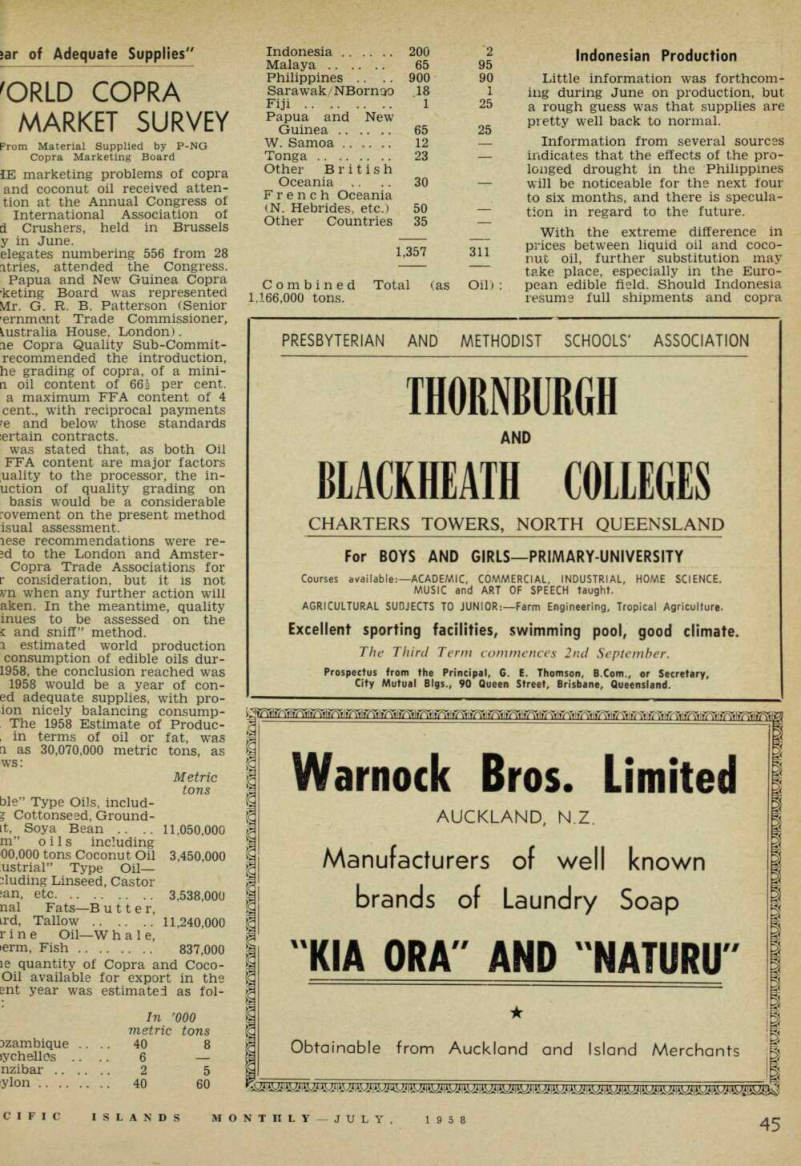
Prom Material Supplied by P-NG Copra Marketing Board IE marketing problems of copra and coconut oil received atten tion at the Annual Congress of International Association of d Crushers, held in Brussels y in June. elegates numbering 556 from 28 itries, attended the Congress.
Papua and New Guinea Copra •keting Board was represented Mr. G. R. B. Patterson (Senior r ernmont Trade Commissioner, Australia House, London). le Copra Quality Sub-Commit recommended the introduction, he grading of copra, of a mini n oil content of 66i per cent, a maximum FFA content of 4 cent., with reciprocal payments re and below those standards ;ertain contracts, was stated that, as both Oil FFA content are major factors uality to the processor, the in uction of quality grading on basis would be a considerable rovement on the present method isual assessment, lese recommendations were re ?d to the London and Amster- Copra Trade Associations for r consideration, but it is not vn when any further action will aken. In the meantime, quality inues to be assessed on the s and sniff” method, i estimated world production consumption of edible oils dur -1958, the conclusion reached was 1958 would be a year of con ed adequate supplies, with pro ion nicely balancing consump- The 1958 Estimate of Produc , in terms of oil or fat, was a as 30,070,000 metric tons, as ws: Metric tons ble” Type Oils, includ l Cottonseed, Ground
it, Soya Bean .. .. 11,050,000
m” oils including 00,000 tons Coconut Oil 3,450,000 ustrial” Type Oil eluding Linseed, Castor >an, etc 3,538,000 nal Fats —Butter, ird, Tallow 11,240,000 ri n e Oil—W hale, ierm, Fish 837,000 le quantity of Copra and Coco- Oil available for export in the ent year was estimated as fol-
Indonesian Production
Little information was forthcom ing during June on production, but a rough guess was that supplies are pretty well back to normal.
Information from several sources indicates that the effects of the pro longed drought in the Philippines will be noticeable for the next four to six months, and there is specula tion in regard to the future.
With the extreme difference in prices between liquid oil and coco nut oil, further substitution may take place, especially in the Euro pean edible field. Should Indonesia resume full shipments and copra
Indonesia 200 2 Malaya 65 95 Philippines .. .. 900 90 Sarawak/ NBornqo 18 1 Fiji 1 25 Papua and New Guinea 65 25 W. Samoa 12 — Tonga 23 — Other British Oceania 30 — French Oceania (N. Hebrides, etc.) 50 Other Countries 35 — 1,357 311 Combined Total (as Oil) 1,166,000 tons.
In ’000 metric tons Dzambique ... 40 8 lychellcs ... 6 — nzibar 2 5 •ylon 40 60
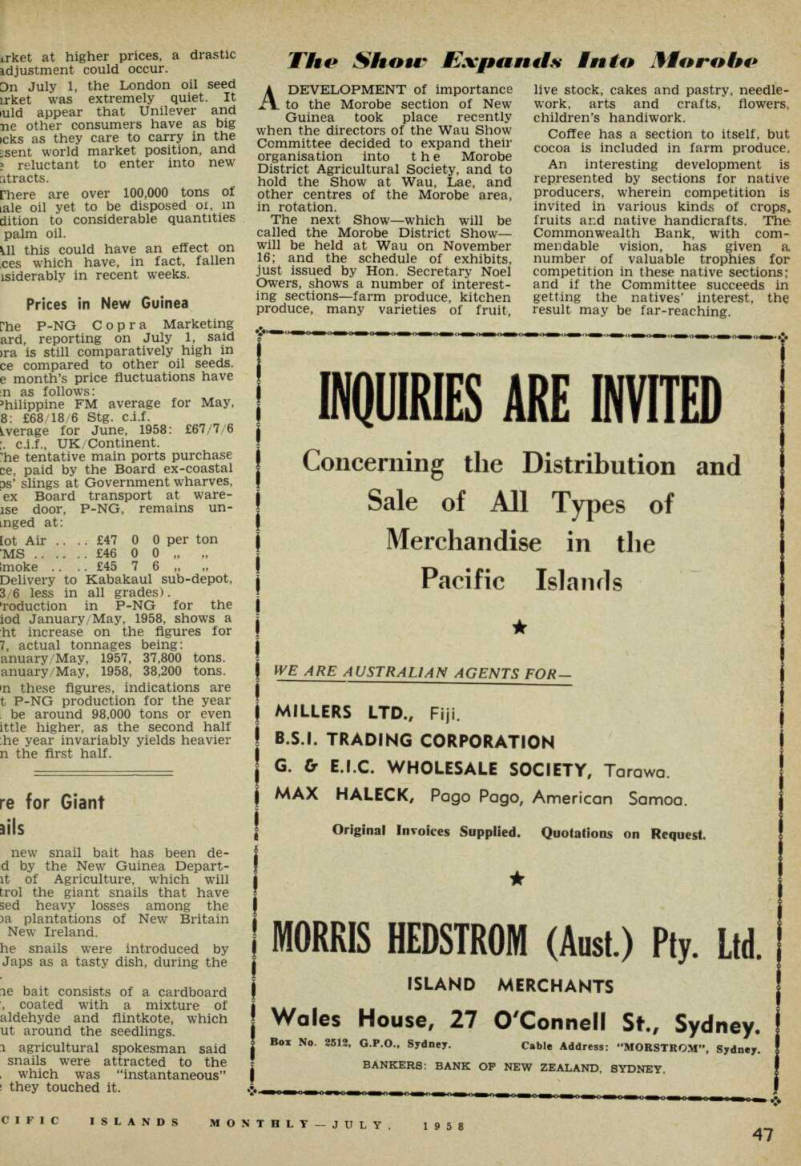
irket at higher prices, a drastic adjustment could occur.
Dn July 1, the London oil seed irket was extremely quiet. It (Uld appear that Unilever and ne other consumers have as big »cks as they care to carry in the ?sent world market position, and ? reluctant to enter into new [itracts. rhere are over 100,000 tons of tale oil yet to be disposed oi, in dition to considerable quantities palm oil.
U 1 this could have an effect on ces which have, in fact, fallen isiderably in recent weeks.
Prices in New Guinea rhe P-NG Copra Marketing ard, reporting on July 1, said >ra is still comparatively high in ce compared to other oil seeds, e month’s price fluctuations have •n as follows: s hilippine FM average for May, 8: £6B/18/6 Stg. c.i.f.
Average for June, 1958; £67/7/6 :. c.i.f., UK/Continent. ’he tentative main ports purchase ce, paid by the Board ex-coastal js’ slings at Government wharves, ex Board transport at ware ise door, P-NG, remains un mged at: lot Air ... £47 0 0 per ton 'MS £46 0 0 „ „ imoke ... £45 7 6 „ Delivery to Kabakaul sub-depot, 3/6 less in all grades). ’reduction in P-NG for the iod January/May, 1958, shows a ht increase on the figures for 7, actual tonnages being: anuary/May, 1957, 37,800 tons. anuary/May, 1958, 38,200 tons. •n these figures, indications are t P-NG production for the year . be around 98,000 tons or even ittle higher, as the second half ;he year invariably yields heavier n the first half.
re for Giant
ails
new snail bait has been de d by the New Guinea Depart it of Agriculture, which will trol the giant snails that have sed heavy losses among the )a plantations of New Britain New Ireland. he snails were introduced by Japs as a tasty dish, during the ae bait consists of a cardboard , coated with a mixture of aldehyde and flintkote, which ut around the seedlings, i agricultural spokesman said snails were attracted to the which was “instantaneous” i they touched it.