American Half Of Smith Team Will See
p. 23 · Read in the full issue
h Anniversary of [?]s-Pacific Flight
Old Bus Dedicated
e Towards the end of this month, the two surviving members f the four-man crew that made history in 1928 by flying for le first time across the Pacific between America and Australia, sing the 3-engined monoplane, Southern Cross, will relive that flight / flying again those 7,000-odd dramatic miles.
IT this time they will be doing it in a Super-Constellation, as the guests of Qantas, in roughly -fourth of the 83 hours 29 utes flying-time taken on that ; occasion. he men, of course, are Harry n, of Maine, who is now 73; and les Warner, of California, who is lis 60’s. Lyon was the navigator hat pioneer flight; Warner was radio-operator. heir two companions on that epic flight, Charles Ulm and arl e s Kingsford-Smith dis “ared in separate ocean flights 934 and 1935. ae “Southern Cross” reached bane on June 9, 1928, but the . anniversary celebrations have i delayed somewhat—for the ling of the memorial pavilion at bane airport which will per icntly house the Old Bus. lis is to be opened by the le Minister around August 17, the trip of Warner and Lyon i their wives) from the United es has been designed to fit in l this event. They will arrive in ley on August 6, and before that will have spent two or three ; in Honolulu and another days in Suva.
The Hell-Raiser
iptain Harry Lyon calls him a “nefarious character” but jars to have done pretty well for self in the intervening 30 years. j is described as living the life i country squire in his white nial mansion in Maine, and is obviously a solid, respectable en who seems to have filled t of the honorary community at one time and another, it he looks back with a chuckle he days when he was a ship’s ain, “rum runner, pioneer flier village hell-raiser”. the time Smithy and Ulm ■ looking for crew in 1928, he “on the beach” looking for a He didn’t know anything it aerial navigation but “naviga the way I would on a ship— faster”. As a method, it :ed. ley hit the right spot in Hawaii p 27 hours in the air. This had done before, of course, and it the next 3,000 miles to pin t the dot in the Pacific that Fiji, that the fliers regarded ifflcult.
They accomplished it “right on the nose”, says Lyon, with 20 minutes reserve of fuel, and after almost 35 hours non-stop flight in considerable discomfort.
Warner, too, was on the beach when the Southern Cross trip was being planned. He had just been discharged from the Navy after 16 years service as a radio man. He was pedalling pants m San Hrancisco and findmg it dull”, when a mutual friend told him that Lyon had tangled with a couple of Australians who were aiming to fly tne pacinc.
The Radio Ooerator me naaio uperaior Warner thought Lyon must have gone crazy, but he looked him up —and the Southern Cross got its radio operator.
Today, Warner is an unremarkable, grey-haired man, who has a little difficulty with his hearing.
He is in the real estate business and lives in a quiet suburban street in Hayward, California, not so far from where the Southern Cross rumbled into the dawn, just over 30 years ago.
When he and Lyon returned to the States in 1928, it was to a heroes’ welcome. California news-
papers collected over $12,000 for the pair of them, but, says Warner, “I was a real green pea —16 years in the Navy hadn’t prepared me for the variety of sharpies that were after me”. The money was gone inside two years and he went back to fixing radios until the Navy re called him in 1940.
A trip back to Australia has been a thing he has dreamed about occasionally, and now in com pany with Lyon—their trails don’t appear to have crossed in these 30 years the dream will become reality.
It's Different Now And they are going to find a lot of things that are different. When they are flying at 20,000 ft in the big pressurised cabin of the Super Constellation, drinking champagne cocktails and eating food delicasies from half the world away, they may recall the lumbering gait of the Old Bus, which flew at 100 knots and sometimes so close to the sea Warner had to reel in his radio aerial.
And when they stretch out and sleep in foam-rubber comfort, they may remember that that first flight was a strictly immobile affair, as not once during flight could they move from their quarters crouched behind the 750 gal. drum of petrol; and that radio messages from Warner, and navigational instruc tions from Lyon, were passed to the pilots, Ulm and Smithy, pinned to a long stick with a clothes-peg.
Next month, the Old Bus in its new home in Brisbane, will be dedicated as a permanent memorial not only to Australia’s own Kingsford-Smith and Ulm whose dream of trans-Pacific flight was the genesis of aerial ocean crossings that are today commonplace, but to these two Americans who helped make their dream come true.
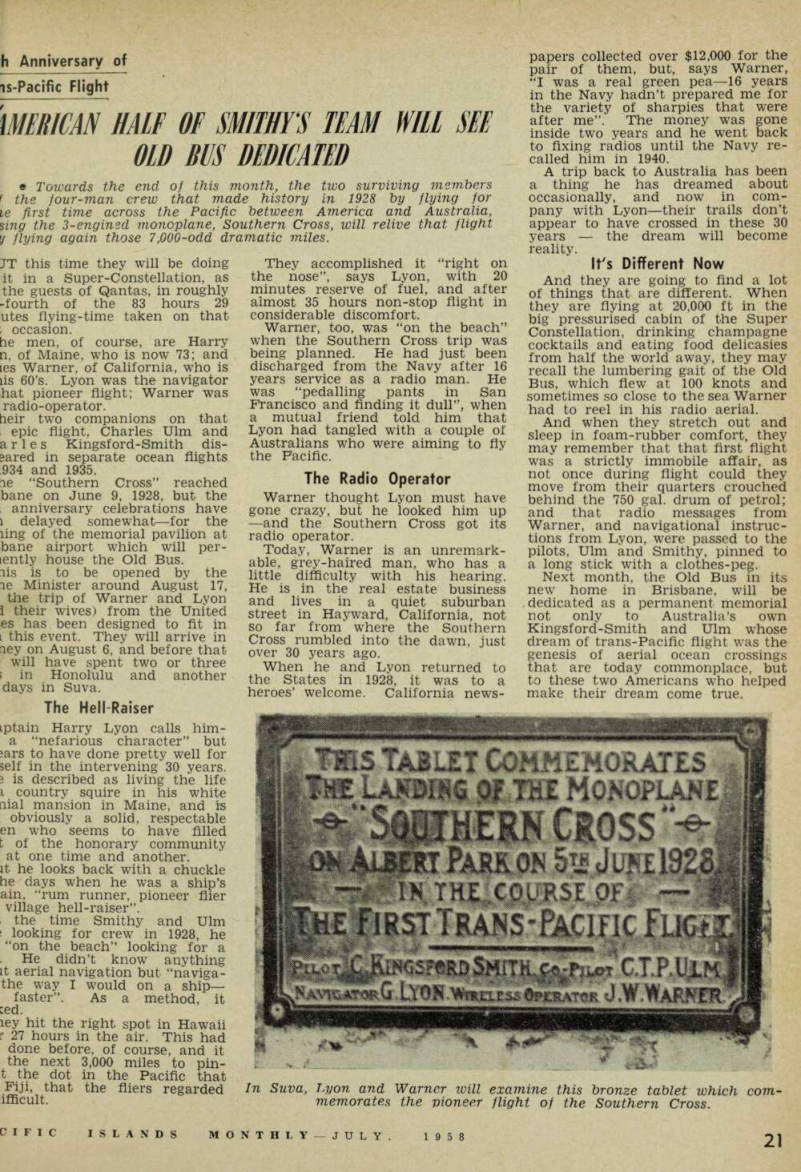
In Suva, Lyon and Warner will examine this bronze tablet which com memorates the Pioneer flight of the Southern Cross.