Vernor's Action Saves N. Caledonia
pp. 19-151 · Read in the full issue
[?]ss Hatred Flares Up
From Civil War
The political situation in New Caledonia, by July 10, had jen brought under full control.
The machinery of government, directed personally by the ovemor, is functioning quietly and efficiently, although the mntry remains divided generally between Rightists and Leftists, ime of whom are snarling savagely at each other.
ERE is one man who comes out tf it all with credit —the lovernor, M. Aime Grimald. as fortunate for New Cale i that there was someone like rrimald, with wisdom, tolerance strength, to take charge of the cal volcano that erunted so mly on June 18. ( PIM, June, Grimald inherited this trouble the political and economic tions which dominated New lonia for many years. w Class Hatred was Bred ■ too long, the big French iy was ruled by powerful cial interests represented in metal industries and certain ig companies. Governors and administrative officials were their complaisant tools, is, life was made easy and stable for the upper classes ; Colony, and there was order and good government. But was no worthwhile place in un for (a) the poorer classes rmers; (b) the large number ixed blood people who live r close to the earth in NC; (c) the native people— lesians, closely akin to those w Hebrides and Solomons, i population today is made up ximately thus— iean and Mixed-race pie living as Euro ns 22,000 lesian natives .. .. 36,000 ese 2,700 amese (Tonkinese) .. 5,000 5 Islanders 1,000 ians 1,300 68,000 a good many years longer was necessary, the poorer s endured the arrogance, and ed political injustice at the of the rich traders and . top bureaucrats. Thus was bred , a degree of class hatred that, e late ’Forties, was becoming ;d. > class feeling really became after World War ll—probably, isult of the American occupa m France surrendered to in 1940, New Caledonia and h Oceania were left politically
and administratively and econo mically adrift. For a time, until De Gaulle’s Free France began to function, they were actually with out a government.
The first of the American divisions arrived in NC in March, 1942; and thereafter, until late in 1945, the French Pacific Territories were governed nominally by De Gaulle, but actually by the military com manders of the Allies.
New Caledonia, desperately poor for the three years following 1939, suddenly became rich. Hundreds of middle-class people, who counted little in pre-war NC, owned masses of US dollars when the war ended, and France resumed control.
Those economic changes reached from the middle into the lower classes and changed the political balance. The downtrodden people of pre-war still hated the privileged classes; and the dollars gave them something effective to hate with.
Effect of 'Anti-Colonialism 7
Nothing much happened, politic ally, in NC, for a few years—until about 1951, when colonies of France felt the effect of the changes in the
French Colonial Empire, brought about by the Fourth Republic’s attempt to save the Colonial Empire from the wave of anti-colonialism now sweeping across the post-war world.
It came to New Caledonia and
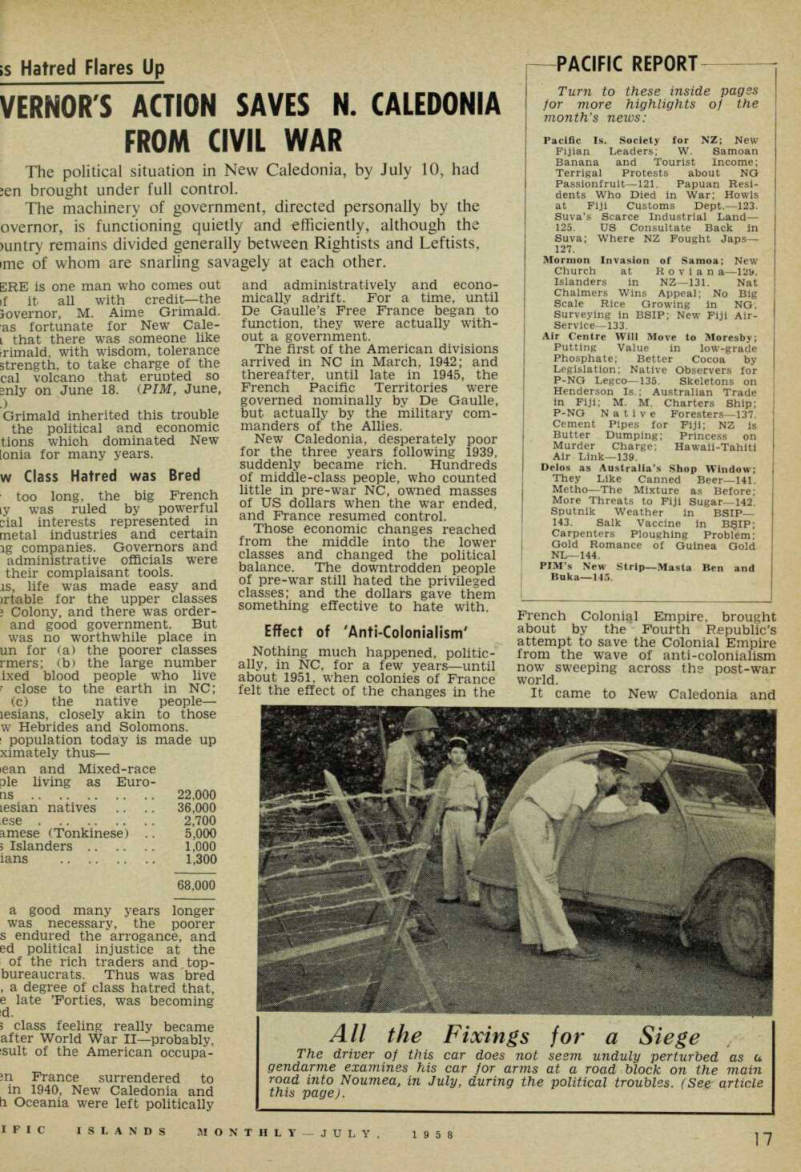
All the Fixings for a Siege
The driver of this car does not seem unduly perturbed as u gendarme examines his car for arms at a road block on the main road into Noumea, in July, during the political troubles. (See article this page).
French Polynesia and (more re cently) to New Hebrides in the shape of the French Union, under which all classes of persons in the French Colonies Europeans and indigenes and mixed race—became entitled, wherever possible and practicable, to equal voting rights in electing their representatives to the French Union Assembly.
In July, 1951, Maurice Lenormand, a well-educated French pharmacist, regarded as ardently pro-native, who had demonstrated his deep interest in ethnology by marrying a Melanesian native, closely related to the Colony’s highest native chief, got sufficient native votes to secure election to the French Union Assembly (sitting in Paris)—a position he has held ever since.
In 1952, France decided to enlarge the NC Assembly to 25—16 to be elected by Europeans, and nine by natives. Lenormand immediately challenged and fanatically fought (m Paris) the new measure: and —despite bitter opposition by the better-class Europeans of NC—he succeeded eventually in the intro duction of a common roll, for all classes. (PIM, April, 1952, p. 12) A period of turmoil was followed by the Loi Cadre, and when the rolls closed, in 1957, they carried Re names of 13,406 French and 18,964 Melanesians.
The inevitable result was the election of an Assembly, in 1957 dominated by Lenormand and his nominees, some of whom were Mela nesians.
By now, the Party led bv Lenormand was called Caledonien Lnion, and the opposition party
(mainly Rightist and De Gaullist) was mainly Republican Socialists.
The latter was led by an alert and energetic attorney, George Chatenay. Chatenay challenged Lenormand for the position on the French Union Assembly, but Lenormand again won the poll (January 8, 1956) by some 5,000 majority.
Excesses by Leftists
There was a similar development in French Polynesia, where also a common roll for Europeans and Islanders was introduced. A Leftist Party, led by Jean Baptist Celan- Jerusalemy and Pouvanaa a Oopa took control of the Government, and caused a Rightist revolt (May
Pim, P. 14).
Both the Noumea and Tahiti Assemblies, having Socialist majori ties, introduced, in 1957, measures which the Rightist sections regarded as oppressive.
In Noumea, for example, M.
Lenormand appointed a governing Council of seven Ministers, two of whom were natives and four of whom were recent arrivals from France, and suspected Reds; and these Ministers awarded themselves salaries equal to no less than £485 per month Australian, plus per quisites—a figure that would have been regarded as outrageous even in Australia, where the politicians’ snouts are so often thrust into the trough of public finance. It was sinful in NC, where declining metal prices have introduced a really lean period.
For years, the NC administrative pendulum had swung a long way
to the Right. Now, understands it was making a compensai swing away over to the Left, that reflection did not make property-owning sections any resentful of what was going on..
The Melanesian natives v wholly behind Lenormand.
Revolt by Rightists
The dissatisfaction of the Fres Empire with the French Pan mentary system confirmed merchants and traders of New Cl donia in their anger and discontj Thus, when the Chamber Deputies collapsed, and hanr power over to De Gaulle, the au Lenormand sections in New Cj: donia were ready for action.
They were deceptively quiet, some weeks. But it now is cl; that some underground organisatf was proceeding.
They made their own opportun on June 18. They assembled at De Gaullist statue (memorial to battle of Free France in 1940and made salutation; and then tic marched directly upon Governmr House, and demanded the remo] from office of Council Vi President and Premier Lenorms: and his coterie of Ministers.
It was apparent that this demci stration was organised by j Republican Socialist Party, a George Chatenay was its leader a chief spokesman.
Governor G r i m a 1 d nature? hesitated. Lenormand’s Governmli was legally in power, elected £ cording to the laws of the Freni Union. The Governor had suprek authority over the Colony; but w
(Continued on page 145)
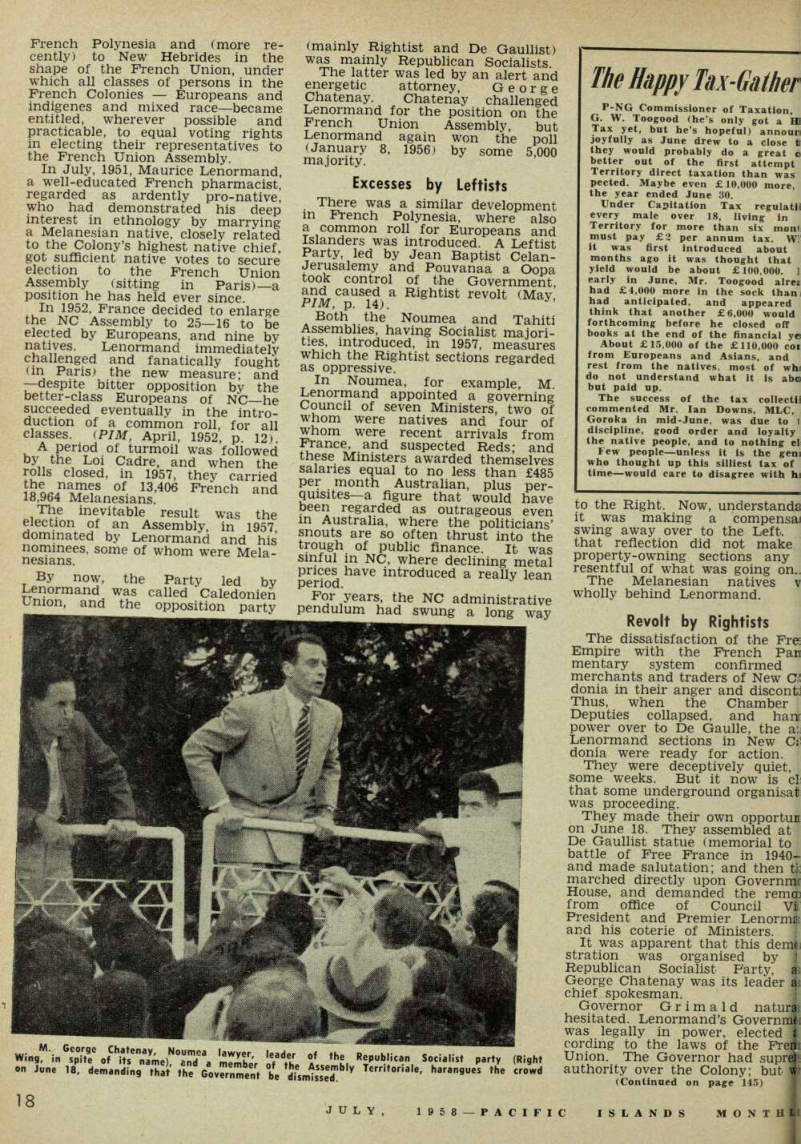
M. George Chatenay, Noumea lawyer, leader of the Republican Socialist party (Right Wing, in spite of its name), a member of the Assembly Territoriale, harangues the crowd on June 18, demanding that the Government be dismissed.
he justified in exercising it to throw out the elected government?
Two arguments appear to have influenced him.
One was advanced by M.
Chatenay. The Loi Cadre, under which community rolls —as originally planned—were discarded in favour of a common roll, was obviously unfair and unjust; and the proof of it lay in the fact that the Mela nesian-dominated government had added no less than £lh millions to the annual administrative costs of the Territory, and was proceeding to wring this huge additional ex penditure out of the property owning classes. Furthermore, the Loi Cadre was the product of a Metropolitan Assembly now so dis credited that it had broken down and surrendered its authority to De Gaulle.
The other —and very tangible— argument was that Committees of Public Safety were springing up throughout the Territory, and challenging the governmental personnel and machinery; and, if this were not stopped, it would un questionably develop into civil war.
The Governor's Decision The Governor took the only possible course.
He suspended immediately the Government of M. Lenormand, and personally assumed full administra tive control, and responsibility for the NC Administration.
He instructed the police, and the military personnel available that all arbitrary acts —that is, any action taken outside the machinery of the law—by either Rightists or Leftists, must be immediately suppressed and the offenders arrested.
He then reported the situation fully to the De Gaullist Govern ment m Paris, and asked for in structions.
Police and soldiers took charge of all public roads and buildings; and places of public assembly were placed under strict surveillance.
Hotel bars were closed. There were some clashes, but generally the people obeyed.
Naturally, the Governor was assailed furiously by both Left and Right. Lenormand’s followers in sisted that this was an outrageous De Gaullist dictatorship. Chatenay’s Republican Socialists demanded that their organisation should have its right and proper place in the maintenance of public safety.
M. Grimald ignored them both.
So deputations of Caledonia Unionists and Republican Socialists, within the week following June 18, flew to Paris, to place their furious arguments before the highest authority.
De Gaulle Acts Quickly But Prime Minister De Gaulle had been wasting no time.
On June 18 —the very day of the first demonstration—M. Carle, an inspector of the Department of Overseas France, already had arrived m Noumea to examine and report to the De Gaulle Government on the operation of the Loi Cadre, which had established Lenormand and his £6,000 per annum Ministers so firmly in power.
On July 2, exactly three weeks later, as a result of the reports of the Governor of June 18-19, there arrived in Noumea M. Raoul Angamanne, a highly-esteemed former Governor of New Caledonia (1951-54). He and M. Carle were immediately constituted a special Mission, to assist Governor Grimald m Noumea, and advise the Prime Minister of Prance.
It was announced on July 4 that the suspension of the Lenormand government probably would con tinue until November (when, under
national agreement with De die, anew Constitution for nee —and, presumably, her over i Territories—will be submitted De Gaulle to the people. and better solution could have been id.
Political Heat and Fever
icidents which indicate the heat fever of the inter-communal tionship in NC were reported 7 in July by our Noumea sspondent: le Governor has issued anew to remain in force for one th, forbidding all persons to 7 weapons of any kind.
Lenormand challenged the jrnor’s power to suspend the trmand administration. The rtments of administration are tioning as usual; but their nistrative heads are the rnor and his officials, and not .enormand and his “ministers”, e deputation of. Republican .lists returned to Noumea on 2 from Paris in a state of mdency it appeared that, te the heavy costs of the n air journey, their repre tions were not sympathetically red. e Lenormand propaganda -sheet Calsdonien directed
acidulous comment to the British and Australian Consuls, pointing out that British and Australian “citizens” have associated them selves too prominently with the anti-Lenormand demonstrators. It demanded that these foreigners stay out of a situation affecting the internal security of NC.
A pastoral letter by Monsignor Martin, head of the Roman Catholic Church in NC, read in all the churches and widely printed, has had a calming effect. Monsignor Martin—who, incidentally, is a fervent De Gaullist—strongly con demned the Rightist demonstrations of June 18, and the lawless acts of the political organisations. He declared that only disaster could follow any governmental action based on a belief that government was obliged to serve a particular group or party. He reminded the people that there were more than one race and group in New Cale donia’s population: and there never could be peace in a country whose government directed acts of violence against a particular race or com munity.
Rightists and the Law Here, according to one corres pondent, are some of the unlawful acts of the Republican Socialists
who demonstrated between June 18 and 21: • Armed men at Bourail molested Lenormand sympathisers, and three members of the Assembly were held prisoners until freed by troops acting under the Governor’s orders. • Armed parties of Republican Socialists set up road blocks and inspected cars. Government forces dispersed them. • Two natives —one a “Grand Chief”—who are members of the Lenormand “cabinet” were forcibly detained—some reports say they were assaulted. • Asa counter to the De Gaullist demonstration of June 18, trade union members and other followers of Lenormand organised a demon stration to take place in Noumea on June 21; but the Governor forbade the gathering and brought out armed forces to see that his order was obeyed. Street assemblies were forbidden and all bars closed. • On Sunday, June 22, Lenor mand “vigilantes” discovered what they regarded as a hostile assembly of 20 men in a building about 100 yards from Lenormand’s house Security forces were called and some of the group were arrested, and the premises searched. The owner of the premises left NC by the next outwards plane.