The Month's New Reading
pp. 90-101 · Read in the full issue


With Judy Tudor
Taylor Caldwell is one of those artists in words who find it necessary to have a large canvas and much elbow room to work.
The Sound of Thunder follows the pattern of others of her larger novels, taking every line of its 500 pages to trace a German-American family through two generations of inhibited existence. For Miss Cald well, a sound technician when it comes to the writing business, specialises in cramped souls and individuals driven by strange furies.
Probably the best character is mother Maria* an impoverished Ger man noblewoman, but the core of the story is her son Edward Enger, who was deliberately sacrificed by his parents for the three brothers and one sister regarded as geniuses.
In order that David should be a musician, Sylvia a theatrical pro ducer, Gregory a writer and Ralph an artist, Edward had to leave school at 14 and help his father in the family delicatessen.
A not unusual theme, of course, if Miss Taylor had played it straight. But somewhere along the way of self-sacrifice, Edward’s nature curdled and from burnt offering he became—not too con vincingly at times —the piper of the tune.
The whole of family activity was devoted to enshrining the talents of the brothers and sister: Un alterable as the laws of the Persians was the fact that they were Geniuses. Said Edward: They’d better be.
The real genius was Edward. Not only did he have a talent for mak ing money but he could outdo the Geniuses at their chosen arts. They, bludgeoned into acquiescence, be came competent performers and de veloped a flair for side activities, carefully hidden from Edward.
And. even as each took a spouse, they tended to congregate together in feudal state on the home estate, and the frictions, passions and temperaments of the individual characters combine to provide scope for the author’s own Genius—which is considerable.
A theme of this sort is no task for an amateur, and the fact that she surmounted it should perhaps be sufficient reason for allowing Miss Caldwell the Reader’s Digest sentimentality of her ending. But it will not be to all tastes. In fic tion, men may suffer a complete volte face in character following a Revelation. In real life character changes are as rare as revelations —which is probably fortunate.
Nonetheless it is interesting to
speculate on the thought processes of the author when working out her theme in just this particular way. (THE SOUND OF THUNDER, published by Wm.
Collins, Ltd. Australian price, 20/-.)
Walking Above the Clouc
IT is disconcerting, to say least, to pick up the at biography of an air-hostess find inside a loose slip—tribute the author who lost her life i plane crash while the book being printed.
However, that is what happe to Muriel Hanning-Lee who< Head in the Clouds gives u, bright account of what it is to be on the other side of travel. It is likely, anyway, ths statistician would be able to ca
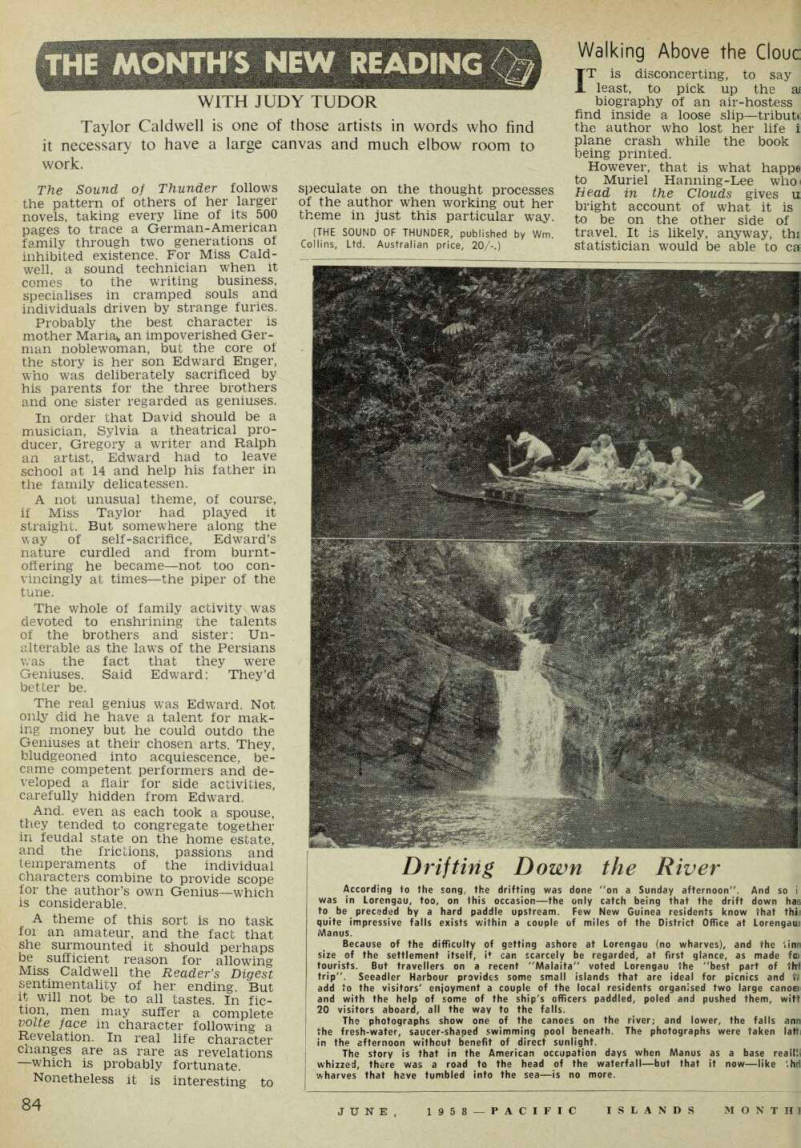
Drifting Down the River
According to the song, the drifting was done "on a Sunday afternoon". And so i was in Lorengau, too, on this occasion—the only catch being that the drift down has to be preceded by a hard paddle upstream. Few New Guinea residents know that this quite impressive falls exists within a couple of miles of the District Office at Lorengaw Manus.
Because of the difficulty of getting ashore at Lorengau (no wharves), and the [?]in[?] size of the settlement itself, it can scarcely be regarded, at first glance, as made fo tourists. But travellers on a recent "Malaita" voted Lorengau the "best part of th[?] trip", Seeadler Harbour provides some small islands that are ideal for picnics and [?] add to the visitors' enjoyment a couple of the local residents organised two large canoe and with the help of some of the ship's officers paddled, poled and pushed them, wit[?] 20 visitors aboard, all the way to the falls.
The photographs show one of the canoes on the river; and lower, the falls an[?] the fresh-water, saucer-shaped swimming pool beneath. The photographs were taken lat[?] in the afternoon without benefit of direct sunlight.
The story is that in the American occupation days when Manus as a base reall[?] whizzed, there was a road to the head of the waterfall —but that it now—like [?] wharves that have tumbled into the sea—is no more.
3 that the occupational hazards air-hostessing are no greater m bus-conductressing. (For the ord: she was killed in the flying it crash on the Isle of Wight ; November).
Jefore her death she had ten rs of a Magic Carpet life, fas ing thousands of seat-belts, and ang thousands of meals of rse, but also seeing strange lands [ meeting stranger people, o South America, the Far East, 0 China during the fighting, all r Europe, the Middle East and ica. She took care of pilgrims Mecca; and evacuees from Suez ing the troubles of 1956; film ■s and sailors. t one time she hitched a ride le to Canada for a holiday on delivery flight of the Solent t was to become part of South ific Airlines fleet on the Hawaii liti service. She was offered a as hostess before she left them Halifax, but she refused. (This ice never came to anything of :se; it was balked by the H ib experiments on Christmas nd). 3 air-hostessing is one of the ciour jobs of this age, this little y will be of considerable interest oung women—and to others, of ■se, who like reading about ;r people’s adventures.
EAD IN THE CLOUDS, published by Hodder Stoughton, Ltd. Australian price, 18/9.)
)it Maclean
-Iistair Maclean’S South
By Java Head should be re viewed by someone who did read his former best-selling :esses HMS Ulysses and The 'S of Navarone. ley then might find the present y, f.a.q. adventure fare. As it r ava Head is a keen disappoint it to anyone who enjoyed the ping excitement and suspense he former novels, lere is so little resemblance be ;n the current Maclean and the lean of the past that it is hard, ed, to believe that the same 1 wrote all three stories. le characters of Java Head lack ty and the whole construction he story and its craftsmanship messy. lere was much that was fabu ly incredible in the Guns of irone but such was the skill of author in creating the right Dsphere on that occasion, that reader was persuaded against better judgment that the feats ormed were performable by ts, le feats in Java Head remain 3ly incredible and the would pants are cut down to pigmy e have read somewhere that of Maclean’s Navy service was t in the Far East. If so, he t have forgotten more than he
remembers. Not even his Japanese seem believable.
It is hard to put a finger on what made the other novels so very good and this one on the wrong side of mediocre. But for the first time he has introduced a woman, a child and a love story into a narrative and such maukish sentimentality sits ill upon him.
There were thousands of exciting incidents in the Pacific war that would weave well into the fabric
of a novel; but so far most leading novelists have left them completely alone. That makes it doubly dis appointing to see one who did at tempt it—and a writer of Maclean’s calibre—fall down on the job so dismally. {SOUTH BY JAVA HEAD, published by Wm.
Collins. Australian price, 17/6.
Policeman's Lot
ONE of the essential differences between a London policeman and an Australian cop, is that the former never says: “Hey, you!
Or so we are led to believe.
But one thing they have in com mon is that they seldom burst into print—at least not until they are Commissioners. So Sydney C. Har vey’s London Policeman is unique in this respect as it tells of his day to day duties during his 15 years with the “best force in the largest city on earth”.
Sergeant Harvey is now ex sergeant and manages a furniture shop in Hastings, New Zealand, where he migrated some years ago.
During his time in The Force his job took him to various districts in London but mostly he was in the
West End which is a magnet for odd types and where all of the petty crimes and lurks abound just beneath the sophisticated surface, And the Sergeant’s story is not of the big-time crimes that hit the headlines but of the daily routine of a policeman on normal duties, Harvey did not find a policeman’s lot an unhappy one, nor find it dull and as he has a simple direct style of writing, a sense of humour and was obviously more concerned with helping people than “pinching” them, his readers will go along pleasantly with him to the end.
His book could be regarded as having a secondary purpose to that of entertainment—it is an excellent guide for the visitor to London,
Most tourists gravitate to the West End and few see deeper than the big stores with the famous names, the theatres and restaurants. But a policeman’s view of this hub of the metropolis is a very different dish, and seeing it through his eyes will help visitors to understand Lon don better. (LONDON POLICEMAN, published by Angus and Robertson, Ltd. Australian price, 17/6.)
Life in Our Street
11HE human young is universally . a dirty-minded brat, existing in a world compounded of funda mental instincts, ignorance, im agination, half-truths, an over whelming curiosity. It inhabits a
Closed-Shop, the opposing fi being represented by Grown from whom it automatically scr the baser facts of its life
knowledge.
Above all, the child is a resil animal, able to accept most of facts of life without undue dam to the constitution or fear of veloping soul-destroying frustrat) in later life.
That anyway, is the view Kathleen (Forever Amber) Win The kids of Our Street, Small American Town, is the thi of America, With Love, a docun of no mean technical mi although it maybe does not re the goal if you require only tc entertained by a book.
For reasons unstated, Miss Wii selected the year 1932 as the to be described in the life of C; and the other kids in her stre: but the things with which author and Gassy are occupied undated: the year 1962 might Y done as well; or 1912.
In Cassy’s world there was moi whom she loved, and her fa whom she thought she disliked; brother Don, part-ally, part- Russ, with whom she had a c sionate 12-year-old affair; Willy, her best girl-friend.
There were the cult-worship; Hollywood star, Jean Harlow, the fascination of Vivian who w out with strange men and beaten up by sailors.
Then there were the desperath tragedies, joys and triumphs i culiar to the young; the perem wonderment about the mecha: of sex and the paradoxical, c: acceptance of what went on beh the blackberry bushes in the vac lot.
With it all, Gassy was a nor little girl who washed the disc set the table and went to Sura school and conformed to the 1« social pattern.
If you think that all children “sweet” and you come from a II line of “sweet” children yourr you will spurn Miss Winsor’s position of small-town life—pr ably as sordid.
But if you come of ordinary fi whose gregarious young learn , sharpening experience, you probably agree that the process growing up is unchanging, irresn tive of time or place; that extre youth is not always sweet or be; tiful, and contains, at times, mi that is sordid.
As one might expect, the w; that has gone into the book; technically expert. Miss Winsor private life, the wife of a Was ington lawyer) is apparently wi out young herself—or if this is so, has successfully managed survive the perils of sentimental that sometimes go with motlrl hood. (AMERICA WITH LOVE, published by H Davies, Ltd. Australian price, 18/9.)
ike Yarns
OST people in Australia have . at least an academic interest in snakes although most citi -5 see few of them in their daily >. Nonetheless, most would agree ; snakes as a subject for a pop ■ book would be wide of the k. *ic Worrell, Australia’s Mr. ke No. 1, seems to have sur nted the problem of prejudice ever, in Song of the Snake— ibly because although it has :es aplenty, it covers many ir interesting aspects of Aus an life; Aboriginal cave paint buffalo shooting, crocodile ;ing, Arnhemland natives, fish mutton-birding in the Bass it islands, and a hundred other s touching on Australia’s odd and fauna, orrell lives in the Gosford dis of NSW, which in many recan be regarded as the far
southern limits of the sub 's. With its densely timbered rs and hills and numerous al lagoons, its relatively high all and warm climate for ■ nine months of the year, it ideal hunting ground for Mr. sirs activities. s district is only headquarters, 7 er. Most of his wandering far after snakes has been done ehalf of the Commonwealth i Laboratories who require a ming supply of snake venom, ike-charmer Worrell has an ring eye and writes well; the is therefore an interesting mrri of nature lore, fascinating to people who have a natural on to reptiles. 1 production of the book is top illustrations in black and and colour photography are rous and very good. f OF THE SNAKE, published by Angus oertson. Ltd. Australian price, 27/6.)
A Box of Delights
From Masefield
JOHN MASEFIELD, dramatist, novelist, and poet laureate for the last 28 years, is not usually regarded as a writer of children’s stories, but as a matter of fact, he is a good one.
It is a long time since he has written one now (he’s in his 80’s) but his Box of Delights— published first in 1935 —has now been put out in an attractive new edition by Heinemann.
In its 400 pages there is plenty of indication, if it were needed, that Masefield is no longhair—that he knows what goes on in the world, and what stuff young boys are made
of - 171115 is all ln order - because Masefield spent part of his youth at sea and worked at various jobs before he took up a literary career.
Hero of the Box of Delights is a wellspoken young schoolboy, of the type that English railway porters touch their caps to and address as “Young Master’’, But young Kay is no sissy for all that, and in the first few pages he has learned all about a murderer who, allegedly, puts people through the mincer and sells them to the dog meat man; he is smartly done out of a half-crown by a couple of card sharps; and meets the Punch and Judy man, a queer fellow who seems to have lots of dramatic pass words and mysterious hangers-on.
From there on, it is impossible to
d where realism ends and legend fins, but it doesn’t matter, be ise that is the way any eight or year-old will like it.
FHE BOX OF DELIGHTS, published by William lemann. Ltd. Australian price, 18/9.)
j Bet You
ve Problems
AVE you one of those vitamin packed, ranting, roaring, super charged monsters in your sehold—the Modern Child? hen you’ve got problems, mother robably in variety unknown to her or grandmother. It is true t you are not going to learn how ;ope by reading a book about it it a book might help, ow Dr. Claire Isbister has pro -3d the book ( What is your Prob , Mother?) which although it ht not be able to actually wave magic wand, will convince you a s a new and harrassed mt, your problems are not iue. r. Claire Isbister is a well
known child specialist and broad caster over the Australian Broad casting Commission network. She has four children of her own. So from both the scientific and the practical angle she should know what she is talking about.
There are thousands of books on child care, but not many of them Australasian.
Whether the child of these Southern latitudes creates any par ticular problems is a technical ques tion—but he seems to deviate more from the well-conducted mean than some of the European works on child-care would have us believe.
Dr. Isbister’s book-children seem, therefore, refreshingly human (South Pacific type).
The book begins with the asser tion that Having a Family Can be Fun, and ends with Preventing Ill ness in Your Child. In the 36 chap ters in between she covers just about every contingency that could happen in the first 10 years of your child’s life. (ov er)
(What Is Your Problem, Mother?, Pub
lished by Angus and Robertson, Ltd. Australian price, 21/-.)
ver feel like this, mother? Probably not, if you stay in the islands, those dozens of well-trained native servants. But it is the common of young women in Australia. This is one of the amusing drawings What is your Problem, Mother?"
Ladies in Libraries
RBARA GOOLDEN seems bent »n doing for the present genera -ion what Ruby M. Ayres did the last. Through the Sword s is her 25th “work”—all dedi l to good - will - prevail and mteed not to raise the blood ure, e present book concerns a , beautiful woman whose only
is domesticity. Her household ts of half a dozen youngsters er much younger second hus- She guides them through all srils and vicissitudes of life in glish country parish by means lliant placidity. For a woman nakes a virtue out of dumb she does too well. )UGH THE SWORD GATES, published by ‘inemann. Australian price, 18/9.)
\'s New in
r Editions
following books in paper as, released recently by Pan Ltd., should provide some for every reader: E IN THE HAT BOX; This Is (we Arthur Upfield’s first appearance and will no doubt win him many ins. Upfield’s part-Aborigine De- Inspector Napoleon Bonaparte is in detective fiction—and so are the which are always set in out-of-the arts of Australia. Upfield’s Bony s popular in Australia and overseas that is really saying something.
ON’S DAT: A thrill-packed day in f of Superintendent George Gideon Hand Yard that takes in a bit of
dope-peddling, mail-van robbery, murder and sundry other violence. It is written by “J. J. Marric” who turns out to be well-known thriller writer John Creasey; and it has recently been made into a Columbia British picture starring Jack Hawkins. If the film is half as good as the book it will be a winner. (Great Pan).
GIVE US THIS DAY; By Sidney Stewart.
Although there have been many stories from Britishers who fell into the hands of the Japs during the Pacific War, there has been remarkably little (in Australasia, anyway) about Americans who suffered the same fate. Stewart was one of thousands of Americans who became a POW in Jap hands in the Philippines.
The pattern there follows along the same lines as internment did in other parts of SE Asia. (Great Pan),
Sourdough Gold, By James B
Hendryx. We thought that people had given up writing about the Klondike a
generation ago—but apparently not. This was first published only last year. For those who like this sort of entertainment it has the necessary amount of gun fights, gore, tough men. bad men and assorted claim-jumpers. (Pan).
THE NEW GHANA, by J. C. Amamoo.
A necessarily idealistic account of the birth of the new nation of Ghana (formerly Gold Coast) and its leader Kwame Nkrumah. The author is an African journalist of Ghana and what he has to sa y makes interesting enough back ground for an event that had few reper cussions in our own region—although it as been said often enough that what happens in Africa today will happen in the Pacific tomorrow. (The only result from the change from Gold Coast to Ghana that we have noticed is that cocoa once quoted as “Accra”—and on which is based world-price, of course—is now quoted as “Ghana”). (A Great Pan Original),
(Continued foot column 1, page 95)
Ode Of Sparrows, By Rumer
i This writer, who has specialised icr mystical novels with an Indian >und, writes here about London, .ovejoy, a small child of a poor the central figure. Lovejoy wanted en in a spot where gardens were inted This story has also been (Great Pan). riONAL CONFLICT, by Peter r. If you are nervy, anxious or iscious, this book will help free you jur fears. So it is claimed. (Great
Hntment In Samarra, By John
This is a reprint of the best hat was first published in 1935. It s to “take the lid” off small-town m life. It appears that small-time in life consists of sex, marital and larital. (Great Pan). copies from Wm. Collins (Overseas),