Now Tagged and Preserved
p. 88 · Read in the full issue
Rarotongas Rock of Ages Is Now Tagged and Preserved
By W. H. Percival
FOR more than half a century, a weathered basaltic rock some three feet high, has stood in the grounds of the London Missionary Society’s church at Avarua, Rarotonga.
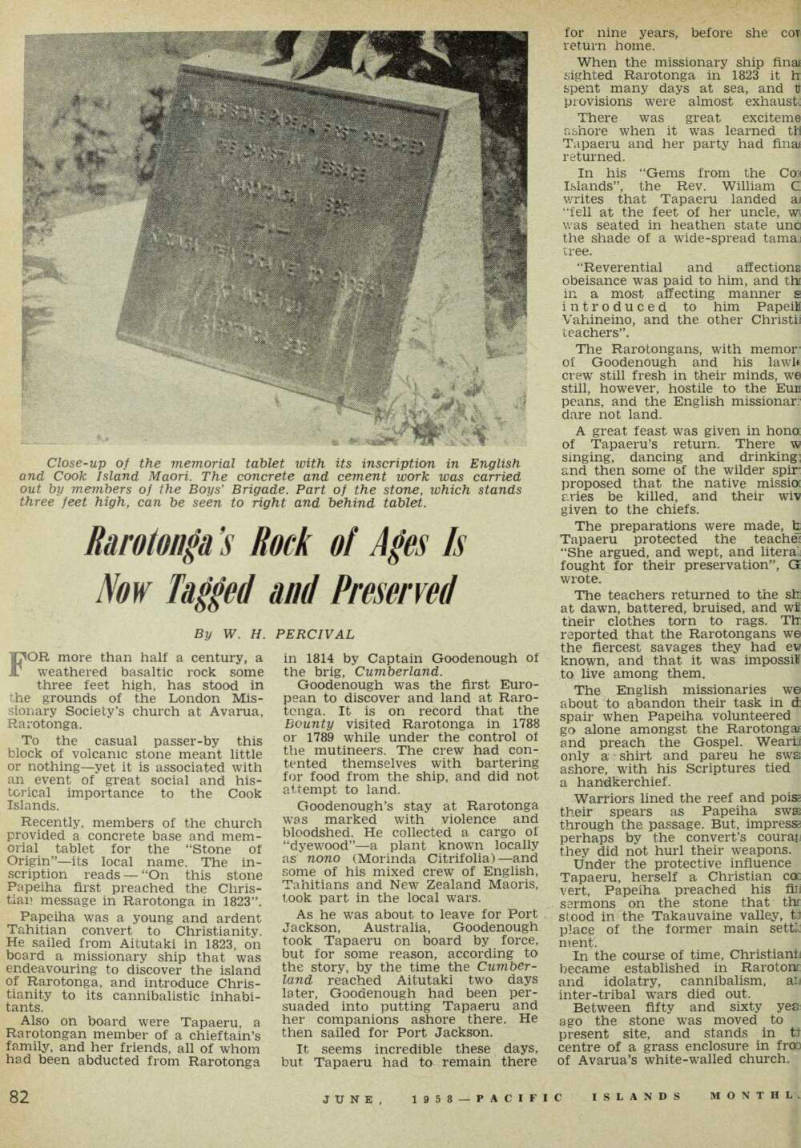
To the casual passer-by this block of volcanic stone meant little or nothing—yet it is associated with an event of great social and historical importance to the Cook Islands, Recently, members of the church provided a concrete base and memorial tablet for the “Stone of Origin”—its local name The inscription reads “On this stone Papeiha first preached the Christian message in Rarotonga in 1823”.
Papeiha was a young and ardent Tahitian convert to Christianity.
He sailed from Aitutaki in 1823 on board a missionary ship that was endeavouring to discover the island of Rarotonga, and introduce Christianity to its cannibalistic inhabitants.
Also on board were Tapaeru, a Rarcptongan member of a chieftain’s family, and her friends, all of whom had been abducted from Rarotonga
in 1814 by Captain Goodenough of the brig, Cumberland.
Goodenough was the first Euro pean to discover and land at Raro tonga. It is on record that the Bounty visited Rarotonga in 1788 01 while under the control of the mutineers. The crew had Con tented themselves with bartering for food from the shl P> and dld not attempt to land.
Goodenough’s stay at Rarotonga was marked with violence and bloodshed. He collected a cargo of “dyewood”—a plant known locally as 710710 (Morinda Citrifolia) —and some of his mixed crew of English, Tahitians and New Zealand Maoris, took part in the local wars.
As he was about to leave for Port Jackson, Australia, Goodenough took Tapaeru on board by force, but for some reason, according to the story, by the time the Cumber land reached Aitutaki two days later, Goodenough had been per suaded into putting Tapaeru and he r companions ashore there. He then sailed for Port Jackson, It seems incredible these days, but Tapaeru had to remain there
for nine years, before she cot return home.
When the missionary ship final sighted Rarotonga in 1823 it h spent many days at sea, and t provisions were almost exhaust; There was great exciteme ashore when it was learned tb Tapaeru and her party had final returned.
In his “Gems from the Co;i Islands”, the Rev. William G writes that Tapaeru landed a/ “fell at the feet of her uncle, w was seated in heathen state unc the shade of a wide-spread tama. tree.
“Reverential and affections obeisance was paid to him, and thi in a most affecting manner g introduced to him PapeiM Vahineino, and the other Christii teachers”.
The Rarotongans, with memor of Goodenough and his lawl» crew still fresh in their minds, we still, however, hostile to the Eun peans, and the English missionar:' dare not land.
A great feast was given in hona of Tapaeru’s return. There w singing, dancing and drinking; and then some of the wilder spir proposed that the native missioc aries be killed, and their wiv given to the chiefs.
The preparations were made, b Tapaeru protected the teachei “She argued, and wept, and literal fought for their preservation”, G wrote.
The teachers returned to the sh at dawn, battered, bruised, and wii their clothes torn to rags. Th reported that the Rarotongans we the fiercest savages they had ev known, and that it was impossilf to live among them.
The English missionaries we about to abandon their task in <i spair when Papeiha volunteered go alone amongst the Rarotonga* and preach the Gospel. Wearii only a shirt and pareu he swa ashore, with his Scriptures tied a handkerchief.
Warriors lined the reef and poiss their spears as Papeiha swss through the passage. But, impress perhaps by the convert’s courajj they did not hurl their weapons.
Under the protective influence Tapaeru, herself a Christian coc vert, Papeiha preached his flu sermons on the stone that thr stood in the Takauvaine valley, tiJ place of the former main settle ment.
In the course of time, Christianij became established in Rarotonr and idolatry, cannibalism, au inter-tribal wars died out.
Between fifty and sixty yes ago the stone was moved to present site, and stands in tJ centre of a grass enclosure in froo of Avarua’s white-walled church.
Close-up of the memorial tablet with its inscription in English and Cook Island Maori. The concrete and cement work was carried out by members of the Boys’ Brigade. Part of the stone, which stands three feet high, can be seen to right and behind tablet.