On The Australian Front
pp. 75-81 · Read in the full issue
Coffee Too, is a Matter of Taste
New Guinea Planters Battle
By a Staff Writer
• The reaction of Australian merchants to New Guinea coffee is much the same as other Australian merchants to New Guinea cocoa: ‘Some of it’s alright, hut —” In an effort to find out what the huts were, “PIM” made a round of Sydney coffee merchants in May. We wanted to know how New Guinea coffee compared with other coffee; ind what was its future in relation to Australia’s requirements.
lETTING this, what we con- F sidered to be legitimate infor mation, was like drawing teeth, le Australian coffee business is en more of a closed shop than 5 cocoa business. Some merchants fused to be interviewed; others i so reluctantly and then refused be quoted. ‘lt’s a touchy subject”, they said.
Why touchy? New Guinea inters are growing coffee; they nt to sell it in its natural market Australia. Does Australia want w Guinea coffee? And if it does t, why not? It is as simple as it. Or so we thought.
But here are a few facts that did glean and some conclu ns; £ost merchants admit that there a prejudice against New Guinea fee in Australia. This seems to ve two reasons: 1) There has been some very erior coffee come from the Terri y in the past and it is still ning, particularly in the Robusta 'iety which is largely in the ads of native growers. 2) New Guinea coffee tastes ferently and is unacceptable to iates that have acquired their fee drinking habits elsewhere, nto the latter category come the w Australians who are mainly ponsible for the boost in coffee isumption in Australia in latter ,rs. They prefer the bitter brews Europe—which most Australian tors thereto find not at all to ir taste.
The Matter of Taste
Growers who are sometimes dis ssed because another Territory wer may get a few pence more lb for his coffee do not make per appreciation of the quality I grading aspects in purchasing, the merchants. 7ith the exception of a few types particular Mocha types) most ibica coffees are used in blends, before price of each coffee will end on the characteristics of the ividual coffee.
'influences of climate and soil In growing areas have produced iistinpt varieties with charac teristic appearances and flavours ind Nature has produced dif ferent varieties of Arabica cof fees. ew Guinea Arabica is “nearly
equal” to some African Arabicas but must be sold tied to world prices.
According to merchants, the in crease in coffee consumption in Australia has been most marked in the sale of coffee blends for home percolators rather than in bottled essences and tinned soluble coffees.
The proposal made by New Guinea growers in April that a growers’ co-operative be formed to pack coffee for direct retail sale in Australia through grocery chains is apparently not as simple as it sounds.
Blending the Arabicas is most important, and selling the NG Arabicas through chains may not bring the results hoped for, particu
irly as chain-stores follow the ollcy of buying cheap and selling w.
New Guinea coffee at present ijoys only a small proportion of le Australian market. Coffees from ganda, Tanganyika and Kenya aving command of 60 per cent, of le market.
Figures, based on Customs De artment statistics for the year ided June, 1957, show that out of total 6,242 tons of coffee entering ustralia, New Guinea supplied 272 ns.
Kenya, Tanganyika and Uganda jcounted for 4,213.6 tons beween em; and other countries supplied nounts as follows: India, 150 tons: idonesia. 368.6 tons; Aden and :hiopia, 389.7 tons; and Brazil 6.3 tons.
There are two world coffee blocks African and Central South nerican. It is not as easy there re to get a “world price” for cof ? as it is for other commodities, though what is going on in one Dck naturally influences the price coffee in the other. Recently the nerican block has been advocat y witholding coffee to force up e price but this seems to have d little effect to date on the rican market.
Because of dollar restrictions, istralia does not buy much South nerican coffee anyway, and when e did, did not get value for money cause of inflated prices being paid the USA for the Central Ameri- Vi product.
A Rude Word
During May coffee merchants be ne even more sensitive about fee than usual, following publicity r en by the Sydney Sun on the )spectus of Goroka Coffee Hold ;s Ltd. —and were reluctant to k at all about NG coffee, even a general way.
Overnight “coffee” had become a le word. lowever, some information was thcoming from the following, med and unnamed: Ar. Scholfield (Griffiths Bros. 1.) said NG produced “quite good fee” and there was no prejudice »inst the class of coffee but linst the method of marketing.
Merchants in Australia were quite pared to buy it, provided it was d at a comparable world price.
He said the growers in the Terri tory, however, had “inflated ideas about their coffee”.
Ir. Scholfield added that he was : prepared to make any more tements about the coffee because enever he had, in ninety-nine es out of a hundred, he was ;quoted. iccording to Dr. G. Repin ?pins Pty. Ltd.) the processing 1 grading of NG coffee beans ; improved in recent years, and
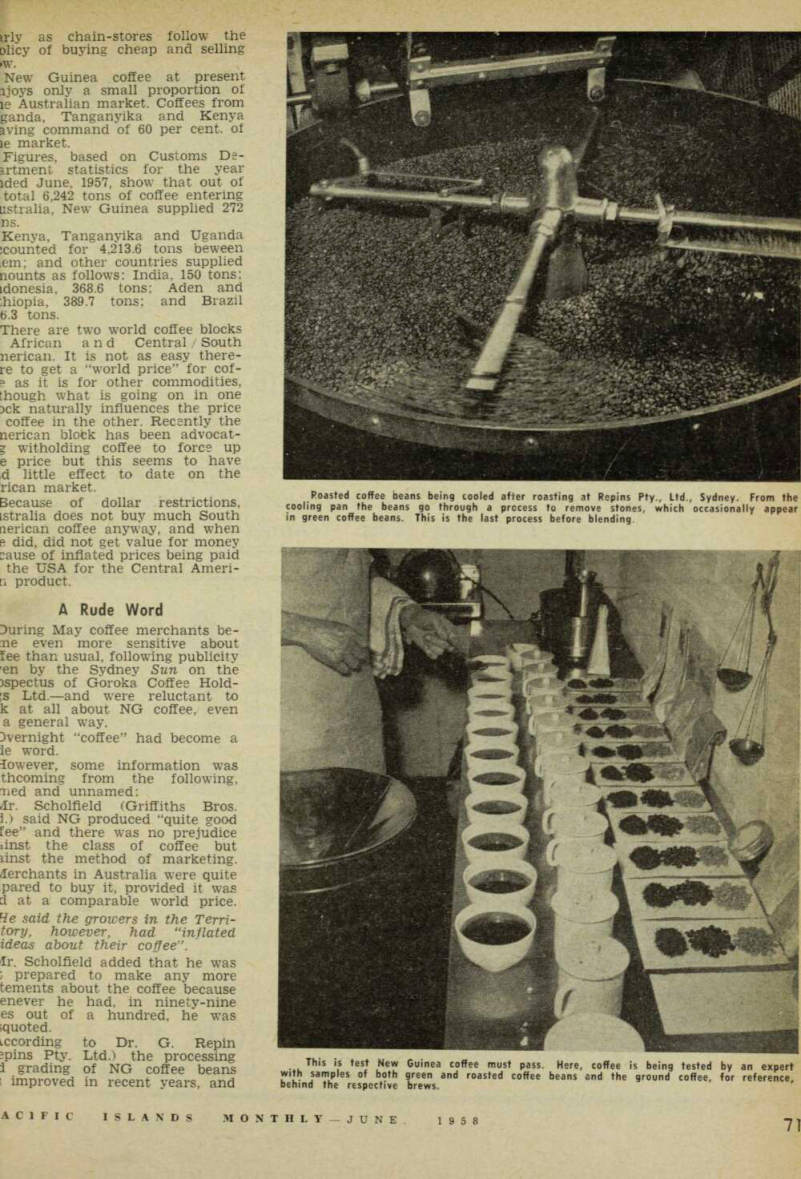
Roasted coffee beans being cooled after roasting at Repins Pty., Ltd., Sydney. From the cooling pan the beans go through a process to remove stones, which occasionally appear in green coffee beans. This is the last process before blending.
This is test New Guinea coffee must pass. Here, coffee is being tested by an expert with samples of both green and roasted coffee beans and the ground coffee, for reference, behind the respective brews.
ath the greater confidence of mer hants the product of the Terri fy was finding a rapidly expand ig market.
“The influx of hundreds of thou mds of New Australians to the ommonwealth has meant a big icrease in the coffee drinking ipulation and, as well, many tea inkers have adopted the coffee ’inking habit.”
However, the great majority of mthern Europeans who have come Australia have been accustomed coffees of different origin, and ith characteristics different from ose of the NG product.
“It is a matter of taste”, said '. Repin. Those people used to abian or Central American coffee efer it, even if the coffee from :w Guinea is equally fine of its pe.
Although some growers in NG 3 now producing Arabicas equal those from Africa, the prejudice lich existed among some Aus trian importers because of lower ide coffees once exported from J, has still to be overcome, he d.
Australian growers in the Terri y should be encouraged, said Dr. pin, but not in the manner sug ted by the delegation of growers ently returned from the main d.
They suggested that Australian rchants be forced to blend a tain proportion of NG with all :ee). l Mocha coffee with, say, 10 per tt. NG blended into it, is, of rse, no longer Mocha, said Dr )in.
Politicians Get NG Brew Ir. Hoy (Hoy’s Tea and Coffee ducts) said that three years ago had written to the Department Ferntories suggesting that when contracts were ar ged for the supply of coffee, it stipulated that the coffee must a blend of at least 25 per cent, f Guinea coffee. is suggestion was made to assist NG industry but it was not ;d upon. oweyer, he does supply Parlia it House, Canberra, with coffee ch does contain a large prop an of New Guinea. r. Hoy said that NG coffee was PS in increasing quantities in traha. i comparison to the best Arabica A f. ica » the Territory’s coffee a. bit mild”, and was blended l other varieties. 3 had no complaints about its essing. > one at Bushells Ltd. or Inglis Ltd. (two other big coffee mer its) had anything to say for ication when contacted, veral other merchants refused I
to allow any statement on NG cof fee to be attributed to them.
One of these merchants claimed that since the Indonesians took over control from the Dutch there had been a falling off in the quality of coffee exported from Indonesia, although prices had been main tained artificially through taxes etc., returned to growers.
Should natives take control of coffee plantations in Africa in the next 30 years, a similar situation could occur, thus making the NG plantations of great importance to Australia.
On these grounds, apart from those of sentiment, he thought Territory growers should be given consistent support.
Another merchant claimed that “Dutch auction” tactics used by Territory growers during the time of severe import restrictions op erating in Australia, had been un fair.
What's to do About it?
It is obvious from the foregoing that the problem is only half solved when the planter has obtained his land, planted his seedlings and waited the necessary half dozen years until his crop is coming in.
And that there is more in coffee drinking than grinding up a bean and adding hot water. As the mer chants have shown, there is a great deal of technical know-how needed to produce the kind of blend that
11 appeal to Tom, Dick and Harry because ultimately it is all a itter of preference.
But many people have drunk w Guinea coffee, straight, with t blending, and have found it od and there seems no reason ly, with good-will on both sides, s matter of individual preference rmot be overcome to the point iere there is a ready market in stralia for all the good coffee NG i produce. In one generation New stralians become Old Australians.
Phe idea of waiting 30 years until te Africans take over in Africa”, suggested by the coffee merchant jove) is not going to appeal ich to present-day P-NG plan s. rhe first prejudice that growers ve to overcome is that of the rchants, because without their operation the general public will r er find out whether it likes New inea coffee or not. lelp from the Australian govern at is a doubtful quantity—judg by the help other NG industries r e got from that quarter. P-NG 'ee does receive some aid a.z sent the 3d per pound duty t is charged on all imports of ee other than from Papua-New inea. offee is not a “strategic mat il”, but purchasing coffee out * Australia uses overseas funds, conserve them is supposed to be national duty (although it may wondered why, during the cur b import restrictions, the posi i has been so eased that there r is an abundance of overseas ee offering to Australian mer nts). here is still room for improve it in a lot of Papua-New Guinea ee and in this field the P-NG linistration could help consider r . So far as we know, the only )gnised coffee expert who has
ever looked the New Guinea scene over was brought in at the expense of the growers themselves.
It is obvious that merchants will net change their buying practices and “buy New Guinea” unless New Guinea has something to offer— and accordingly to the merchants all New Guinea has to offer is in the way of price. The present po sition is that all P-NG coffee can be sold but not always at the price planters want, or feel they should have —and what they think they should have is sometimes unreal, say merchants. P-NG planters want to fix the price, themselves, they complain.
There have been faults on both sides: some merchants are still sour because they say they were let down by some planters during the acute period of import restrictions when
prices rose: verbal forward agree ments they had with growers were repudiated by the latter when they could “do better”.
Growers, on the other hand, re gard merchants with suspicion—• mostly because they can get little satisfaction from them as to where they stand in the overall picture.
Finally, whatever else has not been made clear by our survey of the New Guinea coffee market in Australia, it is abundantly clear that there is a great need of better relations between the growers and the people who market the finished product.
This is where the Department of Territories might bestir itself. A conference along the lines of the recent cocoa conference in Rabaul could be a start in the right direc tion.
Coffee samples being roasted in a sample ster at Repins Pty., Ltd., before testing determine suitability for blending. This often done before the coffee is bought.