Rom Colonel
pp. 71-73 · Read in the full issue
[?]Ilding A New Nation
New Guinea
Ome Advice
Rom Colonel
[?]Lue' Allan
From a NG Correspondent
Honours, greetings and good
shes were showered upon lue” Allan (Colonel H. T. lan) when he returned to New dnea on a brief visit in March, er a few years’ absence from country to which he gave •art from World War II) over years of his active life.
E was invited to officially open the Annual Congress of the P-NG branch of the ex-service- Ts Association, held in Lae on rch 19-20; and he also formally ned the new club-house for the ive Ex-Servicemen’s Association, Rabaul. ccompanied by the Ex-Service i’s President, Mr. R. F. Bunting, made a call at most of the Trust ritory centres. Everywhere, he ountered old friends of his iting and mining and soldiering s. s he entered Kavieng, he met group of natives; and three mg men suddenly stopped and ed at him.
“Masta Blue!” they shouted In chorus.
He recognised all three as former employees of his, on his plantation and on his sluicing claim at Wau (which he abandoned hurriedly in 1939 in order to join in the over seas argument with Mr. Hitler).
Thus, there was a period of reminiscing, and inquiry after old friends, right there in a Kavieng thoroughfare.
Colonel Allan takes a keen in terest in the future of Papua and New Guinea, and especially in the future of the natives. He has known the New Guineans under all sorts of conditions —he has employed them on plantations, in mining, on ships, and he has used them as trained soldiers under his command in the jungles.
He understands their mentality as well as any European can; and he has great confidence in their ability to adjust themselves to the demands of good citizenship in a Western world—if given a chance.
"Very Intelligent"
He says that they are generally a very intelligent and a very de pendable people, intensely loyal to those who gain their trust and goodwill. There is good material here, for nation-building.
Conversely, if wrongly handled, by weak and inexperienced Euro peans, they could be intractible and dangerous.
Everything is in the approach to these - people, says Colonel Allan.
More than most, they appreciate strength, with justice. Controlled (Continued on page 67)
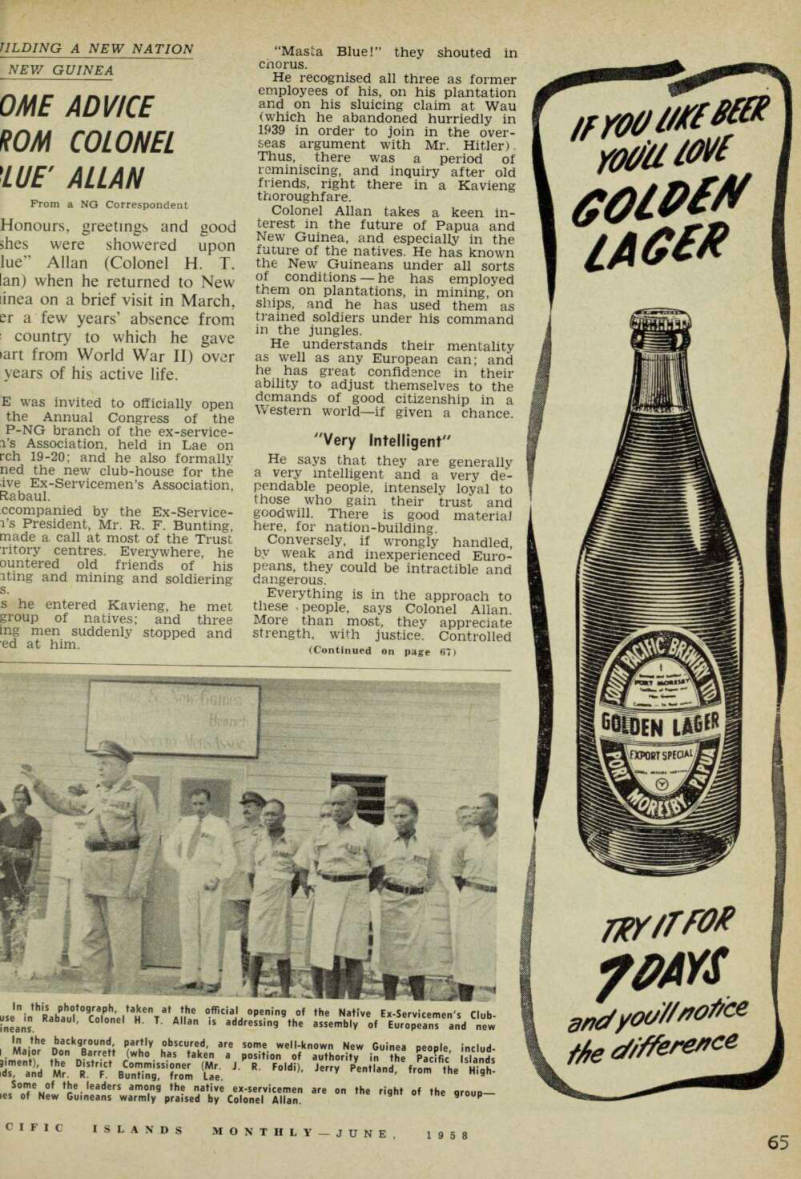
In this photograph, taken at the official opening of the Native Ex-Servicemen's Club use in Rabaul, Colonel H. T. Allan is addressing the assembly of Europeans and new
ineans.
In the backgrond, partly obscured, are some well-known New Guinea people, includ- Major Don Barrett (who has taken a position of authority in the Pacific Islands giment), the District Commissioner (Mr. J. R. Foldi), Jerry Pentland, from the High ds, and MR. R. F. Bunting, from Lae.
Some of the leader among the native ex-servicemen are on the right of the group es of New Guineans warmly praised by Colonel Allan.
ud directed by men who under and and like them, they can be nulded effectively into a nation iendly to Australia. Handled by Lexperienced people, or by people ho have a superiority complex rer natives, they can cause a lot trouble.
Colonel Allan formally opened le new club-house built in Rabaul r the Native Ex-Servicemen’s ranch of the P-NG Ex-Service en’s Association.
He took the opportunity of em lasising, to New Guinean as well European ex-servicemen, the eat psychological importance of ch an institution. These native ;w Guineans were proud of their twice records, and of their formal cognition by their European com des; and that spirit of loyalty d co-operation should be de loped in civil as well as in mili ry associations. He particularly aised the work being done in ex iding the Boy Scout movement long young New Guineans.