Sukuna, Famous Fijian, Loved
pp. 67-69 · Read in the full issue
in Mourning
By All, Dies At Sea
• Although there had been warning in the reports of his grave '.ness —which developed at sea on the liner Arcadia, between ustralia and Colombo—the death of Ratu Sir Lala Sukuna, KCMG, ’BE, Medaille Militaire, on May 30, came as a profound shock to the olony of Fiji, and especially to the Fijian people.
The whole Fijian Community went immediately into mourning.
ILA SUKUNA will go down in history as the most famous Fijian of this century. He was ible in three ways—first, because proved that a full-blooded m, in mental attainment and joise, can be the equal of the Dpean; second, because of his ities of statesmanship in plan ; a future for the Fijian race; third, because of his lovable as a man, and as a staunch id. s outstanding service to Fiji given as the head of the De ment responsible for Fijian ad .stration. There, he worked in i harmony with a succession of .sh Governors. His achieve ts are seen in the Fiji Develop b Fund, the Native Land Trust •d and the Fijian Affairs Board, s influence among the Fiji le was immeasurable. To him much of the credit for the »y relations maintained be n the Fijian race and the sh Crown. His example, and lersonality, are reflected in the ide and influence of the ger Fijian leaders who now are ling in his footsteps. Without wise and tolerant and kindly tion of Sukuna, it could have a different picture.
He Was a Sick Man became plain, ten years ago, Sir Lala Sukuna was tiring— had come upon him a little :er than expected—and when lonald Garvey became Gover he planned an easier job for distinguished veteran. He moved ■om the directorship of Fijian *s to the Speakership of the cil. sn he suffered a deep loss in leath of his well-known popu ife, Lady Maraia. fellow-Fijians, in an attempt vercome his apparent loneli encouraged him to marry ; and, last year, he married a well-known in the Lau area, became Lady Liku. :, by 1957, it was plain that amous Fijian leader was not and, at his own wish, he was ed to resign all public offices s 70th birthday, in April.
May 13, with Lady Liku, he Jd in Sydney, after a harass-
ing air journey plans has been dislocated by bad weather. Sydney friends were eager to give hospi tality—but Sir Lala Sukuna would see none of them. It was evident that he was not his normal self.
Within a fortnight, he was dead.
The body was taken from the liner at Bombay, and embalmed, for transport to and burial in Fiji, in a public funeral (which took place on June 11).
The plight of the young wife, Lady Liku —who had not previously been outside of Fiji—was distress ing. However, the Indian Commis sioner in Fiji, Mr. Bhasin, co-op erated most helpfully with the Gov ernor (Sir Ronald Garvey) so that the more painful duties attending Sir Lala’s death at sea were at tended to by British and Indian officials.
In their care, Lady Liku returned by air to Sydney where she was met by Mr. J. S. Thomson, of the Native Lands Commission, who accom panied her to Fiji.
Some Personal Memories
Jos e f a Lalabalavu Vanaaliali Sukuna was a member of a noble Fijian family, and he received his
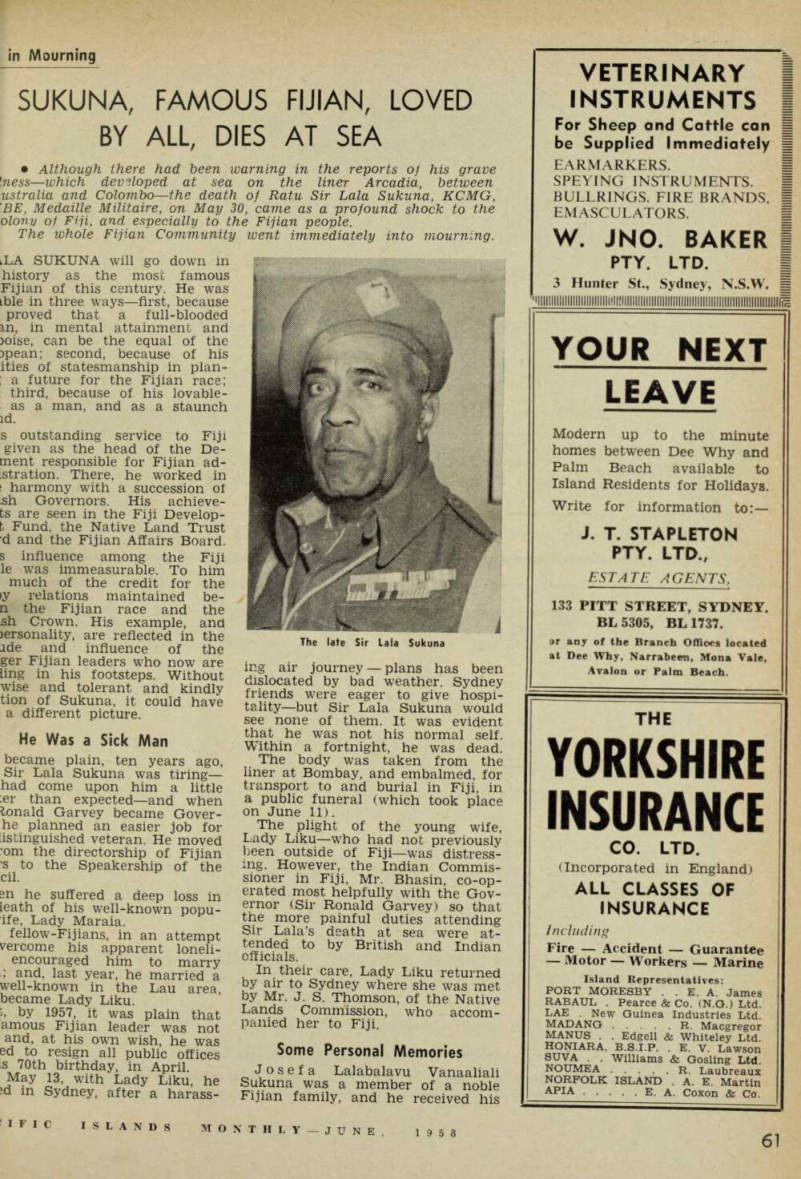
The late Sir Lala Sukuna
ly education from a private >r. Then he went to Wanganui lege, in New Zealand, and on to brd. e was an Oxford undergraduate ;n World War I came, and he irally wished to accompany most his fellow-students, who took missions in the armed services. the stuffed-shirtism of 1914 d not see a Fijian as a British er. ila Sukuna went across the nnel, and joined France’s >ign Legion. He was wounded b than once in battle, and he awarded a French decoration. r en at that early age he was and tolerant, and showed no itment of the then “colour bar”. day came when a grateful ain awarded him a highly ted distinction—the Knighthood t. Michael and St. George.
World War I, in World War 11, le Malayan rebellion, the men r iji rendered magnificent ser to Britain; and leadership and ration were given them in all ; enterprises by their well l Ratu Sukuna. i old personal friend of Sir Sukuna, Mr. Len Usher, in the Times of May 31, in a tribute ie Fijian leader, gives some ex es of his humour and his isty. There was the famous oc n when, travelling in United s, he found himself being sub d to Jim Crow laws (negro gation). b resorted to no violent pro or bitter words”, says Mr. r. “He simply donned a tur and became a romantic Indian e, and as such was welcomed feted.” What delight he took lling that story—that was the are of his tolerance and his t wit. iere can never be another na”, says Usher. “We have not only the foremost Fijian lis century, but a true and ous friend.”
Buried in Lau ; body of Ratu Sukuna arrived ane in Fiji on June 5. The 1 took place at Lakemba, in iau Group, on June 11. body was taken from Nadi va by road, with full military )olice escort, and it made the stage of the journey, from to Lakemba, on the govern ship, Adi Maopa. ing the time that the body Lala lay in state at his home ava, and at Lakemba, the onies reserved for Fijians of ighest rank, were performed. ;her communities joined with hjians, in paying tribute to leader. )ngst the many messages of ithy received in Suva was one Queen Salote of Tonga