[?]Rst Steps Towards A Cook Islands
pp. 63-64 · Read in the full issue
[?]ey're on the Move
Pearlshell Farm
by Gordon Russell
For one hundred years or so the lagoons of Manihiki and J enrhyn have furnished pearls for milady; buttons for milord nd handsome returns to Cook Islanders.
But there has never been a clear picture of what was the
tock-in-hand position fifteen fathoms deep.
? last it would seem that this gamble with nature, lucky to date, is to be superseded by a e intelligent approach to the resting of a natural resource remains the best revenue- pro r in the Cooks. hen the inter-island schooner e Maori departed Rarotonga I 23 for the Northern Cooks, ting with post-hurricane season :s, among the passengers were eries Officer Ron Powell, assis loaba Marsters, and, lashed deck, numerous wooden con nces having a distinct marine ►ur. But the story started 53 5 ago.
Planting Sea Pastures ay back in i 905 a biologist sd Crossland was appointed by Sudan Government to found an stry to cultivate the pearl ir of the Red Sea. r 17 years Crossland grappled the host of perils that beset life of pinctada Margaritifera , ered the collection of its spat, d ever-increasing quantities of ire pearl oysters on a profitable , and recorded his success story anuscript form. en fate played a hand. The of MOP slumped, the venture abandoned, and in due course ;land passed on. All that was was his M/S, which reached British Museum and lay there tten, it would seem, for over ars. 1956 this M/S came to the e of that Australian scientific the CSIRO and late the same Ron Powell and loaba Marsters chosen as the Cook Islands ates to the Fisheries Course lised by the South Pacific nission.
Disciples Meet
die en route to Noumea a i of delegates visited the O oceanographic centre at ilia, near Sydney, and here the ian was helpful. Perhaps Mr.
II would like to see a rough of Crossland’s work, in pro of revision for publication by 1. S. Hynd, Division of Fish
eries and Oceanography?
Mr. Powell most certainly would.
On his return to Rarotonga, Mr.
Powell, armed with a finished re print, decided that Crossland’s methods were practicable in the Cooks; that conditions in enclosed lagoons promised, in fact, to be mere favourable to shell growth and marine husbandry than those en countered by Crossland in the strong currents and rough seas common to the open Red Sea waters.
Meanwhile Mr. David Trantor, a CSIRO marine biologist who had been working on techniques of pearl culture at Thursday Island, came to the same conclusion regarding the feasibility of Crossland’s methods in Cook Island lagoons.
Tranton was aware of Powell’s work in transferring pearlshell from Manihiki to Rakahanga and Puka puka through an article in the SPC Bulletin.
Powell was aware of Tranton’s
work through the Canberra pro duced Fisheries Newsletter.
They wrote to each other, inde pendently, with Don Reid, of Island Territories, Wellington, on the liaison side. In such manner were two Crossland disciples united.
And now field work is underway at Manihiki; to establish the breed ing season of Cl pearl oysters: to trace the prospects of survival, per spat, per year; to find the local growth rate under organised con ditions; to track the currents in the lagoon and locate areas of opti mum growth; to decide what size of shell can be safely fished, and, ultimately, it is hoped, to promote a pearlshell farm in lagoon pastures.
A long term project this, with Crossland’s noble efforts as a very helpful guide. On location Powell and Marsters will be aided and abetted by Don Bryan, senior Resi dent Agent in the Northern Cooks, who is stationed at Manihiki and very partial to marine work in any form.
Early Life of a Junior Oyster
But who would be a pearl oyster spat? From the day when Mum and Dad fulfilled their contract and Juniors in their thousands join the stream of plankton flowing past the old homestead, life is a grim affair.
Should an individual Junior sur vive the numberless plankton eaters, sooner or later the weight of his growing shell will waft him to greater depths—and his point of landing is critical. If it is on grow ing coral, the polyps will gobble him up; if the water is still, he’ll be choked by silt; if the current is
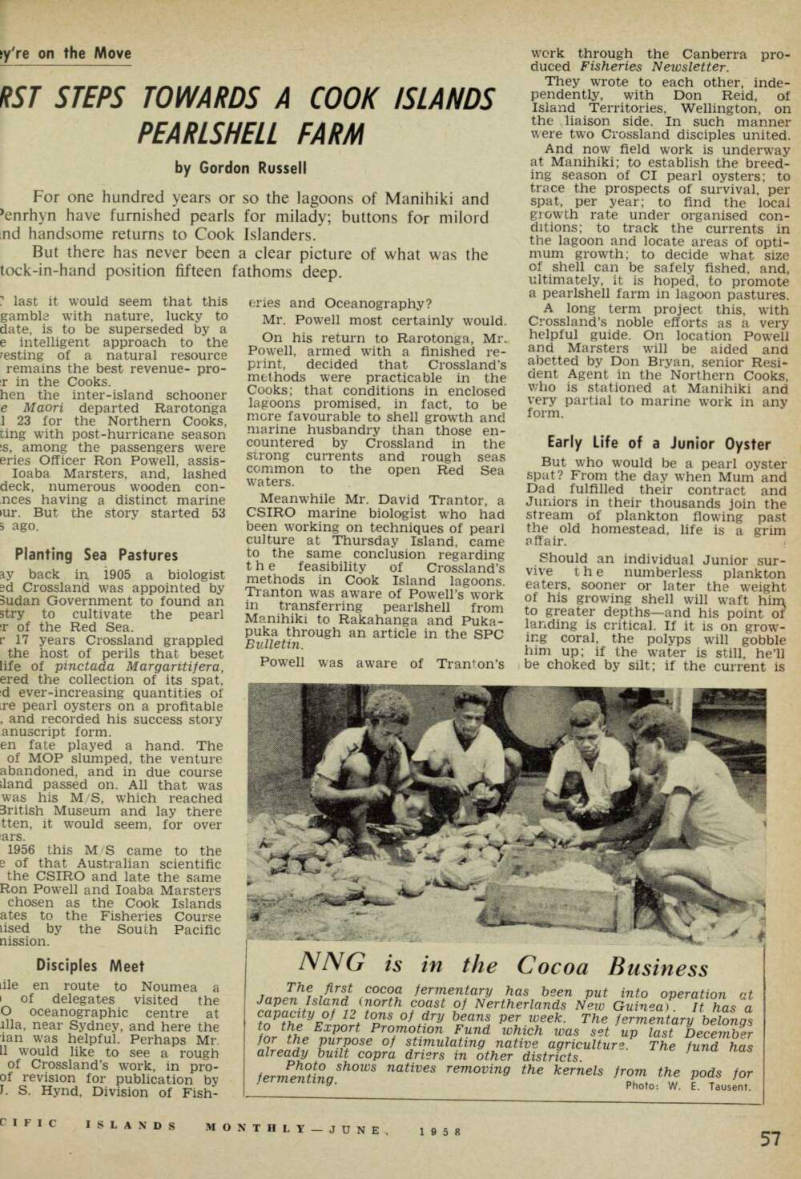
NNG is in the Cocoa Business
The first cocoa fermentary has been put into operation at Japan Island (north coast of Netherlands New Guinea). It has a capacity of 12 tons of dry beans per week. The fermentary belongs to the Export Promotion Fund which was set up last December for the purpose of stimulating native agriculture. The fund has already built copra driers in other districts. fermentina shows natives removing the kernels from the pods for fermenting.
Photo: W. E. Tausent.
strong, destroyed by moving se Ii by a miracle the possie is right, numerous shell-eating will compete for his flesh; should he achieve adolescence spite of all, his growing brotJ and sisters, elbowing for liw room, will as likely smother 1 All this, and man, too. And mr depredations in remote atolls not easy to control.
The native divers live for the and have no long-term view lagoon resources. The dealer’s ■ look, too, is based entirely u the period in which he is licer to operate.
For long enough the Cl prao has been to close the Manii lagoon to diving every second T or so, peremptorily at times w the size of shell fished has j gested that mature stock is in si* supply. At Penrhyn, a mag lagoon, it is customary to allot portion for diving each year.
So far these rule-of-thumb terns have worked, but all that be said for certain is that tl lagoons are not yet worked outi is the case with a number of Tuamotu atolls, an archipelago rich in pearlshell resources.
The diving season in Fr© Polynesia is now restricted t«d three-months period each year it could be that this is a satis:* tory answer that takes account the breeding season.
We have been fishing in too nr waters too long with a song am prayer. Much has been writtenr and around the romance and venture of life in the pean lagoons. It’s time for a chapter two on the scientific side.
By a little constructive ges? incidental to a major project, SPC set in motion, or at least celerated, a venture that will lili prove of inestimable value to future economy of the Cooks.