More Self Government
pp. 55-57 · Read in the full issue
Time For Fiji To Seek More Self Government
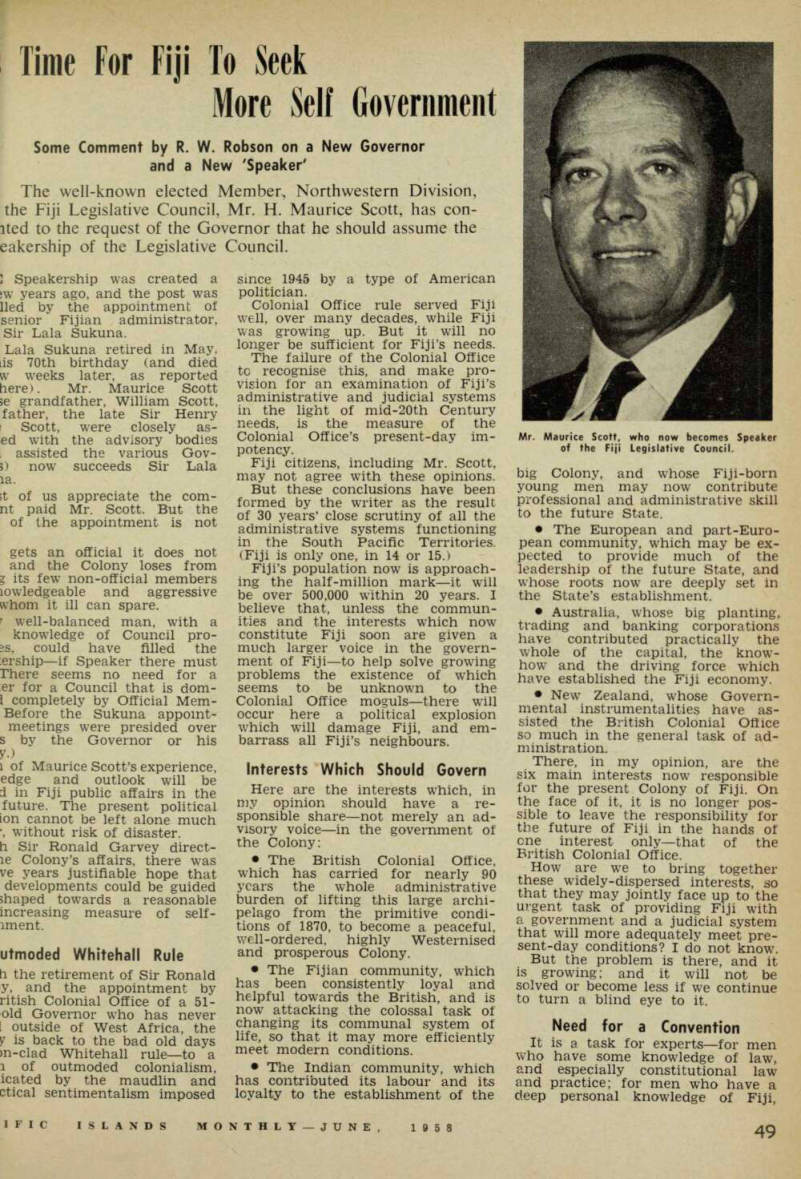
Some Comment by R. W. Robson on a New Governor and a New 'Speaker' The well-known elected Member, Northwestern Division, the Fiji Legislative Council, Mr. H. Maurice Scott, has con ited to the request of the Governor that he should assume the eakership of the Legislative Council.
I Speakership was created a ;w years ago, and the post was lied by the appointment of senior Fijian administrator, Sir Lala Sukuna.
Lala Sukuna retired in May, ds 70th birthday (and died w weeks later, as reported here). Mr. Maurice Scott >e grandfather, William Scott, father, the late Sir Henry Scott, were closely as ed with the advisory bodies . assisted the various Gov -5) now succeeds Sir Lala la. it of us appreciate the com nt paid Mr. Scott. But the of the appointment is not gets an official it does not and the Colony loses from I its few non-official members lowledgeable and aggressive whom it ill can spare. r well-balanced man, with a knowledge of Council pre ss, could have filled the ership—if Speaker there must There seems no need for a er for a Council that is dom l completely by Official Mem- Before the Sukuna appomt meetings were presided over s by the Governor or his y •) i of Maurice Scott’s experience, edge and outlook will be i in Fiji public affairs in the future. The present political ion cannot be left alone much •, without risk of disaster, h Sir Ronald Garvey direct le Colony’s affairs, there was ve years justifiable hope that developments could be guided shaped towards a reasonable increasing measure of self iment. utmoded Whitehall Rule b the retirement of Sir Ronald y, and the appointment by ritish Colonial Office of a 51old Governor who has never i outside of West Africa, the y is back to the bad old days m-clad Whitehall rule —to a i of outmoded colonialism, icated by the maudlin and ctical sentimentalism imposed
since 1945 by a type of American politician.
Colonial Office rule served Fiji well, over many decades, while Fiji was growing up. But it will no longer be sufficient for Fiji’s needs.
The failure of the Colonial Office to recognise this, and make pro vision for an examination of Fiji’s administrative and judicial systems in the light of mid-20th Century needs, is the measure of the Colonial Office’s present-day im potency.
Fiji citizens, including Mr. Scott, may not agree with these opinions.
But these conclusions have been formed by the writer as the result of 30 years’ close scrutiny of all the administrative systems functioning in the South Pacific Territories. (Fiji is only one, in 14 or 15.) Fiji’s population now is approach ing the half-million mark —it will be over 500,000 within 20 years. I believe that, unless the commun ities and the interests which now constitute Fiji soon are given a much larger voice in the govern ment of Fiji—to help solve growing problems the existence of which seems to be unknown to the Colonial Office moguls—there will occur here a political explosion which will damage Fiji, and em barrass all Fiji’s neighbours.
Interests Which Should Govern
Here are the interests which, in my opinion should have a re sponsible share—not merely an ad visory voice—in the government of the Colony: • The British Colonial Office, which has carried for nearly 90 years the whole administrative burden of lifting this large archi pelago from the primitive condi tions of 1870, to become a peaceful, well-ordered, highly Westernised and prosperous Colony. • The Fijian community, which has been consistently loyal and helpful towards the British, and is now attacking the colossal task of changing its communal system of life, so that it may more efficiently meet modern conditions. • The Indian community, which has contributed its labour and its loyalty to the establishment of the
big Colony, and whose Fiji-born young men may now contribute professional and administrative skill to the future State. • The European and part-Euro pean community, which may be ex pected to provide much of the leadership of the future State, and whose roots now are deeply set in the State’s establishment. • Australia, whose big planting, trading and banking corporations have contributed practically the whole of the capital, the know how and the driving force which have established the Fiji economy. • New Zealand, whose Govern mental instrumentalities have as sisted the British Colonial Office so much in the general task of ad ministration.
There, in my opinion, are the six main interests now responsible for the present Colony of Fiji. On the face of it, it is no longer pos sible to leave the responsibility for the future of Fiji in the hands of one interest only—that of the British Colonial Office.
How are we to bring together these widely-dispersed interests, so that they may jointly face up to the urgent task of providing Fiji with a government and a judicial system that will more adequately meet pre sent-day conditions? I do not know.
But the problem is there, and it is growing: and it will not be solved or become less if we continue to turn a blind eye to it.
Need for a Convention
It is a task for experts—for men who have some knowledge of law, and especially constitutional law and practice; for men who have a deep personal knowledge of Fiji,
Mr. Maurice Scott, who now becomes Speaker of the Fiji Legislative Council.
of the conditions which have ;ed Fiji’s present-day problems; men who have a regard for, understanding of, the outlook wishes of the two big com ities in Fiji—the Fijians and Indians; for men who under i the implications of the ►nal economic structure—that the importance of investment al and commercial manage in the development of a new ere is need for a Convention senting all these interests, i will attack the task of plan a suitable Constitution to meet nt-day needs. In such a Con on, a man like Maurice Scott i be invaluable, ere is need for someone, or institution, to display initiative manding or arranging such a ention. Obviously, the initiative d come from the British dal Office. There is not a sign -not even a sign that the need >een recognised.
The circumstances surrounding the appointment of the new Gov ernor shock us into this realisation.
Failing a movement from White hall, the initiative must come by way of a demand made by Fiji it self.
That should not be an irrespon sible movement—it should be under taken by Fiji’s leading men, who understand all the implications.
Again, in such a thing, the services of a man like Maurice Scott should be invaluable.
That is why, while we appreciate the compliment that has been paid to this notable third-generation Fiji- European, we deplore his removal, by way of the Speakership, from the active political life of the Colony.
Fiji always has had need of lively Councillors. She has a handful now —Europeans, Fijians and Indians — who are alert and ambitious in their outlook, but woefully small in num bers. She will have greater need of them in the early future.
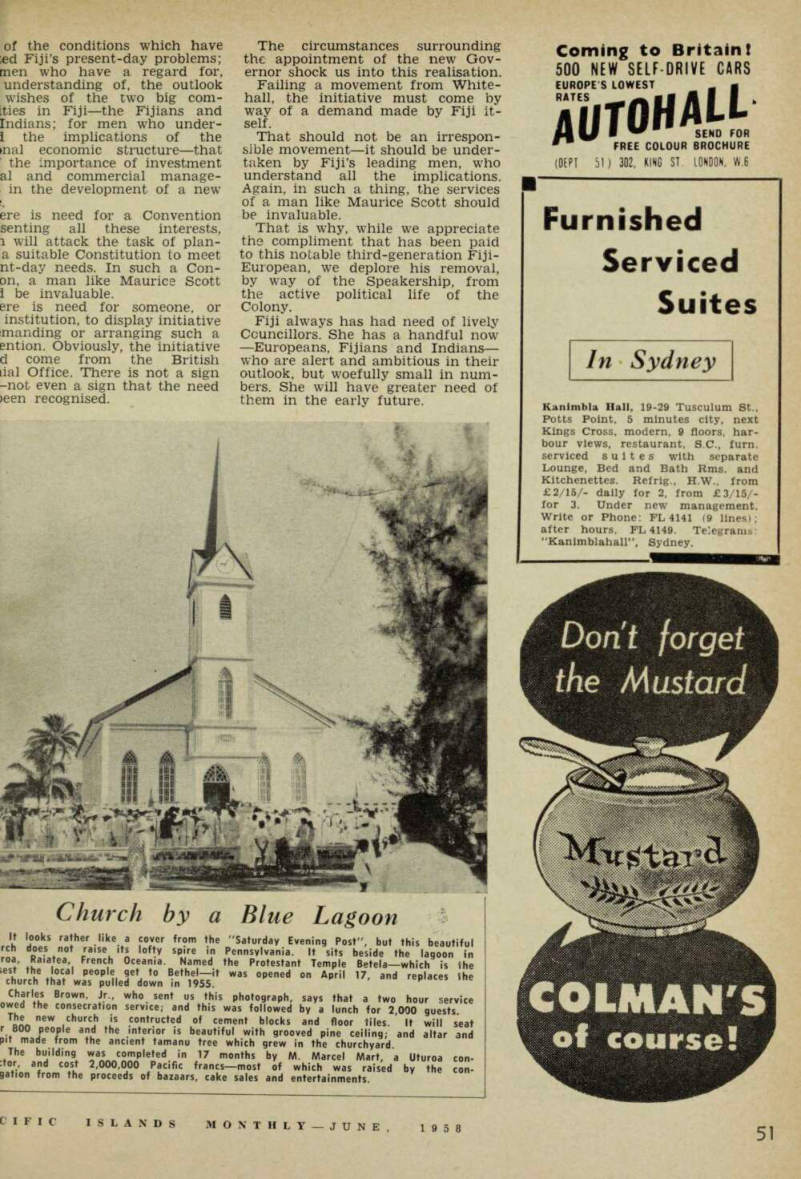
Church by a Blue Lagoon
It looks rather like a cover from the "Saturday Evening Post", but this beautiful rch d oe s not raise its lofty spire in Pennsylvania. It sits beside the lagoon in roa, Raiatea, French Oceania. Named the Protestant Temple Betela—which is the sest the local people get to Bethel—it was opened on April 17, and replaces the church that was pulled down in 1955.
Charles Brown , Jr., who sent us this photograph, says that a two hour service owed the consecration service; and this was followed by a lunch for 2,000 guests.
The new church is contracted of cement blocks and floor tiles. It will seat r 800 people and the interior is beautiful with grooved pine ceiling; and altar and pit made from the ancient tamanu tree which grew in the churchyard The building was completed in 17 months by M. Marcel Mart, a Uturoa con tor, and cost 2,000,000 Pacific francs—most of which was raised by the con gation from the proceeds of bazaars, cake sales and entertainments.