Fiji Talanoa
pp. 47-51 · Read in the full issue
Nakatawa Talks
Of This And That
One result of the reconstruction of Nadi Airport will be the disappearance of the Fiji Mocambo, the colourful lounge, with bar and dining room attached, which has become wellknown to thousands of air travellers passing through Nadi since the war.
THE name Mocambo comes from a Hollywood night club, of course, and Fiji’s Mocambo came existence as an officers’ club i Nadi became an American itional base during the war.
There must have been someone among the Americans with a flair interior decoration, and ex it use was made of local materials, including bamboo. The Mocambo influence can now be seen homes, offices and hotels in many s in Fiji. :, never far from the minds le US soldiery (or any other iry, for that matter) found its in the Mo
b o decorative tie, too. lind the bar, i was roofed a thatched i bure, was a mural. It de i a GI, seated idydlic rapture on tropical beach, offered the of the land by group of wellped young n dressed only grass skirts. i caption below mural came an American tte advertise - “So round, so so fully d”. m the Mo ) was no longer icers’ mess, but ting place for neral travelling
ic, Authority,
an eye turned to propriety to wartime Y, decreed that ural must go. it was trans to the Nadi t Club, whose srs were pre ly considered susceptible to corruptions of esh than air passengers.
Fig Leaves
And Wolf Whistles The Americans had another play ful device at the Fiji Mocambo.
On the wall of the Ladies’ Powder Room was a life-sized painting of a man, naked except for a wooden fig-leaf, hinged at the top.
On the fig-leaf were the words, “Do Not Lift”.
The device came into full opera tion at dances and other festive occasions when there were female guests.
Those patrons of the Powder Room who could not resist the
temptation to disobey the instruc tions found that lifting the fig-leaf set a loud wolf-call ringing through the main lounge of the Mocambo.
There were still further calls, this time from eager American throats, when the unfortunate victim of feminine curiosity eventually gathered up enough courage to emerge, through the only exit, into an expectant ball-room.
Strong Hotel
Hopes
Since the war, the Fiji Mocambo, with its related sleeping accom modation, has been run by Barry Philp, as a hotel.
Barry has spent a lot of money on the bedrooms and has improved the accommodation greatly, but nothing could overcome the basic functionalism of the buildings.
They were put up as a transit camp, and a transit camp in which people are coming and going at all hours of the day and night can never become a luxury hotel.
Barry has plans for something which will deserve that description, and which architecturally will create the South Seas atmosphere, as the Korolevu Beach Hotel in the
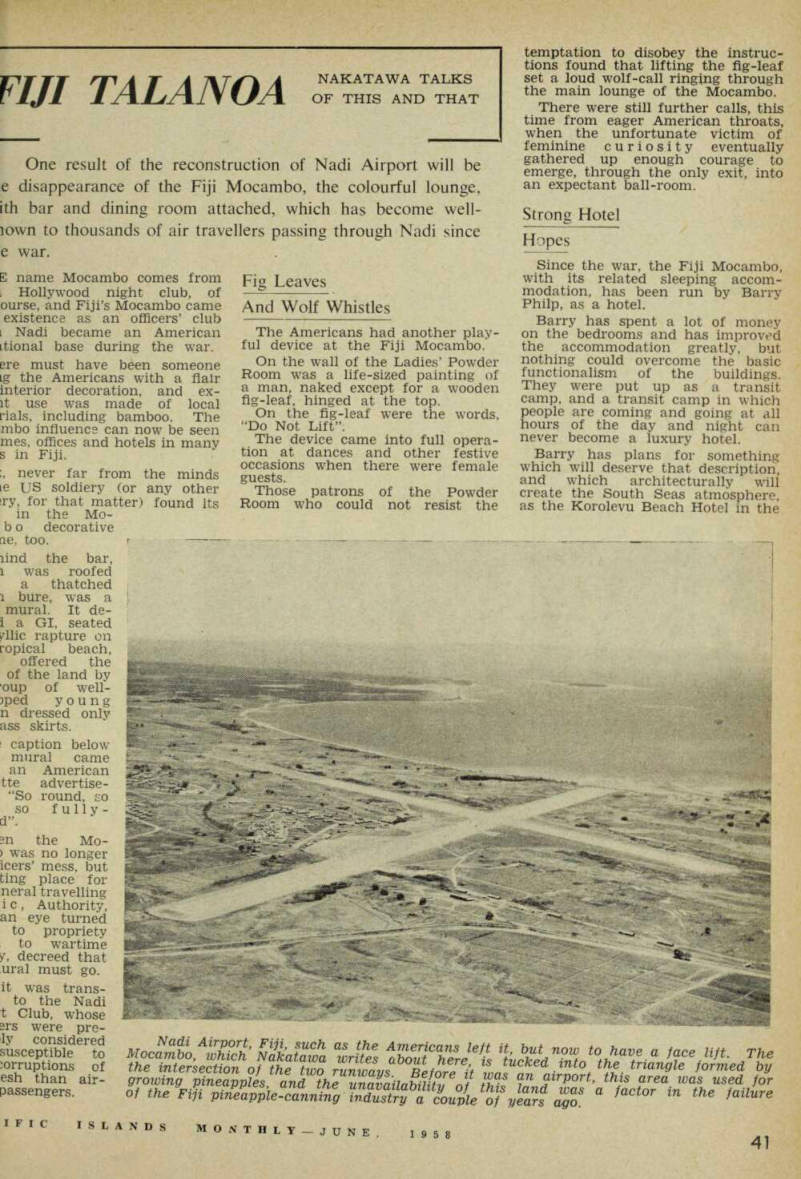
Nadi Airport, Fiji, such as the Americans left it, but now to have a face lift. The Mocambo, which Nakatawa writes about here, is tucked into the triangle formed by the intersection of the two runways. Before it was an airport, this area was used for growing pineapples, and the unavailability of this land was a factor in the failure of the Fiji pineapple-canning industry a couple of years ago.
them Hotels chain does so essfully now. irry’s plans, designed for a site Famaka, overlooking the airport, ; a place in the proposals of the irican group, headed by Mr. C.
Rehnborg, who announced he intended to build a chain otels across the tropical South fic. ttle that is definite has emerged : except the purchase of Les liques in Tahiti by Mr, iborg—but financial discussions said to be still going on in the ed States and hopes are still in all the Pacific Territories srned. lanwhile, there are rumours at least one of the major air using Nadi Airport is thinking hiding a hotel near the airport iccommodate air-crews, pas ;rs and general tourists, rthern Hotels Ltd. is already established at Lautoka, 15 miles , and at Nadi township, three away from the airport.
t Steps
jovernorship
' people of Fiji, always fair, vithin limits, prepared to wait see whether the wise, strong imaginative leadership they I for from their new Governor be forthcoming from the ial Office choice, Mr. K. P. ocks. they have been studying his 1 record without any enthu at all. o 1. He was appointed a cadet geria in 1929. 0 2. He became an Admini /e Officer, Class 111, in 1932. 5 3. In 1943-44 he was clerk e Legislative and Executive :ils of Nigeria. (In Fiji, this > handled quite competently ’ijian clerk in the Secretariat). 1 4 • The wheels of promotion 1 and in 1947 he became an nstrative Officer, Class 11. » 5, Still further up the scale, saw him an Administrative ’, Class I. ► 6. In 1955 we was appointed Secretary of the Northern i of Nigeria.
' 7 came a year later, when s made Deputy Governor. he is to be Governor of Fiji. s 51, and Colonial Governors t retire at 55. sr the best of circumstances, >re, Mr. Maddocks will have more than three years as wr of Fiji. las sent word ahead that he 3 to travel from London by Fiji Government regulations, iced a year or so ago, require civil servants to travel by air ice the time spent away from
work, but this apparently doesn’t apply to Governors).
The new Governor will arrive at the end of October, a few days before the Budget session of the Legislative Council opens.
This means that the financial policy for next year, which in effect means Government policy generally, will have been decided without him.
A fairly reasonable question which Fiji might ask the Colonial Office is, “What sort of people do you think we are?”
Could Be A Muzzle For Maurice Scott Last month the question was asked in this column whether a Speaker for the Legislative Council of Fiji is really necessary.
Since Mr. H. Maurice Scott was chosen for appointment to the post, lots of other people have been asking the same question. (See PIM article, page 49), Mr. Scott is a man with years of active political life ahead of him.
His lineage, legal training, war record and his skill in debate all make his voice one that should be heard, and continue to be heard in Fiji.
Now he must become politically neutral and remote.
There are many people here who look with deep suspicion on the moves of certain of their Betters and they have been looking for Hidden Motives behind the selec tion.
There probably weren’t any: but suggestions are not lacking that Mr. Scott was becoming too effective
and too vigorous a spokesman for the Fijian people. • This seems to fit in with other ideas, which were given expression in the Governor’s address last Cession Day. Students of Fijian affairs believe that he then gave notice that the Colonial Office intends to throw overboard the re peated pledges given to the Fijian people, in the name of the British Crown, that their interests will continue to be paramount in the country which their forebears gave to Queen Victoria.
In the Legislative Council a month or two ago, Mr. Tui Johnson said that he had been shocked by that address. He was by no means the only one.
Saved By A
Lottery—Almost
Every now and then somebody comes up with a bright idea to solve Fiji’s financial problems.
It is always the same idea—Run a lottery.
Do hospitals need money? Have a lottery.
Do the roads need straightening or tar-sealing? Have a lottery.
Are more schools wanted? Have a lottery.
In Legislative Council Ratu Edward Cakabau has several times suggested a State Lottery.
Tb j Times has always backed the idea and has added one or two good causes of its own which it would like to see supported by the same magic means. (Over)
is the view of this column that enthusiasts don’t learn very i from experience. It is true a lot of money goes from for Australian lotteries, and many bets are placed each through agents on Australian t the number of people involved atively small, and the amounts ted would not support the sort 3ttery that would bring in lands of pounds every week j Government tried the idea n 1952, with the £5 Premium scheme in which it was isible to lose anything, in the run. ill the bonds had been bought, rst prize at each of the annual ngs would have been £1,250. w bonds were in fact sold that 1,250 came down to a little £3OO.
Suva Rotary Club are having the same experience. They )ted a lottery, with 5/- tickets £2,000 as first prize, for a y cause—a Suva Youth Centre reports say that they, too, nding it hard to sell all their 3. The full prize money will, irse, be paid, but as a money ig scheme the lottery will t certainly be not as good 5 club had hoped. explanation, or one of the lations, may well be the quite ; one that there are not b people in Fiji with £5 or 1 spend on lotteries to make things the money-spinners lave been claimed to be.
Have Been Tatt’s.
3 not generally known that is nearly the home of another Fiji Times told the story ly. It said that the late 1. Collins, father of the table Johnny, who is soon i up the post of secretary of pra Board, was the promoter, ran race meetings in Suva he turn of the century, and
rst monster “Consultation”,
.00,000 tickets, was to have n the Suva Cup. e was apparently a tie-in Tatt’s, and a Tattersall’s was also to have been held e Suva Cup, while both lations intended to offer in a Melbourne Cup sweeo. : the 100,000 tickets from Fiji d be sold in New Zealand.' Mission pressure in both nd London brought Govern iction, and the Fiji venture 0 an end before it started.
Mail Rates Go Up
ostal rates, including airmail,
1 Western Samoa and New 1 have been increased by 25 nt. Airmail letters to NZ st 8d per half ounce. Other
■ rates are unchanged.