It Could Be The Garden Of Papua
p. 41 · Read in the full issue
Been 50 Years Coming, but — IT COULD BE THE GARDEN OF PAPUA
From William Gasson of AAP-Reuter, in Port Moresby o Already rich in history, beginning with the pacification by ministration patrols, to the gold rush era, the advance and retreat the Japanese during World War II along the famous Kokoda Trail d, more recently, the gigantic eruption of Mt. Lamington—the \rthern District of Papua is expected to develop into one of the hest areas in the Territory.
DAY it is becoming rich in •übber plantations it is ;stimated that the rubber pro ton this year will be more than ,000 lbs, about a seventh of the production for the territory— e, cocoa and cattle stations, cently the Administrator, idier D. M. Cleland, returned a flying visit round the ict, seeing at first hand the s development. He was full of 5 for the European settlers. *ty six years ago, another
uistrator, Lieutenant-Governor,
P. Murray, later Sir Hubert ay, made a report on the lern District, then known as Sumusi Division. He said: the Kumusi Division, patrols visited the practically un red country of the Managulasi e south of Mt. Lamington and ly, I think, now be said that r hole of the Division is known, ist, superficially.” ;t flowing rivers that sweep bridges and wash out roads been the main cause for the )f development throughout the iern District. Brigadier id, appreciative of the sity for access to the area, has for a top engineering inquiry.
First in were Miners dy gold miners were among irst Europeans to penetrate he district at the turn of the T when gold was discovered dda. Their life was hard and :ain. A magistrate’s report at ime gives an example: regrettable incident occurred e gold field when a miner tiot dead by one of his native yees whilst writing in his r the years administration s pacified the area. Settlers illy filtered into the country, T , up rubber plantations. Two first and now the wealthiest ;se pioneers, are the Kienzle rs who, with six leases of control 9,700 acres of rubber tions and cattle grazing Kienzle brothers w r ent into rea in 1934. From mining urned to rubber and, before ir, had between 800-900 acres iture trees planted. Since ir they have planted between
400-500 acres of high-yielding trees from Malaya and their target for the next few years is to clear and plant 100 acres of land each year.
At present their rubber production is 560,0000 lbs and, within the next ten years, they plan to increase this by 50 per cent.
Now Come the Farmers Three years ago the brothers began cattle raising. They shipped cattle from Queensland and now have two herds—one of Aberdeen Angus, the other Polled Shorthorns —totalling 367 head.
Molasses, elephant, kikuyu and para grasses have geen imported from Australia and South Africa to improve the pastures.
Other agricultural work in the area includes big development in the planting of cocoa which is expected to produce about 460 tons within the next four years. Several hundred acres of coffee have been planted.
Experimental work in coffee, cocoa and coconuts on the District’s grass land soil is bein S carried out at the Pppondetta Agricultural Station.
A native agricultural training centre is being developed to train young men as agricultural assistants.
Running through the northern district is the war-famous Kokoda Trail, upon which the invading Japanese forces were halted by the Australians as they crossed the Owen Stanley Ranges in 1942, then cnven back to the northern coast.
United States armed forces joined with the Australians to push back the Japanese. Today, a link with the Americans still exists.
The Anglican Mission hospital at Eroro, two miles from Oro Bay on the north coast, which was estab lished in 1946, was formerly the bakery for American Forces who were based there.
A few years ago, one of the American servicemen who had been working in the bakery during the war, sent a donation to the mission for the purchase of operating theatre equipment. He explained that the local natives who had worked with him had talked so much about the mission in the area and the work it had done that he wanted to help with a donation Later he sent another.
Mt. Lamington Eruption
The Northern District later made world headlines when the side of Mt. Lamington, a volcano that had been dormant for years, blew out with a terrific explosion. The death role was 3,000 Papuans and 35 Europeans.
Today the area is likely to become one of the wealthiest and most productive agricultural districts in the territory. The develolpment of the country and of its people is a far cry from this administration report made in 1906: “Progress in the northern division has been less continuously success ful as regard native affairs than in some of the other divisions. It is strange that the Koko and Ausembo tribes should still be the most troublesome.
“These people live near the Kokoda Station, but they soon weary of the role of law-abiding citizens and are compelled from time to time to seek distraction in murder or cannibalism, though not in a combination of both. About Kokoa the murderer does not eat his victim, he eats somebody else’s and somebody else eats his.
“These lapses will become less frequent as time goes on and at last the tribe will settle down to the humdrum existence of modern civilisation: But is seems to take some natives a long time to ac custom themselves to the loss of the excitement incidental to their old life.”
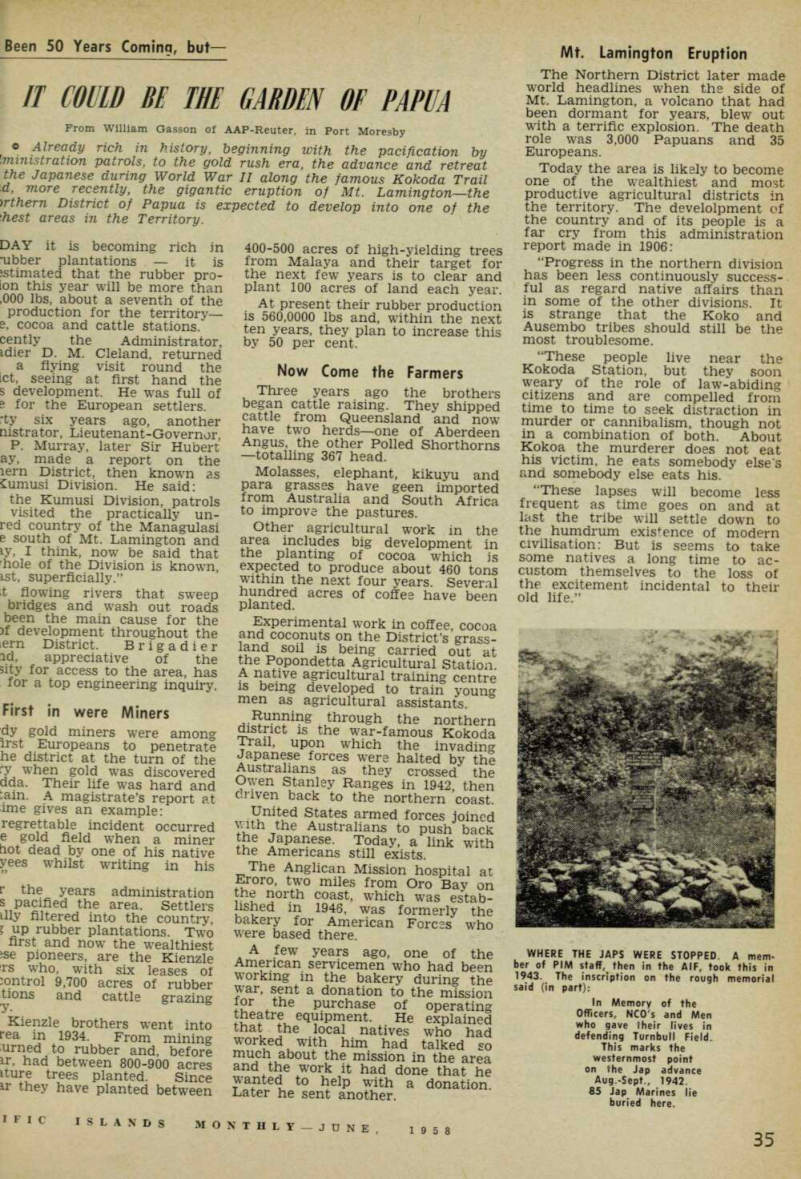
WHERE THE JAPS WERE STOPPED. A mem ber of PIM staff, then in the AIF, took this in 1943. The inscription on the rough memorial said (in part): In Memory of the Officers, NCO's and Men who gave their lives in defending Turnbull Field.
This marks the westernmost point on the Jap advance Aug.-Sept., 1942. 85 Jap Marines lie buried here.