[?] teran Mission Couple
pp. 41-43 · Read in the full issue
[?]e Metcalfes
[?] ire From BSI
The Rev. John R. Metcalfe, who for the past seven years been d of the Methodist Mission in British Solomon Islands Pro orate, and Mrs. Metcalfe, left islands in February to live in toria.
R. Metcalfe has had 38 years . of missionary service in the Solomon Islands. Mrs. Metcalfe, ) was Sister Ivy Stanford until marriage in the 1920’5, has d in the Solomons for 42 years, [r. Metcalfe was appointed to the non Islands in 1920 as soon as become an ordained Methodist lister in Victoria, where he had ady spent some years as a me missionary”. At that time as a missionary was not without ger in the Solomons, e is the last of the Methodist sion workers, originally appointed ;he Australian Methodist Mission rd to work in BSI. i recent years the Methodist sion there has become the >onsibility of the Methodist irch of New Zealand, and the sion stations are now staffed New Zealanders. [r. Metcalfe expects to give a f period as a minister in Victoria )re finally accepting super lary status. or much of their long missionary ice Mr. and Mrs. Metcalfe lived the island of Choiseul. They e there when the Pacific War £e out, and Mr. Metcalfe re ned through part of the anese occupation. Eventually he other missionaries were evacua by the American forces.
When the Japanese were driven out of BSI, Mr. Metcalfe returned to Choiseul to re-establish the mission. Mr. and Mrs. Metcalfe transferred to Roviana, in New Georgia, in 1951, when Mr. Metcalfe became chairman of the Methodist mission district in succession to the late and famous Rev. John P.
Goldie, who had then retired after nearly 50 years of mission service.
At one stage Mr. Metcalfe was stationed at Teop, on the north coast of Bougainville, as the first superintendent of Methodist mission work in Bougainville and Buka. Mr. and Mrs. Metcalfe have often been referred to as model missionaries,
They have been much loved by the people of BSI.
On January 30 hundreds of native women of Roviana gathered to say farewell to “Marama Metcalfe , £L e i r c l^?i he s ra ‘ n “ ; c f e ew of p t ’ he ol^er women ‘ SO me of whom had been girls under the care of the then sister Ivy Stanford 41 years before. Each of several women speakers referred with affection to “Marama’s” love of the mission people, her care of the sick, her readiness to help wherever needed, her words of en couragement and guidance, and her personal interest in each one of them and their families.
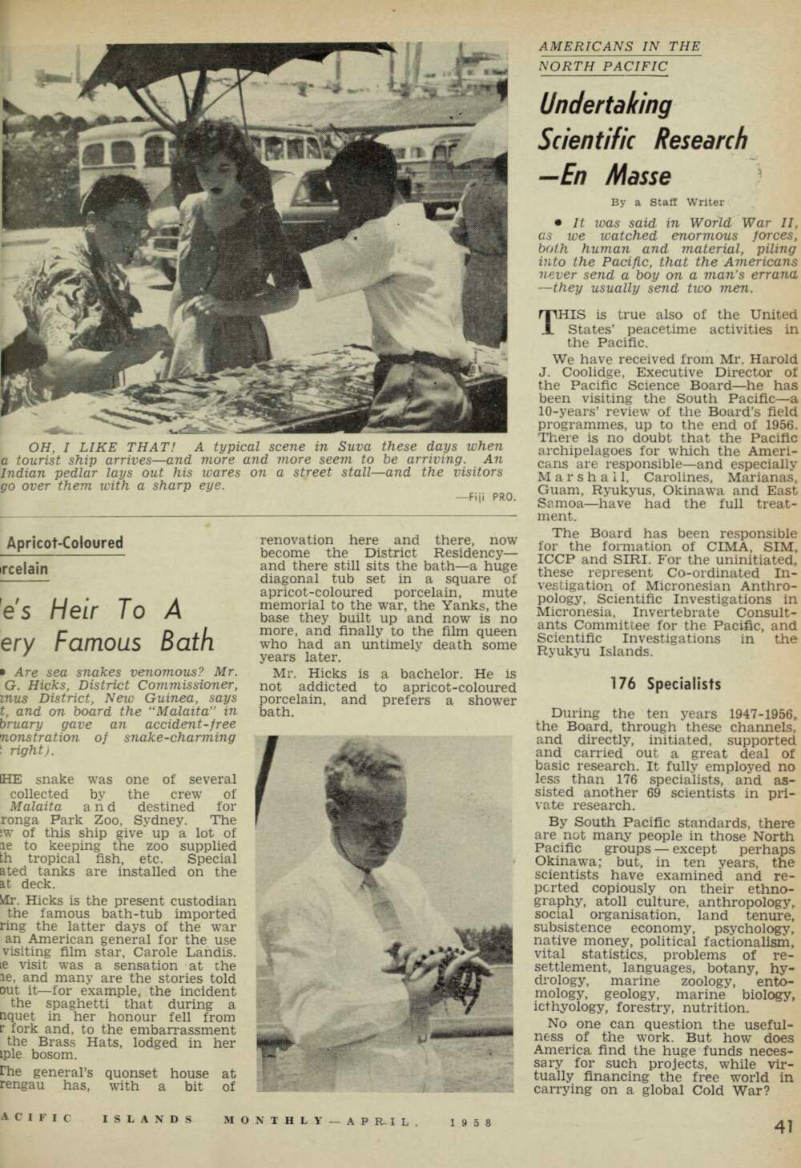
OH, I LIKE THAT! A typical scene in Suva these days when a tourist ship arrives—and more and more seem to be arriving. An Indian pedlar lays out his wares on a street stall —and the visitors go over them with a sharp eye. —Fiji PRO.