[?]St Of The
pp. 39-41 · Read in the full issue
[?]alcanal Gold
[?] Ld Time
[?] Rospectors
Special to PIM red Ball—one of the last of
older, tougher race of pros
ors—has gone.
! was one of the old hands vhose pluck and endurance vould shame many a young ; one of the old hands prepared it up with any hardship in the ing hope of one day making h strike beyond the next ridge, died in Palmerston North, Zealand from a stroke red in a restaurant, e history of gold on Guadal l would not be complete with some notes on Fred Ball—the Pirate”—as he was affection known. was so completely sold on the lects of gold mining on lalcanal. His great regret that his health could not [ up, and many times he said ?, “If only I had found Guadal . 20 years ago!” first visited Guadalcanal in Originally from Cornwall, he already had a lifetime of ig and prospecting experience id him and was a mining nality in Nigeria, the Gold ; and elsewhere in the British ual Empire.
Enthusiastic
was very enthusiastic about (old potential of Guadalcanal, ugh careful to say little at the fortunately he suffered a is illness and it was 1952 — ears later—before he returned e scene, with another mining eer, Mr. John Broadhurst, ; on instructions from the Dn Tin Corporation, arrival they met with a dis ntment. Their main objective, old-bearing Kovagombi Valley Is on the Sovohio River, had taken up by the Clutha opment Company, er, the Old Pirate ventured on a prospecting trip into the known Betilonga Basin, il hours walk south of ira, where fine gold was found, had some difficulty with the ss, who were not used to I Europeans there, geological survey party later fered substantial lodes there, the plans for prospecting tions on Guadalcanal fell igh suddenly when the London
Tin Corporation decided not to go ahead.
Another Disappointment
Fred Ball, although again dis appointed, was not deterred.
He had set his heart on a small gold-mining lease on the Sovohio River just upstream from the Kovagombi leases. He built a house and named it “Dunroman” as this was to be his last venture.
Although then 57, and not as strong as he used to be, he walked many times the track across the oven-hot several-feet high grass of the alluvial plains from “Dunroman” to the Nalimbiu River. This was then roadhead; here he had built a Fijian-style thatched house as a depot.
His teething troubles with labour were many, and there were times when he was forced to carry his own pack alone these many miles, and sleep in the swampland where he found himself as night fell.
Just when things began to go well, and his unusual method of mining the gravels had begun, Fred Ball, through showing his boys how to work, did a little too much—and had to leave the Solomons for hospital in New Zealand. “Dunro man” was slowly reclaimed by the jungle.
Yet, in spite of his doctor’s orders, it was not long before he
was again on the job, drilling for gold on the Jaba River in Bougain ville with engineer Broadhurst, again for the London Tin Corpora tion.
Near where the river gorge enters the wider valley, earthquakes tumbled the rock walls into the stream and more than once shook the party from their beds. Photo graphs were received in Honiara of the Old Pirate—looking fit and wearing still his old felt hat, and resplendent with a beard dyed black with potassium permanganate, to hide his years (so he said).
Very little work had been done before once again Fred Ball did too much: while exerting himself and cursing the light drill stuck in the heavy boulder gravels, he suffered a stroke, and was again flown home to New Zealand.
He "Believed"
He recovered from this blow, to everyone’s surprise, and also from the added complication of TB. But another stroke killed him.
Fred Ball was probably right in his belief that he could have made something of Guadalcanal if he had found it earlier. But it takes a man with his strength and spirit to appreciate it.
He was perhaps the last of the great tribe of persistent prospectors
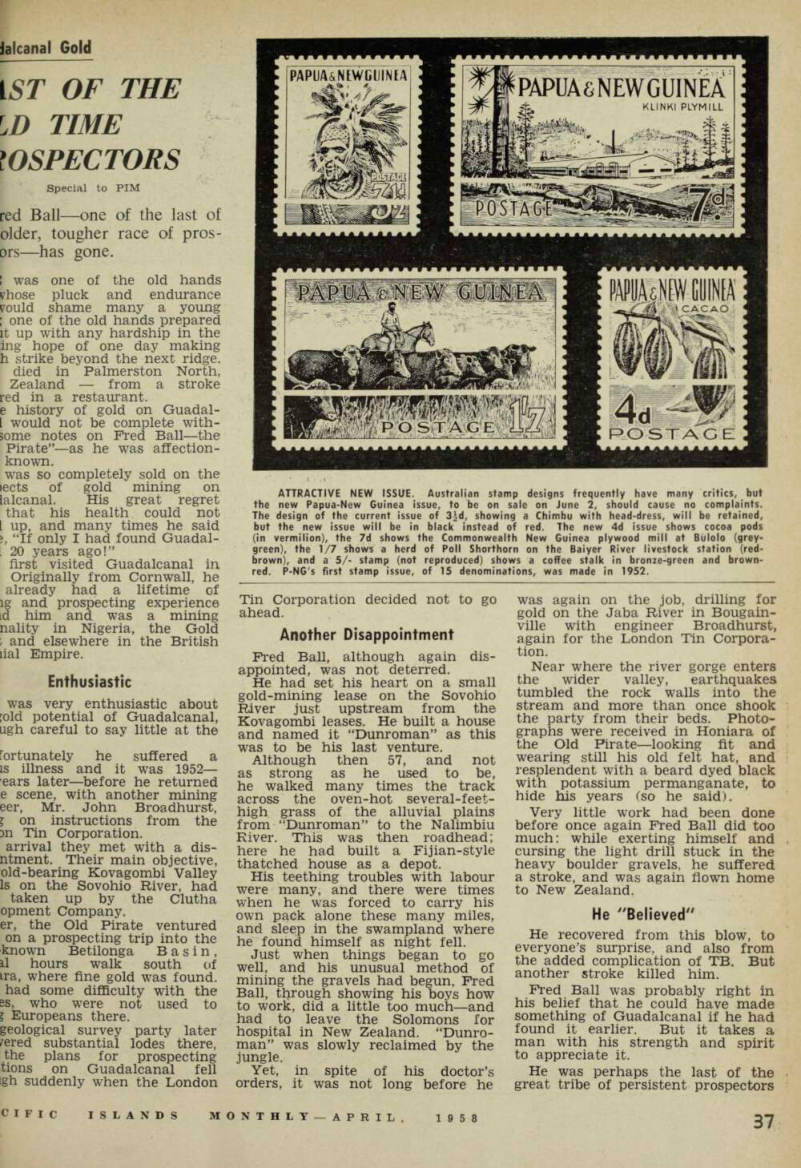
ATTRACTIVE NEW ISSUE. Australian stamp designs frequently have many critics, but the new Papua-New Guinea issue, to be on sale on June 2, should cause no complaints.
The design of the current issue of 3½d, showing a Chimbu with head-dress, will be retained, but the new issue will be in black instead of red. The new 4d issue shows cocoa pods (in vermilion), the 7d shows the Commonwealth New Guinea plywood mill at Bulolo (grey green), the 1/7 shows a herd of Poll Shorthorn on the Baiyer River livestock station (red brown), and a 5/- stamp (not reproduced) shows a coffee stalk in bronze-green and brown red. P-NG's first stamp issue, of 15 denominations, was made in 1952.
spared to suffer hardships as a itter of course.
What young men of today would prepared to do the same in the iinary course of events? Too
;en a government geological
rvey is asked to serve up a mining jposition complete with all trim ngs on a plate; and unless this done, nothing happens. Fred 11 knew better.
When next I visit the gold-bearing per Sovohio I shall look around i jungle tangle that marks the 5 of his house “Dunroman”, and 1 not be surprised if I should ir the familiar voice of my old md from down below on the er bank, and the sound of gold iring gravels being shaken skil ly in an old prospector’s pan. ■’or if Fred Ball hears of gold rond those Pearly Gates of aven, he will be out again rching for it —and will find it anyone can.—JCG.