Ships That Leaked
pp. 84-85 · Read in the full issue
Burns Philp's 75th Anniversary Recalls
An Sla Ads Empih
By Toagoba
How many folk who now travel between Australia and tl various archipelagoes of the Pacific Ocean—particularly N»1 Guinea ever stop and think of the great job of pioneering thl was done here by Burns Philp & Co. Ltd.?
THE great steamship companies of Britain—Elder Dempster Co., to West Africa, Nigeria, etc.; British India Co. to India and China; Blue Funnel to China and Japan, come to mind—all played their part in building up the British Empire. But few can compare with the Burns Philp achievement in establishing Australian trade and
industry in the vast, sparsely g lated archipelagoes of the S Seas.
In every instance, the inhabit of these groups were 95 per illiterate. The white traders, in to trade, had to teach the nsj how to count coconuts in fir and how to produce crops. Ther sionaries undertook similar t All their efforts would have useless without contact withr outside world. Contact was proc by Mr. (later Sir) James Burnsa his very able lieutenants like A Forsyth, P. G. Black, Noswo Joseph Mitchell, and others.
To care for and develop theses tacts, it was necessary to pro cargo-carrying vessels, either ss< steam. The BP vessels which t( with a few small sailers like schooner Myrtle, grew to a hr efficient fleet of cargo and passe< ships.
The modern liners do not any place in this article. I will only to vessels owned by H Philp and Co. prior to World W The Myrtle —designated a schoc but hardly that—was of 150 burthen and plied between O town and Samarai. Prior to BP C ing her over, she had been eng§ in the Solomon Islands labour t;J Her captain was a Mr. Inman,, finally retired to Samarai and t
e of the small 20-tons schooner ia —and the name of her cook jteward was William Wisdell ie the Cook”) later landlord of Old Pub” in Samarai. tunately, the Queensland Gov ;nt subsidised the running of issels: but such subsidy was re td against the then British- Juinea Territory Government. ;r a very checkered career, the 5 ended her days in the sion of Mr. Harold P. Reynolds, ru, and did good work recruit iwai natives for estate work. y early, BP gave the Gilbert Ellice Islands the British ons, and New Guinea, direct ship services from Sydney. The for the two last-named in l Brisbane; while the New a service went to Cooktown. ater, the last port of call on ntinent was Cairns, steamers purchased for these is were mostly second-hand, employed on the Gilbert and run were the Tambo, built in ,nd (but this may be wrong) i the NSW coastal trade; the a, built July, 1891, and previ operated on the Natal coast; the Muniara, built 1901. ra’s name was changed from \eer —her previous place of ion is not recorded. The re re tonnages were all gross tons 699 and 837. They all went irfolk, New Caledonia, New les and Groups eastward.
Real Traders work of these steamers was ar to that of real trading as could be found anywhere world. They and their “super s’’ really were real Empire 's. i vessel was equipped with a room and the “supercargo” )t only a bookkeeper, but also pert in merchandising, ad to purchase copra and shell f available, sandalwood and articles. Each was usually the al adviser and confidant of ople dealt with. The women ould ask him to purchase all of personal articles for them the steamer was in Sydney, round trip took up to four s. n the supercargoes’ lists of were presented to the andise Department, in Bridge dney, the staff had to go “all i place them, so that the goods be ready for shipment on the trip. mable this to be done, “Bill” t, of the Merchandise branch, .1 Indents placed before him, fith the help of his staff, he ed purchases or allocated items to “brokers”, who were go out and find—eventually— m wanted. tout this tremendous organised the people of such places as tari (Northern Gilberts)
could not have existed; and their whole livelihood was dependent on BP. The latter, whilst surely not a benevolent institution, were most mindful of their obligation. They left no stone unturned to fill each order, even if it was only for a shilling’s worth of garden seeds.
Wide Authority
On other runs—with perhaps the exception of the Hebrides—there was no necessity for trade-rooms. But the pursers had authority to pur chase copra and other items market able in Sydney. Articles which had to go to Europe were accepted in a consignment basis. If head office was able to pass a 90 per cent, credit, this was immediately credited to the trader.
The first regular steamer to New Guinea was the Moresby, previously called the Jacob Christiansen, and owned by a Scandinavian Company, Moresby was a most uncomfort able vessel. When the Matunga (built 1900, and o.wned by the Liver pool Mersey Shipping Co., as the Zweena ) was put on the newly subsidised regular scheduled run, the New Guinea people were very happy.
About the same time (1910) BP purchased a small, wooden vessel called Mindora. She ran, as far as was possible, as a coastal feeder to Matunga ; and also in a like capacity with the then Sydney Straits vessel Airlie and Guthrie (ex. E & A ships).
The Northern terminal of the Mindora was Buna Bay (Northern Papua) and to the credit of BP. She
certainly brought joy to the people in some very out-of-way places.
On the Solomons-Hebrides runs were the Marsina (previous name Samuel Hough, built 1905) and that awful tub of a boat Malaita (built in 1893, and known first as Antilla) .
She was about the most uncomfort able vessel ever built, but no doubt suited the trade.
All these ships were more or less subsidised by the Australian Com monwealth Government. Without subsidy, it would not have been possible for Burns Philp to operate them. But their introduction showed great foresight and enterprise on Sir James Burns’ part. Some people may not always see eye to eye with the firm, but all must pay tribute to the great work it did in develop ing the trade of the Pacific for the benefit of the Australian merchants.
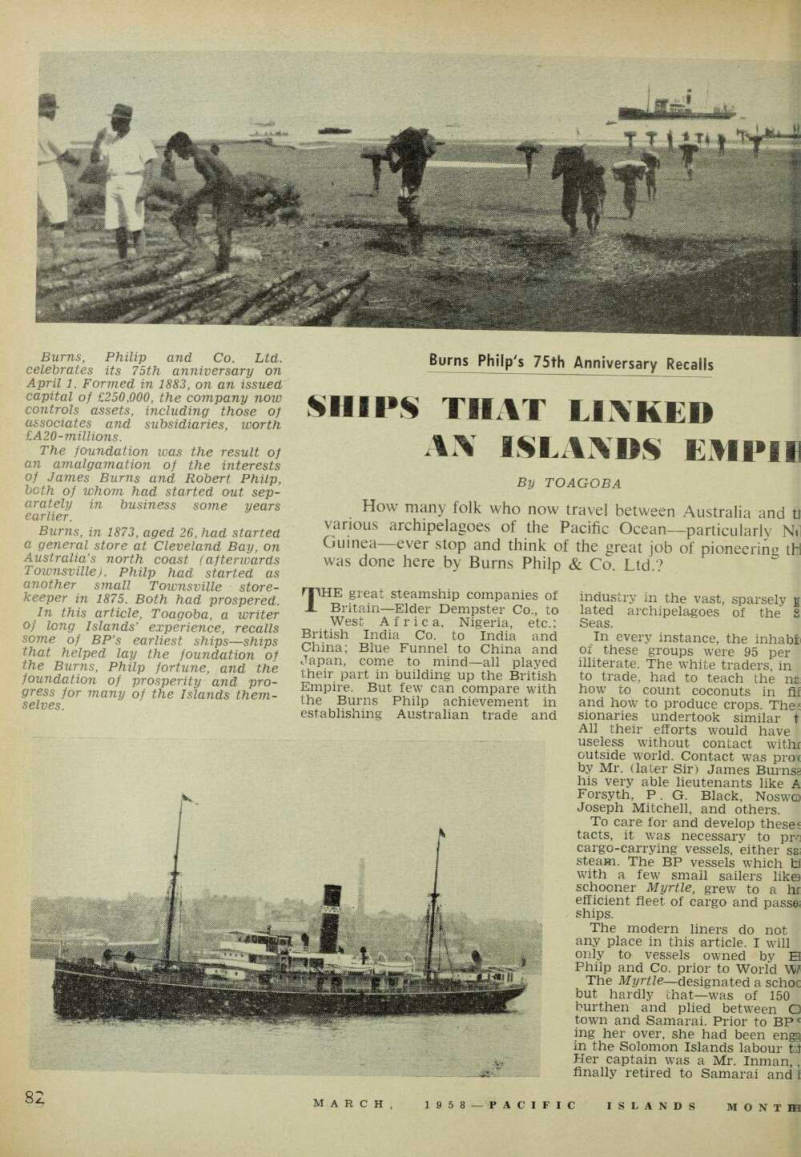
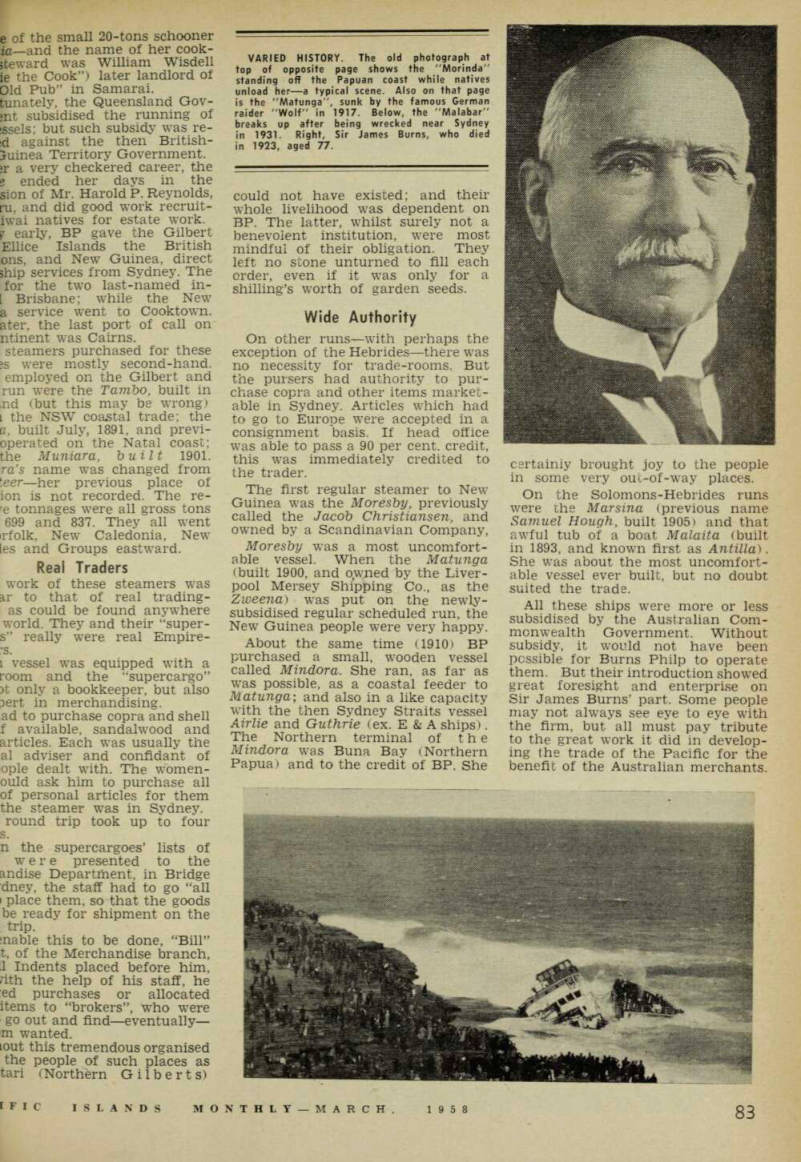
VARIED HISTORY. The old photograph at top of opposite page shows the "Morinda" standing off the Papuan coast while natives unload her —a typical scene. Also on that page is the "Matunga", sunk by the famous German raider "Wolf" in 1917. Below, the "Malabar" breaks up after being wrecked near Sydney in 1931. Right, Sir James Burns, who died in 1923, aged 77.