A Gracious Queen
pp. 82-84 · Read in the full issue
A Little Bit of Trouble Over Protocol, But—
A Gracious Fiji
Meets
A Gracious Queen
Queen Elizabeth, the
Mother, spent a fortnight in Nev
Zealand, a month in Australis. 18 hours in Fiji; and “the camen
cannot lie”.
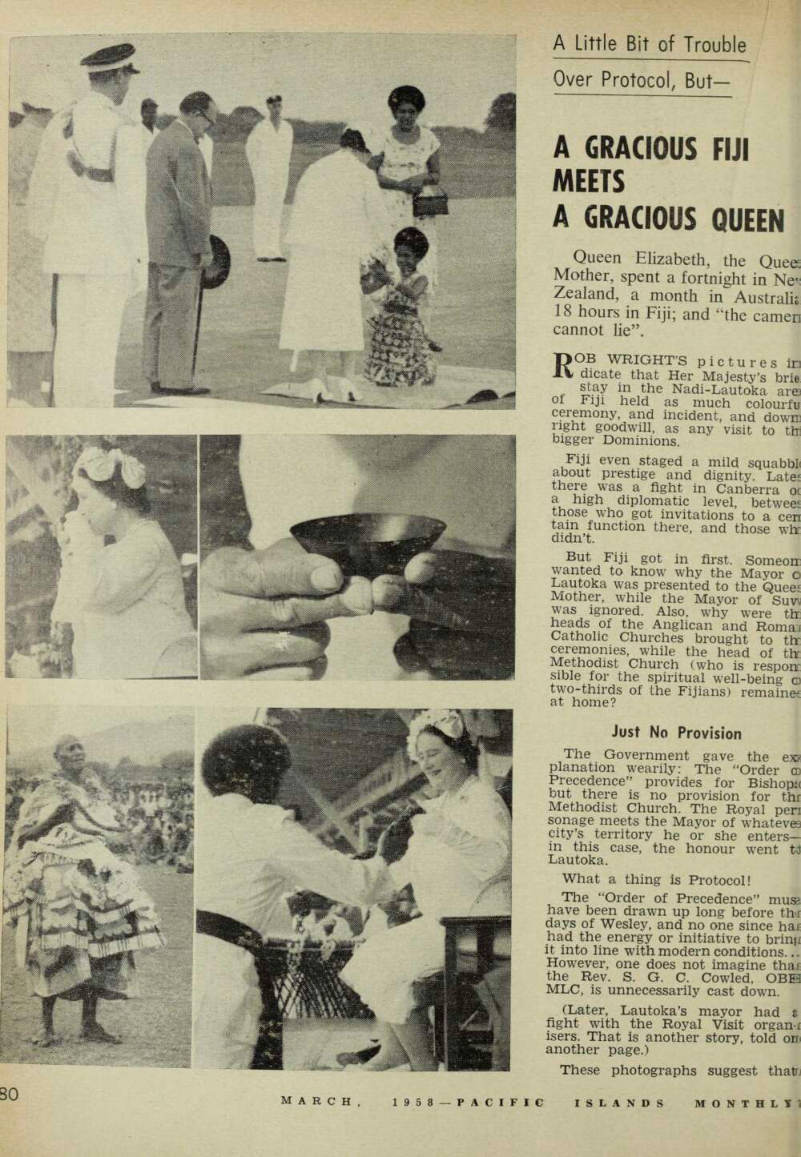
Rob WRIGHT’S pictures in dicate that Her Majesty’s brie stay in the Nadi-Lautoka are ol Fiji held as much colourfu ceremony, and incident, and do win right goodwill, as any visit to th bigger Dominions.
Fiji even staged a mild squabblt about prestige and dignity. Late* there was a fight in Canberra oc a high diplomatic level, betwees those who got invitations to a cen tain function there, and those whr didn’t.
But Fiji got in first. Someorri wanted to know why the Mayor o Lautoka was presented to the Queer Mother, while the Mayor of Suw was ignored. Also, why were th heads of the Anglican and Romar Catholic Churches brought to tlr ceremonies, while the head of thr Methodist Church (who is responr. sible for the spiritual well-being o two-thirds of the Fijians) remained at home?
Just No Provision The Government gave the exx planation wearily: The “Order cd Precedence” provides for Bishopa but there is no provision for thr Methodist Church. The Royal pen sonage meets the Mayor of whatevea city’s territory he or she enters— in this case, the honour went ti Lautoka.
What a thing is Protocol!
The “Order of Precedence” musa have been drawn up long before thr days of Wesley, and no one since har had the energy or initiative to brinji it into line with modern conditions...
However, one does not imagine that the Rev. S. G. C. Cowled, OBE3 MLC, is unnecessarily cast down. (Later, Lautoka’s mayor had s fight with the Royal Visit organr isers. That is another story, told on< another page.) These photographs suggest thatfj
i though the mayors and heads churches were thrown to the res by the guardians of tradition, smiling Queen Mother was py with her few hours in Fiji.
Fijians Predominate
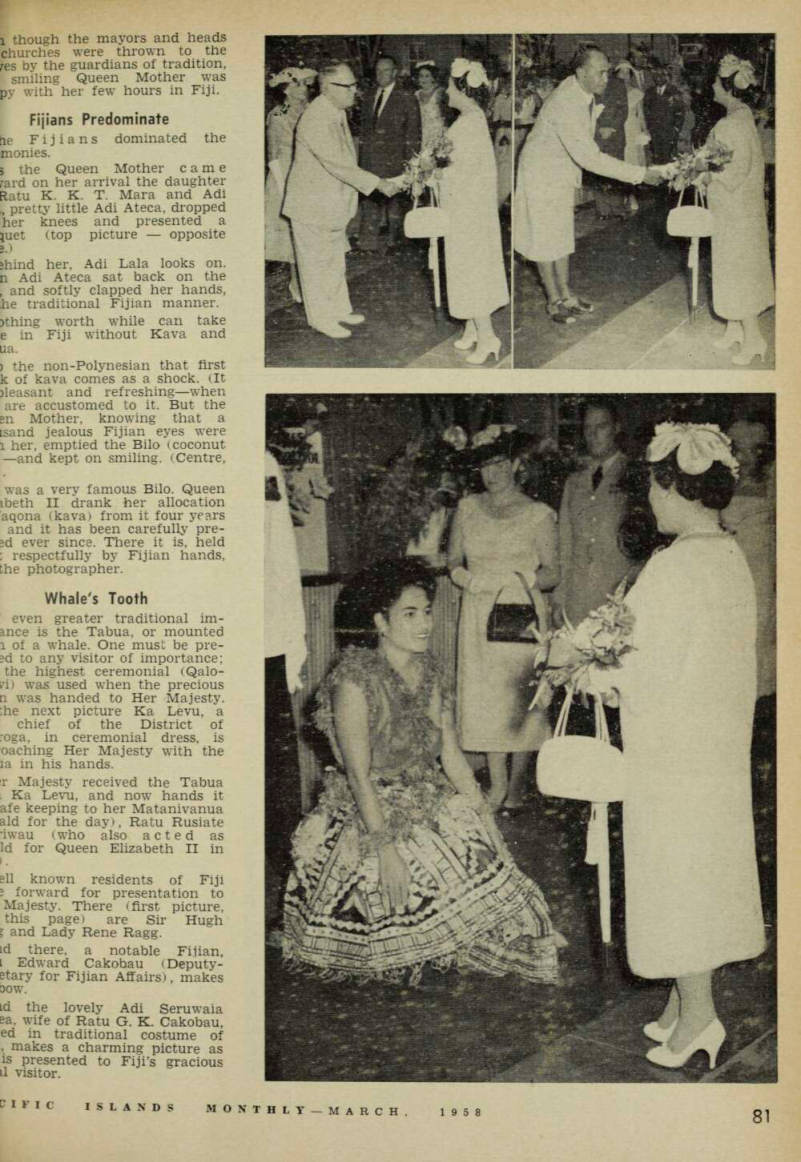
tie Fijians dominated the monies. 3 the Queen Mother came rard on her arrival the daughter Ratu K. K. T. Mara and Adi pretty little Adi Ateca, dropped her knees and presented a juet (top picture opposite 3.) jhind her, Adi Lala looks on. n Adi Ateca sat back on the , and softly clapped her hands, he traditional Fijian manner. >thing worth while can take e in Fiji without Kava and ua. ) the non-Polynesian that first k of kava comes as a shock. (It Peasant and refreshing—when are accustomed to it. But the en Mother, knowing that a tsand jealous Fijian eyes were i her, emptied the Bilo (coconut —and kept on smiling. (Centre, was a very famous Bilo. Queen ibeth II drank her allocation aqona (kava) from it four years and it has been carefully pre sd ever since. There it is, held : respectfully by Fijian hands, the photographer.
Whale's Tooth even greater traditional im ance is the Tabua, or mounted i of a whale. One must be pre -3d to any visitor of importance; the highest ceremonial (Qalo id) was used when the precious n was handed to Her Majesty. ;he next picture Ka Levu, a chief of the District of :oga, in ceremonial dress, is caching Her Majesty with the la in his hands, r Majesty received the Tabua . Ka Levu, and now hands it afe keeping to her Matanivanua aid for the day), Ratu Rusiate dwau (who also acted as Id for Queen Elizabeth II in ell known residents of Fiji 3 forward for presentation to Majesty. There (first picture, this page) are Sir Hugh j and Lady Rene Ragg. id there, a notable Fijian, l Edward Cakobau (Deputy etary for Fijian Affairs), makes bow. id the lovely Adi Seruwaia ea, wife of Ratu G. K. Cakobau, ed in traditional costume of , makes a charming picture as is presented to Fiji’s gracious il visitor.
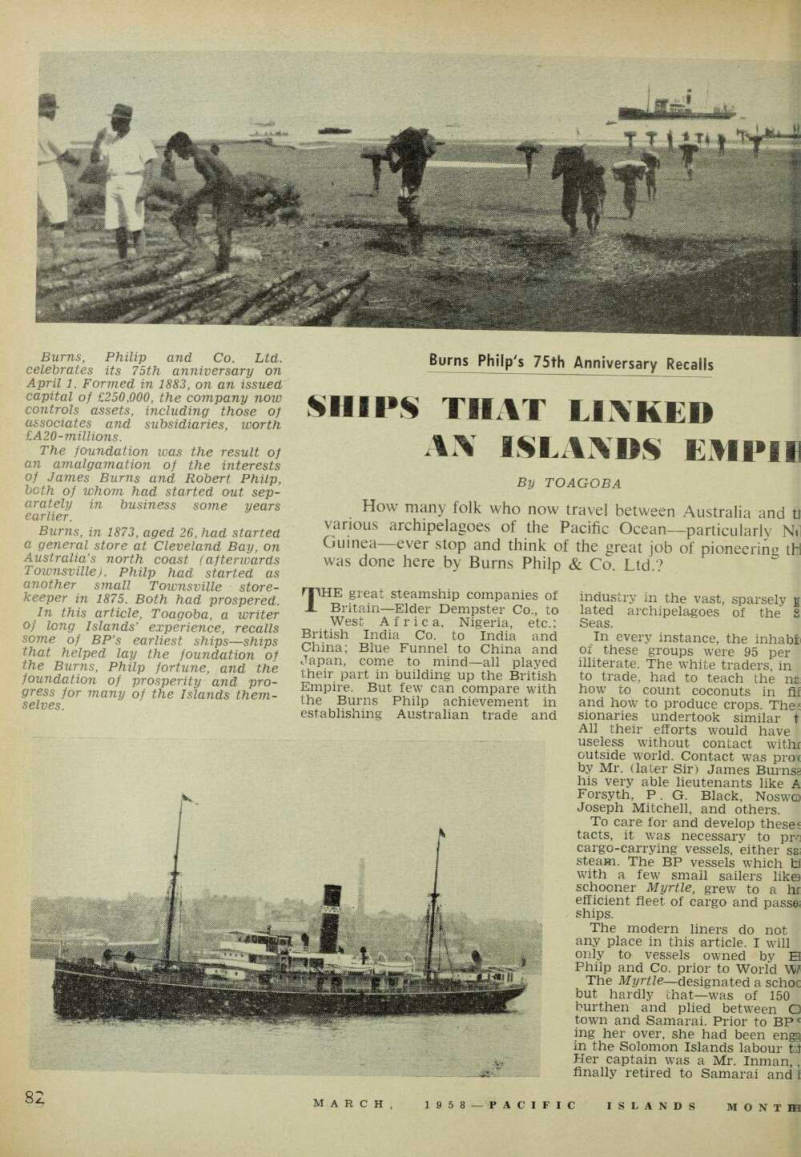
Burns, Philip and Co. Ltd. celebrates its 75th anniversary on April 1. Formed in 1883, on an issued capital of £250,000, the company now controls assets, including those of associates and subsidiaries, worth £A2O-millions.
The foundation was the result of an amalgamation of the interests of James Burns and Robert Philp, both of whom had started out sep arately in business some years earlier.
Burns, in 1873, aged 26, had started a general store at Cleveland Bay, on Australia’s north coast (afterwards Townsville). Philp had started as another small Townsville store keeper in 1875. Both had prospered.
In this article, Toagoba, a writer of long Islands’ experience, recalls some of BP’s earliest ships—ships that helped lay the foundation of the Burns, Philp fortune, and the foundation of prosperity and pro gress for many of the Islands them selves.