Into Edie Creek
pp. 52-55 · Read in the full issue
Fabulous Gold For "The Big Six"
How They Climbed
By R. W. Robson
Someone, writing of the death of Bill Money in February, said he was the fifth of the Big Six to die—only Bill Royal is left.
MEMORY carried me back 27 years, to “the beach” at Salamaua as I saw it first. Lines of weary carriers were coming out of
those Terrible jungles, after an 8days’ walk from Koranga and Edie Creek. (Only the other day, I fiew over much the same route, Salamaua
via Black Cat to Wau, in j minutes.) Groups of rollicking i were disposing of their packs gold in the palm-leaf stores, over Allen Innes’ bar. All were yes from anti-malaria drugs.
At that time, Shark-eye P c and Nettleton, and Levien, and j Big Six, were household wo Some of them still were around: To-day, how many people k: how those once-famous names v introduced to the Morobe goldfio World War 11, and the Jap vasion distorted the New Gui record, or wiped out parts of it. ' fascinating story is worth re-tell It was William Park —a toe Australian jack-of-all-trades— actually found the very rich Bn goldfield: but he did not disco the fabulous Edie Creek section it. That came later.
Park was a queer, tactiturn m He liked to be by himself. He a peculiarly cold and searching and natives who encountered its wavering stare bent at the krr and would go to considerable leng to placate the tambaram. “Shs eye” was no misnomer.
Smelled Gold
Shark-eye was one of scores well-salted Australian prospec; on the Papuan goldfields 50 ye ago; and these men seemed to sn gold. They argued that, if th were colours in a river, the sou of the gold would be found hig up. Working up the rivers and tL tributaries, they located many gc fields, large and small.
Thus, they were greatly attrao by signs of gold in the Waria Rii just across the Papuan border,, German New Guinea. In the dec: before World War I, the Gern officials were always hunting Australian prospectors out of Waria country especially M s Crowe, Shark-eye Park, Arthur D:( ing, Jim Preston and Frank Pry< But, in spite of the Germans, three first-named apparen prospected their way into the heE waters of the Waria, and across dividing ranges into the Bulolo wat shed, before 1914. It is certain tt Park was in there then, and gold”.
World War I was no sooc finished than Shark-eye was be there again. There were no Germr now to chase him out; but Shark kept his own counsel. He literr went native —he must have spq a couple of years living among thi exceedingly primitive folk, whiles fossicked his way along the Bur River.
Between 1919 and 1922, rep®< about him filtered through. * miners were exceedingly curious., also was Cecil J. Levine, an Af tralian-New Guinea District offii with headquarters at the little n of Morobe.
Jack Nettleton, an Australian v had left the Australian-New Guii
ice and gone trading, established ittle trade-store near the mouth the Markham River. One day, in 2 or 1923, there came to him, of the jungle, a hairy, emaciated ropean, attended by a small line very primitive natives. It was irk-eye. ,hark-eye told Nettleton (whom had met somewhere previously) t he was on rich gold, away back the mountains, but he could not ■k it alone. Someone must keep plies up to him, while he washed the gold. He needed a mate, tleton joined Shark-eye. ettleton increased his supplies ey came from Rabaul) but closed trade-store. His track from the 010 seems to have been through Buangs to the coast, and then canoes to Morobe, where supplies e unloaded from a small ship n Rabaul. hark-eye had found gold in a d of Koranga Creek, near a alder of Mount Kaindi. The men maintained strict silence le they concentrated on cleaning a fortune before the news got md, and the rush started.
Shark Eye Missing
ut old Australian prospectors had ced that Shark-eye still was sing, and that Nettleton was iding a lot of time inland, and e very restive. loane (“Lucky Joe” they called ) smelled the gold strike from ■esby. He got around to Samarai, ice to Morobe, and thence along coast to Salamaua, which Nettle now was using as a beach-head. )e organised a team and pain y found his way in, along Nettle s track. Approaching the Bulolo, met Ernie Dover, istory does not say how Ernie in there so early. Sloane and er joined the reluctant Shark and Jack Nettleton on the anga. There still was plenty of I for all. at not for long. Men came Lggling in over that terrible track: 3 Smart, Travers Black, George old, Bill Anderson, Peter Burke, t Livingstone, Herbert Wilson, ton, Burleigh Gorman, were mg them. ill Money made a nightmare age from Rabaul in 1923 in a boat ed the Manam, with a broken n engine—he carried as passen ; Doris and Yorkie Booth. The ths decided to go in to the 010. Yorkie went ahead, to in nate; Doris stayed on the beach jalamaua for a while, to organise •iers and supplies, tore men were reaching the amaua beach from overseas by ious means. Bill Money saw a ling opportunity. He left Collins the beach, to build him a shed of nleaves, to house the stores, and set off back to Rabaul in his ched-up Manam. (Collins was
later murdered by the Nakanais in New Britain.) About this time, boatbuilder Bill Royal arrived from Rabaul, followed soon afterwards by his friend Dick Glasson; and they also walked in. . . c ...
Risked Everything
District Officer Levien had the earliest tidings of the Koranga strike, and he decided to risk everything on it. He resigned his job, went to Australia, and looked up a fellow-officer of World War I, C V T Wells, an accountant, of Adelaide. He told Wells of what he thought might happen in New Guinea; and then he returned, as a miner, and joined the trek into the Bulolo.
Two years passed, while the trickle of goldseekers grew into a stream, and the stream became a pool of men in Koranga Creek, and in the creeks and gorges round about. The good claims thereabouts soon were all taken up and worked out. B y Ju i y> 1924, Nettleton had amassed what he regarded as a fortune, and he departed for Eng land.
He was happy to leave. It was a terrible life, in those Morobe gorges—frequent rain, no amenities, shortage of supplies, constant danger from malaria, dysentery and the deadly scrub typhus.
Shark-eye Park sold out to Levien in 1925 and retired to Canada and a new wife—a very rich man. (Over)
here are two or three varying ies of how Bill Royal found ; Creek. This is the account n me by Allen Innes, who saw 01. r. and Mrs. Allen Innes (he a Burns Philp man) estab =d a store and the first hotel Salamaua in 1925, and made a une. They live now in Sydney, □ranga had been pretty well sed out, as a place for individual ers. The “mob” tended to get ther in groups. Thus was led the Alpha Syndicate—Bill al. Joe Sloane, Dick Glasson, Money, Stowers. They were i up against it —if Allen Innes not kept them going with ss, they might have given it and missed Edie. lere came a time in 1925 when iey and Glasson were over at Watut end of the Bulolo, pros ing, and Stowers and Royal i waiting at Salamaua for ;s. The stores came, and Royal Stowers on to the Watut, with nt supplies, while he headed ; into Koranga, with Sloane. il had with him a very well led and loyal New Guinea boy had had experience on the ikamu goldfield, in Papua, ospects were grim. they got back into the Bulolo , Royal looked for the hun th time at the ugly precipices nd Kaindi, out of which some he big creeks came tumbling i. So far, every prospector who tried had failed to get up 5, “on top”. Royal’s hunch was that Koranga gold came from top”.
Scaled Precipices
; provisioned his special boy instructed him to try and get following a particular line of itry. A few days later, the boy back. He had finally got up op; and the story of what he d in a creek there seemed in ible. le boy guided Royal back up precipices. It took them two hree days to advance only a n miles —in which they nted from 3,500 feet to 7,000 )yal’s return trip was much leer. In his excitement, he prac ly slid down the precipices, carried to Joe Sloane a tale of lous gold in the bed of Edie k. ley planned secretly and acted [uickly as they could. Unlucky /ers had “given it away”, and gone. But the others of the la Syndicate (Royal, Sloane, ey, and Glasson) brought in holm and Royal’s brother irt, and formed the Big Six, and ceded to peg all the Edie k they were entitled to. no time at all, the new rush on. ght at their heels came Whit-
bourne, Yorkie Booth, Arnold, Robertson, Taylor, Wilson, Ernie Dover, Ned Coakeley. The Big Six —and most of the others —made fortunes.
One day in February, 1926, in Adelaide, C. V. T. Wells got a radio gram from Levien: “Phenomenal alluvial gold dis covered at Edie Creek, get busy.”
This was Levien’s signal to Wells to proceed with the plan they had made. It was the toughest assign ment of Wells’ life.
He had faith in Levien —but how to convince Adelaide investors of this chance? He appealed to another fellow-officer of World War I, W. P. A. Lapthorne.
Somehow, they got the funds to gether. Guinea Gold, NL, was formed; the country which Levien had nominated (the flats below the Bulolo Gorge—miles below the Edie Creek - Koranga - Bulolo junction) were taken under lease; and from that group there came Placer, Bulolo Gold Dredging, Guinea Airways and the further development of the Morobe goldfield, almost as sensa tional in its gold-production as Edie Creek.
The original development of the Morobe goldfield, therefore, was in three sections: first, the discovery of Koranga, by Shark-eye Park; next, three years later, the discovery of Edie Creek by Bill Royal and Joe Sloane; and the location of the Bulolo flats by Cecil Levien, soon afterwards, and the establishment of the eight dredges there by Bulolo Gold Dredging Ltd..
From 1922 until June 30, 1957, the gold exported from New Guinea (mostly Morobe) was worth £30,000,000.
Of all the venturesome people who were there in 1923-24 I think only Bill Royal and Mrs. Doris Booth are alive. The others “died before their time”—and no one, who knew anything of the conditions they endured in those first years in the Salamaua-Bulolo area, can wonder at it. * * * I believe that there still is rich gold in the lesser-known parts of New Guinea, but it is hard to get at. We want a new generation of Shark-eye Parks, Matt Crowes, Bill Royals, Joe Sloanes and lads of that calibre.
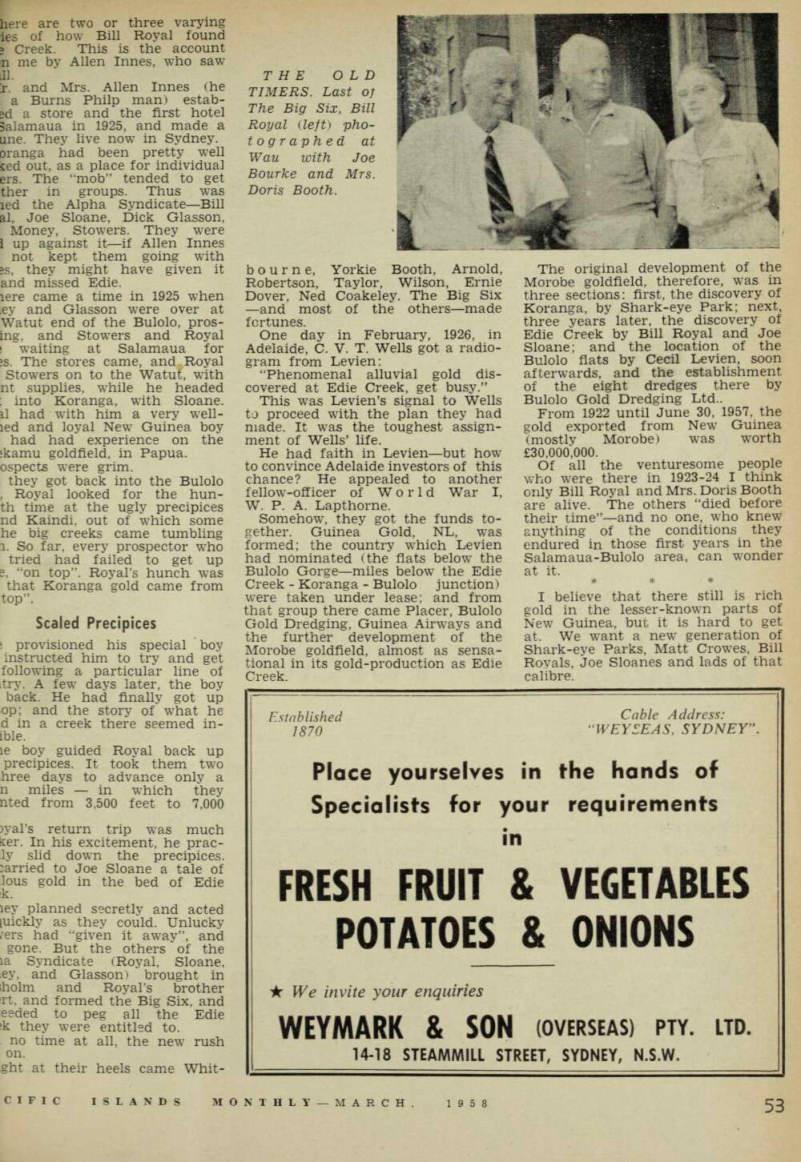
The Old
TIMERS. Last of The Big Six, Bill Royal Heft) pho tographed at Wau with Joe Bourke and Mrs.
Doris Booth.