Ragic Death Of Bill Money,
p. 51 · Read in the full issue
stery of the Disappearing Fortune
A Legend In His Own Time
Few men become legends in their own time —but one of he few was Bill Money, who struck it rich on New Guinea’s Bdie Creek in the late Twenties. In recent years, Money was i legend rather in eclipse —but a legend for all that.
ITH his death in Lae, New Guinea, on February 8, only other member of the original b Creek Big Six remains in New nea. He is Bill Royal, who for ly years made a living at allu mining around Maprik in the vak district. Recently he has m a job with New Guinea Gold is in Wau. rith the exception of Bill Royal his brother Albert (who was a ping partner in the syndicate) the others are dead, moss of n in tragic circumstances. Prob r, Bill Money’s end was the most ;ic of all. [oney was born in London in . of humble Cockney parents. As oungster he sold papers in the ets, but when he was 22 he mi ;ed to Australia. r orld War I came soon after and mlisted as a private in the First Money had had little educa , but he was a natural soldier.
Bn hostilities ended he had won Medaille Militaire, DCM, MC the Russian White Order. He commissioned in the field, and r attained the rank of Captain. r hen he returned to Australia was sent as a member of the tralian Occupation Forces to r Guinea; and during this period became District Officer in the lang area. r hen Civil Administration took • from the Army, Money began stablish himself in the commer field; and, in partnership with rlie Reynolds, he planted up a table coconut plantation on tsi Island and established trad stations up and down the obe coast. (Siassi was later to the Lutheran Mission, and nolds lost his life in World War during the Sandakan “death ch”). r hen Edie Creek was discovered, ley was the right man in the t place at the right time—and i all the right kind of assets, owned schooners, could recruit 5 and provision them —and that .nt the difference between suc and failure to miners in those s.
Dr this reason he became one he Big Six —with Bill and Albert al, Chisholm, Dick Glasson and Sloane. he Big Six made a fortune each the Edie, and most of them
spent it. But of Bill Money it was said that he was “a shrewdie”—he retained his wealth—at least un until the end of World War 11.
When World War II broke out he enlisted in the NGVR as a private —he was at that time mining on the Black Cat in Morobe.
When the Japs struck, he was instrumental in saving many of the members of the 22nd Battalion AIF which had been cut off in New Britain, and in the small G'Air took them and some civilians to Queensland.
In Queensland. Bill Money was commissioned in the Australian Intelligence Bureau (AIB), and he returned to New Guinea to work behind the enemy lines. He had a natural aptitude for native languages, and was considered an authority on Ko i, the principal language of Morobe.
At one time during the Pacific war he was landed by submarine at Umboi Is., disguised as a native, and he lived there until picked up by the same means six days later.
At the end of the war, he returned to the Territory and made profits out of disposals. In 1946 it was estimated that he had £78,000 —but 10 years later he was penniless. He had far too many “friends” —he never refused a “loan”.
He was sent down to the Repat riation Hospital in Brisbane in the hope that he would rehabilitate himself, but within a few months he had returned to Lae where the Returned Servicemen’s Association was able to get him a Digger’s pen sion.
What actually happened to Bill Money after the war is something of a mystery. It seems he was no longer the “shrewdie”, the one member of the Big Six who retained his wealth.
In more recent years, this man who had won decorations for valour in the First War, and performed most exacting assignments for In telligence in the second, suffered in intellect, and became something of a charge upon the community.
His fortune he gave away with both hands —allegedly to finance other, more enterprising citizens. Bill Money kept no records, and asked for no securities —so the fate of that £78,000 is likely to remain one of Lae’s unsolved mysteries.
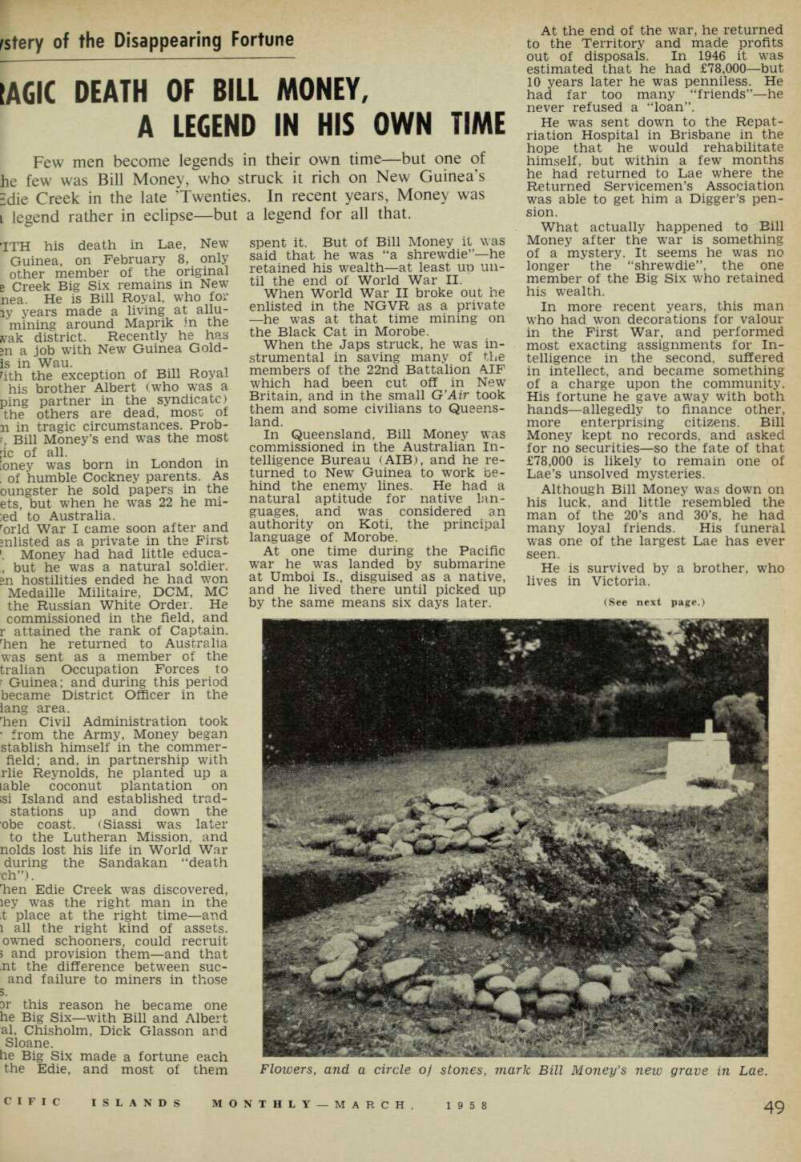
Although Bill Money was down on his luck, and little resembled the man of the 20’s and 30’s, he had many loyal friends. His funeral was one of the largest Lae has ever seen.
He is survived by a brother, who lives in Victoria.
(See next page.)
Flowers, and a circle of stones, mark Bill Money’s new grave in Lae.